
The Last Train to Nowhere
Some journeys take you home. Others take you back to the truth.
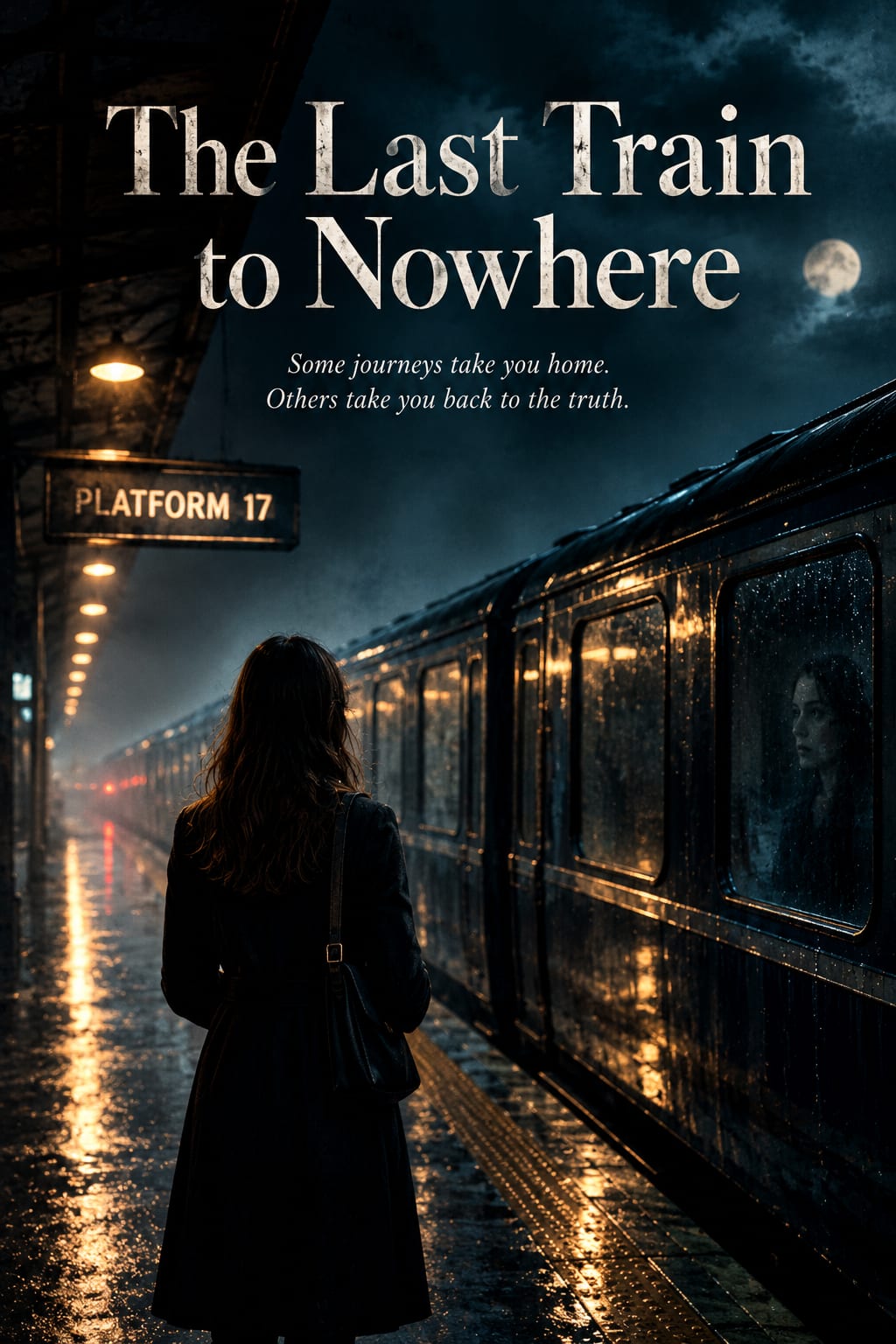
The station was almost empty when Eleanor arrived.
It was 11:47 p.m. The fluorescent lights flickered above the platform, and a cold wind moved through the tunnels. Eleanor checked the departure board, but the words seemed to change every time she looked at them.
THE LAST TRAIN — PLATFORM 17.
She had never heard of Platform 17.
Still, a train waited at the end of the platform, its black windows reflecting the pale lights of the station. There was no destination written on its side.
Eleanor hesitated.
She had missed the last ordinary train home. Her phone battery was almost dead, and the streets outside were unfamiliar. She told herself that any train was better than spending the night alone in an empty station.
When the doors opened, a bell rang three times.
She stepped inside.
The Passengers
The carriage was nearly empty.
An old man sat beside the window, holding a newspaper upside down. Across from him, a little girl in a red coat stared at Eleanor without blinking. At the far end of the carriage, a woman with silver hair watched the darkness outside.
Eleanor chose a seat and placed her bag on her lap.
The doors closed.
The train began to move.
After a few minutes, the old man lowered his newspaper.
“You're late,” he said.
Eleanor looked at him. “Excuse me?”
“We've been waiting for you.”
She laughed nervously, assuming he was confused. “I think you've mistaken me for someone else.”
The old man folded his newspaper.
“No,” he replied. “We never make that mistake.”
Eleanor turned toward the window.
Outside, there were no buildings, no lights, no signs of the city. Only darkness stretched endlessly beyond the glass.
She took out her phone.
No signal.
The time displayed on the screen was still 11:47 p.m.
She tried to open her messages, but the screen went black.
Then a voice came from the little girl.
“Do you remember me?”
Eleanor looked at her.
The girl had dark eyes and a small scar above her left eyebrow.
Something about her face felt painfully familiar.
“No,” Eleanor whispered.
The girl smiled sadly.
“You used to tell me that you would never leave me alone.”
Eleanor's blood turned cold.
She knew that voice.
She had heard it years ago, in a dream she had spent her life trying to forget.
The Woman in the Window
The train entered a tunnel.
For a moment, Eleanor could see her reflection in the glass.
But there was something wrong with it.
Her reflection wasn't sitting still.
It was standing behind her.
Eleanor spun around.
Nobody was there.
When she looked back at the window, the reflection had returned to its seat.
She pressed her hands against her knees, trying to steady her breathing.
“This isn't real,” she whispered.
The silver-haired woman finally turned away from the window.
“That's what you said the first time.”
Eleanor stared at her.
“Who are you?”
The woman smiled.
“You've forgotten so much.”
“I don't know you.”
“Look at me carefully.”
Eleanor obeyed.
The woman's face seemed to shift beneath the dim lights. The wrinkles disappeared. Her silver hair darkened. Her eyes became younger, brighter.
And suddenly Eleanor understood.
She was looking at her mother.
Not as she remembered her from the hospital, pale and exhausted, but as she had looked twenty years earlier.
Before the accident.
Before the funeral.
Before Eleanor had learned to live with the unbearable weight of being the only survivor.
Eleanor stood up so quickly that her bag fell to the floor.
“No,” she gasped. “You're dead.”
Her mother tilted her head.
“Are you certain?”
The Missing Night
The lights flickered.
The carriage changed.
The seats disappeared, replaced by the interior of an old car. Rain struck the windows. Headlights cut through the darkness.
Eleanor could smell wet asphalt and burning rubber.
She was no longer standing on a train.
She was sitting in the passenger seat of a car, twenty years younger, screaming at her mother to slow down.
Then came the headlights of another vehicle.
The screech of brakes.
The violent impact.
Glass shattered around her.
And a little girl in the back seat began to cry.
Eleanor fell to her knees.
Her younger sister.
She had forgotten the sound of her sister crying. She had forgotten the red coat she wore that night. She had forgotten the promise she had made just before the crash.
I'll never leave you alone.
Eleanor covered her ears.
“Stop!”
The memory vanished.
She was back on the train, gasping for air.
The little girl in the red coat was standing in front of her.
“Why did you leave me?” the child asked.
Eleanor shook her head.
“I tried to save you.”
“You ran.”
The words struck harder than any physical blow.
And suddenly, the memory she had buried for twenty years returned in its entirety.
After the crash, Eleanor had escaped through the broken window. She had heard her sister calling for help from inside the car.
She had been terrified.
She had run toward the road, screaming for someone to stop.
But by the time help arrived, it was too late.
Her sister had died.
Her mother had died.
And Eleanor had spent the rest of her life convincing herself that there had been nothing she could do.
The Final Station
The train began to slow.
For the first time, a destination appeared on the digital screen above the door.
HOME.
The old man stood up and put his newspaper under his arm.
“This is where you get off,” he said.
Eleanor looked at the doors.
Beyond them, she could see a familiar road, shining beneath the rain. In the distance stood the house where she had grown up.
The house she had never visited again.
Her mother approached her.
“You can stay,” she said gently. “You don't have to remember anything else.”
Eleanor looked at her sister.
The little girl reached out her hand.
For one brief moment, Eleanor wanted to take it. She wanted to return to a world where the past could be changed, where apologies could bring the dead back to life, where one different decision might have saved everyone.
But the girl was crying now.
And Eleanor understood that staying would mean forgetting again.
She knelt in front of her sister.
“I'm sorry,” she whispered. “I was scared. I was just a child, and I was scared.”
The little girl said nothing.
“I should have stayed with you.”
Her sister touched Eleanor's cheek.
“You can't change what happened.”
The doors opened.
Warm air filled the carriage.
Eleanor looked at her mother one last time.
“I miss you.”
“I know,” her mother replied.
“And I'm sorry.”
Her mother smiled, but there was sadness in her eyes.
“Then stop punishing yourself.”
Eleanor stepped onto the platform.
Behind her, the doors closed.
The train began to move again, disappearing into the darkness without making a sound.
For the first time in twenty years, Eleanor could breathe.
She stood beneath the rain and looked at the house in front of her.
Then she began to walk.
The Next Morning
At 6:15 a.m., a station cleaner found an old newspaper lying on Platform 17.
The station had no Platform 17.
There had never been a Platform 17.
But on the front page of the newspaper was a photograph of a car accident that had occurred twenty years earlier.
Three people had died.
A mother.
A little girl.
And a young woman whose body had never been found.
Beneath the photograph, someone had written a single sentence in black ink:
Some passengers are not looking for a destination. They are looking for the courage to leave.
And somewhere beneath the city, a train continued its journey through the darkness.
Its windows were black.
Its carriages were empty.
And above the door of the last carriage, a digital screen flickered.
NEXT STOP: PLATFORM 17.
About the Creator
Enjoyed the story? Support the Creator.
Subscribe for free to receive all their stories in your feed.
Comments
There are no comments for this story
Be the first to respond and start the conversation.