
The Last Sap of Jerusalem
That’s the funny thing about war. It always swallows you whole.

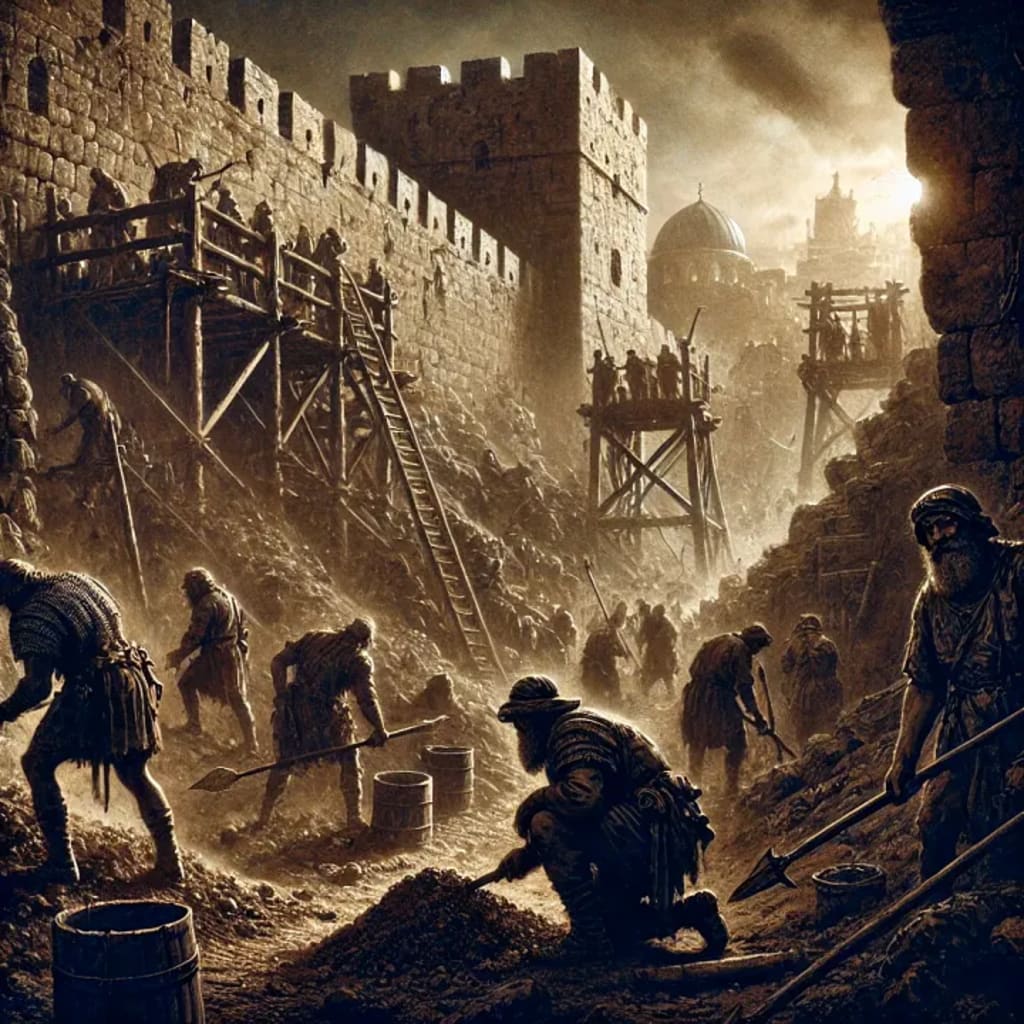
It’s a bit of a strange thing, the life of a sapper. You crawl under the earth, laying your plans in the dark, while above, the world rages on — arrows flying, stones crashing, men shouting, and the gods themselves seeming to laugh at the mess we’ve made of their perfect world. My name, by the way, is Gaius Vitellius. I’m a sapper in the Roman legions, and this is the story of how I helped take Jerusalem.
You’d think the ground would be quieter. That’s the only place we’re safe, under it. At least, that’s what they tell you. You never think of the earth as a place for sound — except, perhaps, the dull roar of the world above, which is like the sound of thunder, far off, distant. Until you get close enough. And then… bam! The earth cracks open with the impact of a stone, and you realize it’s not the sound of thunder anymore. It’s the sound of your own impending doom.
But let’s start from the beginning.
The orders came down from the top — Titus, the big man himself, called for a full siege of Jerusalem. Now, I’m not one to question orders, especially when they’re from someone who’s already done more fighting than I’ve seen in my lifetime, but this one felt different. Jerusalem wasn’t like any city I’d seen before. It wasn’t the quiet dustiness of Carthage, or the messy streets of Gaul. No, this was something else — a holy city, they said. Something about the temple and the sky and the divine plan. Fine. Whatever. I’d been in a hundred sieges, and I wasn’t about to start caring about the gods now.
What I did care about was getting under those walls, which were tougher than anything I’d ever seen before. Thick, heavy, old as sin. As a sapper, that’s where I come in. My job is to dig. You think of soldiers with swords and shields and armor, and that’s fine, but the real work, the real fun, is digging beneath the earth like a rat, trying to crack open a fortress from the bottom up. We’re the unsung heroes of war, but hell, someone has to dig.
And so, I started digging.
We’d been at it for days. The city was a fortress, and each day we’d dig deeper into the earth, the air heavier, the ground harder to shift. There were other sappers with me, each of us under orders to make sure we could break the walls with minimal exposure. Our tunnels were like a maze underneath the city, snaking through the earth until we could be right under the walls, unnoticed.
If you’ve never been a sapper, let me explain something to you. It’s not just digging. It’s not like you’re out there just moving dirt. Oh no. You’ve got to move quietly, carefully, always with the threat of collapse in your mind. A slight misstep, a little too much weight, and the earth itself could come crashing down on you. But it’s not just that. No, it’s the fear of what you don’t see. The Jerusalemites — those pesky, paranoid Jews — they weren’t just sitting there waiting for us to dig under them. No, they were tunneling too. They had their own sappers, their own tunnels, and while we were down there hoping for a clean break in the wall, we were also constantly worried about what might be creeping up on us from beneath.
And then there were the smells. After a few days of digging, you get used to the scent of earth. It’s the smell of sweat and dust and oil from our lamps. But when you get deeper into the earth, it starts to change. The air gets thick and musty, and that’s when you start worrying. Because the longer you dig, the closer you get to what you really fear — the smell of death.
It’s hard to tell when it happens. One minute, everything is fine, and then — crack. You hear it before you feel it, the sound of rocks shifting above you. The noise from the battle outside starts to fade away, and all you can focus on is the earth. Crack, crack, crack. The ground shakes, a tremor runs through the tunnel, and you feel it — the stones from above are coming down.
There’s no time to react. My comrades shout, trying to scramble, but there’s no place to go. We’re all squeezed into this narrow shaft, like rats in a trap. One of the sappers is crushed, and I can hear his body crumple beneath the rubble. The rest of us are left scrambling in the dark, our hearts pounding, wondering if this is the end.
I barely remember how I got out of there. I guess I must’ve been lucky — at least for a time. The rocks stopped falling. I made it out of that tunnel and up to the surface, gasping for air. My body is covered in dirt, my hands scraped and bleeding. The sun’s too bright for a moment, and I blink, disoriented. When I finally see clearly, I realize the siege is still raging on.
They give me a new tunnel. A new shaft. A new hole to dig. They don’t stop the war just because I almost died. No, the war keeps going. And so does the digging.
Every night, I find myself back under that damned city. It’s as though the earth’s calling me. No rest. The tunnel I’m working on is even deeper now, and the stones are starting to press in, claustrophobic. Each stroke of the pickaxe feels like it’s driving me further into madness. I think I’m starting to hear things. Voices. Whispering. Maybe it’s the other sappers, but I’m not sure anymore. They say that happens after a while. The isolation. The dark. The waiting. You get used to it.
But nothing prepares you for the crunch. It’s not even a loud noise. It’s just a sudden shift, and then… nothing. The earth gives way beneath me, and I fall. The walls collapse. The rocks come down. It’s the end. Or so I thought.
Press enter or click to view image in full size
When I woke up, it was dark again. And quiet. Too quiet. I couldn’t feel anything at first, but when I managed to move, I realized I was still buried under the rubble. For a moment, I thought I was dead. That’s a strange feeling, you know? The moment when you think you’ve died, and then you realize you’re still alive. And you’re in pain. Terrible pain. And you start to wonder if you should’ve just stayed dead.
But I couldn’t stay dead. Not yet.
I dug myself out of that mess. I don’t know how. The tunnels are a labyrinth, but I was driven by something darker than fear now. Something primal. Anger. Hatred. I wanted out. I wanted to see the city fall. I wanted to see the Romans win. Hell, I wanted to see something burn.
And burn it did. The walls crumbled. The soldiers above cheered. The battle reached its climax. And Jerusalem fell.
But for me? The fun didn’t last. My comrades — the ones who were still alive — grabbed me, threw me into another tunnel, and told me to get back to work. Like a dog. A rat. Another day, another hole to dig.
And that’s when I started to feel it. The light-headedness. The blood loss. The exhaustion. It was a deep, sinking feeling in my chest. I could barely breathe. My hands were slick with sweat and blood. I was falling apart.
I remember the last tunnel. It wasn’t much. Just another hole beneath the rubble. But that’s where it happened. I think I hit a stone just the wrong way, or maybe I shifted the earth in a way I shouldn’t have, and suddenly, everything caved in. There was no scream. There was no time for that. I just… crumpled.
And that’s the end of the story. The story of Gaius Vitellius, the sapper who helped bring down Jerusalem from below. All for the glory of Rome. All for the empire. And in the end? The ground swallowed me up.
Isn’t it just like that? You dig and you dig, you crawl in the dark, and you’re forgotten. Nobody remembers you. They remember the glory above, but beneath it all, beneath the noise and the carnage, the sappers fade into the earth.
And me? Well, I guess I’m still down there somewhere. In the dirt. Just another forgotten soul, waiting for someone else to dig their way into my grave.
That’s the funny thing about war. It always swallows you whole.
About the Creator
Jesse L Shelley
Forensic Scientist. Knows where they’re buried, and won’t pretend otherwise... I dissect crimes and noir alike shaped by prompt rituals, investigative obsession, and narrative precision. Every story, a darker truth. Come closer.
Enjoyed the story? Support the Creator.
Subscribe for free to receive all their stories in your feed.
Comments
There are no comments for this story
Be the first to respond and start the conversation.