
The Last Piece of Toast
A burned breakfast became one of the most important memories of her life.

The Last Piece of Toast
Some memories do not look like much from the outside.
Mara always thought unforgettable moments should announce themselves.
A wedding.
A birth.
A goodbye at an airport with rain on the windows and someone running back for one last hug. Something with music, maybe. Something people could understand when you tried to explain it later.
Not toast.
Certainly not one burned piece of toast on a Thursday morning in November.From the outside, nothing about that morning looked special. The sky was gray, the kind that made the kitchen feel dim even with the lights on. A basket of unfolded laundry sat near the back door.
The sink held two coffee mugs, one cereal bowl, and a spoon with peanut butter dried to the edge.
Mara was sixteen and late for school.
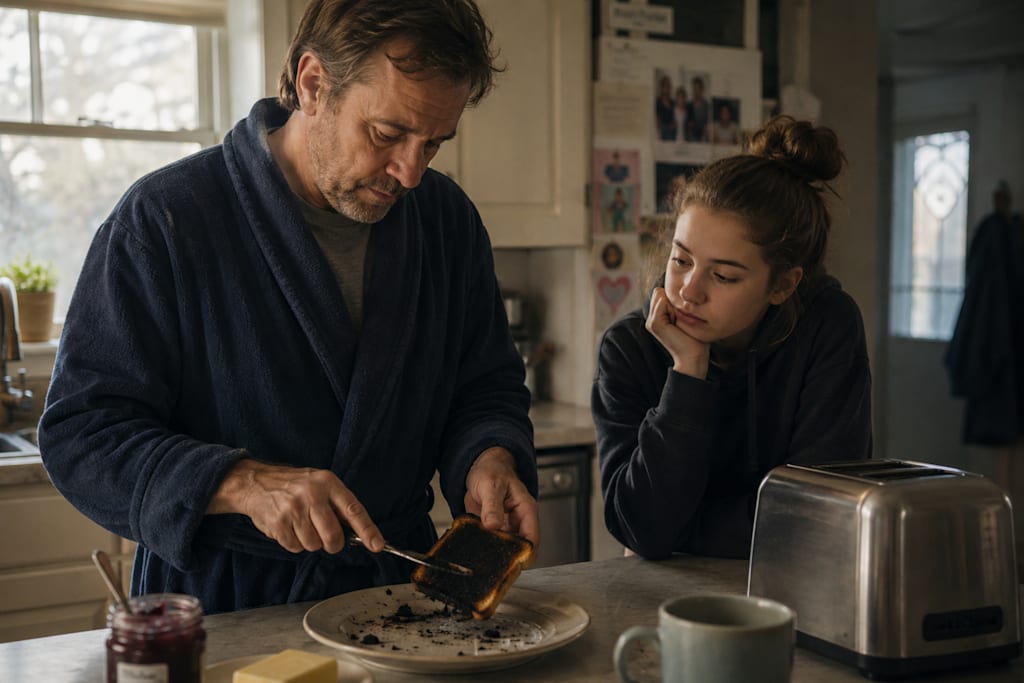
Her father, Eddie, stood by the counter wearing his old blue robe, the one with the loose belt and a coffee stain near the pocket. He had been home from the hospital for three weeks, which everyone kept calling a blessing. Mara hated that word lately. People said it when they did not know what else to say.
“You need to eat something,” he told her.
“I’m fine.”
“You’re not fine. You’re walking like somebody stole your bones.”
Mara rolled her eyes, but not because he was wrong. She had slept badly again. Since his diagnosis, sleep had become a thing she did in pieces. Ten minutes. Twenty. Then wide awake, staring at the dark ceiling, listening for any sound from her parents’ room.
Her father dropped two slices of bread into the toaster.
“Dad, I don’t have time.”
“You have time for toast.”
“I’m going to miss the bus.”
“Then I’ll write a note. ‘Please excuse Mara for being late. Her father insisted on carbohydrates."
She did not want to laugh. Laughing felt dangerous, like stepping onto thin ice. But the corner of her mouth moved before she could stop it.
He saw it and smiled.
That was the thing about her father. Even when he looked tired, even when his cheeks had gone hollow and his hands trembled sometimes, his smile still arrived like it owned the room.
The toaster clicked.
Smoke lifted first.
Then the smell came sharp and black.
“Oh, come on,” Eddie muttered.
Mara turned. Both slices had popped up nearly charred, the edges curled and dark.
“Great,” she said. “Breakfast by house fire.”
Her father frowned at the toast as if it had personally betrayed him. “This toaster has one job.”
“It’s old.”
“It has loyalty issues.”
Mara grabbed her backpack from the chair. “I’ll get something at school.”
“No.” He reached for a butter knife. “Wait.”
“Dad.”
“Wait.”
There was something in his voice that stopped her.
Not anger. Not even firmness. Just need.
So she stood there, one arm through her backpack strap, watching him scrape the toast over the trash can. Black crumbs fell in little bitter flakes. His hand shook. The knife scratched across the bread again and again.
Mara wanted to look away.
She hated seeing the shake.
He had always been steady. He fixed loose cabinet doors, untangled necklaces, drew perfect stars on birthday cards. When Mara was small, she believed there was nothing her father’s hands could not do.
Now those same hands struggled with toast.
“I can do it,” she said quietly.
“I know.”
But he kept scraping.
The room filled with the small sound of knife against bread. Outside, a car passed on the wet street. Somewhere upstairs, her mother’s alarm went off and stopped after two beeps. The refrigerator hummed. The toaster, guilty and silent, waited on the counter.
Finally, Eddie placed the toast on a plate. It looked awful. Pale in some places, blackened in others, torn where he had scraped too hard.
He spread butter over it carefully, then cut the slices into triangles.
Mara stared. “You cut it like that when I was little.”
“I know.”
“I’m not little.”
“I know that too.”
He pushed the plate toward her.
For a second, neither of them moved.
Then Mara took one triangle.
It was too crunchy. The butter had not melted all the way. One corner still tasted burned. She chewed anyway.
Her father leaned against the counter and watched her with the serious expression of someone waiting for a verdict.
“Well?” he asked.
“It’s terrible.”
He nodded. “Fair.”
“But not poisonous.”
“That’s practically a compliment.”
She took another bite.
Her bus came then. They both heard the brakes hiss at the corner.
Mara froze.
Her father glanced toward the window. “You can still make it.”
She should have run. Any other morning, she would have. She would have grabbed the toast in a napkin and dashed out, annoyed and breathless.
Instead, she set her backpack down.
The bus doors closed.
The engine pulled away.
Eddie looked at her. “Mara.”
She shrugged. “You said you’d write a note.”
He opened his mouth, but no joke came out. His eyes grew shiny, which made hers burn immediately.
“Don’t,” she said.
“I didn’t say anything.”
“You were about to.”
“I was about to say the toast needs jelly.”
“No, you weren’t.”
“No,” he admitted. “I wasn’t.”
Mara sat at the kitchen table. After a moment, he sat across from her.
The plate rested between them.
They ate the ruined toast slowly, passing the jelly back and forth. Her father used too much, the way he always did. Mara pretended to be disgusted, the way she always had. It was their old rhythm, but softer now. Careful. Like a song remembered by people afraid to sing too loudly.
“You know,” he said, “when you were four, you used to ask me to cut your toast into dinosaur shapes.”
“I did not.”
“You did.”
“I have no memory of that.”
“That’s because you were busy being bossy.”
“I was four.”
“You were experienced.”
She smiled into her toast.
He told her about one morning when she refused to eat anything that was not shaped like a stegosaurus. He had tried cutting the toast with a steak knife, failed completely, and convinced her it was a fossil instead. Apparently, she had believed him and eaten two pieces.
“That sounds like something you made up,” Mara said.
“It is one hundred percent true.”
“You also told me clouds were sheep that forgot how to land.”
He pointed at her. “That one may still be true.”
For fifteen minutes, the world stayed in that kitchen.
Not the hospital. Not the pill bottles lined up by the sink. Not the whispered conversations that stopped whenever Mara entered the room. Just toast, jelly, and the sound of her father’s laugh when it surprised him.
At some point, her mother came downstairs in her work clothes, hair still damp from the shower.
“Why are you still here?” she asked Mara.
“I missed the bus.”
Her mother’s face changed with worry.
Eddie lifted the plate. “Medical emergency. Toast failure.”
Mara’s mother looked from him to Mara, then to the crumbs on the plate. Something passed across her face that Mara did not understand then. Sadness, yes, but also gratitude. Like she had walked into a room where something fragile had been saved without anyone saying so.
“I’ll drive you,” her mother said.
“In a minute,” Mara answered.
Her mother nodded. She did not argue.
Years later, Mara would try to explain that morning to people.
She would say, “My dad burned toast once, and we missed the bus,” and they would smile politely, waiting for the real story.
There was no real story.
That was the problem.
There was only her father in his blue robe. The smell of burned bread. His hand shaking while he scraped the black parts away. The bus leaving without her. The jelly jar sticky at the rim. Her mother standing in the doorway, understanding something before Mara did.
Her father passed away the following spring.
Afterward, people remembered him in bigger ways. They talked about how funny he was, how kind, how he helped neighbors shovel snow, how he once drove three hours to pick up Mara from a sleepover because she got homesick and was embarrassed to call.
All of that was true.
But when Mara missed him most, she did not think first of the big stories.
She thought of toast.
She thought of sitting across from him on a gray morning, both of them pretending burned bread was worth being late for. She thought of how he had scraped and scraped, not because the toast mattered, but because feeding her did. Because he was still her father. Because there were so many things he could not fix, but he could still put a plate in front of her and ask her to stay.
And she had stayed.
That was the part no one understood.
Years later, in her own small kitchen, Mara burned toast on a Thursday morning.
Her daughter, Lily, stood near the counter with a backpack too large for her shoulders.
“Mom,” Lily said, wrinkling her nose. “It smells bad.”
Mara stared at the toaster.
Two blackened slices waited there, edges curled, smoke fading into the air.
For one breath, she was sixteen again.
Then she laughed.
Not because it was funny.
Because it hurt.
Because it was beautiful.
Because some moments come back so clearly they feel less like memories and more like doors.
“What?” Lily asked.
Mara wiped under one eye before turning around. “Nothing.”
“Why are you crying?”
“I’m not.”
“You are.”
Mara pulled the toast from the toaster and grabbed a butter knife.
“This toaster has one job,” she said.
Lily giggled. “You sound mad at it.”
“It has loyalty issues.”
Her daughter laughed harder.
Mara scraped the toast over the trash can. Black crumbs fell in soft, bitter flakes. Her hand was steady, but her heart was not.
“Can I just have cereal?” Lily asked.
“In a minute.”
“I'm going to miss the bus.”
Mara looked toward the window. The morning was gray, almost the same shade as that day long ago.
"You have time for toast," she said.
Lily groaned, but she stayed.
Mara buttered the scraped pieces and cut them into triangles. She placed them on a plate and set the plate between them at the table.
Lily took one bite and made a face. "It's terrible."
Mara smiled.
"Fair," she said.
Outside, the bus hissed at the corner.
Neither of them moved.
Some of life's most important moments don't look important at all. This story is about the ordinary memories that stay with us long after the people we love are gone.
About the Creator
Ronna Curtis
Ronna Curtis, Ladybug, is the name I go by when publishing a book. For any books I write, I will show 2 to 4 chapters; the rest of the book or stories will be offered to subscribers. Contact information is [email protected]
Enjoyed the story? Support the Creator.
Subscribe for free to receive all their stories in your feed. You could also become a paid subscriber, letting them know you appreciate their work.
Comments
There are no comments for this story
Be the first to respond and start the conversation.