
The Last Person in the Archive
Nothing was restored

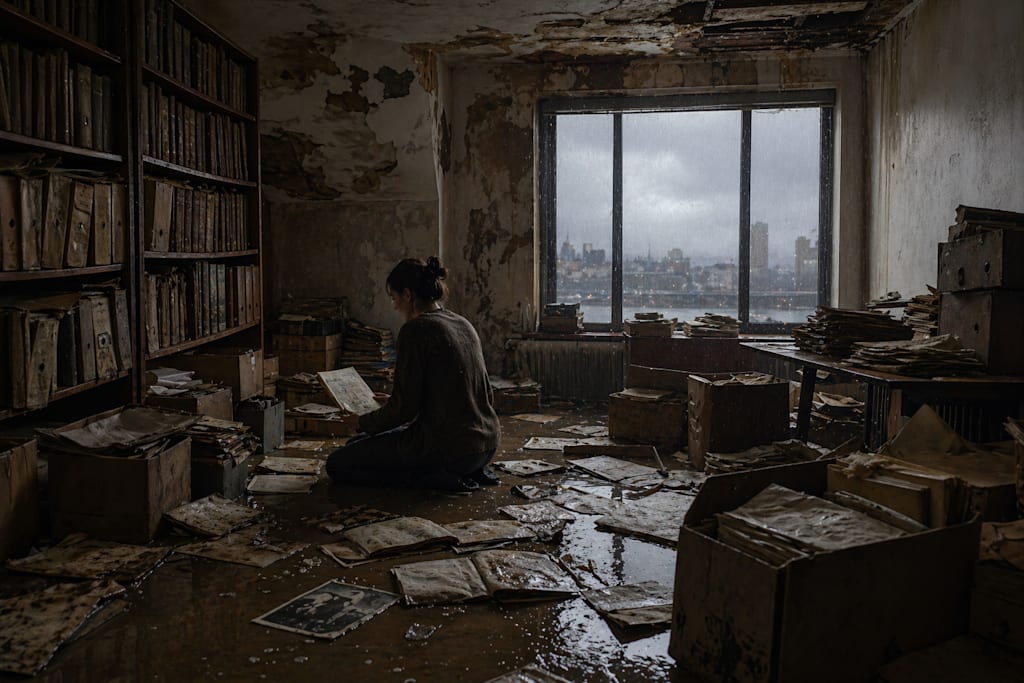
By the time Mara understood what the archive was for, most of it had already been destroyed.
Not burned. Not in some singular act dramatic enough to provoke grief. It had vanished the way important things often do: under reviews, budget notes, transition plans, cheerful language about modernization. Shelf by shelf. Room by room. One harmless administrative phrase after another.
The building still stood at the edge of the city’s administrative quarter, long and gray and easy to ignore. The brass plaque by the entrance had darkened almost beyond reading. The map still called it MUNICIPAL RECORDS, though hardly anyone did.
Inside, the lights hummed.
Mara had worked there for eleven years. When she began, the rooms had still been full: census ledgers, court transcripts, payroll books, hospital intake registers, school rosters, permits for buildings already demolished, correspondence from offices that no longer existed. There were boxes of photographs no one had fully catalogued. Whole shelves devoted to records from vanished public institutions.
At first she believed preservation was the point.
Then came the reviews.
Consultants visited with bright voices and visitor badges. They asked how often certain materials were accessed, whether duplication existed, whether physical storage still justified its cost. The vocabulary spread quickly: legacy, redundancy, transition, nonessential.
They said everything important would be digitized.
Some of it was. A contractor spent four months scanning selected materials, then left behind warped files, mislabeled drives, and a database that indexed names incorrectly and cut pages off at the margins. After that, fewer people came looking for records. The public line was harder to reach. The website routed inquiries elsewhere. Low demand became proof of low value.
At the end of each quarter, another section emptied.
No one called it destruction. The official term was deaccessioning.
"The city can’t preserve everything," Leon told her one winter in the break room, stirring powdered creamer into coffee. "You’re taking this too personally."
On the table between them sat transfer lists marked with accession numbers and neutral verbs: remove, release, reclassify.
"They’re payroll records from the municipal laundry," Mara said.
Leon shrugged. "From the 1940s."
Yes, Mara thought. From the 1940s. Meaning women whose names might survive nowhere else. Wages that recorded labor no memorial would mention. Evidence that people had stood in rooms, signed pages, taken pay home in envelopes, existed in systems now eager to forget them.
Instead she only said, "Someone will need them."
Leon asked, "For what?"
Not cruelly. That was the worst part.
By summer, the second floor had been converted into "collaborative civic workspace." Bright furniture replaced shelving. The city newsletter praised the transformation of "underutilized records infrastructure into adaptive public innovation."
Mara read that sentence twice and closed the email.
Then, one Monday in October, she arrived to find the fourth floor locked.
No notice. No explanation.
She stood in the hallway with a cart of returned files and tried her key twice. Through the wired glass she could see shelving in shadow and nothing more.
At 9:26 an email arrived.
ACCESS RESTRICTED PENDING SPACE RECONFIGURATION.
At lunch, Tomas from building services told her the city had leased the floor.
"To whom?"
He shrugged. "A start-up. Analytics, maybe. Something with glass walls."
"They’re leasing archive space to an office?"
It has windows," he said.
That evening Mara went home later than usual. Her apartment near the river was small, with unreliable pipes and a window that never fully sealed. She listened to a voicemail from her mother’s care facility about revised rates and reassessed levels of care. She did not call back.
The next morning she went to the basement.
The basement had not yet been touched because it was unpleasant. Ceiling pipes ran low. The air smelled of dust, damp cardboard, and stone. The oldest records were down there, and the least requested: school registers from the river district, wartime ration manifests, citizen petitions bound in fading string, flood relocation files from the year the lower neighborhoods went under.
She walked the aisles with one hand on the spines and understood something flat and dangerous.
If she left them there, they would disappear.
Not publicly enough to become scandal. Not violently enough to seem tragic. Just gradually, administratively, until there was nothing left to defend.
That afternoon she started taking things home.
One volume in her satchel. Two folders inside a tote bag. A packet of photographs beneath her coat. She chose what she could not bear to lose: epidemic logs, school registers, flood relocation lists, payroll books from vanished departments, letters never fully indexed.
At first she told herself it was temporary.
She would keep them safe. She would make a record. She would find a historian, a journalist, a legal route, a place where the papers could survive the city’s appetite for elegant erasure.
But apartments are not archives.
Within three weeks, the hallway closet was full. Boxes lined the wall behind the sofa. Ledger books occupied half the kitchen table. Bundles of files replaced winter clothes in the wardrobe. The apartment smelled increasingly of old paper and glue. Mara bought a cheap hygrometer, kept curtains closed against afternoon light, and stopped inviting anyone inside.
At night she woke imagining mildew.
At work, the building continued to empty.
One November morning, a young man arrived asking for flood relocation files from 1978. His grandmother had died, and in clearing her apartment he had found a photograph from a temporary shelter. He wanted to know where the family had been moved after evacuation.
Mara knew exactly where the files had been.
She also knew that some of them were now in her apartment, beneath a blanket behind the sofa.
"Let me check," she said.
He waited in the reading room while she searched the official system for records she had already removed. There was nothing properly indexed. She went downstairs anyway, stood in front of the half-emptied shelf, then returned.
"Anything?" he asked.
"It may have been transferred offsite," she said.
He nodded with effort. "Can I request it?"
"Yes."
He filled out the form carefully. Under PURPOSE OF REQUEST he wrote: family history.
That night Mara found the box. It took two hours. The grandmother’s surname appeared once, misspelled, then corrected in blue pencil on the next page. There was the shelter assignment. The transfer date. The temporary address. The number of blankets issued.
Mara copied the details onto a sheet of lined paper.
She did not send it.
To tell him the truth would mean admitting what she had done: public records hidden in a private apartment, rescued and ruined by the same act.
She folded the paper and put it in a kitchen drawer.
After that, the records no longer felt rescued.
They felt trapped.
In January a pipe burst in the archive basement.
Not dramatically. Enough to soak three aisles before the alarm registered. Water came through a cracked joint above Bay 10 and ran for hours. Cardboard collapsed. Ink lifted. Wet files were spread across tables while consultants in expensive boots discussed salvage priorities.
Mara stood in the aisle and understood two things at once.
What remained in the building would be triaged according to visibility and liability, not value.
And what she had taken home would not survive much longer either.
Her apartment was already too warm, too cramped, too provisional. One leak, one bad week, one electrical fault and the papers would warp, mold, and fail.
There was no solution left that was not already too late.
That night she opened every box.
The apartment filled with the smell of paper and dust and old glue. She spread files across the bed, chairs, and floor, trying to make a list.
Collection title. Approximate date. Condition. Location.
At item thirty-seven her pen stopped working. At item fifty-two the radiator clicked on and she nearly panicked. At eighty-one she realized that the list itself might outlast the materials it described.
Around two in the morning she sat on the kitchen floor and understood that saving and losing had become indistinguishable.
By March, the first signs appeared.
A faint sweet smell in one box of school registers. Curling at the edges of a photograph packet. Damp feathering on the corner of a ledger left too near the bathroom wall.
She bought plastic bins she could not afford. Ran a dehumidifier constantly. Paid electric bills that climbed faster than she could manage. At work she grew tired, forgetful, distracted.
Then Tomas found her in the loading bay.
"They’re clearing the basement next month," he said. "If there’s something you need to do, do it before then."
She almost laughed.
She called a university archive, a regional museum, an independent historical society. Each person sounded sympathetic. Each asked the same first question in a different form.
"Who currently holds legal custody?"
Legal custody belonged to the city. Actual custody belonged to neglect and theft.
Nothing in that arrangement could be publicly defended.
On Monday the young man returned.
"I never heard back," he said.
Mara could have given him the address then. The folded note was in her bag. She could have slid it across the desk and broken procedure once in the direction of something human.
Instead she said, "I’m sorry. The records may have been damaged."
His face changed not with anger but with reduction, as if expectation were lowering itself to meet the world.
"Okay," he said. "Thank you anyway."
After he left, Mara went to the restroom and was sick in the sink.
The end came in April.
Not because of the city.
ecause of the apartment upstairs.
A tenant Mara had never met left a faucet running before going away for the weekend. The overflow seeped through warped floorboards, into the ceiling cavity, then through Mara’s bedroom plaster just after dawn.
She woke to a wet sound and sat up into rain.
For a second she did not understand what she was seeing: water down the wall, plaster bulging, the top box in the wardrobe already darkening at the corners.
Then part of the ceiling gave way.
Not the whole room. Just enough. Plaster, wood splinters, insulation, brown water. It hit the wardrobe and spread across the floor in seconds.
Mara moved without sequence. Towels. Bins. Hands. She dragged boxes into the hallway. Slipped. Tore one packet trying to lift it. Water climbed through the bottoms faster than she could separate the contents. Ink blurred while she was still carrying them.
The landlord arrived later with a plumber and the expression of someone already calculating expense.
"You should move valuables," he said.
On the floor, a school register had opened like a body.
By evening the apartment was lined with sodden documents. She spread them anywhere flat space existed: countertops, chairs, oven trays, towels over the bathtub. The dehumidifier rattled uselessly. There were too many. Always too many.
Mold begins before you can see it.
By the second day the edges furred. By the third, the smell changed.
Mara stopped going to work. She called in once, then stopped answering. Tomas left a message. Leon emailed to ask whether she would be able to resume duties the following week.
She did not respond.
She worked through the nights turning pages, blotting moisture, separating sheets that wanted to fuse forever. Each small success exposed ten failures beside it. Whole ledgers bloomed into unreadable gray. Faces in photographs softened into featureless light. Blue pencil corrections bled into margins until names looked undecided.
On the fifth day she found the note about the young man’s grandmother still folded in the kitchen drawer, dry because the drawer had stayed shut.
She held it for a long time.
Then she put it back.
By the end of the week the city fenced off the archive building. A structural assessment had found "significant maintenance liabilities." Public access was suspended. Staff were to report to a temporary office for reassignment planning.
Mara read the notice on her phone while kneeling beside a box of ruined hospital ledgers.
She did not cry.
In May the landlord issued a remediation order. The apartment had to be professionally cleaned. Damaged materials removed. Contaminated paper disposed of.
The crew arrived in masks and gloves, efficient and apologetic.
"Anything personal you want to separate?" one of them asked.
Mara looked at the stacks, the bins, the flattened pulp that had once been names and wages and addresses and proof.
Personal.
"No," she said.
They worked quickly. Bundles came apart in their hands. Pages from the collapsed wardrobe were shoveled into black bags. Boxes leaked brown water onto the hall runner as they were carried out. One man paused over a ledger whose cover still held its shape.
"Looks old," he said.
Mara said nothing.
By afternoon the apartment was almost empty.
Damp outlines remained on the floor where the boxes had stood. The air smelled sharply of bleach. On the kitchen table lay one thing the crew had overlooked: a single burial permit, dried stiff, the ink mostly intact except for the lower corner where the clerk’s signature had dissolved into blue shadow.
Mara picked it up carefully.
Name of the deceased. Date. District. Cause left blank.
At the bottom, in a different hand, a notation about payment received.
She sat with the paper in front of her and listened to the clean apartment.
The city archive was closed. The basement would be cleared. The records she had stolen were gone. The records she had left were likely already sorted for disposal or trapped behind fencing until neglect finished what budgets began.
The young man would not find the shelter address. Her mother would continue forgetting. No institution would inherit the papers because there were no papers left to inherit.
By evening Mara put on her coat and walked to the river.
The water moved high and brown beneath the bridge, carrying branches and one pale object she could not identify before it slipped under.
She stood there until the city behind her became mostly windows.
The burial permit was folded in her pocket.
She had not brought it to save. She had not brought it to throw away. She had simply not left it behind.
When she finally turned toward home, the paper remained where it was, warming slowly against her body, one surviving record with nowhere to go and no use strong enough to justify its existence.
She kept walking.
Nothing had been restored.
About the Creator
Alain SUPPINI
I’m Alain — a French critical care anesthesiologist who writes to keep memory alive. Between past and present, medicine and words, I search for what endures.
Enjoyed the story? Support the Creator.
Subscribe for free to receive all their stories in your feed. You could also become a paid subscriber, letting them know you appreciate their work.
Comments
There are no comments for this story
Be the first to respond and start the conversation.