
The Last Pastor
In Galactic Era 35, Pastor Yu must disband his remote Earth parish after the Holy See dissolves the church. As humanity expands across space using wormhole/dark matter tech, faith becomes obsolete. While retrieving the dissolution fax, Yu hears a final confession: a man’s incurable inability to feel pleasure—symbolizing technology’s failure to fill humanity’s existential void.
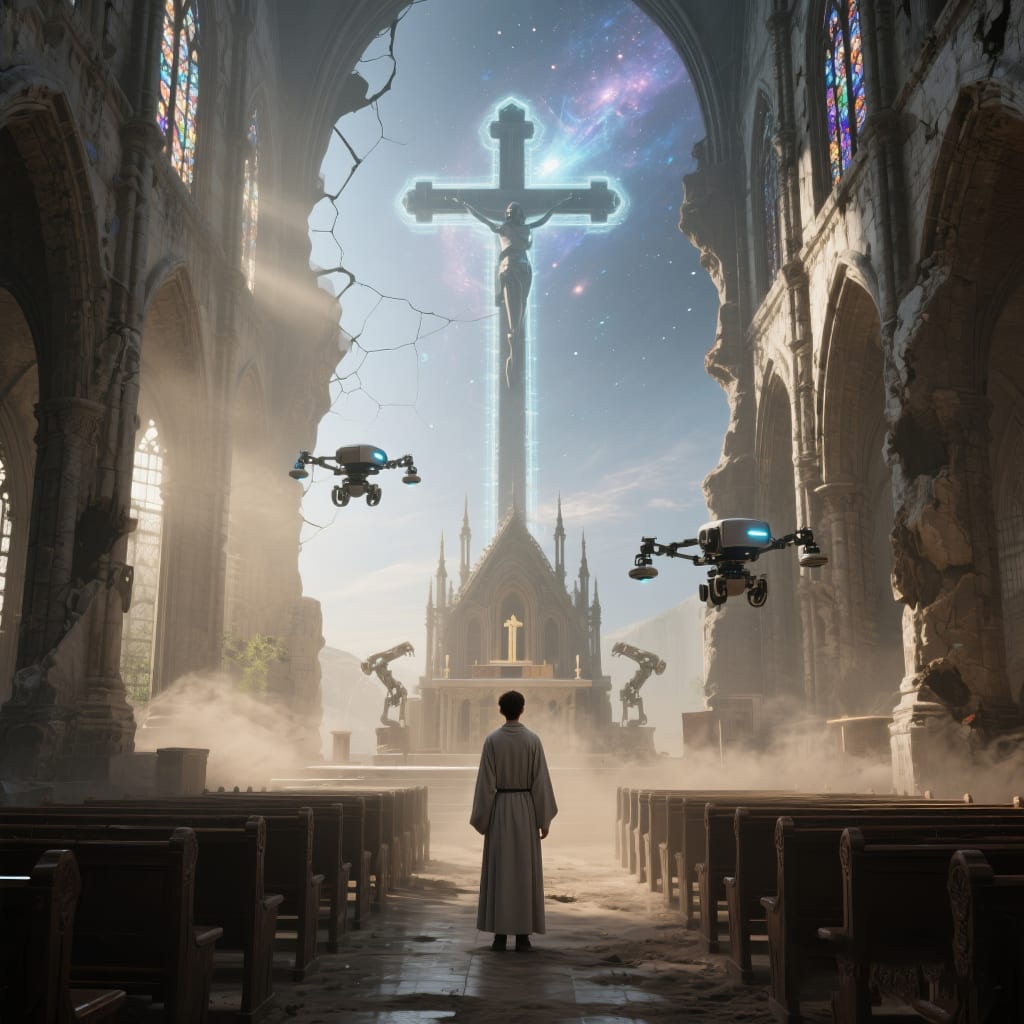
To be honest, I don’t even take my own role as a pastor seriously anymore.
Although the final dissolution notice from the Holy See hasn't yet reached the parish under my jurisdiction, it’s only a matter of time. And while dozens of people still come to me for confession every week, the age of those confessing clearly tells me it’s a habit formed over many years, with not much genuine sincerity left in it.
My parish is located in the Jinchuan Plateau region of the Eastern Continent. According to the local administrative division system, I’m specifically responsible for two counties, twenty-three towns, 1,203 villages, totaling over 540,000 people. But the number of God's faithful is small; I remember the figure: currently only 9,640, including a dozen or so children.
But this number shouldn’t be underestimated. Nearly ten thousand believers – if this were the Western Continent, I’d be qualified to be a bishop. Unfortunately, this is the Eastern Continent, so I’m just an ordinary pastor, the lowest rank in the church hierarchy. The bishop overseeing me has hundreds of thousands of followers. Of course, that includes my 9,640.
The Jinchuan Plateau is not only the most underdeveloped area in the Eastern Continent but also one of the most backward places in the world.
Wormholes and dark matter have been discovered for decades, and their commercial applications have developed to a level nearly as commonplace as "buses and subways." Yet, the nearest wormhole station is still over twenty kilometers from my church. My church is located in Dandong Town, Dandong County – considered one of the cradles of Eastern Continental civilization, deep within the Jinchuan Plateau.
Every day, seeing the cross atop the towering spire of the church, I feel a surge of pride. The church is also the most iconic building in Dandong County. This is also thanks to my efforts; the wealth of my 9,640 believers far exceeds the average income and wealth level of Dandong County.
The discovery and commercialization of dark matter and wormholes truly opened the door for humanity to glimpse the universe. For over 6,000 years of recorded history before that, humanity was essentially fumbling in the dark, always at risk of being swept away by storms.
The discovery and application of dark matter provided humanity with a vast, almost inexhaustible, and universally present source of energy. This energy source almost represents the ultimate in human energy utilization, yet has no side effects. Petroleum, natural gas, coal, metals – the post-industrial era that began in the latter half of the 21st century AD saw these resources consumed almost instantly. Nuclear fission and fusion, however, were like Pandora's box, filled with a curiosity to open it, yet always uncontrollable.
The high pollution of traditional and nuclear energy sources plagued humanity for over four hundred years. The application of dark matter ended this struggle.
The discovery and application of wormholes, while disappointing humanity by not enabling instantaneous travel or time travel as predicted by Einstein and other sages, did solve the problem of space.
It seems humanity is more concerned with the question: can we travel through time, go to the future, return to the past, and change things we were powerless to change before?
But wormhole travel takes almost no time; in a sense, it does solve the problem of time.
The construction of dark matter energy stations and wormhole stations, along with the development of related industries and scientific fields, sparked humanity's Third Renaissance. Traveling within a country became as simple as visiting a neighbor; travel between countries became equivalent to interactions between villages or communities; travel between any two points on Earth became as convenient as taking a high-speed train from Beijing to Tianjin.
Most notably, wormhole travel consumes no time whatsoever; the time humans spend is wasted solely on queuing to enter the station and queuing to exit. And then there's the "last-mile" problem. This problem won't be solved unless humans can fly or teleport like super-intelligent beings in science fiction.
Interstellar travel also became simple and feasible. The previously challenging and resource-intensive Mars exploration missions saw spacecraft from Earth's three major powers – China, Russia, and the US – swarm the Martian atmosphere and surface in a very short time, thanks to the commercialization of wormholes and dark matter.
Within just a decade, the first batch of 5,000 Mars immigrants had settled and thrived.
Martian immigration opened the prelude to humanity's conquest of the galaxy. The almost limitless, positively infinite cosmic-scale energy provided by dark matter made humanity's control over wormholes masterful. Human starships, commercial colonization vessels, and commercial cruise ships also became unprecedentedly massive.
The aircraft carriers that once roamed Earth's oceans seemed almost like children's toys compared to starships, commercial colonization vessels, and cruise ships.
Driven by immense panic in the face of the unknown and the infinite universe, Earth's governments united as never before in the conquest of the galaxy.
Humanity, however, became unprecedentedly restless and adventurous with the advent of thrilling galactic travel. No one took faith (essentially meaning religions like ours) seriously anymore; everyone was busy with space travel, immigrating to planets they fancied.
Both Earth and all colonized planets abandoned the AD calendar, ushering in a new era. This new era, counting from the day the first Martian immigrants arrived on Mars, is called the Galactic Era.
Galactic Era Year 35: Across the entire Milky Way galaxy, 109 planets suitable for human colonization had been discovered and utilized. Dozens of these were already on the fringes of the galaxy. The colonization of extragalactic systems had also been placed on the agenda by the Earth Union Government.
The total human population, starting from the year wormholes and dark matter were discovered, exploded from 7.8 billion to over 30 billion in just 75 years. The constant discovery of habitable planets and the complete resolution of the energy problem led to unprecedented rapid growth in the overall human population.
The overall development of industry and science brought by wormholes and dark matter, while failing to solve the problems of lifespan extension or even immortality, drastically improved human survival and quality of life.
The invention and commercialization of cell-level nanobots allowed for the correction of any genetic defects and the treatment of all diseases and cellular damage. Theoretically, as long as your brain is alive, nanobots can rebuild all your cells, giving you a brand new, strong body.
But the immense improvement of the body cannot stave off the arrival of death. The human spirit and brain still age. The Chinese saying describing the "tragedy of white-haired elders burying dark-haired youths" took on a new meaning: a sixty- or seventy-year-old elder with white hair, bidding farewell to someone who looks like a young adult in their twenties or thirties. But in reality, this "youth" is at least in their eighties, often over a hundred years old; it's just that their body is a "replica" reconstructed by cell-level nanobots.
Clearly, the idea that swapping in a young, fresh body could grant eternal life is utterly absurd.
II
The Bishop of the Eastern Continent's Jinchuan Province informed me in our last network communication that the Roman Holy See, at his request, had faxed him the notice dissolving the Church, authorizing him to handle matters as he saw fit.
The Holy See had initially just wanted to inform him and be done with it. The Holy See's actions were among the slowest. All other major and minor religious sects on Earth had already dissolved, either openly or covertly, some months ago, others years ago.
During the nearly 40 years of relentless galactic conquest, religion had been utterly forgotten by people.
Bishop Ze was a somewhat stubborn man. He obstinately told Pope Li, "If we are to dissolve, send a fax. Does this kind of network communication count? What if God blames me without a paper document?"
Pope Li was very patient. In this era, where the entire galaxy is one big Wi-Fi zone, the existence of fax machines and telephones was bizarre indeed.
This also reflected the Holy See's sluggishness.
Ze sent me a message: "Yu, you’d better come personally to collect a copy of the dissolution fax. I’ve photocopied many copies. Get the fax, show it to your congregation, publish it on your parish website – only then will the dissolution be official."
I smiled bitterly but had no choice.
Getting to Bishop Ze’s (no, he’s not a bishop anymore, just an ordinary Earthling) cathedral in Jinchuan City, many years ago, would indeed have felt close. I’d need to walk or take a solar-powered vehicle 20 kilometers to the nearest wormhole station, then enter the station, exit the station, and walk another 5 minutes to reach Ze’s cathedral. The time required was simply the 20-kilometer journey time plus the 5-minute walk.
This made me feel the Earth Union Government’s regulations were working against me. The regulation stated: On Earth, human settlements (cities) with over 300,000 inhabitants would have one dark matter energy station and two wormhole stations; as city size increased, the number of stations would increase proportionally. Settlements under 300,000 (not inclusive) would have no energy or station facilities. On other planets in the galaxy, settlements with 5,000 people would get one dark matter energy station and one wormhole station, increasing proportionally with population growth.
Well, Earth citizens had become second-class citizens of the galaxy.
Neither Dandong County nor neighboring Changlin County had populations exceeding 300,000, so they weren't qualified for stations. The nearest city, Danyang City, had 3 million people. People from both counties either walked or took solar-powered vehicles to the wormhole station.
The supreme allure of space development attracted the gaze and actions of the vast majority of Earthlings. But a significant number still remained on Earth, living peacefully.
Of the 30 billion population, 12 billion were on Earth, while the other 18 billion were scattered like stars across the 109 planets in the galaxy.
After hearing the last confessor, it was still early, just 3 PM. I prepared to go to Bishop Ze’s (no, he’s not a bishop anymore) place to collect a copy of the fax.
Once I got the fax, I would gather my faithful, conduct one final prayer. Then, all 9,640 of them, and I, would cease to be God’s children and become ordinary Earthlings.
Of course, it was unlikely all these people could come to my church. The church was large, capable of holding ten thousand, but these ten thousand were now scattered across the galaxy.
Thankfully, there was the network. Each of their faces could be projected onto the huge screen in the church. They would hear the news of the dissolution firsthand.
I suspected many of them were already impatient. Attending this ceremony would be more out of habit and a sense of obligation than desire.
III
The last confessor left a deep impression on me. He was a middle-aged man with a resolute face, an upright figure, and deep, penetrating eyes – the kind of charmingly mature man.
What was memorable was the story he told about himself.
"Dear Pastor, shepherd guided by God’s teachings. To be honest, I’ve wanted to confess this to you for over twenty years, but I’ve always been too embarrassed to bring it up." His expression was somewhat awkward. Seeing such a large man make this face didn’t strike me as embarrassing.
I remembered my identity: I was a pastor. Whatever I heard, I wouldn’t be surprised. At this moment, I represented God.
"But if I don’t say it now, I may never get another chance to confess. I’ve already seen Bishop Ze’s fax on the network. I also know you are about to go collect that fax. Once you bring that fax back, the church, pastors, God – none of it will exist anymore. What would be the point of confessing then?" The man sounded anxious.
I tried to adopt a kindly expression, which was indeed a bit difficult. After all, I was only 27, a student who had graduated from seminary just three years ago, far from being a seasoned pastor. This parish was also my first job.
"Pastor, I have always lacked sexual sensation, let alone experienced orgasm. I’ve tried many methods, met many people, seen many doctors, undergone countless tests – both physical and mental are fine. But I just have no sexual sensation or orgasm." The man sighed.
About the Creator
Enjoyed the story? Support the Creator.
Subscribe for free to receive all their stories in your feed.
Comments
There are no comments for this story
Be the first to respond and start the conversation.