
The Last Light in Holloway Station
A quiet story about memory, loneliness, and the strange places where lost things wait to be found.

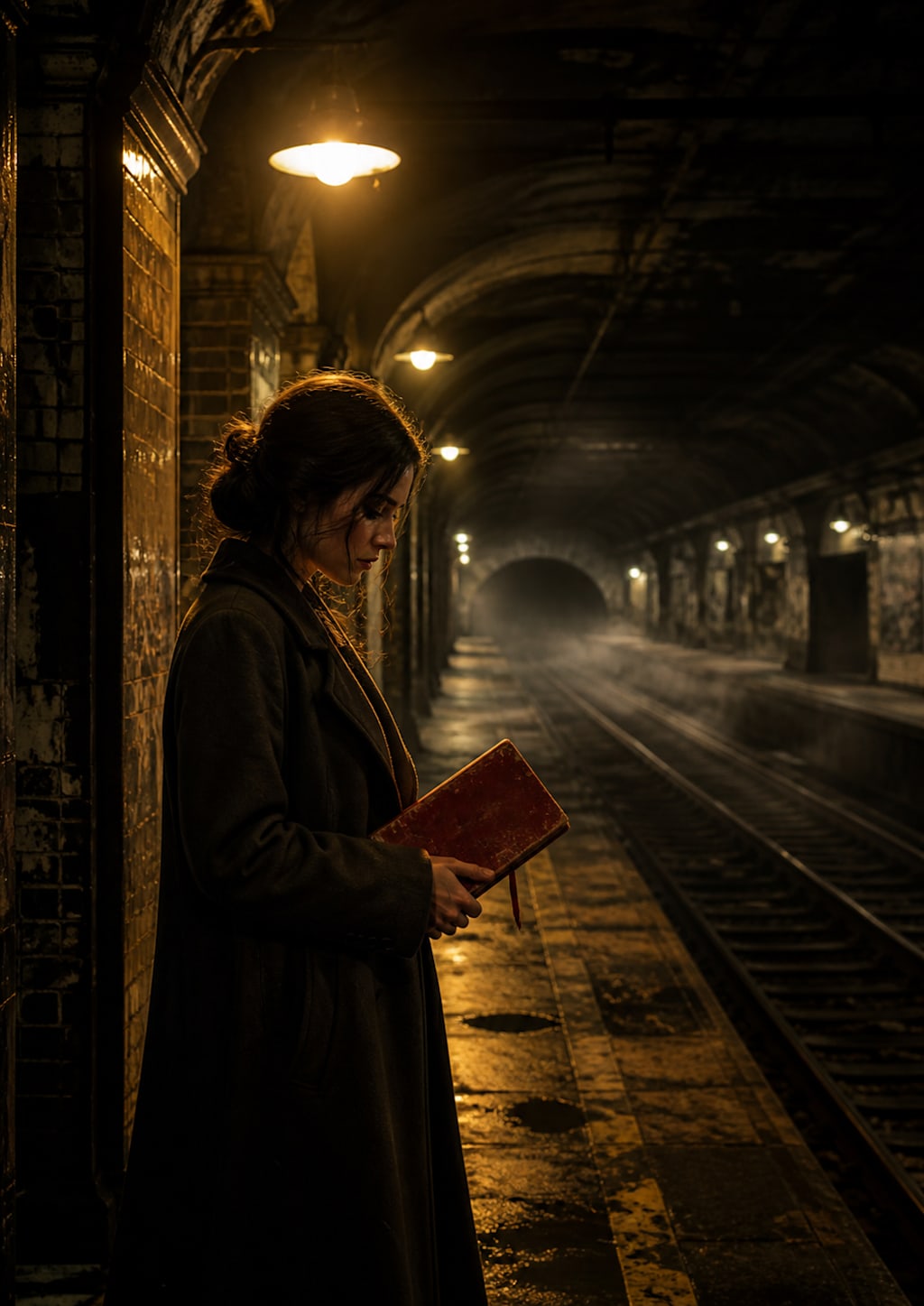
The Last Light in Holloway Station
Mara Whitfield had always believed that cities remembered everything.
They remembered the footsteps of people who were late for work, the whispered arguments beneath bus shelters, the names carved into benches by teenagers who thought love was permanent, and the songs hummed by old men walking home alone. London, especially, seemed unable to forget. Its streets were layered with history like dust on a windowsill. Every stone had heard a secret. Every tunnel had swallowed a goodbye.
But there was one place London had tried very hard to forget.
Holloway Station.
It did not appear on modern underground maps. No train stopped there anymore. Most people who lived above it had no idea it existed beneath their shoes. To them, the old entrance on Farrow Street was only a sealed brick arch beside a closed florist’s shop. Ivy crawled over the stones. Rain collected in the cracks. A faded sign, half-covered by rust, still showed the ghost of a name: HOLLOWAY.
Mara found it by accident on a Thursday evening in November.
She had been walking without direction, which had become a habit since her father died. At first, she told herself these walks were healthy. Movement was better than sitting in her flat, staring at the kettle and forgetting to turn it on. But after three months, she understood the truth. She walked because her home had become too quiet. Her father’s absence filled every room more heavily than his presence ever had.
That evening, the city was wet and silver. Buses groaned through puddles. Office workers hurried beneath umbrellas. Mara turned down Farrow Street because it was empty and because she did not feel like being seen.
She stopped when she noticed the arch.
At first, she thought it was a service entrance. Then she saw the letters.
HOLLOWAY.
Her father had mentioned that name once.
Not recently. Not during his illness, when his words came slowly and disappeared halfway through sentences. Years earlier, when Mara was a child, he had told her stories about hidden stations under London. Stations closed during the war. Stations used for storage. Stations where no train had passed in fifty years.
“There are places under the city,” he had said, “where time gets tired and sits down.”
Mara had laughed then. Her father had been good at making the impossible sound ordinary.
Now, standing before the old arch, she felt something move through her that was not quite curiosity and not quite grief.
There was a narrow gap where the bricks had fallen away near the side. Behind it, darkness breathed.
Mara should have kept walking. She was thirty-two years old, sensible enough to know that abandoned places were dangerous. There could be unstable stairs, broken glass, rats, or worse. But grief has a way of loosening the rules by which people live. When you have already lost the person whose voice warned you to be careful, danger becomes less convincing.
She turned on the flashlight on her phone and slipped through the gap.
The air inside was colder than the street. It smelled of damp stone, metal, and old dust. A staircase led downward, its tiled walls cracked and stained. Mara moved slowly, one hand against the wall. Her footsteps echoed too loudly.
At the bottom of the stairs was a ticket hall.
It was smaller than she expected. The old ticket windows were boarded up. A timetable hung crookedly on the wall, its paper browned with age. A poster advertised a seaside holiday in Brighton for prices that seemed almost imaginary. Near the turnstiles, someone had left an umbrella, black and folded neatly, as if they meant to return for it.
Mara’s light passed over the platform entrance.
A low humming sound came from beyond it.
She froze.
It was impossible. There should have been no electricity, no movement, no life below the abandoned station. Yet there it was: a soft electrical buzz, like an old lamp trying not to die.
Mara stepped through the archway onto the platform.
The lights were on.
Not all of them. Most were dead, hanging dark from the ceiling. But at the far end of the platform, one golden lamp flickered above a wooden bench. Beneath it sat a red notebook.
Mara stared at it for a long time.
The notebook was clean. Not new, exactly, but untouched by dust. It looked entirely out of place among the decay, as if it had been set down five minutes earlier.
She approached the bench.
The cover was made of worn red leather. A thin elastic band held it shut. Mara reached for it, then stopped. She had the strange feeling that touching it would change something. Not dramatically. Not in the way of fairy tales or horror films. More like opening a letter you already know will hurt.
Still, she picked it up.
On the first page, written in blue ink, were three words:
For the forgotten.
Mara swallowed.
She turned the page.
The handwriting was different now. Smaller. Neater.
My name is Evelyn Price. I left my violin on the northbound train in 1949. It was the last thing my mother gave me before she died. I still dream of the sound it made.
Mara turned another page.
My name is Samuel Reed. I never told my brother I was sorry. We argued on this platform in 1962. He boarded the train. I stayed behind. He died before Christmas.
Another page.
My name is Alina Moroz. I came to London with one suitcase and no English. I cried here because I thought I had made a mistake. A woman gave me a peppermint and said, “You are braver than you feel.” I never learned her name.
The notebook was filled with entries. Some were only a sentence long. Others covered several pages. Lost objects. Lost chances. Lost people. Each story belonged to someone who had passed through Holloway Station when it was still alive.
Mara sat down on the bench beneath the flickering lamp.
She read for nearly an hour.
There was a man who had planned to propose but lost his courage. A nurse who had fallen asleep after a night shift and missed her stop, only to meet the woman she later married. A boy evacuated during the war who had hidden a toy soldier behind a loose tile and promised to retrieve it, but never did. A mother who had waited every Friday for a son who stopped coming.
None of the stories were famous. None would appear in history books. They were small human things, the kind the world steps over without noticing. But together, they felt enormous.
Mara did not realize she was crying until a tear fell onto the page.
She wiped it quickly, afraid to damage the ink.
Then she saw the final entry.
It was dated only two weeks earlier.
Her hand tightened around the notebook.
My name is Daniel Whitfield.
Mara stopped breathing.
Her father’s name.
She stared at the sentence until the letters blurred.
I found this station when I was twenty-one and trying to decide whether to leave London. I had no money, no plan, and no faith in myself. I sat on this bench and wrote down the thing I feared most: that I would live an ordinary life and leave nothing behind.
Mara pressed one hand to her mouth.
Years later, I brought my daughter near this street. She was six, wearing a yellow coat, asking questions about everything. I almost showed her the station, but I didn’t. Some places should find you when you are ready.
The station seemed to grow quieter around her.
I am ill now. My hands shake, and sometimes my memories scatter like birds. But I remember this place. I remember the notebook. I remember what I wrote when I was young. I was wrong, of course. An ordinary life is not an empty one. I made soup for my daughter when she was sick. I taught her how to ride a bicycle. I showed her Orion in the winter sky. I loved one woman for thirty years, even after she was gone. I paid bills. I burned toast. I worried. I laughed. I stayed.
Mara could hear her father’s voice in every line.
Not the voice from the hospital, thin and tired, but the voice from her childhood. Warm. Patient. Always slightly amused by the world.
If Mara ever finds this, I hope she knows I did not leave her willingly. I hope she knows grief is not a room she has to live in forever. It is a station. She may wait there for a while. She may sit under its dim lights and listen to the echoes. But one day, a train will come. When it does, I hope she gets on.
Mara closed her eyes.
For months, people had told her versions of the same thing.
He would want you to be happy.
Time heals.
You have to move on.
They had meant well. She knew that. But their words had felt like hands pushing against her back, urging her away from the only place where her father still seemed close.
This was different.
Her father was not telling her to leave grief behind. He was telling her that grief was a place, and places could be departed without being destroyed.
Mara read the final lines.
I leave my memory here with the others. Not because I want to be forgotten, but because I trust that what is loved is never truly lost. It changes platforms. It waits in another form.
Below that, he had written:
For Mara, when she is ready.
The lamp above the bench flickered.
For one wild second, Mara thought it might go out. She imagined being left in complete darkness beneath the city, holding her father’s last message. But the light steadied.
Mara sat there for a long time, the notebook open in her lap.
Then, slowly, she took a pen from her coat pocket.
Her hand trembled as she turned to a blank page.
She did not know what to write. There were too many things. She wanted to tell her father that she missed him in the mornings, especially when the kettle clicked off. She wanted to apologize for being impatient during his final weeks. She wanted to ask whether he had been afraid. She wanted to tell him that she still looked for his face in crowds.
Instead, she wrote:
My name is Mara Whitfield. I lost my father, and for a while I thought that meant I had lost the whole world.
She paused.
Somewhere far away, or perhaps only in her imagination, she heard the faint sound of a train.
Tonight I found a station beneath London where forgotten things are kept safe. I found his words waiting for me. I do not know if I am ready to leave grief yet. But for the first time, I believe there may be somewhere else to go.
Mara placed the pen down.
The air shifted.
At the far end of the platform, beyond the reach of the golden lamp, a light appeared in the tunnel.
Small at first. Then growing.
Mara stood.
The sound came next: rails singing softly, wheels moving through darkness. A train emerged, old and silver, its windows glowing with warm light. It slowed beside the platform without a screech, without a gust of wind, as gently as a thought arriving.
The doors opened.
Inside, the carriage was empty.
Mara looked at the notebook on the bench.
She understood, without knowing how, that she could take it with her or leave it behind. Both choices were allowed. Both were forms of remembering.
After a moment, she closed the notebook and placed it back beneath the lamp.
“For the forgotten,” she whispered.
Then she stepped onto the train.
The doors closed behind her.
As the train began to move, Mara looked through the window. The platform slid past slowly. The bench, the lamp, the tiled wall, the red notebook—all of it receded into the dark.
But just before the station disappeared, Mara saw something that made her breath catch.
A man stood beneath the flickering light.
He wore the brown coat her father had loved. His hair was thinner than it had been when she was young, his shoulders slightly bent, but he was smiling.
Not sadly.
Not like goodbye.
Like someone watching his daughter finally find her way home.
Mara pressed her hand to the glass.
The train entered the tunnel.
When she emerged from the old arch on Farrow Street, morning had come. The city was waking. Delivery vans rolled past. A woman unlocked the florist’s shop. Somewhere, coffee was being ground. Somewhere, a child laughed.
Mara turned back toward the station entrance.
The brick arch was sealed.
No gap. No darkness behind it. No sign of a way in.
Only the rusted letters remained.
HOLLOWAY.
For the first time in months, Mara smiled.
She walked home through the brightening streets, carrying nothing from the station except what mattered.
And beneath London, under stone and steel and memory, the last light in Holloway Station continued to burn.
About the Creator
Alpha Cortex
As Alpha Cortex, I live for the rhythm of language and the magic of story. I chase tales that linger long after the last line, from raw emotion to boundless imagination. Let's get lost in stories worth remembering.
Enjoyed the story? Support the Creator.
Subscribe for free to receive all their stories in your feed.
Comments
There are no comments for this story
Be the first to respond and start the conversation.