
The Last Light at Harrow House
For eleven years, Room 4 of the Harrow House Hotel stood empty. Then a guest checked in and vanished without a trace.

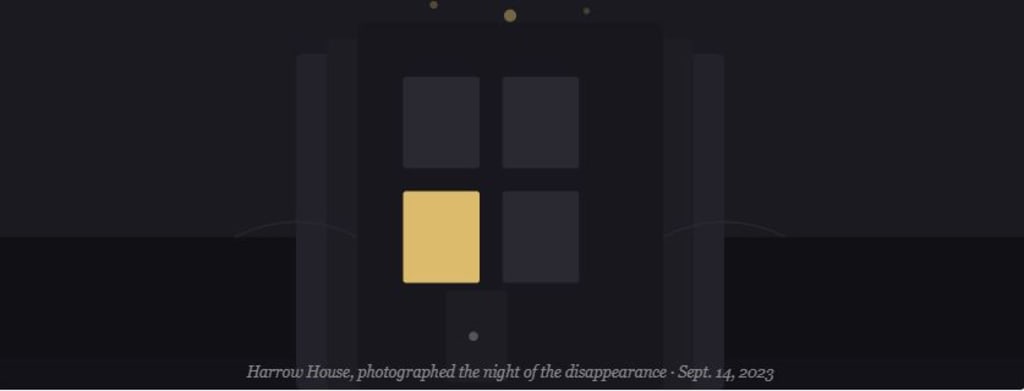
The rain had been falling for three days when Daniel Voss pulled his car into the gravel lot outside Harrow House. It was the kind of September that made the English countryside look beautiful and sinister all at once hedgerows heavy with water, the hills smeared grey and green, the old hotel's Victorian facade rising out of the mist like something remembered from a bad dream. He had booked a single room. He had booked Room 4.
That detail matters. Room 4 had not been let out in over a decade. The staff at Harrow House had quietly kept it off the booking system ever since the night in 2012 when a guest named Patricia Holt had apparently walked out of it and into nothing. No luggage left behind. No farewell at the front desk. Her car, a burgundy Citroën, was still in the lot by morning. Patricia was never found.
"He asked specifically for that room. We thought it was strange, but who were we to refuse? It had been empty long enough."
Helen Briggs, who has managed Harrow House for twenty-two years, tells me this with the careful evenness of someone who has rehearsed it many times first for the police, then for the journalists, and now, apparently, for me. She pours tea without asking and keeps her eyes on the window that looks out onto the car park. "He asked specifically for that room," she says. "We thought it was strange, but who were we to refuse? It had been empty long enough."
The guest
Daniel Voss was thirty-eight, a freelance archivist from Leeds who had recently taken a commission cataloguing private papers for a solicitor's firm in the nearby market town of Ashford Cross. His colleagues describe him as methodical, solitary in the pleasant way, and possessed of an unusual enthusiasm for old documents. He had no known connection to Patricia Holt. He had never, as far as anyone can determine, been to Harrow House before.
He checked in at 6:14 p.m. on September 14th, 2023. He signed the register in a precise, upright hand. He carried one bag a battered leather holdall and a cardboard box sealed with brown tape. He declined help with either. He did not come down for dinner. A housekeeper passing the corridor at ten o'clock noted a thin bar of light beneath the door of Room 4 and heard the faint rustle of paper, the kind of sound that libraries make. She did not knock. By two in the morning the light was gone. By morning, so was he.
"The box was open. Whatever had been inside, he had taken it out and arranged it on the floor photographs, letters, a hand-drawn map of the hotel itself."
What was left behind
Unlike Patricia Holt, Daniel Voss left things behind. His holdall sat open on the bed, clothes folded inside as though he intended to return. His phone was on the bedside table, battery dead. His shoes sturdy brown brogues, laces still tied were placed neatly by the door. And the cardboard box, the one he had so carefully carried in himself, was open on the floor in the centre of the room. Whatever had been inside, he had taken it out and arranged it photographs, letters, a hand-drawn map of the hotel itself, with a single room circled in red ink. Room 4. His own room.
Among the papers, police found a name written repeatedly in the margins of several documents. Not Daniel's name. Not Patricia Holt's. The name was Aldous Greave a previous owner of Harrow House, who had died in 1967, and whose estate, a solicitor's firm in Ashford Cross had recently finished settling after decades of legal dispute. The same solicitor's firm that had hired Daniel Voss to catalogue their archives.
Detective Sergeant Ros Okafor, who led the investigation, tells me that the case is still open. She uses that word open with an emphasis that suggests she means it as more than a procedural status. "There were no signs of struggle," she says. "No signs of exit, either. The window was latched from the inside. The door was locked when we arrived, from the inside." She pauses. "We don't have a tidy explanation."
Room 4, today
Helen Briggs has put the room back off the system. She shows me to it on a Tuesday afternoon in early spring, unlocking the door with a key she keeps on a separate ring from the others. The room is ordinary: a brass bed, a wardrobe with a foxed mirror, wallpaper with a pattern of small ferns. The floor where the papers were arranged is bare wood, scuffed in the way that old floors always are. There is nothing to see. There is nothing to explain what happened to Daniel Voss, or to Patricia Holt before him, or why whoever booked the room always seemed to know even when it wasn't listed anywhere that Room 4 was there, and waiting.
I ask Helen if she ever feels uneasy coming in here. She considers the question seriously, the way she seems to consider everything. "Not uneasy," she says at last. "Just watchful." She locks the door behind us. On the way back down the corridor, neither of us says anything at all.
About the Creator
Mark Lim
Hi I am mark an automotive student and a car, tech and food enthusiast ! Im gonna try and post daily & hope you enjoy what I write and do share my page with people you know. I would gladly appreciate it! Cheers
Enjoyed the story? Support the Creator.
Subscribe for free to receive all their stories in your feed.
Comments
There are no comments for this story
Be the first to respond and start the conversation.