
“The Last Lantern of Dera”
The Boy Who Refused to Let the Light Die

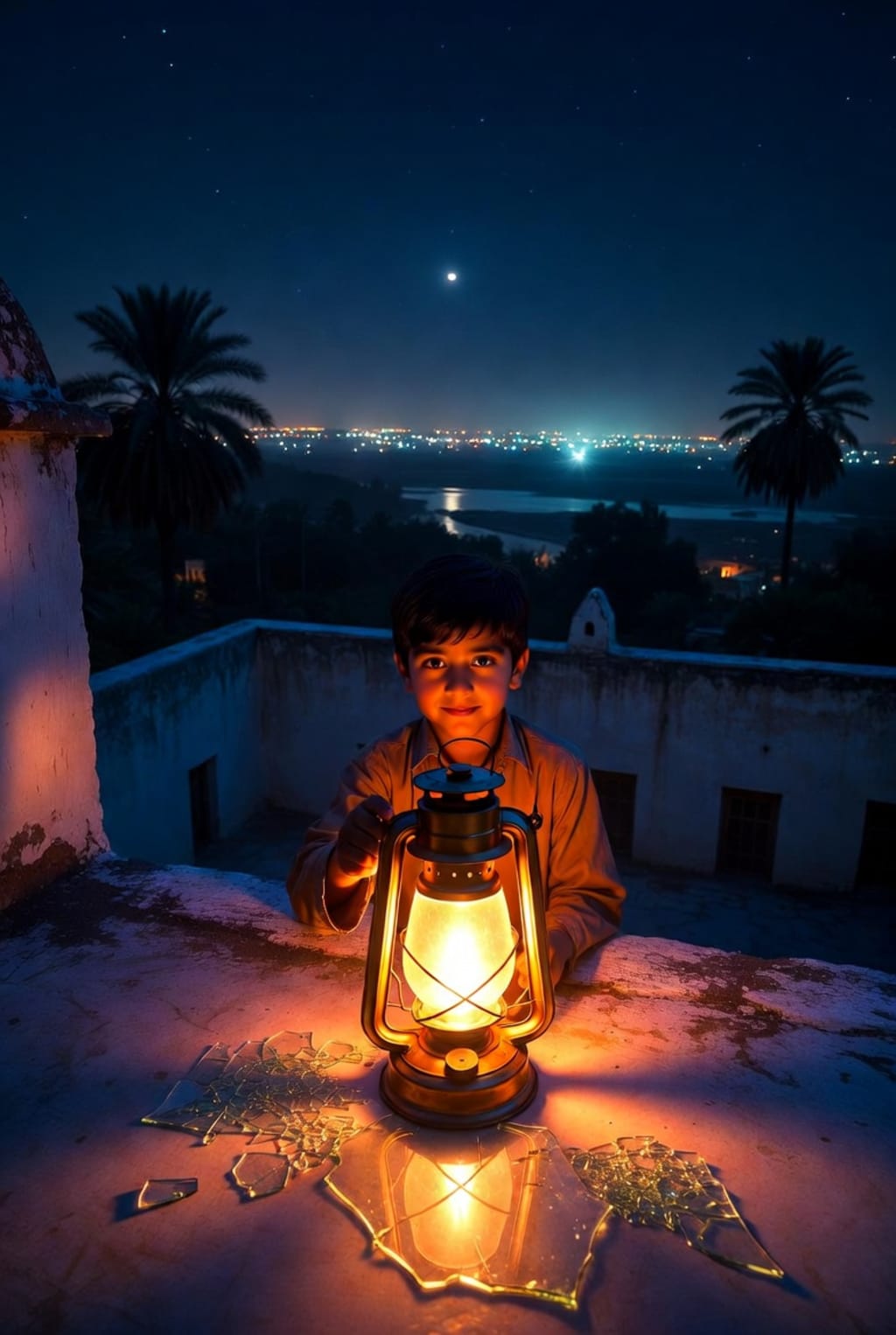
In the dusty heart of Dera Ismail Khan, where the Indus River whispered ancient secrets to the date palms, lived a boy named Zain. He was twelve, thin as river reed, with eyes that carried the color of late monsoon skies. Every evening, as the call to prayer floated over the rooftops, Zain would climb the crumbling stairs of the old haveli and light his grandfather’s brass lantern.
The lantern was no ordinary light. Its glass was etched with tiny birds that seemed to flutter when the flame danced. Grandfather had called it “Roshni-e-Akhir,” the Last Light, and told Zain a single rule: “As long as this lantern burns, our family’s stories will never die.”
But stories were dying anyway.
Zain’s father had left for the city years ago, chasing work that never came back. His mother sold embroidered shawls at the Sunday market, her hands cracked from needle and worry. The haveli itself was slowly surrendering to time—walls peeling like old skin, wooden doors groaning like tired elders.
One scorching April evening, a sandstorm swallowed the sun. The wind howled like a wounded animal through the narrow streets. Zain rushed to the rooftop, clutching the lantern. Rainless lightning cracked the sky. In the chaos, the lantern slipped from his sweating hands and crashed onto the cracked tiles.
The glass shattered. The flame hissed and died.
Zain stood frozen, shards glittering at his feet like fallen stars. For the first time in his life, the rooftop felt unbearably dark. He gathered the broken pieces in his shirt and carried them downstairs, heart pounding louder than the storm.
His mother found him sitting on the floor, trying to fit the glass back together with trembling fingers.
“It’s gone, Ammi,” he whispered. “The last lantern… I broke it.”
She knelt beside him, brushing sand from his hair. “Lanterns can be mended, beta. But only if you remember why they were lit.”
That night, Zain couldn’t sleep. He kept hearing his grandfather’s voice: “Every family has a light. Sometimes it lives in brass and glass. Sometimes it lives in the tongue that tells the tale.”
At dawn, he made a decision.
He took the largest shard of glass, wrapped it carefully, and walked through the waking bazaar. He visited the old storyteller under the banyan tree, the blind calligrapher near the mosque, the fisherman who sang to the river. To each he told the story of the lantern and asked for one piece of their own story in return.
By sunset, his small cloth bag was heavy with fragments: a faded photograph of a wedding from 1972, a yellowed page of poetry written by a great-aunt who fought for girls’ education, a rusted key to a door that no longer existed, and most precious of all — a tiny brass bell that once belonged to his own grandfather’s camel.
Zain returned home and spread everything on the floor. With his mother’s help, he built something new. They melted old candle stubs, poured the wax into a clay pot his father had once made, and fixed the largest lantern shard into the side like a window. Around it, they tied the stories — literally. The photograph became a label, the poem a scroll wrapped around the handle, the key and bell dangling like charms.
When night fell, Zain lit the new lantern.
It didn’t look like the old one. It was rough, imperfect, a little crooked. But when the flame caught, the shard glowed warm amber, and the tiny birds etched on the glass seemed to fly again. The bell tinkled softly with every breeze.
His mother smiled through tired eyes. “See? The light never left. It only changed its home.”
Word spread through the mohalla. Children came first, then elders, then even the young men who usually hid behind their phones. Every evening they gathered on the haveli rooftop. Zain would hold up the new lantern and ask someone to share a story. Sometimes it was funny — the time Uncle Noor tried to ride a motorcycle with three goats. Sometimes it was painful — the year the flood took half the village. Sometimes it was just quiet memories of how sweet the mangoes used to taste before the orchards dried.
The lantern became their heartbeat.
One evening, months later, a dusty bus stopped at the edge of town. A tired man stepped down carrying a worn suitcase. It was Zain’s father. He had come back, thinner, older, eyes full of regret and hope.
He climbed the stairs to the rooftop and stopped when he saw the strange glowing lantern surrounded by neighbors.
Zain walked forward, holding the light between them.
“Welcome home, Abbu,” he said softly. “We kept the stories alive for you.”
His father’s eyes filled. He took the lantern with both hands, feeling its warmth, hearing the soft jingle of the bell.
That night, for the first time in many years, four generations of stories burned under one roof — some in words, some in silence, and all in the steady, stubborn flame of a boy who refused to let the light die.
And in Dera Ismail Khan, where the Indus still whispered, people began to say that if you walk past the old haveli after dark, you can still see a small, imperfect lantern burning on the rooftop.
They call it Roshni-e-Akhir.
The Last Light.
Not because it is the final one…
…but because it refuses to be the last.
About the Creator
Waleed khan
Mysterious & Artistic
Enjoyed the story? Support the Creator.
Subscribe for free to receive all their stories in your feed.
Comments
There are no comments for this story
Be the first to respond and start the conversation.