
The Last Cup of Coffee
A quiet morning, an old kitchen table, and a goodbye no one was ready to say.

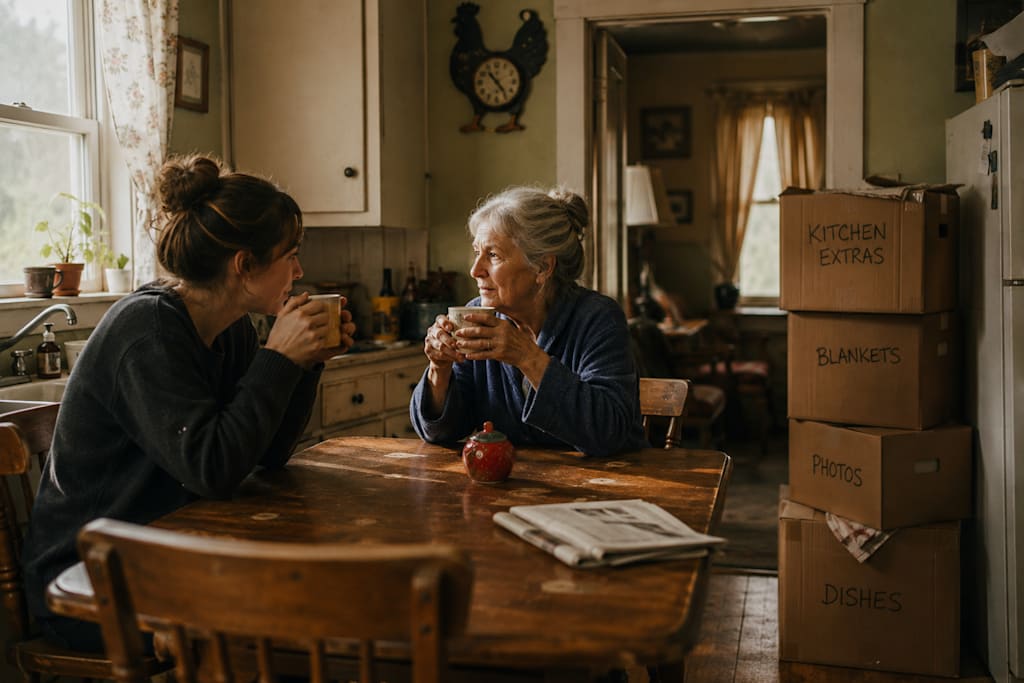
It was only a cup of coffee.
That was what anyone else would have said if they had walked past the small yellow house that morning and looked through the kitchen window. They would have seen two women sitting at a table, steam rising from mismatched mugs, the curtains moving softly from the open window above the sink.
Nothing about it looked important.
The table had scratches in it from years of elbows, homework, grocery lists, and birthday cakes cut too quickly. One chair had a wobble that everyone in the family knew about, though no one ever fixed it. The refrigerator hummed in the corner. A clock shaped like a rooster ticked above the doorway, five minutes slow like always.
To anyone else, it was just morning.
To Mara, it was the last morning.
Her mother sat across from her, wrapped in a blue robe with tiny white flowers. The robe had faded so much that some of the flowers looked more like little dots. Her hands were wrapped around her mug, though she had not taken more than two sips.
“You made it too strong,” her mother said.
Mara looked down at her own cup and smiled. “You say that every time.”
“Because every time, you make it too strong.”
“You taught me how to make coffee.”
“I taught you better than this.”
Mara laughed, but it came out soft and uneven.
Her mother noticed. Of course she did. Mothers had a way of noticing things before they were fully there.
“Don’t start that,” she said gently.
“I’m not starting anything.”
“Yes, you are. You’re making your sad face.”
“I don’t have a sad face.”
Her mother lifted one eyebrow.
Mara looked away first.
Outside, a neighbor’s dog barked twice and then gave up. Somewhere down the street, a trash truck groaned and clattered. The world was doing exactly what it always did, which felt almost rude.
There were boxes stacked in the hallway. Some were labeled in black marker: dishes, blankets, photos, kitchen extras. The house had been sold three weeks earlier, though Mara still could not bring herself to say it that way. Sold sounded too final. Too clean. As if a house where people had lived, argued, cried, grown up, and come back home could simply belong to someone else because a paper said so.
Her mother was moving into a smaller apartment near Mara’s sister. It made sense. Everyone had agreed it made sense. The stairs were too hard now. The yard was too much. The old house needed repairs no one had the energy or money to keep chasing.
Still, sense did not make it easy.
Mara stirred her coffee even though she had not added sugar.
Her mother watched the spoon circle the cup. “You’ll scratch the bottom doing that.”
“It’s a mug, Mom.”
“And mugs deserve respect.”
Mara smiled again. That was her mother. Giving dignity to cracked mugs, old towels, and leftovers stored in butter containers.
For a while, neither of them spoke.
The silence was not empty. It was full of every morning that had come before this one. Mara could almost see them layered in the kitchen: herself at seven years old, sitting at the table with cereal milk on her chin; her brother rushing in late for school; her father reading the paper with his glasses low on his nose; her mother standing at the stove, turning pancakes with one hand and pointing a warning finger with the other.
Don’t run in my kitchen.
Eat before you leave.
Take a jacket.
Call me when you get there.
So many ordinary sentences. So many small commands that had held their lives together.
Mara reached for the sugar bowl. It was shaped like a strawberry, with a tiny green lid. The paint had chipped near the bottom.
“You’re taking this, right?” she asked.
Her mother glanced at it. “You want it?”
“No, I just mean… are you packing it?”
“I was thinking of leaving it.”
“Leaving it?”
“It’s chipped.”
“It has always been chipped.”
“Exactly.”
Mara picked it up carefully. “You can’t leave the strawberry sugar bowl.”
Her mother’s face softened. “Your father bought that at a yard sale.”
“I know.”
“He said it was ugly enough to be charming.”
“It is ugly.”
“It is charming.”
They both laughed then, a real laugh, and for a moment the kitchen felt normal. Not like a place being emptied. Not like a chapter closing. Just theirs.
Her mother reached across the table and tapped the sugar bowl with one finger. “Fine. Pack it.”
Mara stood and opened a box near the doorway, but it was already full. She moved aside old dish towels and a stack of plastic cups. Then she found a space just big enough and wrapped the sugar bowl in yesterday’s newspaper.
As she tucked it away, something small and white slipped from between the pages.
“What’s that?” her mother asked.
Mara picked it up.
It was an old grocery list, written in her father’s handwriting.
Milk
Eggs
Bread
Coffee
Glue sticks
Bananas if not green
Mara stared at the words.
Her father had been gone six years. Long enough that people no longer paused before saying his name. Long enough that grief had become part of the furniture of their lives, always present but not always noticed. Still, there were moments when it stepped into the room like it had just arrived.
Her mother held out her hand. Mara gave her the list.
She read it once. Then again.
“Bananas if not green,” she said.
Mara swallowed. “He hated green bananas.”
“He said buying green bananas was an act of false hope.”
“That sounds like Dad.”
Her mother smiled, but her eyes had filled. She folded the list carefully, the way someone might fold a letter from a soldier or a child’s first drawing.
“Put it in my purse,” she said.
Mara did.
When she returned to the table, her mother had finally taken another sip of coffee.
“Still too strong?” Mara asked.
“Terrible.”
But she kept drinking it.
The sunlight shifted across the table. It touched the place where Mara’s father used to sit. For years after he died, no one had officially called it his chair. They simply left it empty more often than not. On holidays, someone would put a coat there or a stack of paper plates, and then move them without being asked.
Mara looked at the empty chair now.
Her mother followed her gaze. “He would have hated all this fuss.”
“He would have pretended to hate it.”
“He would have stood in the hallway telling everyone they were carrying boxes wrong.”
“And then carried the lightest one himself.”
Her mother laughed into her mug. “He was not a moving man.”
“No, he was a pointing man.”
They sat with that, smiling.
Then her mother looked around the kitchen, slowly, as if she were reading every wall.
“I brought all three of you home to this house,” she said.
Mara nodded.
“You learned to walk right there.” She pointed toward the doorway. “You fell into that wall and cried like the world had ended.”
“Maybe it had.”
“You were dramatic.”
“I was a baby.”
“You stayed dramatic.”
Mara rolled her eyes, but she was glad for the teasing. It gave her something to hold besides sadness.
Her mother’s fingers moved over the edge of the table. “I used to think houses kept things,” she said. “Like if I stayed here, nothing could really leave.”
Mara listened.
“But things leave anyway. Children grow up. People pass on. Neighbors move. Even wallpaper gives up if you wait long enough.”
The corner near the pantry still had a small peel in the wallpaper. Mara remembered being thirteen and picking at it during a lecture about her grades. Her mother had slapped her hand away without even looking.
“I don’t want you to think I’m giving it all up,” her mother said.
“I don’t.”
“I’m taking what matters.”
Mara looked toward the boxes.
Her mother shook her head. “Not just those.”
Then she reached across the table and took Mara’s hand.
Her hand felt smaller than it used to. The skin was thinner, the veins more visible, but her grip was still firm.
“This morning,” her mother said. “I’m taking this.”
Mara’s throat tightened.
It was only coffee. Bad coffee, according to her mother. Coffee in chipped mugs at a scratched table in a half-packed house.
But Mara understood.
Her mother was not talking about the cups or the room or even the house. She was talking about the two of them sitting there while the world waited. She was talking about the sunlight, the grocery list, the strawberry sugar bowl, the chair no one mentioned, and the way love could sit quietly between two people without needing to announce itself.
Mara squeezed her hand.
“I’m taking it too,” she said.
They finished their coffee slowly.
Afterward, Mara washed the mugs by hand, though the dishwasher still worked. Her mother dried them with a towel that had apples on it. Neither of them said they were stalling.
When the mugs were dry, Mara wrapped them in paper and placed them in the box beside the sugar bowl.
Her mother stood in the doorway and looked once more at the kitchen.
Then she turned off the light.
Outside, the moving truck waited. Her sister was calling from the driveway, asking if they were ready.
Mara picked up the box marked kitchen extras.
Her mother picked up her purse, the old grocery list tucked safely inside.
They stepped out together.
To anyone passing by, it would have looked like nothing special. Two women leaving a house. A box. A purse. A morning ending like mornings do.
But years later, when Mara tried to explain why she still remembered it so clearly, she never knew how to make it sound right.
She would say, “We had coffee before we left the house.”
And people would nod politely, waiting for the real story.
But that was the real story.
You just had to be there.
About the Creator
Ronna Curtis
Ronna Curtis, Ladybug, is the name I go by when publishing a book. For any books I write, I will show 2 to 4 chapters; the rest of the book or stories will be offered to subscribers. Contact information is [email protected]
Enjoyed the story? Support the Creator.
Subscribe for free to receive all their stories in your feed. You could also become a paid subscriber, letting them know you appreciate their work.
Comments
There are no comments for this story
Be the first to respond and start the conversation.