
The Last Chevrolet in China
From 767,000 sales a year to a single Equinox. How the golden bow tie lost to the times.
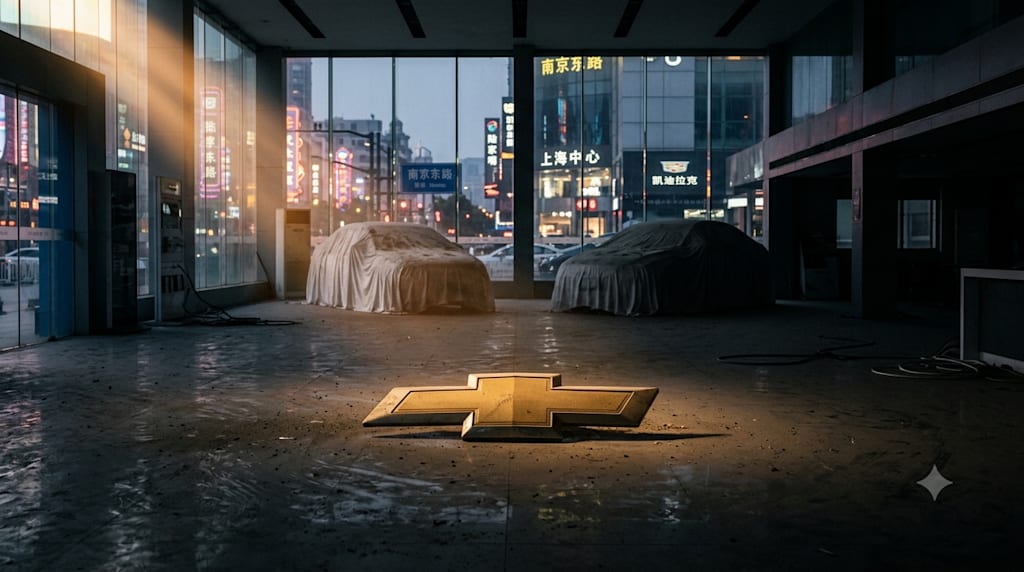
2005, Shanghai. A name called "Sail" was taken off the Buick badge and pinned with a golden bow tie.
No one knew how long that bow tie would stay in China. But at the time, everyone assumed it would be there forever.
General Motors positioned Buick as a suit—respectable, businesslike, appropriate for meetings. Then they needed a cheaper brand to sell to those who had just gotten their driver's license, just saved up for a down payment, and were just about to put their lives on four wheels.
So Chevrolet came.
Chevrolet's first owners are mostly in their forties now. Many of them walked into the dealership back then with not much money in their pockets. But they remember that day: the showroom lights glinting off the Sail's roof, the sales consultant handing them a glass of warm water, and when the contract was signed, some of them gripped the car key so hard their palms sweated.
It was an era when a joint-venture brand could still be looked up to.
2009. The Cruze launched.
If you passed by any Chevrolet dealership that year, the scene was probably the same: the showroom packed with people, the display car's doors opening and closing, the hood lifted and lowered, the sales consultants' voices hoarse from talking. By that afternoon, they had sold out the month's quota.
The Cruze sold 28,000 units in a single month.
What does 28,000 mean? Even today, that number would rank in the top five of sedan sales charts. And in 2009, it was almost dominant.
Most of those who bought the Cruze were first-time car buyers. They didn't know what a torsion beam or a multilink suspension was, but they knew this car looked fiercer, younger, and less like a "family car" than anything else at the same price.
That year, Transformers: Revenge of the Fallen hit theaters. When Bumblebee—the Camaro—transformed on the big screen, the boys in the cinema cheered. After the credits rolled, they stood in front of the posters and said: one day, I'm going to buy a Chevrolet.
Most of them ended up buying a Cruze.
But that no longer matters. What mattered was that the golden bow tie meant something back then: youth, the first car, and an expanding middle-class dream.
Over the next few years, the Malibu came, the Trax came, the Equinox came. Chevrolet's product line stretched from A-segment to B-segment, and its dealer network grew to nearly a thousand locations across the country.
In 2014, Chevrolet sold 767,000 vehicles in China.
That was its peak. After that, it declined steadily.
In 2018, General Motors made a decision: switch entirely to three-cylinder engines.
The decision sounded reasonable in the boardrooms of Detroit—emissions regulations were tightening, three-cylinders were the cheapest solution, and Europeans had already accepted them.
But Chinese consumers weren't buying it.
They hadn't studied thermal efficiency or frictional losses. They only knew one thing: three-cylinders shake.
That "shake" became a label Chevrolet could never shake off. Go to any car forum, and whenever Chevrolet was mentioned, someone would inevitably say: "You'd actually buy a three-cylinder?"
The collapse of reputation came fast and complete. Social media amplified every negative review, and Chevrolet's response was silence.
In 2019, sales fell to 410,000.
In 2024, 52,700.
In 2025, fewer than 9,000.
By June 2026, data from Dongchedi showed that Chevrolet sold exactly one car in China that month.
One Equinox.
A brand that once sold 767,000 units a year had compressed itself into a single grain of dust over 12 years. Once the dust settled, you couldn't even find a reason to be angry—it had simply vanished, like a tire slowly losing air. Every day you thought it could hold out one more day, and then one day you looked down and it was completely flat.
Where did it go wrong?
You could say the three-cylinder engine was the last straw. But what really crushed Chevrolet was its product line that hadn't been refreshed in a decade.
The Malibu XL—launched in 2016, discontinued in 2026. Ten years. The interior never changed. The exterior never changed. The screen size never changed. Whatever you sat in in 2016 was exactly what you sat in in 2026.
And in those ten years, Chinese brands had swapped resistive touchscreens for curved OLED displays, manual seats for ventilated, heated, massaging ones, and no driver assistance for highway-level NOA.
The Malibu XL changed nothing.
Chevrolet's R&D decisions were controlled by its overseas headquarters. Any change the Chinese team wanted to make had to go through a long, drawn-out global approval process. A decision to lengthen the wheelbase could take three to five years to implement, and by then the competition had already moved on to another generation.
So Chevrolet could only copy global models wholesale.
But global models weren't designed for China. Their screen sizes were based on the finger lengths of Europeans and Americans. Their chassis tuning was based on Germany's unlimited-speed autobahns. Their smart cockpit logic was based on Americans' habit of using CarPlay.
Chinese consumers wanted big screens, long range, voice commands, fast charging—Chevrolet had none of it.
There was an even more fatal problem: Buick's knife was cutting into Chevrolet's neck.
In SAIC-GM's brand matrix, Cadillac occupied the premium space, Buick the mid-to-high-end business segment, and Chevrolet "high value for money." That positioning worked ten years ago, when Chinese brands hadn't risen yet, and Chevrolet's "value" was measured against Volkswagen and Toyota.
But now it was different.
Geely, Changan, and BYD had packed their spec sheets to the brim in the 100,000–150,000 RMB price band. Chevrolet's "value for money" was a joke next to them.
Worse still, Buick had been cutting prices in recent years. And when Buick cut prices, it stepped right into Chevrolet's territory. Consumers compared the two and thought: for about the same money, should I buy a Buick or a Chevrolet?
The answer was obvious.
Cadillac pressing down from above, Buick squeezing from below, and Chinese brands swarming in from all directions—Chevrolet was being pushed into an ever-shrinking gap, until there was no gap left at all.
On August 5, 2026, SAIC and General Motors renewed their joint-venture agreement, extending it 20 years to 2047.
The press release was polished—at least 30 new energy vehicles by 2030, Buick's product plans, Cadillac's transformation roadmap, all laid out clearly.
From beginning to end, Chevrolet was not mentioned.
Three days later, the decision came: Chevrolet would stop selling new cars in China.
But the factories would keep running—the cars produced would no longer be sold to Chinese buyers, but shipped overseas. South America, Southeast Asia, the Middle East—Chevrolets made in China for export.
After-sales service for the existing 7.5 million owners would be handled by Buick dealerships.
It was a graceful exit. No factory closures, no layoff drama, no owner protests. Just quietly turning off the showroom lights, putting away the keys, and continuing in a different role—from "in China, for China" to "in China, for the world."
Every time a joint-venture brand exits, someone says it's "bad money driving out good."
They said it when Suzuki left. They said it when Renault left. They said it when Mitsubishi left. They said it when Škoda left.
Now it's Chevrolet's turn.
Let me ask you a question: if Chevrolet really was the "good money," why is it leaving now and not in 2014?
If Chinese consumers really couldn't tell good from bad and only bought cheap stuff, then why is Porsche still selling? Why is the Mercedes-Benz S-Class still selling? Why do people still line up for a Lexus even when there's a markup?
Consumers aren't stupid.
Whether a car drives well—they feel it every day on their commute. Whether assisted driving is reliable—they know after one try on the highway. Whether interior quality is good—they know the moment their hands touch it. Whether the infotainment lags—they know after tapping the screen three times with no response.
These judgments don't need anyone to teach them.
You can miss Chevrolet—miss the way it once gave an entire generation the thrill of their first car, miss the arc of the Cruze's taillights cutting through the night on a highway, miss the moment Bumblebee transformed on screen.
But missing is just missing.
Chevrolet couldn't sell because its products couldn't keep up with the times. Not because Chinese consumers had no taste.
Blaming consumers' aesthetic sense is the last dignity of every loser—and the most hypocritical one.
Nokia was once the king of phones. Would you buy a feature phone today just because you miss Nokia? You wouldn't. You'd buy an iPhone, a Huawei, a Xiaomi—because those phones can scan codes, navigate, and let you scroll through short videos.
What you miss is your youth, not Nokia's keypad.
Chevrolet is the same.
What you miss is the version of yourself sitting in the driver's seat of a Cruze in 2009—young, broke, but feeling like the world was opening up to you.
That's your story, not Chevrolet's.
Chevrolet just happened to be there at that moment in your life.
Now it's gone.
You won't buy a new Chevrolet—because there are no new ones. But even if there were, you probably wouldn't—your needs today can be met by a Chinese plug-in hybrid for around 150,000 RMB.
That's the market.
The market doesn't owe any brand a right to exist. It only recognizes product strength, experience, and one simple truth: if you do it well, people buy. If you don't, they don't.
So the greatest respect you can show Chevrolet is to admit that it was once genuinely great.
Admit that in 2009, it gave countless young people a dream about cars.
Admit that in 2014, it stood at 767,000 units—one of the most glorious moments of China's joint-venture era.
And then admit that it lost.
It lost to the times, to change, to brands that were faster and understood Chinese consumers better.
There's no shame in that. Surviving 21 years in the Chinese market and leaving behind 7.5 million owners is a record worthy of respect in any industry.
But if you insist on asking, "Why did Chevrolet lose?"—there's only one answer:
Because it wasn't fast enough.
And on this track, those who aren't fast enough can only watch others overtake them, until there's nothing left to see behind them.
About the Creator
Jin
Writer of reamstories
https://reamstories.com/jin
Enjoyed the story? Support the Creator.
Subscribe for free to receive all their stories in your feed. You could also become a paid subscriber, letting them know you appreciate their work.
Comments
There are no comments for this story
Be the first to respond and start the conversation.