
The Lantern Keeper of Hollowmere
In a village where lanterns hold the last dreams of the dead, a silent keeper guards the balance
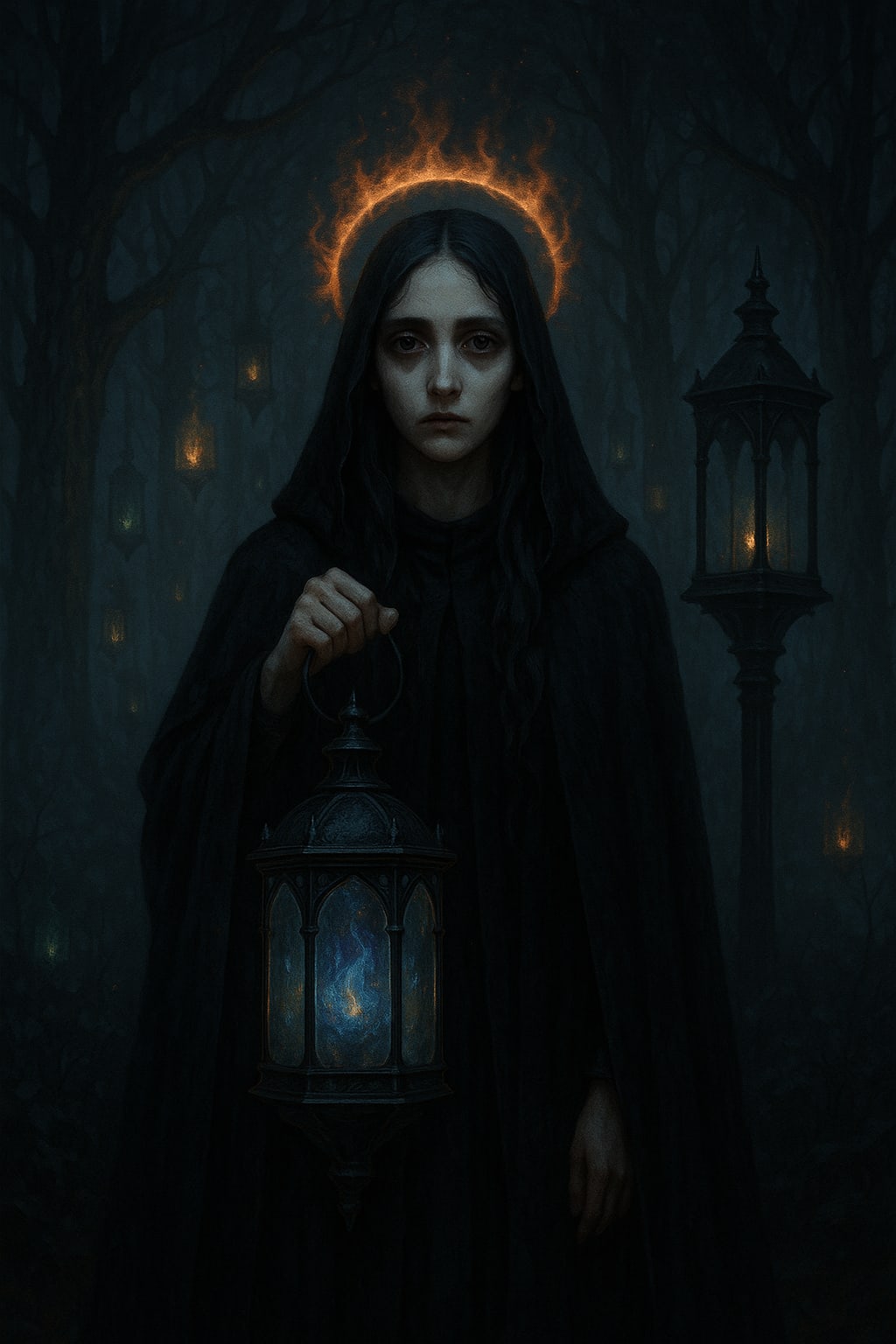
In the forgotten folds of the world, where maps curl at the edges and stars seem closer than clouds, there stood the village of Hollowmere. Shrouded by ancient forests and surrounded by glimmering mists, Hollowmere was a place that did not appear on any sensible traveller's itinerary. Its cottages were built from moss-cloaked stones, its wells whispered secrets in forgotten tongues, and every night, as the moon rose, the village glowed with lights that danced like will-o’-the-wisps — blue, green, and violet flames suspended in jars of crystal glass. These were the lanterns of Hollowmere, and they were no ordinary lights. Every lantern held a dream — not one dream, but the last dream of a soul departed. The villagers, quiet and wary folk, had long accepted this enchantment as a fact of their strange world. When someone passed on, a lantern appeared by their windowsill, softly humming, casting their final vision in flickering hues. At the centre of this tradition stood a young woman named Corva, the Lantern Keeper. No one knew how she came to be there. She had arrived one solstice evening as a child, barefoot, mute, clutching a broken lantern with a flame that refused to die. The elders took her in, and as she grew, it became clear that the lanterns answered to her alone. Corva never spoke, but her silence was never empty. Her eyes spoke volumes — of places too bright to be real, of grief that moved like tidewater, of truths left unsaid. Each evening, she would walk the cobbled lanes of Hollowmere with her satchel of silver tools, tending to the lanterns. Some she polished. Some she repaired. Some she whispered to, though none ever heard her voice. The villagers watched from behind curtains, never daring to interfere. Then, one winter's dusk, a stranger arrived. He wore a dark blue cloak stitched with constellations, and his boots left no prints in the snow. He introduced himself as Elior and claimed to be a traveller of dreams. The villagers, ever suspicious of outsiders, said nothing. But Corva watched him closely. Elior, for his part, was fascinated by Hollowmere. He followed Corva silently, asking no questions but observing everything — the way her fingers hovered just so over a cracked lantern, how she lingered by a certain window longer than the others, and how one lantern, a dull black-glass vessel with no light inside, never left her side. Weeks passed. The villagers began to change. They smiled more. Laughed in the streets. Some even claimed to dream again — vivid, waking dreams that pulled them from their beds and into the woods at night, muttering names no one remembered. Corva grew restless. The lanterns flickered. Some burst outright. The mist surrounding Hollowmere thickened and turned a silvery grey. And still, Elior remained. One night, the black lantern opened. There was no sound, only a sigh — as if the earth itself had exhaled a sorrow buried too long. A flame, dark as ink but flickering like starlight, emerged and hovered before Corva’s chest. Elior stepped forward. “You were never meant to bear it alone,” he said softly. And then she spoke — not aloud, but in the minds of every villager, clear and aching: “He should not have returned.” The villagers began to scream. Their lanterns — those beautiful lights of memory and peace — turned crimson. They cracked, spilling shadows that crawled across the cobbles like spilled ink. The dreams once held so delicately had twisted into nightmares: fields of burning sky, eyes without faces, laughter that never ended. Elior smiled. “You kept them too well, Keeper,” he said. “Some dreams are meant to fade.” Corva fell to her knees. The black lantern flared once, then vanished into her chest. When she stood again, her eyes were entirely white, and a fine ring of fire crowned her brow. Elior bowed. “The debt is paid.” And with that, he vanished, leaving behind only a feather that burned to ash before it touched the ground. The next morning, the villagers woke with no memory of Elior. No memory of the crimson lanterns. No memory of the screams. Hollowmere was as it had always been — quiet, strange, serene. But Corva was gone. In her place, at the edge of the village where the forest began, stood a tall black lantern. It never flickered, never sang. And though no one ever approached it, the children would sometimes hear a soft voice from inside, murmuring fragments of dreams that made no sense — yet left behind a sorrow they could not name. And each night, the mists grew just a little closer. --- End.
About the Creator
Enjoyed the story? Support the Creator.
Subscribe for free to receive all their stories in your feed.
Comments
There are no comments for this story
Be the first to respond and start the conversation.