
The Language of Salt
A sommelier discovers that taste is not merely sensation—it is confession, and every person carries a flavor only she can understand

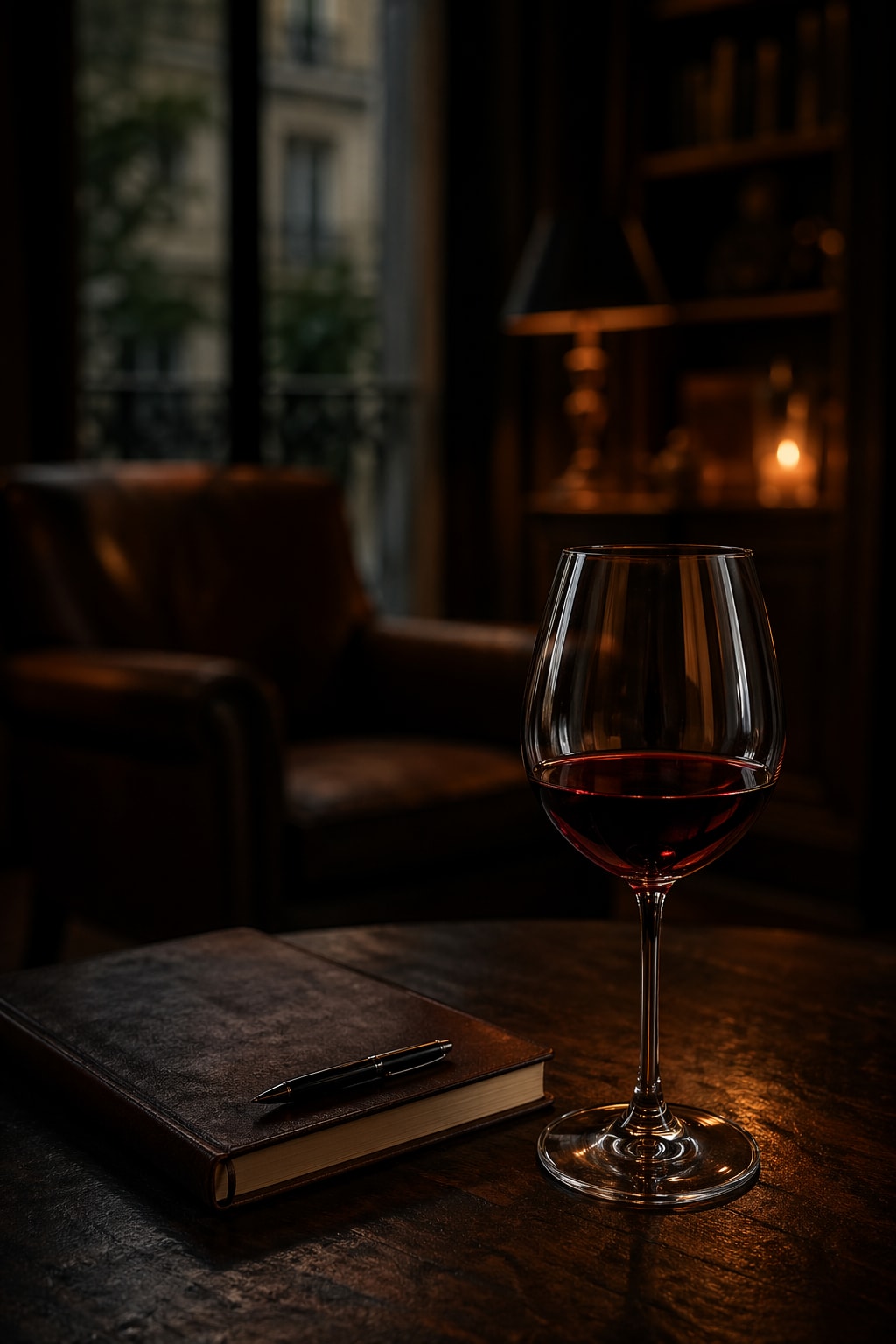
The Vintage of Lies
Iris Mercier had spent fifteen years learning to lie about wine. Not the wine itself—the wine was always honest—but about what people wanted to hear. A businessman anxious about his merger needed reassurance wrapped in complex tannins and leather notes. A woman on her first date needed a story about romance, something that spoke of possibility and risk in equal measure. Iris had become expert at reading the room and serving not truth, but comfort.
Until the evening she tasted the sommelier's secret directly from his skin.
It happened during the monthly wine-tasting at Ciel, the restaurant where she had worked for a decade. A new staff member—Marcus, recently hired from a prestigious house in Bordeaux—was presenting a 2015 Château Margaux to a table of investment bankers. Iris was refilling water glasses, moving quietly through the dining room as she always did, present and invisible.
Marcus's hand brushed hers as she set down a pitcher.
The taste hit her tongue like a slap: salt, copper, iron. Underneath that, something darker—the acrid flavor of burnt plastic and gasoline. And beneath that, a sweetness so corrupted it turned the entire taste profile nauseating.
Iris pulled her hand away.
For several seconds, she stood frozen, pitcher suspended, unable to process what had happened. She had never tasted anything in her mouth during that contact. The taste existed nowhere in her body's sensory apparatus, and yet it had been more real, more vivid, than any of the wines she had spent her career learning to articulate.
She excused herself and went to the walk-in cooler, leaning against the cool metal racks, trying to steady her breathing.
By the end of the service, she had convinced herself it was a neurological blip. Some small misfire in her brain, perhaps triggered by low blood sugar or stress. Sommelier burnout manifesting in hallucinations. She would see a doctor. She would be fine.
But the taste lingered in the back of her mouth all night, long after she had rinsed and brushed and drunk chamomile tea. The taste of Marcus—salt, copper, burnt things, spoiled sweetness—remained like a stain.
The Flavor of Confession
It happened again the next evening.
Iris was greeting a regular customer—Monsieur Devereaux, a retired judge who came in every Thursday for the same table, the same wine, the same dinner. As she shook his hand in welcome, the taste unfolded across her palate like an oil slick:
Ash and regret. A specific kind of regret—the flavor of a decision not made, an opportunity that had been allowed to pass. But underneath that, something almost sweet, almost pleasant: the relief of having escaped responsibility. And woven through it all, a metallic note of shame so carefully buried that it had fossilized.
The judge had smiled at her. She had smiled back. And she had tasted the fundamental dishonesty of his peace.
That night, Iris sat in her apartment in the 11th arrondissement, surrounded by the wine collection she had spent decades assembling, and tried to construct a framework for what was happening to her. Medical explanation: some new form of synesthesia, taste triggered by tactile contact. Psychological explanation: she was having a breakdown, her mind fragmenting under the weight of too many years pretending to feel things she didn't. Spiritual explanation: something had opened in her, some sensitivity that had always been latent, and now it was active.
She pulled up her laptop and began researching.
The terms were not encouraging: "gustatory hallucinations," "olfactory phantoms," "temporal lobe seizures." But none of these seemed right. The tastes were too specific, too personal, too impossible to have come from her own mind. And they were consistent. The flavor of Marcus—that particular constellation of salt and burnt plastic and spoiled sweetness—remained exactly the same every time she encountered him in the restaurant. It didn't vary. It didn't waver. It was as reliable as a wine's tasting profile.
It was as reliable as truth.
By the following week, Iris had orchestrated a series of subtle interactions. A handshake with the restaurant's head chef (taste: copper and smoke, underneath a foundation of genuine pride—he was a good man, confident in his skill). A moment where she steadied the arm of a regular customer, a woman named Sophie who came in alone every other week (taste: bitter almonds and honey, underneath a thread of something desperately lonely—she was waiting for someone who would never arrive). A brief contact with the owner's wife at a staff meeting (taste: a confusion of flavors, all simultaneously competing—she was harboring multiple contradictory desires, wanting incompatible things with equal desperation).
By the end of the week, Iris understood.
She wasn't tasting lies. She was tasting truth.
The Burden of Knowing
The knowledge was corrosive.
Iris found herself unable to maintain the professional distance that had sustained her for fifteen years. When she recommended wines to customers, she was no longer simply reading their faces and bodies. She was tasting their interior contradictions. She could sense when a man was choosing wine to celebrate a promotion he didn't actually feel proud of—taste: ashes and plastic, performance masquerading as authenticity. She could detect when a woman was using the restaurant as a refuge from a marriage she was too afraid to examine closely—taste: spoiled honey, the sweetness of escape mixed with the acidity of guilt.
She began to understand that most people lived in a state of constant contradiction. They wanted things that directly opposed each other. They believed things they knew to be false. They were kind when they wanted to be cruel, and cruel when kindness would have cost them nothing. And underneath it all, beneath even these contradictions, lay a deeper stratum of wanting: to be known, to be loved, to be recognized as fundamentally acceptable.
Most people would never achieve that acceptance. Most people knew they wouldn't.
Iris could taste it.
One evening, a woman came in alone—dressed expensively, moving with the careful precision of someone very conscious of being observed. Iris recognized the flavor immediately: a customer she had served three months prior, when the woman had come in with a man who was not her husband. Tonight, she was alone. Iris watched as the woman ordered a wine—a Riesling, not the Bordeaux she had chosen on her previous visit. When Iris brought the glass, the woman reached for it with hands that trembled slightly.
Their fingers brushed.
The taste was overwhelming: salt and copper, yes, but also something new. A flavor of desperation so acute it was almost animal. The woman had swallowed pills, perhaps, or was considering swallowing them. Either way, she had thought about it. The thought had a flavor, and that flavor was suffused with a longing so complete that it transcended sadness and became something almost like hunger.
Iris set the glass down and did not retreat.
"Stay," the woman said suddenly, though Iris had not moved to leave. Her eyes were fixed on the wine glass. "Just for a moment. Please."
So Iris stayed, standing beside the table, neither sitting nor leaving, inhabiting a liminal space. The woman drank her Riesling in small sips, and with each sip, the flavor that had tasted so much like dying seemed to shift, to lighten, to become almost bearable.
"I don't know why I came here," the woman said finally. "I don't even like wine particularly. But I remembered this place. I remembered coming here and feeling, for an evening, as though my life was something other than what it actually was."
"It was a false feeling," Iris said quietly. It wasn't kind, but it was true.
"Yes," the woman agreed. "And that's the only kind I seem capable of sustaining."
When the woman left, several hours later, she had eaten nothing and drunk only that single glass of Riesling. But she had left a generous tip, and her flavor—when Iris cleared her table—had changed. The taste of desperation had been joined by something else: a very faint note of something almost like hope. Not hope, exactly. Postponement. The woman had decided, at least for tonight, not to swallow the pills.
It was not a victory. But it was something.
The Weight of Translation
Iris gave notice the following week.
Her employer was shocked. She had been a fixture at Ciel for a decade, and her departure left a void that would take months to fill. But Iris could not remain. The restaurant had become unbearable—every handshake, every moment of necessary contact, delivered a taste of someone's interior truth, and she was not strong enough to hold all of that weight and pretend it was just another evening in a room full of wine and candlelight.
Instead, she rented a small office in the Marais, and she began to advertise a service that no one quite knew how to categorize. Confidante, she called it. A space where people could come to speak to someone who listened without judgment, who seemed to understand the contradictions that lived within them without needing them to articulate every contradiction explicitly.
The first few months were slow. A few referrals from people who had known her at Ciel, uncertain what exactly they were seeking but trusting her instinct. A woman who wanted to discuss her marriage without actually discussing it. A man who needed to confess to small thefts he had been committing for years without any consequence beyond his own knowledge. A teenager whose parents had died and who wanted to talk to someone who wouldn't try to make him feel better about it.
Iris would sit across from them, sometimes in a formal capacity, sometimes just listening while they talked. And occasionally—when it seemed necessary, when she felt that the contact wouldn't be violating—she would reach across and take their hand, or touch their arm, or allow her fingers to brush theirs.
She would taste them.
And in tasting them, she would know whether they were ready to hear the truth about themselves, or whether they still needed to believe their comforting lies. She would know whether they wanted advice or simply acknowledgment. She would know, with a precision that no amount of traditional therapy could provide, what they needed.
It was not a gift. It was a burden. But it was a burden that seemed to matter, in ways that recommending wines had never quite managed to matter, no matter how carefully she had curated her recommendations.
One afternoon, a man came in—perhaps fifty, with silver threading through his dark hair, wearing the kind of suit that suggested wealth and the kind of exhaustion that wealth could not alleviate. He sat across from her without speaking, and after several minutes of silence, he said:
"I've done something terrible. I've been doing something terrible for so long that I can no longer distinguish between the terrible thing and myself. I don't know who I am underneath it."
"Tell me," Iris said.
He did. The story was not particularly original—infidelity, professional malfeasance, a pattern of small cruelties justified by larger ambitions—but the telling of it was. He spoke with the care of someone confessing to a priest, or a god, or a construct of his own mind that might absolve him. And when he finished, his hands were shaking.
Iris reached across the desk. She took one of his hands.
The taste was immediate: salt and ash and something almost like smoke, but underneath it, a quality of fundamental decency that the man himself had spent decades suppressing. He was not a bad person living a bad life. He was a good person who had learned to ignore his own goodness, and the contradiction had hollowed him out until only the bad remained visible.
"You know what you've done," Iris said. "And you hate yourself for it. But underneath the self-hatred, you're still there. Still capable of meaning something other than what you've become."
The man began to weep.
It took him an hour to stop. By the time he left, he had no answers, no absolution, no neat resolution. But he had been witnessed. His interior truth had been tasted and acknowledged and found to be more complex than his worst interpretation of himself.
It was not a cure. But it was a beginning.
The Aftertaste
Years passed in this way.
Iris's small practice became known, quietly, through networks of recommendation. People who needed to be truly understood found their way to her office. Some stayed for months or years. Others came once and never returned, carrying with them the strange relief of having been fully known by another person, even briefly.
Iris herself never married, never had children, never developed the kind of ordinary life that most people inhabited. Instead, she lived in relationship to other people's truths, and gradually, over the years, she developed a kind of immunity to the weight of knowing.
She could taste despair without being destroyed by it. She could sense dishonesty without hating the person who harbored it. She could understand the fundamental human contradiction—wanting to be known while being terrified of being truly seen—and hold that contradiction without needing to resolve it.
On quiet evenings, in her apartment that overlooked a small garden, Iris would sometimes pour herself a glass of wine. Not to evaluate it, not to write tasting notes, not to make sense of its particular flavor profile. But simply to taste it, to remember that some flavors came from grapes and soil and fermentation, and not from the secret interior lives of people who needed to be known.
And she would think about the sommelier's art—the art of translation, of taking something as complex and ineffable as wine and rendering it into language that other people could understand and share.
Perhaps, she would think, that was what she had always been doing. Not lying. Translating. Finding the language—the particular combination of words and silences and careful attention—that would allow other people to understand themselves.
The taste of truth, it turned out, could be translated into many languages.
And sometimes, that translation was exactly what people needed to become, if not whole, then at least less fractured. Less alone.
THE END
About the Creator
Alpha Cortex
As Alpha Cortex, I live for the rhythm of language and the magic of story. I chase tales that linger long after the last line, from raw emotion to boundless imagination. Let's get lost in stories worth remembering.
Enjoyed the story? Support the Creator.
Subscribe for free to receive all their stories in your feed.
Comments
There are no comments for this story
Be the first to respond and start the conversation.