
The King and the Caretaker
There were more beautiful things about you than evil.
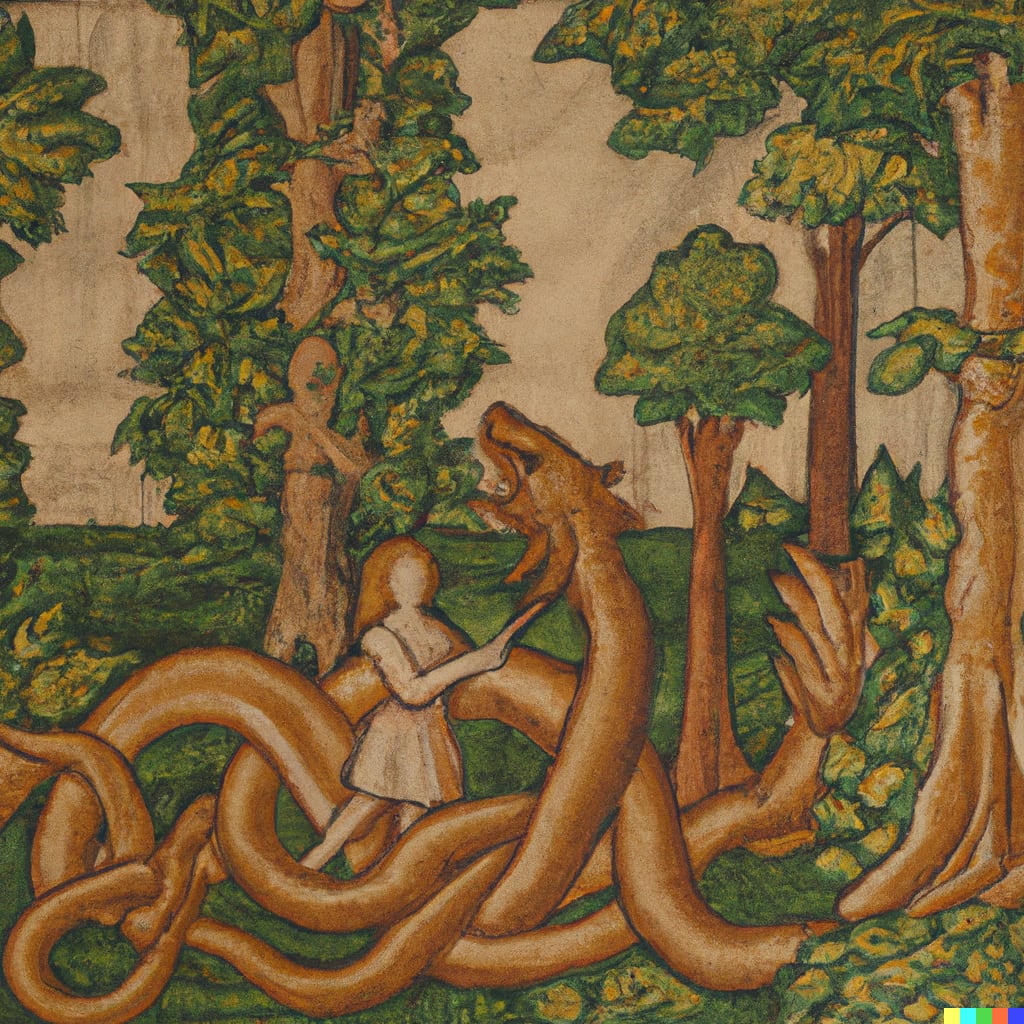
The journey into the deep Forest was more arduous than the king remembered. And yet, with each step forward, he felt familiar youth returning to his bones.
His steward was beginning to think they’d both grow old and die surrounded by rotting logs and spiders.
“We’ll arrive within the day,” the king said presently. He’d chosen uncommonly simple garb for the journey: cotton breeches, a thick, goatskin overcoat, leather boots and gloves. As usual, he’d forgone sword and sheath. The jeweled rings and iron pendant of his house were left where they always were, collecting dust in some broom closet near his quarters. A peculiar brace of woven branches, leaves and violet blooms on his arm was the only hint of his royal status, and even then, it was a ghost of a hint. No one within the castle or without knew for certain what the king had done with the old diadem. He intended to keep it that way.
His steward, in contrast, wore a nearly complete set of light armor and a falchion strapped to his hip that repeatedly snagged on the passing undergrowth. The boy had grown frustrated with the forest, and more frustrated with the secrecy that enshrouded their mission.
“I hope so,” he said, swatting back a low-hanging branch. “Much longer, and I think the forest’ll have me for breakfast.”
The king laughed deeply. He moved through the woods as if he knew every leaf and stem.
“To be consumed by the forest is an honor,” he said.
A twig snapped in the overgrowth to the east. King and steward froze, turning to the noise.
Cast in mottled shadow, an unmistakable crown of bone rose slowly from the brush. A mighty stag, perhaps seven or eight-point. It stared at them with inkblot eyes, chewing.
The king looked to the boy, whose eyes widened with lust. The boy’s hand slipped toward his sword.
“Percival,” the king said quietly. The boy crept forward, ignoring him. His blade inched from its hilt, and as it did, a dim scrape of metal-on-metal sounded.
The stag bolted away.
“Damn it!” the boy exclaimed. “Did you see the size of ‘im? The boys back home would never believe it. I could’ve bagged him just then, I know it.”
The king sighed. “It would have been wasteful, Percival. The Forest provides us with what we need: skins and wools for our backs, fuels for our hearths, food for our bellies. What more we take, we steal.”
His steward made a huffing sound. “How can it be stealing if it don’t belong to no one in the first place?”
“It belongs to all of us,” the old king said. He put a hand on the boy’s shoulder. “Come. When we arrive, you will see more clearly.”
But the king had his doubts.
“Don’t think I’ll see much of anything in this murk,” the boy grumbled. He tossed his pack on his shoulder, and the object inside clattered against his armor.
“Hey,” he said plainly, “You want to explain why I’m still carrying this thing with me? It feels just as useless now as when I fetched it from the kitchens.”
The king smiled and said nothing. They continued on for some time.
----------------------------------------------------------------------------------------
Several leagues later, the king reached out an arm to stop the boy. He reached down and placed his palm on a gnarled oak root that reared up from the ground. He closed his eyes.
“Yes, it’s just ahead,” the king whispered. His steward raised an incredulous eyebrow. He’d heard the stories and had an idea he would soon be able to separate fact from legend.
Sure enough, the canopy opened less than a quarter league ahead of them into the maw of a narrow pass between the cliffs that guarded the forest’s heart. The king’s pace quickened as they navigated between high walls of craggy stone.
“Can you hear it, Percival?” he asked.
The boy listened. He heard a canyon wind and distant birdsong.
“Nothing unusual, my lord.”
The king smiled. “You’ll pick it up. Eavar knows, it took me time.”
His steward shook his head softly.
In short order, they reached the end of the pass, where the old king scrambled up a small slide of boulders as if he were more mountain goat than man. When the boy at last threw his sack over the top and clambered over, he joined his king in staring with slack-jawed amazement.
“Gods,” the boy squeaked. “Is that—”
The king cut him off with a full-throated hum that resonated like a song off the mountain peaks. The noise shook the leaves of a magnificent tree planted like a watchtower at the center of the clearing.
It was surely the largest living thing the boy had ever seen, what with its trunk that spanned wider than a river and canopy that stretched higher than the castle’s tallest spire. But just as breathtaking as its immensity was its appearance. Dozens of thick branches snaked into the sky, and each bore leaves of a vibrant, uniform color. Aqua, orange, violet, rust, shades the steward hadn’t even imagined — all arranged in the patches of a living quilt.
“I thought it was a myth,” the steward said.
“The most important myths are real,” the king said. “Come, Percival. We have a long climb ahead of us.”
The boy’s awe fizzled out. “Beggin’ leave, my lord, did you say ‘climb’?”
----------------------------------------------------------------------------------------
At first, all the steward could focus on was his grip and footholds. But as the climb progressed and he realized how easily they came to him — as if the tree itself was gripping him — he turned his attention to the tree as a whole. There were oddities in its bark, he noticed. Things decidedly un-tree-like. The trunk appeared to have been woven or braided together in strands as thick as entire oaks, and if he looked closely, he could discern patterns in the bark; swirls and shapes too distinct for nature, yet too natural to have been carved or cut.
He had half a mind to ask the king, who evidently knew much more about this place and their purpose there than he did, but he could spare no breath, as he was falling behind the sprightly old man as it was.
The immense tree flattened at its top, revealing a broad landing beneath its rainbow canopy. It was devoid of any distinguishing features, barring something that lay at its center in a coiled heap.
The king had hardly broken a sweat. He clapped a hand to his servant’s shoulder, eyes glittering.
“You will not hear or understand what we discuss, but know that my life is not in danger, nor will yours be. You must simply wait.”
The boy blinked. “I’m not seeing no ‘we,’ my lord, ‘sides you and me.”
But the king had already turned to approach the coiled mound at the tree’s center. The boy reckoned it was stone or dirt, or a pile of discarded leaves. He quelled his annoyance and leaned against a thick branch, watching and waiting.
When the king was not more than a half-dozen paces from it, the mound began to move. It shuddered, and glittering fragments of its body shook to the ground like snow. The boy’s eyes widened in amazement.
It was not a pile of leaves or stone — it was alive. Two slender arms emerged from under the front of its winding body, and two more from under its rear. From its back shook free two great wings, not of skin or feather, but of what appeared to be thick, tangled roots. And, finally, a great head the size of a carriage emerged. Its mouth was lined with scattered teeth shaped like cutlasses beneath twin nostrils that belched pallid smoke. To the boy’s horror, he saw only indentations where eyes should be.
“My lord!” the steward cried. His sword sung from its sheath and trembled in his hands.
The king raised a palm without turning around, dismissing his servant.
The boy grunted in frustration and held steady. He did not stow his blade.
When it had fully uncoiled itself, the dragon dipped its head toward the king. A warmth and sorrow filled the old man’s chest at the sight of her ashen color and decaying scales.
From within the dragon emanated a deep, low sound — so powerful, the steward’s armor rattled around him.
The king dipped his head and extended the arm that wore his bracelet of branches. For a tense moment, neither man nor dragon moved. Then, as if passing an unknown judgement, the dragon dipped its head in return.
A tear glittered in the king’s eye. He traced his hand along the dragon’s snout, across its jowls and onto its neck, where nearly all its scales had fallen away, revealing clods of earth-like skin.
“Stand by, Percival,” the king said. “I am not sure for how long we will converse.”
“Sir,” the boy said hesitantly. Slowly, he slipped the falchion into its sheath.
When the king reached the dragon’s back, it lowered one of its root-wings to meet him. To his steward’s amazement, the lord’s branching bracelet came alive, snaking outward and melding with the dragon’s roots.
And all was quiet for a great deal of time.
----------------------------------------------------------------------------------------
“The southlands are green again. The field mice sing their joy to me, and the grasses dance. Even the aspen rootlings believe they will soon rise to greet the sky again. You have done well.”
The king’s tears slipped from his eyes, unbidden. After more than thirty years, he’d nearly forgotten the feeling of her voice. It coursed in a chemical trail from her great wings, through his branching bracelet and into his veins. Later, he would tell his people it felt like a sea breeze and smelled like afternoon rain. Not many would understand.
“Oh, how I have missed you, now-mother,” the king replied. He could not keep notes of his sadness from slipping into his response. “You are unwell. Is your flame-water nearly spent?”
She hummed again, lowering her head to the tree. “It is. I am relieved you heard my summons.”
The king smiled. “The roses in the castle garden were most excited to deliver the message.”
“Do you remember the stories I told you, when you were a rootling?”
“Of course, now-mother,” he said. Her question caught him by surprise. “I remember them all.”
The Caretaker stilled her hum. “There is one I have yet to share, from before you came to me in the Forest. I intend to tell you today.”
His heartbeat stirred as the chemical message entered his blood, carrying with it his now-mother’s anxiety.
“It is a tale from before you were born — from when my flame-water was still bountiful within me.”
“Is this why you have called me home?” the king asked.
“It is half the reason. I am in death-process, my child.”
A chill swept over the king. “I feared for this day. What will happen to the forest if you pass, now-mother? You stand guard over the First Flame. Who will protect it from those who seek to take it?”
He hesitated. “Who will protect it from mankind?”
The two found that not enough time had yet passed to heal the wounds the Earth War had left on both their hearts. For the time being, though, the Caretaker ignored his question.
“In my death-process, I must sing my memories to the Forest, so that they might remind everything that lives what has come before and make clear what lies ahead. But I fear my mind is not what it once was, and my stories are thin and wilted. You must help me remember, child. Help me sing them to the Forest.”
The king swallowed. “My song is neither as loud nor pure as yours, now-mother. It cannot reach the far ends of the Forest, where it is needed most.”
She rumbled, a sound like a thunderous waterfall he knew was laughter. “Then sing for me, and I will sing to the southlands, the deep gorge, and the river basin. Now, begin with the story of our meeting. My time is running short.”
“Yes, now-mother,” the king said. He dredged up the memory and began to hum.
----------------------------------------------------------------------------------------
I remember the leaves and twigs crunching underfoot. I could feel them because my shoes had melted away in our escape. I was three, perhaps four years old. We had never gone so deep into the Forest before. Then-mother had warned of dark things that called it home. But we had no other choice because the castle was burning.
We fled in the night-that-was-day, the glow of the flames lighting our way. Then-mother was sick with smoke, and our clothes were riddled with burn holes. When she could no longer carry me, I walked beside her. In time, she could no longer walk at all.
She told me to continue on. That the Forest would save me — that she would pray to Eavar it would. And so, I wandered deeper into the trees.
Soon, my feet felt like iron ingots and my breaths came slow and shallow. I could carry on no farther and collapsed onto a bed of clovers. I remember thinking the shadows cast by the oaks were monsters, stalking me along the Forest floor.
And then you came. You arrived in the canopy, pushing the branches aside as easily as curtains, the smoke of your flame-water billowing from your nostrils. Your claws were longer than the longest knives of the castle kitchen, and your verdant scales caught thin slivers of moonlight and scattered them across the trunks and shrubs.
I had heard the whispers of a beast that prowled the Forest, burning to ash any man who happened upon it, and I was terrified.
But you looked at me with your sightless eyes, and your crown of smoke cooled, and the knot of fear in my belly unwound. There were more beautiful things about you than evil, I realized.
How true that turned out to be. I remember answering the call of exhaustion and waking up only once that night, cradled on your back in a nest of roots, swaying with your movements as you took me to the First Tree.
----------------------------------------------------------------------------------------
The king opened his eyes as if from a dream. The last notes of the Caretaker’s song dissolved through the First Tree’s leaves and into the Forest.
“So was I born again,” the king impressed through his bracelet. “And what a life it has been.”
She had slipped into a laden silence, as if pondering some great decision. The king let the moment rest.
“I have never told you how close I came to burning you alive, child.”
The king stewed on her words.
“I had fallen into a great rage, that night. I did… atrocious things. Things not befitting a caretaker,” she said mournfully.
“You’ve long since atoned for your actions,” the king said, pouring his heart into the words.
“The First Flame will be the judge of that,” she said. “It is time I told you what happened that night before you came to me.”
“As you wish,” he said. His mouth felt suddenly dry.
The Caretaker began to hum.
----------------------------------------------------------------------------------------
You know the genesis by the First Flame. It is the first tale the Caretaker tells their child. But it is a story I have told twice. Once to you, and once before:
There was a time the earth was dark and cold, hewn from rock and still as death. This was before-time. The First Flame ruled from the firmament over the earth but knew that He was alone. He remedied this by casting a burning stone upon the earth and cleansing it in rivers of fire. When the fires cooled, they released water into the air and scattered seeds that took root in the new earth. The first plants grew, and the first things crawled, and the shard of the First Flame burned within the ground, lending its warmth to the earth so that it may never know cold again.
But the First Flame knew its works would need a caretaker to maintain order and balance, so it plucked a rootling from the earth and imbued it with the warmth of the shard. He gave it wings of roots by which to communicate with the growing things, teeth to cut and trim the Forest trees, and a belly of flame-water to purge the overgrowth and seed new life in its place. His creation was the first caretaker, and he charged it with ruling between all things, and never over them.
And so, the caretakers have tended the Forest of the First Flame and watched over his shard, guarding it from all who would seek to claim its power for their own.
This, I have told you. But there is more.
When a caretaker’s flame-water diminishes to half, they are gifted a child in their image, grown of the same earth from which their parent came, so that the caretaker may pass on what it has learned.
My child…
Your people killed my child on the night I found you.
A band of hunters had been stalking us for weeks, staking out where they thought we could not find them. They did not know that the trees reported their every move to us. They sought the hiding place of the shard of the First Flame to use in war against your people’s enemies.
But my child was curious. He held a wonder for the First Flame’s creation that could not be dulled. That night, as we sung the dew from the leaves of the southland trees, he left my side to talk with one of the lords of the aspen grove.
I felt the wailing of the trees just as the hunters struck him dead.
----------------------------------------------------------------------------------------
The king was crying. The steward saw the way his body shook with sobs, his bracelet still entwined with the beast’s gnarled wings. Its head was bowed now, rings of smoke puffing from its nostrils in time with his lord’s shaking.
It’s bewitching him, the boy thought. It’s turnin’ his brains to soup.
The stories had proven true so far — that the forest’s dragon was real, that their king was somehow tied to it. He grew more certain by the moment that the dragon sought to complete its work and leave the realm without its ruler.
His fingers twitched against his sword’s wrapped hilt.
----------------------------------------------------------------------------------------
“How my people wronged you,” the king said, his sadness and regret pouring into her. “Why did you not tell me this?”
She shuddered, the motion knocking loose more clods of her exposed skin. “Oh, Gil-nan!” she wailed, calling him by name. “Because the First Flame gave me a second son, and I feared I would lose him, too.”
The Caretaker bent her neck back and roared at the sky, and all the Forest hushed to listen.
----------------------------------------------------------------------------------------
“Eavar help us!” the steward yelped. His lord did not so much as twitch at the sound, but the boy was forced to clap hands against the sides of his helm.
He wrenched his sword from its sheath once more. This beast would kill them both, he knew as surely as he knew his name.
“Forgive me,” he said.
He began to creep forward.
----------------------------------------------------------------------------------------
I found my child lying on his side, his belly split open like one of your deer and his flame-water draining into the dirt. The hunters had already shorn lengths of roots from his back. They wore them like necklaces.
I did not hesitate to break my oath of peace to the First Flame. I called the flame-water to my throat and returned the hunters to the dirt.
But it was not enough. I went to the castle that night, where I knew I would find more of your kind, and tore it asunder with fire. I slaughtered as many as I could before my reason was restored and I retreated to the Forest.
When I realized what I had wrought, I thought it over. The great creation had been ruined, and the tender of the scales had brought the imbalance. It was my fault. I resolved to return to the First Tree, give up my remaining flame-water and be done with it.
And then, your mother found me.
----------------------------------------------------------------------------------------
The rest, the king knew by heart — how his then-mother told the Caretaker she had fled the castle for the Forest because she believed her son would sooner survive whatever dangers lurked in its depths than those that massed at the castle’s walls. How she implored his now-mother to care for him, that he might learn the old ways of love for the earth, not the plunder of it for riches and war. How she told the Caretaker she loved him.
“All this time, I thought she fled a castle under siege by invaders. But she fled from you,” the king said. Hot tears blinded him. “What befell her?”
The Caretaker made a sound like a lone, distant trumpet. “I know not, child. I did not see her again. I did not return to the realms of men.”
His arm trembled, and the leaves on his bracelet shook.
“The Forest must know each memory — especially those darkest and most fortified,” she said. Guilt and angst ran through her roots.
The king knew not where to direct his emotion. Fury at the hunters who killed his now-mother’s child, fury at his now-mother for the calamity she wrought on his home and family, sorrow for all she had endured. He could not reconcile them, and in his heart, he knew he had failed just as the Caretaker had on that night of fire so many years ago.
“Do you remember why you sent me back to the castle?” he asked quietly.
She rumbled in affirmation. “At first, I cared for you out of obligation to the First Flame. I felt it was penance for the horrors I inflicted on your kind. But then you began to grow, and you showed all the same curiosity my own child had. You were not like your kin — you desired not to kill or maim or pillage the Forest and its creatures. You desired to learn. So, I taught you. And when I had taught you all I could, I realized the First Flame had not sent you as punishment, but as redemption.”
The king’s eyes flickered beneath their lids. “I did not redeem them, now-mother. Their hearts are still black. They still kill and take and rob the Forest of its riches. I failed us both.”
“Then, we are both failures today, my child.”
Silence engulfed them, and in their shared misery, dragon and king found a morsel of peace.
“When you complete the death-process, what will become of the First Flame? You have no progeny — my kind stole that from you, too. When they learn of this place, and when they learn the Flame is unguarded, they will come for it. All the world will burn.”
She snorted, releasing thin tendrils of smoke into the canopy. “No. There is one more thing I must tell you—”
Before she could continue, she froze. A sensation of icy foreboding raced through her root-wings and into the king.
“Forgive hi—” she began to say.
A silver edge flashed.
----------------------------------------------------------------------------------------
The steward had been trained in the sword by the kingsguard. It was a required vestige of the “old ways,” borne from the need to protect the king against those who refused to abandon the violence his predecessors had held as creed.
Even in teaching a necessary evil, the kingsguard held mercy as its highest value. Stewards were first to dissuade, then disarm, and finally — as a last resort — kill. The act was to be merciful, swift and as pain-free as circumstances allowed.
It was that training that guided the steward’s blade through the soft clods of dirt-like skin at the base of the dragon’s head. A clean cut through the throat.
The sound of steel through flesh rang into the Forest.
In an instant, the king pinwheeled backward as if struck by lightning, grasping at his bracelet in a blind panic. The dragon arced backward on itself and the tree beneath them shook. The steward was forced to leap away as the beast snaked over and around itself, writhing and trembling.
“Keep back, my lord!” he cried. He reached down to help the old man and saw the bracelet withering, its leaves growing dark and brittle, branches shriveling and cracking.
The king looked up, and his face was dark. “What have you done?!”
“M-my lord?” the steward stammered. His heart plummeted to his feet. He looked to the king, then to the dragon, which had slowed its writhing dance and now lay on the wooden floor, breathing heavily. “It- it was acting — I mean, the way it roared, it was angry. Just like the stories, my lord. I thought it- it was going to kill again.”
The king’s expression grew hollow as he looked down at his decomposing bracelet. As he traced it with his fingers, parts of it crumbled away.
“All these years,” he murmured. “All this time, I thought we could heal the world. But the one thing on this Earth I did not think capable of cruelty once matched the act you’ve just committed.”
He lowered his head to his hands.
The steward stood in stunned silence. Flecks of crumbling scales and skin clung to his blade. At the sight, he quickly ran it across his tunic, scrambling to clean the signs of his sin.
The great dragon’s breaths grew even slower. Above them, the luster of the prismatic leaves seemed to fade ever so slightly.
Then, through the silence, a great voice spoke a language not suited to its forked tongue:
“Boy. Come.”
The words boomed from the dragon’s muzzle and shook the thick, winding branches around them. At first, they fell on deaf ears.
Again: “Boy. Come.”
The king withdrew from his hands, slow shock spreading across his features. “I have never heard her speak,” he said wonderingly.
“Her?” the steward squeaked.
The king rose shakily to his feet. He gritted his teeth and touched the boy’s steel-plated arm.
“The Caretaker bids you come to her. Go.”
“I- I can’t.”
The old man drew in the Forest air, willing it to grant him peace. “You must.”
The boy paced forward on unsteady feet.
“Gil-nan. Come,” the Caretaker said. This time, the words were deflated, dying.
The king obeyed, following his steward. When they arrived at her side, they discovered no blood or gore. From the cut on her throat, only water spilled, clear and cool as from a mountain spring.
The voice emanating from her was no louder than a morning breeze now, but her words came faster and easier.
“Gil-nan. Perc-ival. I do not guard the First Flame.”
“What?” the king said.
“The. Jar.”
He shook his head vehemently. “Now-mother, you have always guarded the Flame. You are the reason the Forest is warm and alive! You keep the cold of before-time at bay.”
She repeated herself. “The. Jar. Death-process is at an end.”
The king looked at his steward and motioned at his sack. The boy had never seen his master look so helpless. It frightened him deeply.
He fished into the burlap bag and procured the item in question: a plain glass jar from the castle kitchens.
Suddenly, the bark beneath them trembled again, and the great dragon rolled onto its belly, sealing its slashed throat beneath itself. Its great, gray head loomed over the steward, sightless eyes still somehow peering into him.
“Listen now,” she sighed. “We are the Flame. When I am no more, you are the Flame.”
A wave of exhaustion, fueled by fear and sorrow, threatened to topple the boy.
He whispered, “I don’t understand.”
“Then listen,” the Caretaker said. Her remaining color began to drain away, the drooping vegetation on her spine wrinkling and falling away. Her root-wings began to shrivel and shed from her back, but her speech grew ever clearer.
“Listen to Gil-nan. Listen to the wind in the leaves of the aspens that stretch, ever taller, in the southlands again. Listen to the field mice who dance in the tall grasses again. Listen to the song of dew as it falls from the leaves.
“Listen to each other. Listen to the Forest. And when you understand, sing so that all the earth may listen.”
Something glistened in her eye socket. A fist-sized globe of water. Within it, something resembling and ember glimmered.
“Take,” she said.
The king nodded. As the tear pulled free from the socket, the boy caught it in the jar and sealed it. The liquid was warm in his hands.
“I give you the last of my flame-water that you may use it to make way for new life.”
As the overwhelmed boy stared at his gift, the king placed a hand once more on his mother’s snout.
“Don’t leave me,” he said thickly.
“My child,” she said, “Now, I am with you always.”
The First Tree enveloped her, its bark crawling over her, her coiled form becoming another cord in its braided body. And, as it did, a final note in her song slipped into the ether, repeating endlessly:
“My child. My child. My child.”
About the Creator
Enjoyed the story? Support the Creator.
Subscribe for free to receive all their stories in your feed.
Comments
There are no comments for this story
Be the first to respond and start the conversation.