
The Key Nobody Turns: What Happens When Two People Wait for the Other to Speak First
A quiet anatomy of two people who’ve preemptively abandoned themselves, and how a gas station becomes the site of repair.
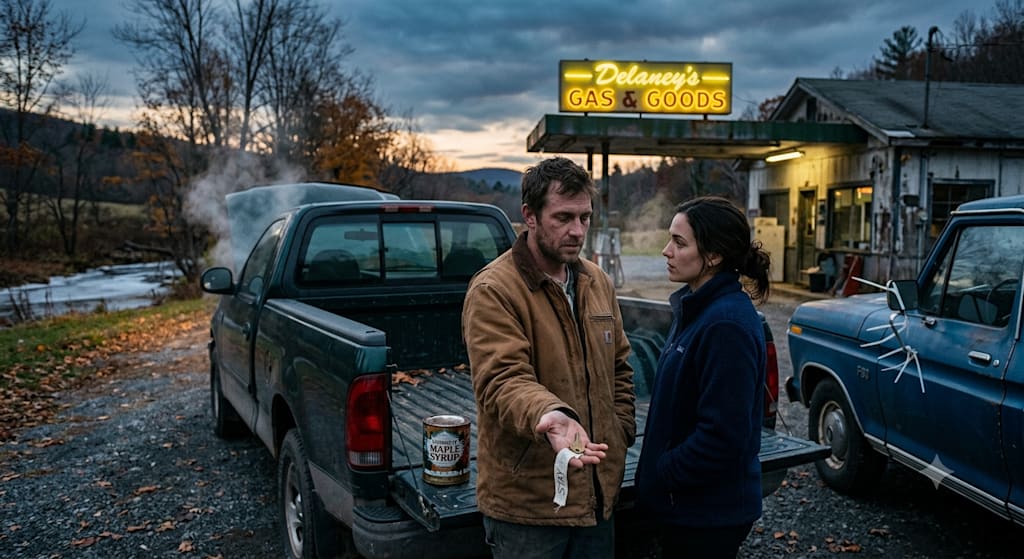
Henry Walter pulled into the Trout Creek gas station with his left front wheel wobbling for the last ten miles. He had no spare. Just a crate of sample cans of maple syrup.
A woman was crouched on the concrete by the loading dock, wrapping a bandage around a collie's paw. The dog whined. She didn't look up. "Wrench is in the metal cabinet behind the register," she said. "Get it yourself."
He didn't ask how she knew he needed a wrench. Inside, he found a set of keys hanging from the cabinet handle. One was labeled WAREHOUSE SOUTH DOOR, worn down to bare brass.
Later he learned her name was Margot Lewis. She worked as a vet's assistant in town and picked up Wednesday night shifts at the station because the owner was her uncle. When his gout flared up, she covered for three months.
That day he used her wrench to take off the bad wheel and her landline to call a tow. Four-hour wait. He carried the crate of maple syrup to the counter and said he'd leave it as collateral.
Margot glanced at the syrup. "Vermont?"
"Canada. Quebec."
"I don't want sweet. I want you to help me carry this dog to my car."
The second time, he came to return the wrench. The cabinet now held a roll of duct tape, an unopened jug of antifreeze, and a note: If it breaks down again, antifreeze half price. He didn't need the antifreeze, but he tore off a strip of tape and stuck it inside the lid of his toolbox.
That toolbox began appearing beside her car. Margot drove a blue old Ford, the side mirror held on with zip ties. Under the driver's seat there was always a half-read paperback. The titles changed: Cannery Row, The Heart Is a Lonely Hunter, The Plains of the City. Henry didn't know books, but he recognized creased covers. Every one was stopped around the two-thirds mark.
One day he asked, "Why never finish them?"
"Don't like endings," she said, and shut her door.
The first time something tightened between them was by the creek. She was feeding bread to the trout. He said the maple syrup business was dying, maybe he should switch to selling antifreeze. She laughed, loud, and the crumbs in her hand scattered all over his shoes. He looked down. She bent to brush them off. Their heads nearly knocked together.
She straightened first. He was still looking at his shoes.
The creek was loud.
The town's small cinema showed old movies, all the seat springs shot. She pointed out the crack running top to bottom on the right side of the screen. "Like lightning." He watched that crack for the entire film. When the lights came up, he saw she had been watching the crack too, not the movie.
Walking to the parking lot, she said, "They're showing it again next Wednesday."
"I'll come," he said.
She didn't answer. When she opened the car door, The Plains of the City slid off the seat and landed in a puddle. He picked it up. The last dozen pages were soaked. She put the book back on the seat without looking at it.
That Wednesday she didn't show. He sat alone in the cinema, the seat beside him empty. The crack was still there. He didn't hear a word of the dialogue. After the credits, he sat in his truck for twenty minutes, then drove back to the station. Margot's blue Ford was parked outside the warehouse, lights on.
He walked in. She was counting oil inventory. Her finger stopped on a row of numbers when she saw him. Neither of them mentioned the movie.
He picked up a quart of oil and put it back. She set down her pen, crossed to the hook, took down the key to the warehouse south door, and slid it into his jacket pocket. As her fingers pulled out, they caught a loose thread.
She stepped back. His shoulder blades touched the shelf behind him. A box of air filters wobbled but didn't fall.
Then the office phone rang. She turned to answer, her voice steady as a weather report. He stood where he was, the key against his thigh through the pocket lining, cold, then slowly warm.
He didn't come back for all of August. Not because he didn't want to. Because something in his bones told him: the moment someone seems about to leave, make yourself not need them first.
His father had been like that. The year his mother was hospitalized, his father tore out every rose in the yard. "Nobody's looking anyway," he said. The next spring he drove to the nursery and bought new bushes. It was too late.
Henry, at eleven, had torn something out once too — a bean sprout for the school science fair. He'd forgotten to water it. It died. He threw the whole pot into the trash. His teacher said he could replant. He said no need.
Margot's own wiring ran straight into his. She was afraid of anything that stayed. The unfinished books weren't an accident. When she was nineteen, she sat beside someone in a hospital until the final page. After that, she never wanted to read another ending.
When they should have been closest, he was waiting for her to say stay; she was waiting for him to say don't go. No one spoke.
At the end of September, he mailed the warehouse key back to the station. Nothing in the envelope.
He addressed it to "Gas Station, Attn: Margot Lewis." No return address.
After dropping it in the box, he sat in his truck a long time. He twisted open a sample can of maple syrup and took a swallow. So sweet it numbed his tongue. That whole crate had expired months ago.
The winter was long. He took more cross-province hauls, routing himself away from the town. The station had a regular night man now, a kid with headphones watching sports. Henry gassed up once and didn't go inside.
At a highway rest stop, he bought a copy of The Heart Is a Lonely Hunter. He stopped reading at the two-thirds mark and put it at the bottom of his duffel bag. Driving at night after that, he always felt something sinking in the bag.
Just before Christmas, the old truck finally died for good, four miles from the Trout Creek station. The temperature gauge spiked red. White smoke rolled from under the hood. He sat for a long time, then dialed the station's landline.
Someone picked up. Not the kid.
"Gas station." Her voice. Unchanged.
He said, "It's me. Broke down again. Antifreeze."
A few seconds of quiet on the line. Then Margot said, "You didn't buy it when it was half price."
"Buying it now."
"No delivery service."
"I know."
She hung up. Twenty minutes later, the blue Ford appeared at the end of the road, the mirror now held with fresh zip ties. Margot stepped out with a jug of antifreeze and a bag of cinnamon rolls from the station.
She set the rolls on the hood, handed him the antifreeze. When he took it, she didn't let go.
"You thought I mailed the key back because I wasn't coming," he said.
"You thought I didn't look for you," she said.
She released her grip. The jug landed heavy in his hands. He reached into his toolbox, peeled off the strip of tape — stuck there so long the edges had frayed — and pressed it onto the side of the jug.
She saw it. Saw it for a long time.
"That book," she said, "the one that got wet. I finished it. The last dozen pages were stuck together. I pulled them apart one by one."
"How'd it end?"
"Badly." Her eyes were red, but she didn't look away. "But I finished it."
He reached out, not touching her, just took the bag of rolls off the hood. The cinnamon smell was strong. Like the gas station. Like the cinema. Like an apple being pared on a fire escape, except there was no fire escape here, only a roadside swallowed in white steam and a man who wouldn't leave.
She turned off the Ford's engine, leaned against the door, and dug something from her pocket. She placed it in his palm.
The key to the warehouse south door, newly cut. A small strip of medical tape was wrapped around it, with a single word written in pen: Stay.
He didn't read it aloud. He just put the key into his pocket — the one that used to hold the sample cans of maple syrup, empty for months now.
He said, "I've got expired syrup in the truck. Want some?"
She said, "How bad can it be?"
They opened the tailgate. In the below-zero air, they took turns drinking from the can, faces twisting at the sweetness. Neither said sweet. Neither stopped.
Far off, under the ice, Trout Creek made a sound, like someone tapping a finger against glass.
About the Creator
Jin
Writer of reamstories
https://reamstories.com/jin
Enjoyed the story? Support the Creator.
Subscribe for free to receive all their stories in your feed. You could also become a paid subscriber, letting them know you appreciate their work.
Comments
There are no comments for this story
Be the first to respond and start the conversation.