
The House That Remembered Me
Some houses keep secrets. Others remember things that never happened.
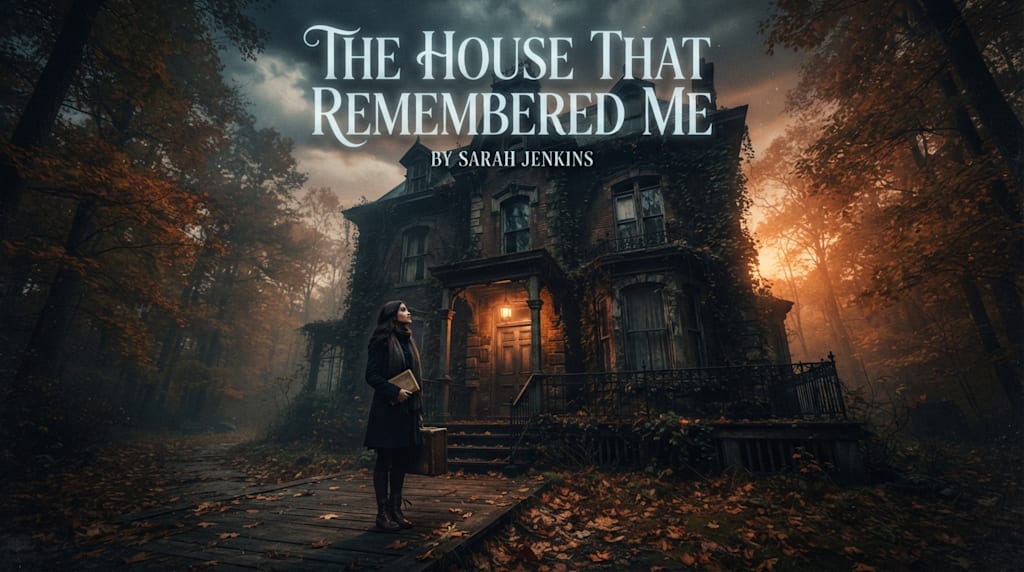
Chapter One: The Return
The house stood at the end of a narrow road, hidden behind a wall of tangled ivy and dead roses.
Clara hadn't seen it in twenty-two years.
She had promised herself she would never return.
Yet there she was, standing before its rusted iron gate on a cold October evening, holding a key she had found inside her mother's desk three days after the funeral.
The key had been wrapped in a yellowed photograph.
In the picture, Clara was seven years old, standing in front of the house beside her mother. Both were smiling.
But there was something strange about the photograph.
A third figure stood behind the upstairs window.
A little girl.
Clara had stared at the image for hours, trying to recognize the child's face. She had searched through old family albums, childhood drawings, even the few letters her mother had kept.
There was no mention of another girl.
She had been an only child.
At least, that was what her mother had always told her.
The gate creaked as Clara pushed it open.
The garden had become a wilderness. Dead leaves covered the stone path, and the branches of an enormous tree scraped against the windows like long, impatient fingers.
She approached the front door.
Before she could insert the key, the lock clicked.
The door opened by itself.
Clara froze.
From somewhere deep inside the house came the sound of a child laughing.
She knew that laugh.
It sounded exactly like her own.
Chapter Two: The First Room
The entrance hall smelled of damp wood, dust, and something sweet Clara couldn't identify.
The furniture remained where she remembered it. The grandfather clock stood against the wall. Her mother's porcelain vase sat on the small table beneath the mirror.
Even the wallpaper was unchanged, its faded blue flowers peeling at the corners.
Clara stepped inside.
The grandfather clock began ticking.
She turned toward it.
It hadn't worked since she was a child.
Its hands moved backward.
With every tick, the house seemed to grow warmer.
Clara shook her head, blaming the exhaustion of the journey, the grief, the strange things that happen when a familiar place becomes unfamiliar.
She walked toward the living room.
The door was open.
Inside, a fire burned in the fireplace.
Clara stopped breathing.
There was no electricity in the house. No one had lived there for years. Yet the flames danced beneath the mantelpiece, illuminating a small armchair.
Her mother's armchair.
And in it sat a woman wearing a blue dress.
Clara recognized the dress immediately. Her mother had worn it on the last day Clara remembered clearly from her childhood.
The woman was reading a book.
"Mom?"
The figure lowered the book.
For one terrible second, Clara saw her mother's face.
Then the woman smiled.
"You're late," she said.
Clara stumbled backward.
The chair was empty.
The fire vanished.
In its place lay a thin layer of gray ash.
Clara ran out of the room and slammed the door.
Her hands were shaking.
She needed to leave.
But when she reached the front entrance, the door wouldn't open.
She pulled the handle again and again.
Then she heard a whisper behind her.
"Don't go upstairs."
Clara turned.
At the end of the hall stood a little girl in a white nightdress.
Her hair was dark and straight.
Her feet were bare.
Her face was hidden in shadow.
"Who are you?" Clara whispered.
The girl tilted her head.
"You know who I am."
Then she disappeared.
Chapter Three: The Upstairs Window
Clara found a candle in the kitchen and climbed the staircase.
Every step groaned beneath her weight.
The upstairs corridor seemed longer than she remembered. The family photographs on the walls were covered in dust, but when Clara wiped one with her sleeve, she felt her stomach tighten.
The photograph showed her parents standing beside a birthday cake.
Clara stood between them.
Behind her, another little girl wore the same white nightdress.
Clara brought the candle closer.
The second girl had her face.
Not a resemblance.
Not a coincidence.
It was Clara's face, down to the small scar above the left eyebrow.
Clara touched her own eyebrow.
The scar was still there.
She hurried to her childhood bedroom.
The door was locked.
She tried the key from her pocket.
It turned easily.
The room was exactly as she remembered it: the small wooden bed, the faded curtains, the bookshelf, and the yellow teddy bear with one missing eye.
But something had changed.
On the wall hung a collection of drawings.
Clara had made them when she was seven.
She remembered drawing houses, trees, and people with enormous smiles.
These drawings were different.
One showed a little girl standing inside a dark room.
Another showed a woman crying beside a bed.
The last drawing depicted the house in flames.
Beneath it, written in childish handwriting, were the words:
I AM THE ONE WHO LEFT.
Clara stared at the sentence.
She had never written those words.
At least, she didn't remember writing them.
A soft sound came from the wardrobe.
Three knocks.
Then a child's voice.
"Clara?"
She backed away.
"Who is it?"
"Please open the door."
The voice sounded frightened.
It sounded exactly like Clara when she was seven.
"I've been waiting for you."
Clara reached for the wardrobe handle.
Before she could turn it, something struck the other side of the door.
Once.
Twice.
Then a third time, so hard that the entire wardrobe shook.
Clara screamed and ran from the room.
Behind her, the little girl's voice followed her into the corridor.
"You promised you wouldn't forget me!"
Chapter Four: The Room That Wasn't There
At the end of the corridor, Clara noticed a door she had never seen before.
It was narrow and painted black.
A brass number had been fixed to its center.
13.
There were only twelve rooms in the house.
Clara knew that because she had counted them as a child.
She approached the door.
A warm light shone through the keyhole.
From inside came the sound of a woman singing.
Her mother used to sing that song every night before bed.
Clara placed her hand on the handle.
The door opened.
Beyond it was a small bedroom with yellow wallpaper and a wooden crib.
A mobile of silver stars turned slowly above the crib, although the windows were closed.
Clara stepped inside.
On a table lay a photograph.
Her mother was sitting on a hospital bed, holding two newborn babies.
Two girls.
Identical.
On the back, someone had written:
Clara and Eleanor. Born October 17.
Clara felt the room tilt.
Eleanor.
The name stirred something buried deep inside her.
A memory flashed through her mind.
Two little girls running through the garden.
Two toothbrushes beside the bathroom sink.
Two voices whispering beneath the blankets.
Then another memory.
A dark staircase.
A broken glass.
Her mother shouting.
And a little girl crying in the night.
Clara dropped the photograph.
"No," she whispered.
The mobile stopped turning.
Behind her, the door closed.
A voice spoke from the corner.
"You remember now."
The little girl stood beside the crib.
This time, Clara could see her face clearly.
It was her own.
The girl smiled sadly.
"My name is Eleanor."
Clara shook her head.
"My mother said I was an only child."
"She wanted you to believe that."
"Why?"
Eleanor looked toward the crib.
"Because one of us had to live."
Chapter Five: The Forgotten Sister
The room grew colder.
Clara wanted to run, but her legs refused to move.
"What happened to you?" she asked.
Eleanor sat on the edge of the crib.
"We were seven. It was your birthday."
Clara closed her eyes.
A memory surfaced.
Candles.
A cake.
Her father laughing.
Her mother calling them downstairs.
Then the argument.
Her parents had been fighting for weeks. Clara remembered the slammed doors and whispered conversations. She remembered her mother crying in the kitchen.
That night, Clara and Eleanor had hidden in the attic.
They had found an old box filled with photographs and letters.
Eleanor wanted to show their mother.
Clara wanted to keep exploring.
They had argued.
Then Clara had pushed her sister.
Eleanor fell down the attic stairs.
There was a terrible sound.
Silence.
Clara opened her eyes.
"No."
Eleanor's expression softened.
"You didn't mean to."
"I didn't know. I thought—"
"You thought I was hiding."
Clara began to cry.
She remembered the ambulance lights.
Her mother's hands covered in blood.
The funeral she had been told was for a distant relative.
The long conversations with doctors.
And the weeks afterward, when her mother had insisted that Clara had always been an only child.
Her father had left soon after.
Her mother had never spoken of Eleanor again.
But there was something else.
Something Clara had forgotten completely.
After the accident, she had spent weeks refusing to sleep. She claimed that Eleanor was still in the house, calling to her from behind the walls.
Her mother had finally taken her to a specialist.
Clara had been told that grief could create strange memories.
Eventually, she stopped talking about her sister.
Eventually, she forgot.
Or believed she had.
"Why am I here?" Clara asked.
Eleanor looked toward the door.
"Because Mom is gone."
Clara wiped her tears.
"What does that mean?"
"She's the only one who knew what happened to me."
The candle flickered.
Eleanor stood.
"And now the house is forgetting how to keep me here."
Chapter Six: The Last Memory
The room began to change.
The yellow wallpaper darkened. The silver stars above the crib turned faster and faster.
From somewhere beneath the floor came the sound of a clock striking midnight.
Eleanor took Clara's hand.
Her fingers were cold.
"Come with me."
They walked into the corridor.
The house was no longer empty.
Figures stood behind the doors: a woman with a broken necklace, an old man holding a suitcase, a boy with mud on his shoes.
Clara recognized none of them.
Yet each figure watched her as if she had been expected.
As they descended the staircase, the walls began to whisper.
Names.
Dates.
Promises.
Apologies.
Memories belonging to strangers.
The house was full of things people had forgotten.
At the bottom of the stairs, Eleanor stopped beside the grandfather clock.
Its hands were moving forward now.
"Every person leaves something behind," she said. "A word they never said. A moment they wish they could change. This house keeps those things."
"Then why did it keep you?"
Eleanor looked at her.
"Because you asked it to."
Clara's breath caught.
Another memory emerged.
The night after the accident, Clara had sat alone in her bedroom.
She had pressed her hands against the wall and whispered into the darkness.
Please don't let Eleanor disappear.
Please keep her here.
I don't want to forget her.
The house had listened.
For years, it had preserved fragments of Eleanor: her laughter in the hallway, her shadow in the window, her voice behind the wardrobe door.
But memories were not the same as life.
And now the house was beginning to crumble under the weight of everything it had been asked to remember.
Clara looked at her sister.
"Can I take you home?"
Eleanor smiled.
"You already have."
A crack appeared in the ceiling.
Dust fell around them.
The grandfather clock stopped.
For the first time in twenty-two years, its hands pointed to midnight.
Eleanor stepped closer.
"I need you to remember what happened. All of it. Even the part that hurts."
Clara nodded, crying.
"I remember."
Eleanor touched her cheek.
"Then I can go."
The house shuddered.
Every door flew open at once.
The whispers became a roar.
Clara held her sister's hand until the fingers began to fade.
Then Eleanor was gone.
And the house fell silent.
Chapter Seven: What the House Left Behind
At dawn, the front door opened.
Clara stepped into the garden.
The sky was pale gray, and the trees stood motionless in the morning mist.
Behind her, the house looked smaller than she remembered.
The windows were dark.
The ivy had stopped moving.
Clara turned toward the upstairs window where she had seen the little girl in the photograph.
There was no one there.
For a moment, she thought she heard laughter.
Not frightened laughter.
Not the echo of a forgotten memory.
Just the sound of a little girl who was finally free.
Clara walked to the gate.
Before leaving, she took the photograph from her pocket.
Her mother stood beside the house, smiling.
Clara was on one side.
Eleanor was on the other.
For the first time, Clara could see her sister clearly.
She looked happy.
Clara slipped the photograph into her coat and closed the gate behind her.
She didn't look back.
Three months later, she moved into a small apartment overlooking the river.
She began therapy.
She learned to say Eleanor's name without feeling as though the walls were closing in around her.
She even began telling people about her sister.
Some listened.
Some didn't understand.
But Clara no longer needed the world to believe her.
She only needed to remember.
Then, one rainy evening, a package arrived at her door.
There was no return address.
Inside lay a small wooden music box.
Clara recognized it immediately.
It had belonged to Eleanor.
She opened the lid.
A familiar melody filled the room.
Beneath the music box was a folded piece of paper.
Clara unfolded it with trembling fingers.
Written in a child's handwriting were five words:
Thank you for remembering me.
Clara smiled through her tears.
Then she noticed something else.
The paper smelled of damp wood and dead roses.
And on its corner was a small, dark stain.
A stain she had seen before.
In the house.
In the room that wasn't there.
Clara slowly raised her eyes toward the bedroom door.
For a moment, she thought she saw a little girl standing in the hallway.
Then the light flickered.
And the figure disappeared.
Clara looked down at the note again.
On the back, a new sentence had appeared.
The handwriting was not Eleanor's.
It was her mother's.
There were three of you.
Clara stopped breathing.
Somewhere inside the apartment, a door creaked open.
And from the darkness came the sound of another child laughing.
The End.
About the Creator
Enjoyed the story? Support the Creator.
Subscribe for free to receive all their stories in your feed.
Comments
There are no comments for this story
Be the first to respond and start the conversation.