
The House That Forgot How to Be Warm
Outside, the temperature was falling. Inside, something much older was finally freezing over.

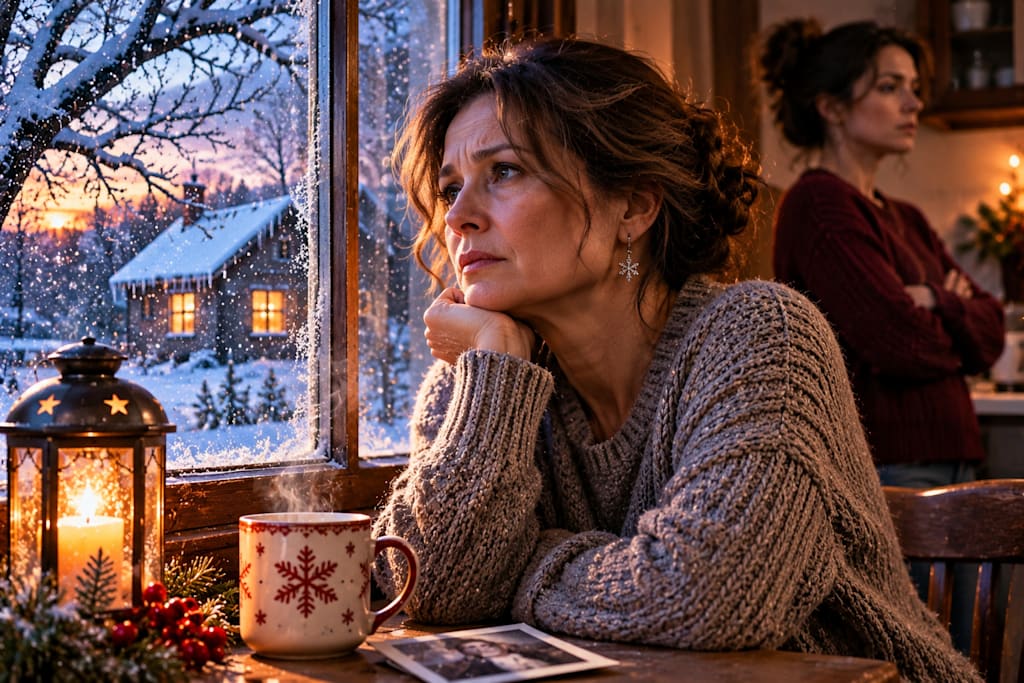
The first thing Margaret noticed was that her daughter hadn't turned on the porch light.
It was a small thing, perhaps. A forgotten switch. A dead bulb. Nothing worth mentioning.
But Margaret had driven nearly four hours through falling snow to spend Christmas with her daughter, and the dark house waiting at the end of the driveway felt strangely unwelcoming.
She sat in the car for another moment, watching the snow collect on the windshield.
The house looked exactly as it always had. White wooden shutters, a narrow front porch, two large windows overlooking the street. A wreath hung on the front door, although it was slightly crooked.
There were no decorations in the windows.
Margaret took her suitcase from the trunk and walked toward the entrance.
Her daughter, Claire, opened the door before she could knock.
"You're late."
"Hello to you too, sweetheart."
Claire stepped aside.
The hallway was cold.
Not unpleasantly cold, but cold enough for Margaret to notice that the heating wasn't working particularly well.
"Is something wrong with the furnace?"
"No."
"Are you sure? It's freezing in here."
"It's winter, Mom."
Margaret smiled politely and removed her coat.
She had expected a hug. Instead, Claire walked toward the kitchen.
"Coffee?"
"That would be lovely."
Margaret followed her daughter, looking around the familiar house.
Everything was neat. Almost unnaturally neat.
The family photographs had disappeared from the hallway. The little ceramic decorations Margaret had given Claire over the years were gone from the shelves. Even the old grandfather clock had been moved.
"Did you redecorate?"
"I got rid of some things."
"Oh."
Claire placed a cup on the counter.
"Your room is upstairs."
Margaret looked at her daughter.
"Is everything all right?"
"Why wouldn't it be?"
There was no answer to that.
Dinner was uncomfortable.
Margaret had brought a homemade apple pie, but Claire barely acknowledged it. She prepared roasted chicken, vegetables, and potatoes, arranging everything carefully on the table.
They ate in silence.
Margaret tried talking about the drive, the weather, the neighbors, and a television program she had recently watched.
Claire answered with brief sentences.
Eventually, Margaret put down her fork.
"Have I done something?"
Claire looked up.
"Here we go."
"What does that mean?"
"It means you've been asking that question for twenty years."
Margaret felt her stomach tighten.
"I don't understand."
"Of course you don't."
Outside, the wind pushed against the windows.
Margaret folded her napkin.
"I came here because I wanted to spend Christmas with you."
"And I invited you because I thought we could manage one holiday without pretending."
"Without pretending what?"
Claire stared at her mother for a long moment.
"That you were a good mother."
The words landed between them like a dropped glass.
Margaret said nothing.
Claire continued eating.
Later that evening, Margaret stood in the upstairs bedroom, looking through the window.
Snow covered the garden. The old oak tree stood motionless, its branches heavy with white.
She remembered Claire as a little girl, running through that garden in a red winter coat, shouting that she had built the biggest snowman in the neighborhood.
She remembered the Christmas mornings, the birthday cakes, the school performances.
She remembered everything.
Or at least, she thought she did.
A knock came at the door.
Claire entered carrying a small cardboard box.
"I found these in the closet."
Margaret recognized it immediately.
It was an old shoebox filled with photographs and letters.
"Why did you keep these?" Claire asked.
"Because they're memories."
Claire placed the box on the bed.
"Maybe you should look through them."
Margaret opened it.
On top was a photograph of Claire at about twelve years old. She was standing beside her father, wearing a blue sweater and holding a birthday cake.
Margaret remembered that day.
It had been the last birthday before the divorce.
Below the photograph was a folded piece of paper.
Margaret opened it.
It was a letter, written in a child's handwriting.
Dear Mom,
I wish you would stop fighting with Dad. I don't like when you shout. I wish we could have one normal dinner again. I promise I'll be good if you stop being angry.
Margaret felt her throat tighten.
She read it twice.
Then a third time.
"I don't remember this."
Claire gave a small, humorless laugh.
"That's the problem."
For a long time, neither woman spoke.
Margaret sat on the edge of the bed, holding the letter.
"I was going through a difficult time," she finally said.
"I know."
"Your father and I weren't happy."
"I know that too."
"I never wanted you to suffer."
Claire looked toward the window.
"But I did."
The sentence was quiet. It didn't need to be louder.
Margaret wanted to defend herself. She wanted to explain the arguments, the exhaustion, the financial problems, and the years when she had felt completely alone.
She wanted to remind Claire that she had worked hard, that she had sacrificed things, that she had tried.
But she suddenly understood that none of those explanations would change the letter in her hands.
"Why didn't you tell me?"
Claire turned around.
"I did. You just never listened."
Margaret lowered her eyes.
Outside, snow continued falling.
The following morning, the temperature had dropped further.
Margaret came downstairs and found Claire standing by the kitchen window.
"I made coffee," Claire said.
There were two cups on the counter.
For a moment, Margaret felt hopeful.
Perhaps the previous evening had been a necessary conversation. Perhaps the truth had finally been spoken, and something could begin to heal.
She sat down.
"Claire, I want you to know that I'm sorry."
Claire remained standing.
"Are you sorry because you understand what happened, or because I finally said it out loud?"
Margaret looked at her daughter.
"I don't know."
It was the first completely honest answer she had given in years.
Claire sat opposite her.
"I don't hate you, Mom."
Margaret reached for her hand, but Claire moved her fingers away.
"That's good," Margaret whispered.
"But I don't feel close to you anymore."
The words were gentle. That made them worse.
Margaret stared into her coffee.
She had spent years believing that time would repair everything. That children eventually forgot painful moments. That Christmas visits, birthday cards, and occasional telephone calls could somehow fill the spaces left by old mistakes.
She had mistaken politeness for forgiveness.
And now she was discovering that the two were very different things.
By afternoon, Margaret was preparing to leave.
The snow had stopped, but the roads were still covered.
Claire helped carry her suitcase to the car.
They stood beside the open trunk, neither knowing what to say.
"Will you come again next Christmas?" Claire asked.
Margaret looked at her daughter.
"If you want me to."
Claire nodded.
"I don't know yet."
Margaret placed her hand on the car door.
"I love you."
"I know."
There was no embrace.
No dramatic reconciliation.
Just two people standing in the cold, surrounded by snow.
Margaret drove away slowly, watching the house disappear in her rearview mirror.
At the first traffic light, she stopped and looked at the letter again.
She had placed it in her handbag.
The little girl's handwriting seemed almost impossibly small.
I promise I'll be good if you stop being angry.
Margaret closed her eyes.
Outside, the winter sky was pale and empty.
For years, she had blamed the weather for making Christmas feel cold. She had blamed the divorce, the passing years, the distance between houses, and the distance between generations.
Now she understood something she had never wanted to consider.
Winter hadn't made her daughter's heart cold.
It had merely made the distance easier to see.
And some things, once frozen, cannot be brought back to life simply by turning up the heat.
About the Creator
Algieba
Curious observer of the world, exploring the latest ideas, trends, and stories that shape our lives. A thoughtful writer who seeks to make sense of complex topics and share insights that inform, inspire, and engage readers.
Enjoyed the story? Support the Creator.
Subscribe for free to receive all their stories in your feed. You could also become a paid subscriber, letting them know you appreciate their work.
Comments
There are no comments for this story
Be the first to respond and start the conversation.