
the hours and her grief
the cadaver


The fluorescents fizzed and popped, the only sounds in the empty classroom before the bell rang. The atmosphere, pungent with the lingering scent of formaldehyde, stung the nostrils of the students when they began to enter, their former animation in the hallway outside the room dying away in dread.
Prior to internships, dissection of human corpses is the first time where the professors can determine if the students are capable of coping with the visceral fear of cutting open a human body.
A pair of orderlies wheeling a gurney follow the students into the room with a cadaver under a threadbare sheet. Pulling the covering down to the dead man's naval, they leave chatting nonchalantly about the Yankee's game the evening before while the students stare at the naked corpse.
Yesterday they had nervously watched their professor separate the dead man's rib cage by cutting a capital T across his torso and sawing through his sternum before prying him open. Then she removed each organ individually, examining them and discussing the state of health of each.
The left ventricle of the heart was clearly shredded by the 9 mm bullet that had entered his back and exited his chest from a wound clearly visible prior to opening his chest cavity. The liver showed signs of alcohol abuse, heavily pockmarked by fatty deposits. The kidneys also showed signs of inflammation.
But today the professor uses an electric bone saw and moves it in a circular motion around the cadaver's head above his brows as she cuts through the skull while careful to leave the brain intact. Removing the top of the skull, she takes a long, curved scalpel and slides it between the meninges and the inside of the back of the man's skull, slowly severing the brain from its stem. Finally, a pair of students prop up the man's shoulders to lean his head back while she slides the brain out onto a metal pan.
But this is the breaking point for one student who passes out and hits the linoleum with a resounding thud. He's next the professor deadpans and the students laugh nervously. When she finally begins to cut into the brain by slicing through the corpus callosum to separate the right and left hemisphere's she notes the widespread damage to the white matter within and asks one the students what it indicates.
Alcohol damage? he asks.
Given the state of John Doe's liver and kidneys, that seems a logical conclusion, but it's wrong. This is a Diffuse Axonal Injury (DAI), the most common type of TBI. Given the burn scars on the cadaver's back, I suspect it was caused by an explosion. I think this may be the body of a combat veteran.
...
If they had only asked him at the police station he might have shared how he received the Purple Heart in Afghanistan, the explosion and its aftermath never far from his tormented thoughts.
But that was a month before his body was removed from cold storage to train future surgeons. They could identify the damage to his flesh and organs but not to his soul. The hours and her grief had branded it so irrevocably that he could never return to the man he was in his life from before.
How often did he awaken in the years before his death from the unique horror of nightmares fused with memory. In every dream the explosion tossed him anew off his feet and across the hard ground in a thunderous roar, the earth turning summersaults again and again, arms and legs moving as if no longer connected to his body, feeling in the moment the fearsome breaking of his bones.
When the earth stopped turning the world went eerily still, the clouds on the horizon appearing majestically bright and billowing as Judgment Day.
In the terrifying remembered moment he felt no pain at all.
And then the strangest thing, he saw the carnage behind him as if he had never fallen at all, withering smoke twisting away from the site of the blast, its tendrils rising above a darkened torso lying still on the desert floor, bits of gore and uniform strewn in a scatter-shot pattern before ending where a boot sat upright as if a leg should still be standing in it, a broken and roasted tibia poking out of its top, even the muscles formerly attached to it burned away.
A second prostrate figure lay in a shallow depression a few yards away from the booted foot as bullets tore at the ground on either side, the soldier either insensate or unbothered by the terrifying proximity of death. He was slow to realize that he was the man lying in the depression.
He had seen things that could not be unseen and done things that he could never undo. Conventual work impossible, the shrapnel still buried too close to his spine to ever safely remove. The traumatic brain injury only made everything worse, alcohol the only thing that dulled the pain.
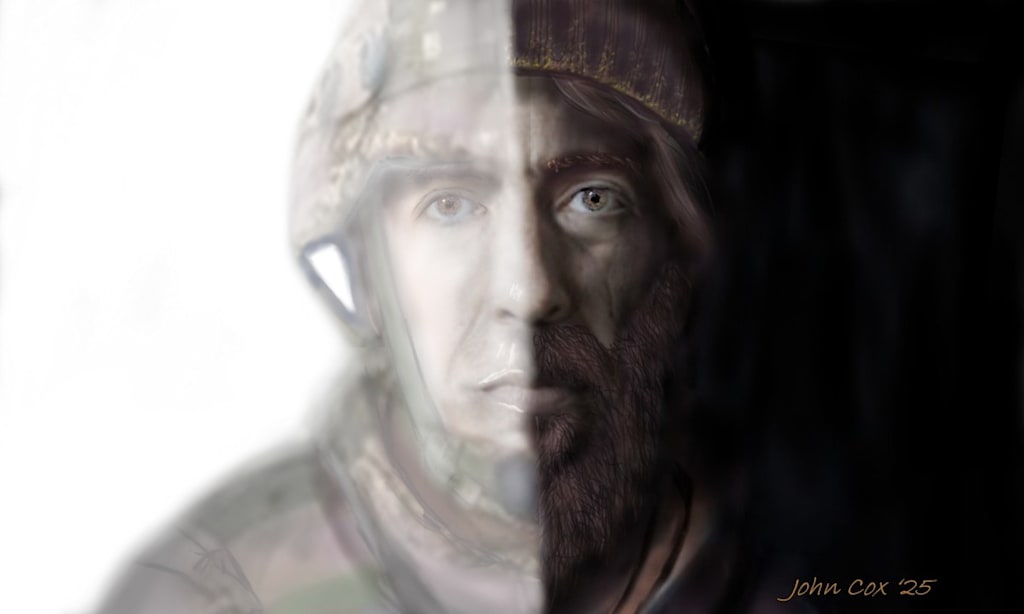
But like all of the many strangers who stared at him with disgust, the police did not ask. They had four murders to solve in the homeless encampment in Central Park and the vet was their only suspect. They noted the vacant gaze and the dark circles under his eyes magnifying the exhaustion and failure emanating from his grizzled features, but nothing more.
Looking through the two-way mirror, the lieutenant said, I think we’re wasting our time with him, sir.
I’m not ready to let him go.
We’ll need to charge him with something other than vagrancy in order to hold him. If he had a decent lawyer, he would force the issue.
It’s a good thing he doesn’t want a lawyer, then, isn’t it? The chief poked the lieutenant just below his name tag for emphasis. Get him to talk. You and I both know he can tell us what really happened there.
After the chief left the viewing room, a detective joined the lieutenant. Boss, I got the para that spoke to the suspect at the scene and the line-up is ready.
Grab the suspect then, we can reinterview the para afterwards. The detectives removed the cuffs before placing him in the middle of a five-man line-up.
After a couple of minutes, the para said, I’m sorry, but it was dark. None of them look too familiar. Maybe if I could hear his voice.
As the para sat in the lieutenant’s office, he listened to a recording of the suspect giving his name, rank, and Social Security number over and over again. But his voice was not too familiar either.
I know you’ve already provided a statement about the events of the night in question, but would you mind sharing it again?
Sure, anything to help. We arrived based on a 911 report of a shooting and found the first victim on the ground as the suspect was administering epinephrine. He was suffering from septic shock. It may have saved his life.
Any idea where he got an Epi-Pen from?
Who knows? Allergies to bee stings or something else that could trigger anaphylaxis, I suppose. He might have even carried one for years.
As the other two medics worked to stabilize the shooting victim, I checked the vitals of the other man at the site, but he was already dead. I asked the suspect what happened, and he said, ‘He shot Howie.’
I pointed at the dead man and said not Howie … him. But he just shrugged and mumbled, ‘Enemy.’ He clammed up after that.
After we loaded his buddy in the ambulance, I told him to wait for the police and he nodded.
Do you remember what he was wearing?
Like I said, it was pretty dark. It looked like he had on a black hoody. So did his buddy … come to think of it. Maybe it’s the other guy’s clothes I remember. I’m sorry, that’s not very helpful, is it?
The lieutenant shook his head, but thanked him for his time, anyway.
They held the suspect for several more hours, but in the end let him go and assigned a couple undercover police to tail him.
He spotted the tail because he expected it. If somebody’s trailing you, he mumbled as he walked, make a circle, come back onto your own tracks.
He stopped at an intersection to beg while the undercover cops watched him uneasily, both experienced enough to recognize as the minutes turned to hours that their cover was probably blown. Knowing the sun would soon drop below the horizon, they crossed the street to improve their visibility. But the sun’s low angle reflected brightly off the windshield of a passing car and briefly blinded them. When their eyes began to focus again their quarry was gone.
But someone else had watched him too, using binoculars from a hidden vantage point within the park.
The suspect moved stealthily into the trees with the stranger following at a discrete distance while using night goggles to ensure he did not lose him in the encroaching dark. The vet climbed high into a tree a mile within the park and disappeared into the heavy foliage.
He got up before dawn and slipped out of the woods while it was still dark. Behind a McDonald’s he pulled a pair of rolled up slacks out of his rucksack, a polo shirt, and a pair of black dress shoes, changing in the darkness. The clothes that he wore when the police had arrested him, he tossed in the dumpster with the empty rucksack and stashed his few remaining belongings in a collapsible bag.
Once the McDonald’s opened, he slipped in the side door and went to the men’s rest room. With a pair of battery-operated trimmers, he cut his hair and beard and gave himself a clean shave with a disposable razor using the soap from the bathroom dispenser. Then he carefully cleaned his hair and beard trimmings from the sink and tossed them in the trash.
His motive was simple. He needed to blend in with the normies if he was to check in with Howie at the hospital and leave the police unawares. The killer was still out there somewhere, and he and Howie needed to get out of town before he struck again.
It might have worked out in another life. But when another might have hunted his impulse was to heal. He had served as a medic in the war and had saved many lives.
The apostle Matthew warned that ‘the kingdom of heaven suffers violence and violent men take it by force.’ Though trained to kill, the veteran was not by nature a violent man. He had only ever killed to protect fellow soldiers, the thought that he should help the police expose the killer or hunt him down never occurred to him at all.
The stranger entered the restroom with a pistol drawn and shot the veteran in the back as he washed his hands at the sink. That’s for Davy, soldier boy, the stranger jeered as his victim lay prostrate on the floor. But when he stepped past his victim’s legs to deliver the coup de grâce to the back of his skull, with a violent twist of his torso the veteran kicked the stranger's legs out from under him, the pistol bouncing and skidding across the tiled floor.
Briefly dazed by the blow to the back of his head, by the time the stranger’s vision cleared, the veteran had climbed hand over hand on top of him and grasped his enemy’s throat in his powerful hands. And that’s how the police found them, the killer unconscious with the veteran’s dead fingers wrapped around his neck.
The next day the following story went out on the national wire due to the high profile of the suspected killer:
AP. The chief suspect for the recent spate of killings of homeless men in Central Park was arrested today, 21-year-old Hudson Lime, son of financier billionaire, William Lime III. Three men were shot to death while they slept, the fourth, Howard Martins, survived due to the life saving efforts of an anonymous bystander.
A fifth man was shot and killed yesterday inside a McDonald’s restroom with the same 9 mm pistol used in the other four shootings. The gun was in Lime’s possession when police arrested him. Since no identification was found on the fifth victim, the police did not know his name or his relation to the other murders at the time this story was filed.
Two of Hudson‘s close friends were also arrested, but since they are both minors, the police have not released their names. As reported here on April 5th, a third member of Hudson’s circle, David Winkle, was found dead at the site of Martins’ shooting and now is suspected of involvement in the prior killings.
At a brief press conference William Lime told reporters that his son had shot his attacker in self-defense and was confident that he would be acquitted if the case went to trial.
...
One of the students abruptly makes the connection between the cadaver and the news cycle. Is this the man who was shot in a McDonald's bathroom last month by that rich brat?
The professor smiles beneath her surgical mask but does not answer. As a matter of university policy, they do not discuss the origin of their cadavers. They are non-persons and the university leadership thinks it best to keep it that way.
…
Let love clasp Grief lest both be drowned
Let darkness keep her raven gloss;
Ah, sweeter to be drunk with loss,
To dance with death, to beat the ground,
...
Than that the victor Hours should scorn
The long result of love, and boast,
‘Behold the man that loved and lost,
But all he was is overworn.’
- Alfred Lord Tennyson, In Memoriam A. H. H.
About the Creator
John Cox
Where would you like to travel? Who would you like to meet? No ticket required, a surprise at every destination guaranteed. Strap on your time travel goggles and bring a compass. It's sometimes bumpy in my imagination, so hold on tight!
Enjoyed the story? Support the Creator.
Subscribe for free to receive all their stories in your feed. You could also become a paid subscriber, letting them know you appreciate their work.
Comments
There are no comments for this story
Be the first to respond and start the conversation.