

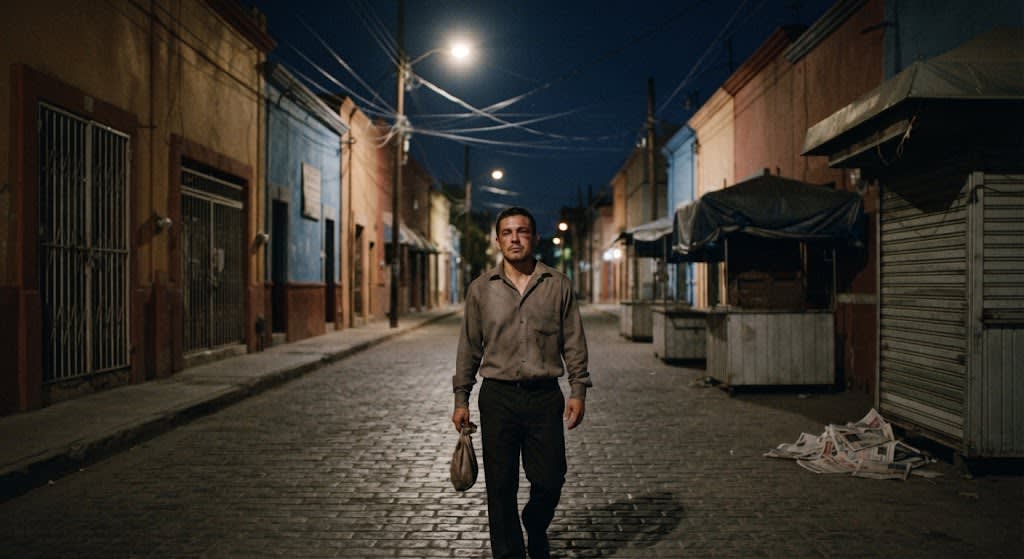
The fight was in Ciudad Juárez, in a hall that held maybe two thousand people when it was full, and that night it was full to the last row. Manolo Reyes was thirty-eight years old and this was to be his final fight. He had told no one this except Emilio, his trainer for eleven years, and he had told him only that morning, over eggs neither man finished.
"How does the leg feel," Emilio said.
"Like a leg that has taken too many kicks over too many years," Manolo said.
"Tonight you fight anyway."
"Tonight I fight anyway."
They walked to the hall together in the dark, past the venders closing their stands, past a boy selling papers who called out the fight card the way he had called it every night that week. Manolo bought no paper. He knew the card already. His name was on it, under the name of a younger man called Villalobos, twenty-four, undefeated, with a right cross people spoke of the way men once spoke of a storm that could ruin a whole season.
In the dressing room Emilio taped his fists in silence. There was a bulb overhead that swung a little on its cord whenever someone slammed a door down the corridor, and the room went bright then dim, bright then dim, keeping a rhythm neither man remarked on.
"You could stop after tonight and never fight again," Emilio said. "No shame in that. A man knows when a thing is over."
"I know it is over," Manolo said. "That is why I fight tonight. A man should choose the day himself, if he can."
The bell for the first round came, and then the second, and Manolo took more punches than he gave, moving his legs the way Emilio had taught him thirty years before, sliding away from Villalobos's long right cross the way a man slides from a train he no longer has the strength to outrun, only strength enough to dodge one more time.
Between rounds Emilio leaned close and said, "He tires in the middle rounds. He always has. Watch for it."
"I have watched for it since round one."
"Then wait for it now."
The bell rang for the fourth. Manolo went out slower than before, and the crowd, sensing an old man near his end, made a low, ugly sound crowds make when they believe they are about to see a thing finished. Villalobos came forward with his chin low and his right cocked, certain of himself the way only a young man who has never lost can be certain.
Manolo let him come. He took two shots to the body he had no cause to take, and one to his temple that made the ring go bright and small for a moment, and then Villalobos, throwing his hardest right of the night, over-reached, the way Emilio had said he would, and Manolo saw the whole thing open in front of him the way a man sees a door left unlocked by accident.
He threw once, with everything the thirty-eight years had failed to take from him, and Villalobos went down onto the boards and stayed there while the referee counted, and the count went on, and the crowd's low sound turned into something else, and at eight Villalobos moved his leg, and at nine he tried to rise, and at ten he was still on the boards and it was finished.
Manolo stood in the middle of the ring while the referee raised his fist, and he looked toward the corner where Emilio stood with a towel over his shoulder, and neither man smiled the way men in stories are said to smile at such moments. Emilio only nodded, once, the way he had nodded eleven years before when Manolo first walked into his gym as a boy of nineteen with more hope than skill.
Later, in the dressing room, with the swelling already rising along Manolo's brow, Emilio said, "You could go on. A win like that buys another year, maybe two."
"No," Manolo said. "I chose tonight to be the last one, and it was the last one, and a man ought to hold to a thing once he has chosen it, or the choosing means nothing at all."
"Some men would take the two years."
"Some men would. I am tired of taking things I no longer believe in."
They walked out together into the dark street, past the same venders now closing their stands for good, past the boy with his papers gone home, and the city moved around them the way a city moves after a thing has happened in it that most of its people never knew about and never will. Manolo felt the cool of the night against the swelling on his face and found it good.
"What will you do now," Emilio said.
"I have a piece of land outside the city. My brother has asked me for years to come work it with him."
"You never told me this."
"I never had a reason to tell you until tonight. Now the fighting is done, and there is a reason."
They reached the corner where their roads split, one toward the hotel, one toward the small house where Emilio's wife would have a meal waiting no matter the hour. Emilio put his fist briefly on Manolo's shoulder.
"Thirty-eight years old and you go out with a win," Emilio said. "Few men get to choose the day like that."
"No," Manolo said. "Few do."
He walked on alone after that, down the dark street, past the last of the closed stands, and he never looked back at the hall where the crowd had already gone home to their own beds and their own lives, believing they had seen an old man's last fight, never knowing they had seen a man close a door himself, with his own fist, before the door could close on him instead.
About the Creator
Tim Carmichael
Let your becoming be louder than your fear, and your smallest steps become the road you once thought impossible to walk. An Appalachian poet and cookbook author my book Beautiful and Brutal Things is on Amazon, Link 👇
Enjoyed the story? Support the Creator.
Subscribe for free to receive all their stories in your feed. You could also become a paid subscriber, letting them know you appreciate their work.
Comments
There are no comments for this story
Be the first to respond and start the conversation.