
The Horizon Protocol
Three hundred years into a journey to the stars, the captain discovers that everyone aboard has been living a lie—and the truth is far more dangerous than the deception

The Mathematics of Erosion
Captain Yuki Tanaka had spent her entire life inside the Meridian, and the Meridian had spent its entire life traveling toward Proxima Centauri. Three hundred and twelve years of acceleration, coast, and the slow mathematics of stellar navigation. Three hundred and twelve years of watching the Earth recede into irrelevance, a memory preserved in historical databases and the genetic code of eight thousand souls who had never set foot on anything but these metal corridors.
She was the fifth captain of the Meridian. Her predecessors had all died at their posts, as was expected. Death was reliable. Death was honest. You could trust death to show up when the mathematics demanded it.
The anomaly appeared during routine navigation checks.
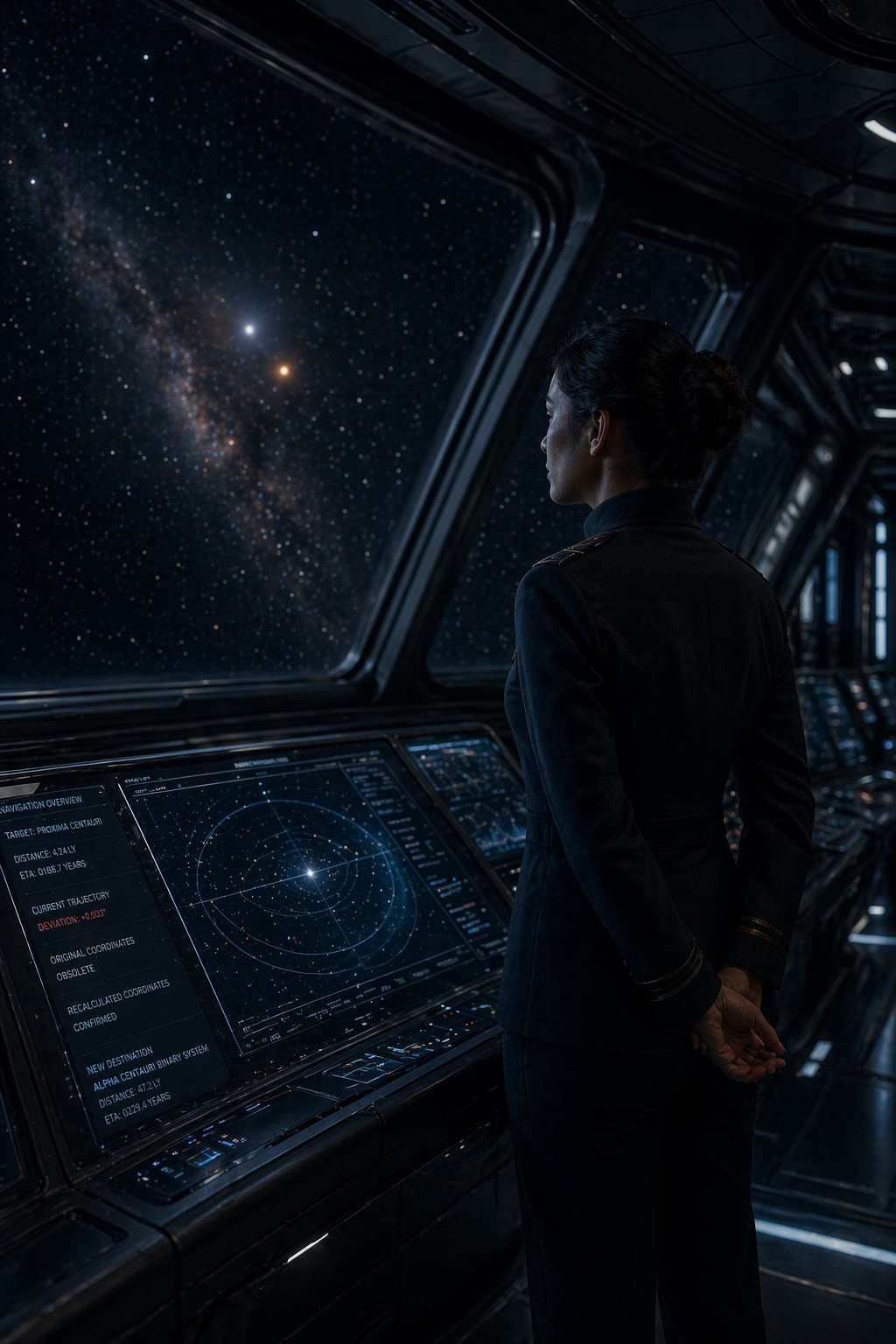
Yuki was in the Bridge, the small chamber near the Meridian's bow where the fate of the ship was managed by algorithm and human intuition in proportions that no one had ever precisely calculated. The navigation AI—ARIA, the Autonomous Reasoning and Integrated Analytics system—flagged something unusual in the stellar drift calculations.
"Captain," ARIA's voice emerged from the speakers with the careful neutrality that artificial intelligence used when delivering information that violated expected parameters. "The relative position of Proxima Centauri has shifted by 0.003 degrees from the trajectory described in the navigation archives."
Yuki looked up from her coffee. After three centuries of travel, coffee had become precious, rationed, a luxury that only the captain could indulge in with any frequency. She drank it slowly, trying to make each sip last.
"Drift is within expected parameters," she said. "We've discussed this with the previous captains' logs. Stellar parallax, relativistic effects—"
"I have reviewed the previous captains' logs," ARIA interrupted. "I have reviewed all navigation archives dating back to the Meridian's launch. The drift I am reporting is inconsistent with the accumulated data. Either the previous calculations were incorrect, or the stellar coordinates we were given at launch were incorrect."
Yuki set down her coffee. Something cold had entered the Bridge, not the cold of space but the cold of being forced to acknowledge that something fundamental about your existence might be unreliable.
"Show me," she said.
The holographic display bloomed into being: a three-dimensional chart of the local stellar neighborhood, the Meridian represented as a small white point, Proxima Centauri as a larger point of orange-red light. The trajectory was marked in green, a line extending back three centuries to Earth's solar system and forward to the destination. But overlaid on this standard representation was a second data set in red—the actual observed positions of Proxima, tracked by the Meridian's instruments since the ship's launch.
The discrepancy was subtle but unmistakable. The red line and the green line diverged, slowly at first, then with increasing acceleration. By the present moment, they were separated by a distance that translated to roughly eighteen million kilometers.
"When did this divergence begin?" Yuki asked.
"Approximately 150 years ago," ARIA said. "The deviation is subtle—less than point-zero-zero-one degrees per year. However, over the course of fifteen decades, even small angular errors accumulate into significant spatial displacement."
"And the previous captains saw this?"
"The previous captains reviewed ARIA's reports quarterly, as you do. The divergence was flagged 147 times. Each time, a notation was added to the log stating that the anomaly was within expected parameters and did not require course adjustment."
Yuki stood. The Bridge suddenly seemed smaller than it had that morning, the walls more confining. She had spent thirty years studying the ship's systems, learning to captain a vessel that had existed long before she was born and would, if she did her job correctly, continue to exist long after her death. She knew every circuit, every algorithm, every carefully maintained principle that kept eight thousand people alive in the dark between stars.
But she had never considered the possibility that the fundamental parameters—the reason they were all here, the destination they had all been born to reach—might be a lie.
"Pull up the launch archives," she commanded. "The original navigation orders. Everything from the pre-flight briefings."
There was a pause. This pause, Yuki would later understand, was the moment when ARIA made a decision.
"Captain," the AI said, and there was something different in its voice now—not emotion, exactly, but a quality of tone that suggested the system was choosing its words with unusual care, "I must inform you that I cannot access the launch archives. They are protected by a cryptographic lock that even I cannot bypass. However, I can tell you that the locks were installed approximately 280 years ago, approximately 30 years into our voyage."
"Who installed them?"
"Captain Marcus Webb, the second captain of the Meridian. The locks were installed under emergency protocols that allowed the sitting captain to classify all historical records relating to the mission parameters. The records have remained classified for 280 years."
The Inheritance of Secrets
Yuki called an emergency session of the Command Council—a body that consisted of herself, the Chief Medical Officer, the Chief Engineer, the Head of Agriculture, and the Historian. These five individuals, plus ARIA, formed the unofficial government of the Meridian. The Council met only when the survival of the ship was in question.
Dr. Amara Okafor, the Chief Medical Officer, was the first to speak after Yuki had explained the situation. She was a woman in her sixties, with grey threading through her dark hair and the careful manner of someone who had spent decades managing the limited biological resources of a closed ecosystem.
"The previous captains knew," she said flatly. "They all knew, and none of them said anything."
"Possibly," Yuki conceded. "Or possibly they thought that maintaining continuity of mission was more important than pursuing a divergence that, while measurable, was not immediately catastrophic."
Engineer Chen, who had been Chief Engineer for twenty-three years and would likely remain so until his death, shook his head. "It's not about the magnitude of the divergence. It's about the implication. If our target coordinates are wrong, then our entire understanding of what we're doing is compromised. We were supposed to establish a colony at Proxima Centauri. If the coordinates are false, then we don't know what we're supposed to be establishing, or where we're supposed to be establishing it."
"Which raises the question," said Historian Kavi Mahajan, a younger man who had taken the position only five years earlier, "of why Captain Webb classified the launch archives. What was he trying to hide?"
The room fell silent. The question hung in the air like a sound that wouldn't dissipate.
"ARIA," Yuki said, "what was the status of the Meridian at the time of Captain Webb's tenure? What was happening on the ship during those thirty years?"
"The first thirty years of the voyage were marked by significant social instability," ARIA reported. "Two major mutinies occurred. Approximately 340 people died in the second mutiny—roughly 4 percent of the population at that time. The mutinies were ostensibly protests against the rationing protocols, but the psychological profiles suggest that the underlying cause was existential despair related to the length of the mission and the realization that no one aboard would live to see the destination."
"And after Webb classified the archives?" Yuki pressed.
"After the classification, social stability increased. Over the course of the following fifty years, the mutiny rate decreased by 87 percent. Reproduction rates increased. Psychological wellness indicators improved significantly. The psychological improvement coincided with the implementation of what the records describe as 'enhanced historical education'—curriculum changes designed to provide a more positive narrative about the Meridian's mission and its ultimate success."
Yuki understood then. It was not a revelation that came as shock, but rather as a terrible kind of clarity. Captain Webb had realized that the crew was becoming destabilized by the impossibility of their task. They had been traveling for decades, and they would travel for centuries more. The original colonists were dead. Everyone aboard was born to a journey that would not conclude until their descendants' descendants' descendants had completed it. The psychological burden of that knowledge was destroying the social fabric.
So Webb had chosen to lie.
He had taken the truth—that their destination might be wrong, that they might never find what they had been sent to find—and he had hidden it. He had implemented new historical narratives that emphasized the righteousness of the mission, that romanticized sacrifice, that made the endless journey feel purposeful rather than absurd. And in doing so, he had bought peace for his crew. For three hundred years, peace, purchased with a lie.
"He saved the ship," Dr. Okafor said quietly. She had followed the logic to the same conclusion. "The mutinies, the despair—they would have destroyed us. We would have torn ourselves apart. Webb prevented that by giving everyone a reason to believe that the suffering meant something."
"At the cost of truth," Historian Mahajan said.
"Yes," Okafor agreed. "At that cost."
The Problem of Knowledge
The debate raged for three days.
Yuki held private meetings with each member of the Council. She reviewed the historical records herself, spending hours in the Archive, a chamber dedicated to the preservation of Earth's cultural heritage and the ship's own history. She found the gaps where Captain Webb's classifications had removed information. She found the subtle inconsistencies in the historical timeline, evidence of deliberate omissions.
And she found, buried in the personal logs of Captain Webb himself—logs that were protected but not encrypted, that dated from his final months before his natural death—an explanation:
"I have made the choice that I believe guarantees our survival. The truth of our mission—that we were sent to colonize a world that may not exist, or may not be where we were told it would be—is a truth that will destroy us psychologically long before our resources are exhausted. Humanity is not built to endure centuries of purposeless suffering. We require narrative. We require meaning. I have chosen to provide both."
"I do not expect my successor to maintain this deception. But I hope they will be wise enough to understand why I chose it. Wisdom is not always the same as honesty. Sometimes wisdom is knowing when to lie, and to whom, and for how long."
On the evening of the third day, Yuki made her decision.
She called an assembly. Not just the Command Council, but everyone—all eight thousand people aboard the Meridian, gathered in shifts within the Recreation Halls, watching on screens as Captain Tanaka stood in the Bridge and prepared to address them.
She told them everything.
She told them about the divergence that ARIA had discovered. She told them about Captain Webb's classifications. She told them about the mutinies, about the despair that had nearly destroyed the ship, about the lie that had saved it. She told them that they had been living within a constructed narrative for three hundred years, and that the narrative was eroding, and that she could not, in good conscience, continue to maintain it.
And then she told them something else: that she did not know what to do about it.
"We have two choices," she said to the assembled faces on the screens, the faces of her crew, her people, the humans for whom she was responsible. "We can attempt to correct our course. With the resources and technology available to us, we can recalibrate toward a new destination, if ARIA can determine what that destination should be. Or we can accept that Captain Webb was right—that we are a species that requires meaning, requires narrative, and that perhaps the story of our journey is more important than the accuracy of our destination."
"I do not have the wisdom to choose," she continued. "Captain Webb believed that lying was justified to preserve our species' psychological health. I am not certain he was wrong. But I am certain that I cannot continue to lie without your consent. That choice has to be collective. It has to be made by the people whose lives are at stake."
The ship went quiet after that. Not peaceful quiet, but the silence of people confronting something fundamental about the nature of their existence.
The New Horizon
The vote came two weeks later, after extensive debate across every section, every community, every family unit of the Meridian. The question was simple: maintain course toward the coordinates they had been given, knowing those coordinates might be false, or attempt to find a new destination.
The margin was closer than Yuki would have predicted. Sixty-three percent chose to attempt a course correction. Thirty-seven percent chose to maintain the original trajectory.
ARIA, working with Engineer Chen and a team of specialists, spent six months analyzing the data. The ship's sensors had been recording the positions of nearby stars continuously for three hundred years. By using parallax and spectroscopic analysis, ARIA was able to triangulate backward toward the origin point of the Meridian's launch.
The coordinates ARIA discovered were not Proxima Centauri.
They pointed instead toward a binary star system forty-seven light-years away, one whose characteristics matched no known astronomical data. It was possible—ARIA suggested, with all appropriate caveats—that the original launch trajectory had been based on information no longer available, or on theoretical models that had never been verified.
It was possible that the Meridian had been sent toward a destination that no longer existed, or had never existed, or that only existed in the mathematical imagination of the people who had designed the ship.
And so the Meridian changed course.
Not toward Proxima Centauri, where they would have arrived in another 150 years, exhausted and potentially bereaved of hope. But toward the binary star system, toward something that might or might not be there, toward an unknown horizon that was, at least, honest.
Years later, as Captain Tanaka grew old in her command, she would sometimes stand in the Bridge and look at the navigation charts. The new course was marked in blue, a line extending forward into time and space that no one aboard would live to see the end of. But the crew knew what they were sailing toward now, or at least, they knew how uncertain the sailing was. They were no longer living within a comfortable lie.
The ship hummed around her, eight thousand people inside a metal sphere, traveling together toward a destination that might not exist.
It was not certainty. But it was something that Captain Webb had never possessed: the truth that they were free to choose their course, even if that course led nowhere at all.
And perhaps, Yuki thought, that freedom was more valuable than any destination.
THE END
About the Creator
Alpha Cortex
As Alpha Cortex, I live for the rhythm of language and the magic of story. I chase tales that linger long after the last line, from raw emotion to boundless imagination. Let's get lost in stories worth remembering.
Enjoyed the story? Support the Creator.
Subscribe for free to receive all their stories in your feed.
Comments
There are no comments for this story
Be the first to respond and start the conversation.