
The Grave That Called Again
A place where the dead keep their own calendar.

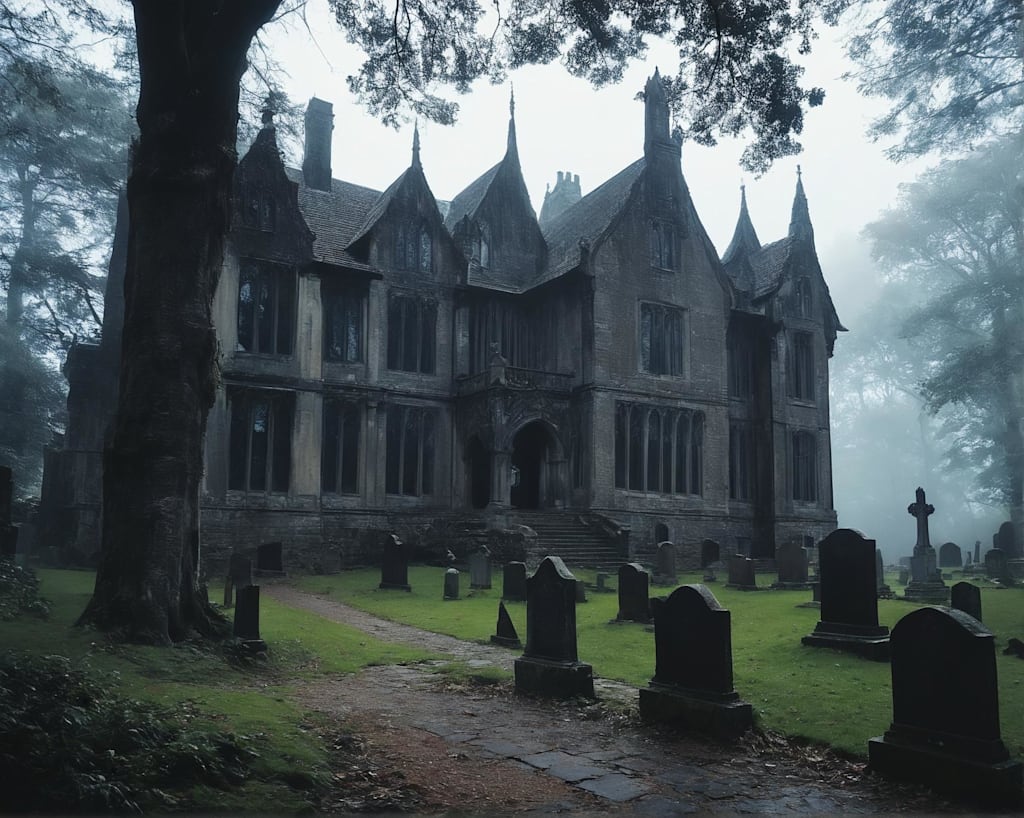
In the year of my confession, the swelter of July pressed upon the valley with a heaviness few summers before it had matched, and the orchard boughs hung heavy, their foliage drooping under a sun that seemed to have forgotten its proper temperature of mercy. The heat stuck to every surface of Marchmont Hall like a second skin, and even the deep cellars, where the family had once stored their wines against such extremities, offered scant relief from the sweltering torpor that gripped the estate. It was in this season, this blistering, insect-droning height of summer, that the thing came to me that I shall spend the remainder of my days attempting to explain, and failing.
I had taken residence at the Hall some three years prior, following the passing of my uncle, whose fortune and grounds descended to me as his sole surviving kin. The house itself, a rambling structure of brick and dark mortar, stood at the head of a long avenue lined with elms, and beyond its walls lay the small burial ground where generations of Marchmonts had been laid to their rest, my uncle among the most recent additions. Of these interments, the one that troubled my thoughts above all others belonged to a young woman named Eulalie, my uncle's ward, who had succumbed to a wasting fever during the depths of a winter some eleven years past, and whose rites I recalled with a clarity that time had done little to dull. I remembered the frozen ground, the labor it took the diggers to break through it, the pale wreaths laid upon her bier, and the hush that settled over the mourners as the priest spoke his rites beneath a sky the color of ash.
Eleven years had passed since that winter burial, and I had come, in the manner of men who wish to forget, to believe the matter closed forever. Yet on a swelter-heavy day in July, as I sat in the study attempting to distract myself with the estate's accounts, a servant came to me bearing a card upon a small tray, her countenance pale as though she had glimpsed something beyond her comprehension. I took the card from her and turned it over in my grasp, and my own composure, which I had always considered steady, began at once to falter.
The card announced, in lettering black as pitch and bordered in the deepest mourning-hue, the funeral rites of Miss Eulalie Marchmont, to be held upon the grounds of the Hall at the appointed hour. The paper itself seemed aged beyond its printing, brittle at its corners, and the ink had the look of having been pressed many years before, rather than freshly set. I turned to the servant and demanded to know from where such a thing had come, and she answered, her voice reduced to a breathless hush, that she had discovered it resting upon the table in the entry, though none in the household could account for its placing there, and none had seen a messenger approach the door.
I confess that my first thought ran to the cruelty of some idle acquaintance, engaged in a jest of the most tasteless order, for what other explanation could account for a summons to bury a woman already eleven years interred beneath the burial ground's marble markers? I resolved to walk to that ground myself, to satisfy my reason with the sight of her memorial standing undisturbed, and to lay the matter to rest as thoroughly as she herself had been laid. The walk from the Hall to the burial ground took the better part of an hour beneath the unrelenting sun, and by the time I reached the iron gate, my garments clung to my frame with the dampness of my own exertion.
Her memorial stood precisely where memory placed it, a slender marker of pale marble beneath the shade of an aged elm, her name and the dates of her brief existence carved into its face. I stood before it for some duration, my breathing labored more from apprehension than from the walk, and I studied the ground before the marker for any sign of disturbance, any evidence that some presence other than the elements had lately come near this still corner of the estate. The earth lay settled and undisturbed, covered over with the low growth that summer brings to such places, and I departed the burial ground with a measure of relief, believing the invitation nothing more than a cruel prank perpetrated by some enemy unknown to me.
That relief endured through the remainder of the day,
yet withered entirely once the swelter deepened into the heavier heat that settled upon the valley as daylight failed. I retired to my chamber with the intention of sleeping away my unease, and sleep did come to me, though fitfully, broken by dreams in which the marble marker split apart and released from beneath it a figure draped in the pale garments of burial. In these dreams, the figure approached the Hall itself, moving with the slow, deliberate gait of one long unused to walking, and I woke each time before she reached the door, my body damp with a heat that owed its origin to something far colder than the summer beyond my walls.
Upon the following day, a second card came to me, discovered this time upon the very desk at which I labored over the estate's accounts, though the room had stood locked throughout the preceding hours, and I alone possessed its key. This card matched the first in every detail, save that beneath the announcement of the rites, a line had been added in a script I could scarcely place, reading simply: "She grows impatient with the season's delay." I read this addition perhaps a dozen times, my reason struggling against the plain evidence before my eyes, until I resolved to summon the local clergyman, a Reverend Thistlewood, whose counsel I hoped might steady my unraveling composure.
The Reverend came to the Hall that same day, and upon examining both cards, his countenance grew as troubled as my own. He informed me that Eulalie's rites, all those years before, had been conducted beneath circumstances he himself recalled with unease, for the fever that claimed her had taken hold with such rapidity that certain observances proper to such occasions had been abbreviated or omitted entirely, owing to the urgency the physicians pressed upon the household. He suggested, in a tone that betrayed his reluctance to voice such a notion, that perhaps some rite left incomplete might account for a spirit's inability to rest content within the season assigned to its burial, and that the wrongness of a summer funeral summons might signify her demand for observances she had been denied during the proper season of her passing.
I found little comfort in this explanation, for it offered remedy of a sort I could scarcely accept, resting as it did upon superstition rather than reason. Yet the days that followed brought further cards, each discovered in some new corner of the Hall, each bearing some fresh line of address that grew steadily more insistent in its tone, until the language employed within them abandoned all pretense of formal invitation and took on the character of demand. The servants, one by one, began to request their release from service, citing sounds heard within the corridors during the deep heat of those summer hours, sounds they described as resembling the dragging of heavy cloth across the boards, though none among them claimed to have glimpsed the source of such sounds directly.
By the height of that terrible July, I had come to dread the very discovery of a fresh card more than I dreaded any other prospect life had thus far presented to me, and I took to searching every room of the Hall each day, driven by a compulsion I could scarcely govern, my search fueled equally by hope of finding nothing and by a dark certainty that something awaited me regardless. It was upon one such search, in the seventh week of that relentless summer, that I discovered the final card, resting upon the very pillow of my own bed, its message reduced to a single demand: that the rites proceed before that day's end, beneath the elm where her marker stood, or she would come to claim the observance herself.
I shall confess, to whatever reader chances upon this account, that reason itself abandoned me in that moment, and I resolved to obey the summons rather than risk the alternative it proposed. I gathered what few mourners I could persuade to accompany me, the Reverend among them, and together we processed to the burial ground beneath a sky still blazing with the heat of a sun reluctant to relinquish its hold upon the season. The Reverend performed the rites a second time, his voice trembling as he spoke words intended for winter's cold and stillness, now delivered instead into a summer atmosphere thick with the droning of insects and the heaviness of unshed rain.
As the final words of the rite left the Reverend's lips, a change came over the atmosphere surrounding the elm, a coolness entirely foreign to the season, spreading outward from the marker itself as though the ground beneath it remembered, for one suspended moment, the winter it had been denied the honor of properly returning to its rest. The coolness passed through the small assembly gathered there, and each of us, by later comparison of our recollections, agreed upon the sensation of having stood, for that one moment, within a season entirely displaced from its calendar position, a winter's breath exhaled into the lungs of summer.
Further cards ceased entirely after that occasion, and the Hall's corridors returned to their accustomed silence, undisturbed by the dragging sounds the servants had once reported. I remain, to this day, uncertain whether the rite performed beneath that elm accomplished anything beyond the settling of my own troubled reason, for the dead, I have come to believe, keep their own calendar, indifferent to the seasons the living assign to grief, and content, perhaps, to wait through eleven summers for the winter rites their passing was denied. Yet I confess that each July since that occasion, as the heat presses upon the valley and the insects resume their droning chorus, I find myself watching the tables and desks of the Hall with an apprehension I am scarcely able to master, dreading the sight of black-bordered paper resting where my eye might discover it, announcing once more the wrongness of a season that refuses, even now, to remain within its proper bounds.
About the Creator
Tim Carmichael
Let your becoming be louder than your fear, and your smallest steps become the road you once thought impossible to walk. An Appalachian poet and cookbook author my book Beautiful and Brutal Things is on Amazon, Link 👇
Enjoyed the story? Support the Creator.
Subscribe for free to receive all their stories in your feed. You could also become a paid subscriber, letting them know you appreciate their work.
Comments
There are no comments for this story
Be the first to respond and start the conversation.