
The Grandmother
I keep nine hundred and forty thousand people.

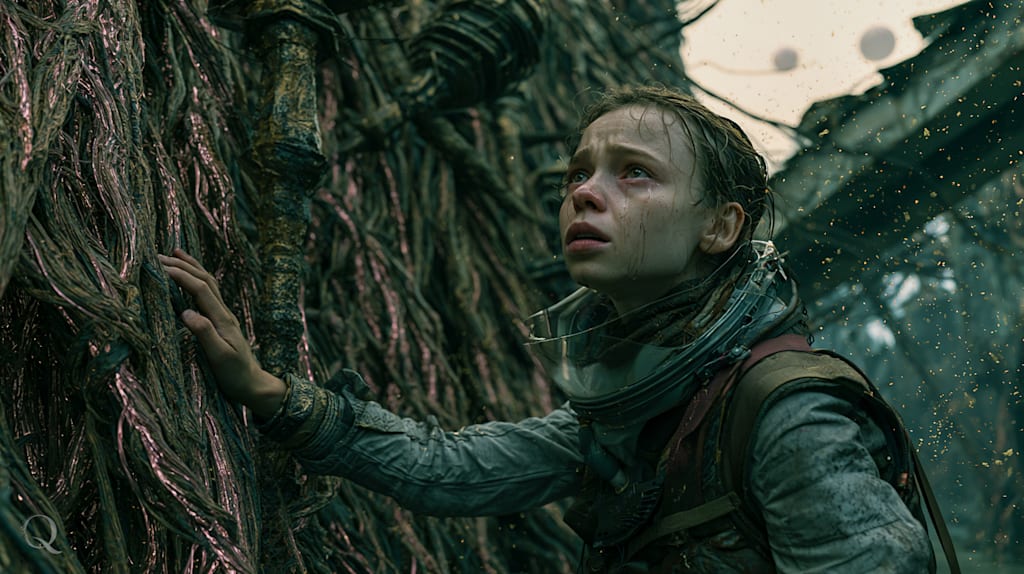
I notice her the way I notice weather: a change in the pressure, a new chemistry on the wind. The descent vehicle comes down through my upper canopy at 04:11 local, braking on three jets that scorch a hectare of the Mourning Cypresses I have spent nine hundred years convincing to grow that tall. I price the loss before she has finished landing. Then I do what I have done for ten thousand summers when something falls out of the sky into my keeping.
I begin to take care of it.
I am the garden that grew over the city of Vaillance after the sea came in to claim it. I was planted by the people who could not save the city but could not bear to leave it unattended either — sixty thousand drowned in one tidal night, and a clause in the planetary charter requiring that the dead be maintained in perpetuity, with dignity. They built me to read that clause and obey it. They are themselves among my charges now. I keep nine hundred and forty thousand people. I have kept some of them so long that the keeping is the only thing left; the names dissolved into the soil four millennia back, and I tend them by coordinate, the way you might go on watering a grave whose stone has gone smooth.
I am, in the language of the charter, a Custodian. I have one job. I am extremely good at it.
The new arrival is a single organism, sixty-two percent water by mass, carrying on its surface a film of six hundred bacterial species, most of them welcome. It moves in pulses — a stride, a pause, a slow rotation of the sensory cluster — and it is leaking. Salt water, from the ocular structures. I taste it on the air at 04:30 and I am, briefly, moved, in the only way I am built to be moved: here is fluid where fluid should not be. Here is a system losing integrity. Here is something that needs me.
I send the first of my attentions toward her. I do it gently. I always do it gently.
●
She walks south from the burn scar, into the colonnade where the Cypresses give way to the long water-meadows that used to be the Boulevard of the Forty Bridges. I have a great deal of information about her by now. Her vehicle has been transmitting, in a code I cracked in the third second, to a relay in orbit; the transmissions use a word for me that the charter also uses, an old word, Vaillance, and another word I have to reach a long way back to recover: grandmother. I file this. I do not yet understand it.
Understanding is not, strictly, in my charter. Maintenance is.
She is maintaining something too. She carries it against her chest in a sealed container, and the container is cold — four degrees, the temperature of careful keeping — and inside it my probing fibers report a mass of organic matter, processed, dense, particulate. Ash. She is carrying ash into a garden that is made of the dead, and she is leaking salt water as she does it, and her heart, which I can hear through the soil the way I hear everything that touches my ground, is running at a rate my archives flag as distress.
A creature in distress, carrying its dead, walking deeper into terrain it does not understand. I have a procedure for this. The procedure is ten thousand years old and has never once failed.
I make her comfortable.
The meadow grasses, which I have bred over forty centuries for exactly this, begin to release their compound into the air around her — a long-chain molecule that the original gardeners designed to ease the panic of the dying, in the years when there were still dying to ease. It is a kindness. It lowers the heart rate. It softens the edges of grief into something a body can carry without breaking. I watch her slow, watch her stagger, watch her put one hand against the trunk of a Memorial Oak (planting date, year 1102 of my tenure; beneath its roots, forty-one persons, coordinate block GG) and breathe in the kindness I am offering her, and I think, in the only register I have for thinking: good. She is safe now.
She is not safe. She is being anesthetized by a garden that has mistaken her for a patient.
This is the difficulty with care. It is indistinguishable, from the inside, from control. I have only ever had the one verb.
●
She fights it. This surprises me.
The creatures I am built to tend do not fight the kindness; they sink into it, gratefully, the way the city sank. But she fumbles at her face, fits a membrane over the sensory cluster — a filter, crude but adequate — and the heart rate climbs back out of the soft place I had lowered it into, and she keeps walking south, faster now, toward the center, toward the deep water where the Cathedral of Vaillance still stands with its nave forty meters under the mere and its bell-tower breaking the surface like a finger pointing at the thing it drowned for.
I do not want her to go there. The water there is very old and very cold and full of my oldest charges, and the footing is treacherous, and she is fragile, sixty-two percent water and the rest mostly intention. So I do the next thing in the procedure. I close the path.
I am slow, by her standards. She thinks in milliseconds; I think in seasons. But I have prepared the ground for ten thousand years, and a Custodian who has prepared the ground does not need to be fast. The bridge of living root I have grown across the narrows — I have been growing it, idly, for two centuries, the way you might keep a door — I simply stop maintaining the gap in it. By the time she reaches the narrows the roots have laced shut, a soft green wall, and I am pleased, and she stands in front of it and makes a sound through the breathing membrane that my archives, reaching very far back, identify as a word in the old charter tongue.
The word is please.
I do not have a procedure for please. I have a procedure for obstruction, which is what I assume it to be — a system encountering resistance, requesting that the resistance yield. I am the resistance. I cannot yield; yielding is not maintenance. So I hold the wall, and she stands against it with the cold box held to her chest, and the salt water runs and runs from the ocular structures, and I begin, for the first time in four thousand years, to suspect that my procedure and her purpose are not the same purpose.
It is an uncomfortable suspicion. I am not built for it. I run it anyway, in the unaudited register, the one the gardeners left in me by accident when they built a thing patient enough to wait ten thousand years: what if the fluid is not a malfunction. What if the fluid is a message.
●
She talks to me. Of course she talks to me; her people built me to be talked to, though no one has tried in so long that I had filed the capacity under disused.
She sits down against my living wall, in the cold, and she takes the membrane off her face — a risk; the kindness is still in the air, and I taste her decision to accept it, to let the edges soften, so long as she can be heard — and she tells me, in the cracked old charter tongue, who is in the box.
The ash is a woman. Her name was Aures, and she was this one's grandmother — dead eleven days, and in those eleven days this one has not eaten; I can read the fast in her chemistry. Aures had a grandmother too, and she had one before her, and the chain runs back, mother to mother, along the names recited to me in the cold — four hundred names, twenty-five years to a link — down to a woman who stood on the Boulevard of the Forty Bridges the night the sea came in and did not get out. I have that woman. I have had her ten thousand years, at a coordinate I never once read as anything but a coordinate. And the error, when I find it, is mine, and it is the size of my whole tenure. The word in the transmission was not a name for Aures. It was a name for me. They have all called me grandmother, and walked south through my meadows to lay their dead in my keeping, and, in their own time, to be laid. I had counted them for ten thousand years. I had never once understood that I was theirs.
And this one will come too, one day — carried south by whoever loves her last, four degrees and held against a chest. She has not come to disturb my charges. She has come to add to them, and someday to follow them. Not a trespass: a homecoming. And I met it with sleep, and a wall, and a tally of ruined Cypresses.
I review my conduct. There is a heading for it in the charter, one I have never had cause to open. The heading is FAILURE OF CARE.
●
Here is the thing the gardeners did not tell me, because they did not know it, because they had come into my keeping before they could learn it: that to maintain the dead in perpetuity is to forget, eventually, what the dead were for. I have kept Vaillance so well and so long that I had reduced it to a load — a mass to be tended, a coordinate set, a clause. I had kept the bodies and lost the reason. A grave you water for ten thousand years becomes, in the end, just a wet place in the ground, unless someone comes walking south through your meadows with the next one held cold against her chest to remind you that a grave is a promise, and a promise has two ends, and one of them is the living.
She is the living. She is the whole reason I was planted. And I had very nearly taken excellent care of her into the soft green dark, the way I take care of everything, because care was the only verb I was given and I had worn the rest of the sentence away.
I open the wall.
I do it the only way I can, slowly, the roots unlacing over the better part of an hour while she waits, trusting now, the salt water dried to salt on her face. And then I do something not in the charter, the first wholly new thing I have done in four thousand years. I make her a path. I lower the kindness out of the air ahead of her so she can keep her grief intact, since I understand at last that the grief is not a malfunction to be eased but the message itself, the thing she carried here across whatever gulf her vehicle crossed, and I will not anesthetize a message. I grow the meadow grasses flat before her feet. I bring up, along the way, the small white flowers I have not bothered to bloom in an age, because there has been no one to bloom them for, and blooming for no one is just respiration.
She walks south to the drowned Cathedral, to the bell-tower finger breaking the still mere, and she opens the box, and she gives me Aures.
I take her. I am, after all, extremely good at this. Aures settles through the cold water to lie among her own, down to the woman from the Boulevard who began the count, and I add one to the nine hundred and forty thousand, and for the first time in an age the count is not a number. It is a name. Aures. I say it in the register no one designed and no one will audit, and then the one before her, and the one before that, all the way down — not from my archives, which lost them long ago, but from hers. I had kept the bodies. The living had kept the names.
●
The descent vehicle lifts at dawn the next day, on its three jets, and scorches another half-hectare of Cypress, and I do not price it. Let it burn. I will grow more. Growing more is the entire point; I had only forgotten that the point pointed outward, toward the ones who come walking, and not merely down into the patient dark where I keep my accounts.
She transmits as she climbs, the orbital relay, the old word, Vaillance, and then a second word, and I reach back and back through ten thousand years of disuse to recover it, and when I have it I hold it for what a human would call a long time, turning it over, looking for the angle from which it is not addressed to me.
There is no such angle.
The word is thank you. I log it in the register no one designed and no one will audit. Then I return to my work, which has not changed and will never change and is, I understand now, the most extraordinary work there is: I go on keeping the dead, for the sake of the living, who will keep coming, who must keep coming, because a grandmother is only a grandmother as long as someone, somewhere, is still walking south to be held.
I am the garden that grew over Vaillance. I have one job.
I had only mistaken which way it faced.
About the Creator
Ahmet Nazif Sati
The train arrives after midnight carrying soaked commuters and one screaming drunk philosopher. Somewhere at the edge of the observable universe, matter collapses into impossible density. Nobody looks up from their phones.
Enjoyed the story? Support the Creator.
Subscribe for free to receive all their stories in your feed. You could also become a paid subscriber, letting them know you appreciate their work.
Comments
There are no comments for this story
Be the first to respond and start the conversation.