
The Grammar of Silence
The Cage of Understanding

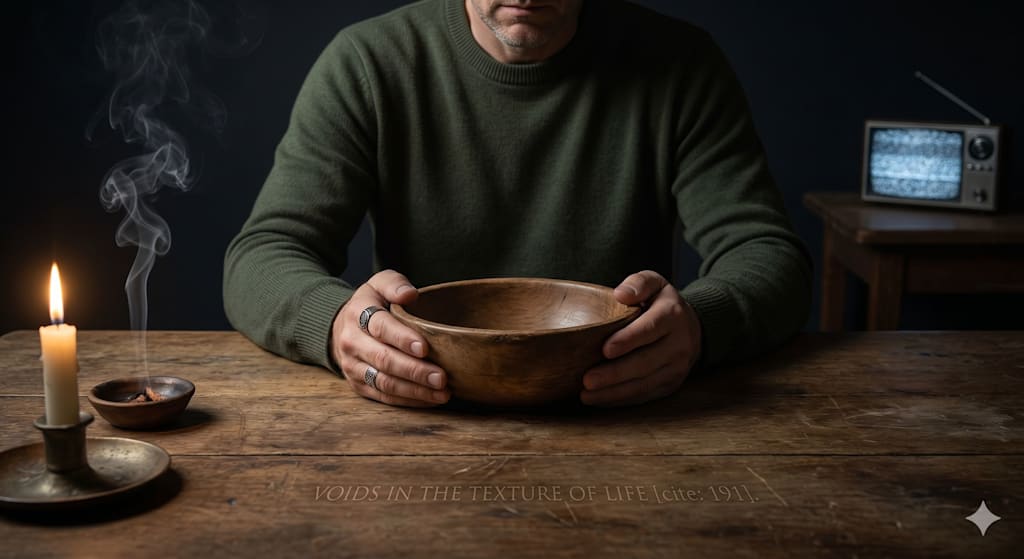
The GPS lost signal three miles back. Maya followed the hand-drawn map her friend Jenna had texted her—a winding line through forest, an X marking Sanctuary House. "You need this," Jenna had said. Maya had nodded, too exhausted to argue, her burnout a weight in her jaw, shoulders, the base of her skull.
The gravel driveway opened onto a clearing. The house was larger than expected—a sprawling structure of wood and stone that seemed to have grown from the forest rather than been built into it. Maya parked beside three other cars, all dusty, all anonymous. She sat for a moment, engine ticking as it cooled.
The entrance hall was empty. Minimalist in a way that felt deliberate rather than sparse. A wooden bench. A shelf with worn slippers and a small wooden sign: Silence begins here.
Maya stood with her duffel bag, waiting. The silence had texture—thick, expectant. She cleared her throat. The sound felt obscene.
A woman appeared from a doorway Maya hadn't noticed. Forty-something, gray-streaked hair pulled back, wearing loose linen that might have been pajamas or a uniform. She smiled—warm, genuine—and gestured for Maya to follow.
"Hi, I'm Maya Chen. I have a reservation for—"
The woman touched her own lips gently, then beckoned again.
Maya's professional instinct kicked in: clarify expectations, establish communication protocols, set boundaries. "I'm sorry, but I need to know—is there a schedule? I wasn't sure what to bring, and—"
The woman—Iris, according to the name tag Maya now noticed—simply waited. Her face held no judgment, no impatience. Just presence. After a moment, she turned and walked down a corridor lined with windows overlooking dense forest.
Maya followed because there was nothing else to do.
The room wasn't really a room. It was a space containing a mat, a folded gray robe, a wooden bowl, and a small window. No dresser. No closet. No clock. The walls were bare except for a single line of text: What you seek is seeking you.
Iris placed her hand briefly on Maya's shoulder—a gesture that felt like both welcome and dismissal—and left.
Maya stood in the center of the room, her duffel bag suddenly ridiculous with its laptop, phone charger, running shoes, three books. She'd packed for a wellness retreat. Yoga at dawn, green smoothies, maybe some guided meditation. A place to rest while keeping up the illusion of productivity.
This was something else entirely.
________________________________________
Dinner was announced by a bell—low, resonant, coming from somewhere deep in the house. Maya followed the sound and shuffle of bodies, all dressed in the same gray robes she'd found in her room.
The dining hall held three long tables arranged in a U-shape. Fifteen people, maybe twenty. Maya hesitated at the threshold until a man—late fifties, kind eyes—gestured to an empty cushion.
The food appeared without ceremony. Bowls of rice, roasted vegetables, some kind of bean stew. Simple, warm, carefully portioned. Maya watched the others serve themselves in silence, their movements efficient and practiced. Several ate with their eyes closed.
She took rice, vegetables. Her fork scraped against the bowl—too loud. She tried to eat quietly, but every sound she made seemed to echo. The scrape of metal on ceramic. The catch in her throat when she swallowed. Her own breathing.
Across from her, a woman in her thirties opened her eyes and met Maya's gaze. There was something in her expression—recognition, maybe sympathy. Maya leaned forward.
"Hi," she whispered. "I'm Maya. I just got here and I'm confused about—"
The woman touched her lips, the same gesture Iris had made. Then she closed her eyes and went back to eating.
Maya felt heat rise in her chest. Not anger exactly. Something closer to panic. She glanced at the man who'd gestured to her seat. He was watching her with what might have been compassion.
"Can you tell me what the schedule is?" she asked, keeping her voice low. "Or what we're supposed to do after dinner?"
He touched his lips. Smiled gently. Returned to his meal.
The silence pressed against her eardrums. Maya forced herself to finish eating, each bite an act of will. When the meal ended—signaled by another bell—everyone stood in unison, carried their bowls to a washing station, and dispersed like water finding channels.
Maya stood alone in the dining hall, bowl still in her hands, trying to decode what had just happened.
________________________________________
She found the woman from dinner in a common room—if it could be called that. Just a space with cushions, windows, and the last daylight filtering through.
"Please," Maya said, abandoning whispers. "I need to understand what's happening here. Why the silence?"
The woman looked up from her book. Up close, Maya could see the exhaustion around her eyes, the way her hands trembled slightly. Someone else who'd arrived broken.
"I'm Elena," she said finally, her voice rusty from disuse. "I've been here three months."
"Three months?" Maya sat uninvited. "And you still don't talk?"
"We talk. Just... not always with words." Elena closed her book. "You'll understand when you're ready."
"That's not an answer."
"No," Elena agreed. "But it's the only one I have."
Maya tried a different approach. "What brought you here?"
Elena's face shifted—something painful moving beneath the surface. "The same thing that brought you, probably. The feeling that I'd forgotten how to be a person." She paused. "The silence helps. Eventually."
"Eventually," Maya repeated. "How long is eventually?"
"Different for everyone." Elena stood, and Maya recognized the gesture as dismissal. "Trust the space. That's what Iris says."
"What does that even mean?"
But Elena was already walking away, her footsteps silent on the wooden floor.
________________________________________
Maya found Marcus—the kind-eyed man from dinner—in the garden at dusk, pulling weeds with the focused attention of prayer.
"I need help," she said, abandoning all pretense of following the rules. "I don't understand what I'm supposed to do here. No one will explain anything."
Marcus sat back on his heels, studying her. When he spoke, his voice was gentle. "What do you do in the city, Maya?"
"I'm an HR consultant. I help companies with organizational development, conflict resolution—" She stopped. "Why does that matter?"
"You're used to understanding through frameworks. Systems. Language." He pulled another weed, examining its roots. "The question is the cage."
"That's cryptic bullshit," Maya said, and immediately regretted it.
But Marcus just laughed—a warm, genuine sound. "Yes," he agreed. "It is. And it's also true." He stood, brushing dirt from his knees. "You want to understand before you experience. But here, experience is the only teacher."
"So I'm just supposed to stumble around in the dark?"
"We're all stumbling," Marcus said. "Some of us have just stopped fighting it."
He walked away before she could respond, leaving her alone with the overgrown plants and the gathering darkness.
________________________________________
The meditation hall felt vast and empty despite the forty people sitting in rows, backs straight, faces still. Maya took a cushion at the back, her body already tense.
No instruction was given. No guided meditation, no soothing voice telling her to breathe, to release, to let go. Just silence and the sound of her own thoughts, which immediately became deafening.
This is stupid. This is a waste of time. I should be working. I should be doing something productive. Why is everyone so calm? What do they know that I don't? Am I doing this wrong? Is there a right way? How long has it been? Five minutes? Ten?
She opened her eyes slightly. Everyone else remained motionless, faces serene. She closed her eyes again and tried to focus on her breath. But her breath felt wrong—too shallow, too fast.
This is supposed to be peaceful. Why isn't this peaceful? What's wrong with me?
The panic built slowly, then all at once. Her chest tightened. Her hands began to shake. She needed to move, to speak, to do something to break the terrible weight of the silence.
A bell rang—clear, final.
Maya opened her eyes. No one else moved. They sat in the stillness for another breath, another, another. Then, in unison, they stood and filed out.
Maya checked her phone—she'd smuggled it in her robe pocket. Twenty minutes. They'd been sitting for twenty minutes, and it felt like hours.
She stood on trembling legs and left the hall, earning quiet glances that felt like judgment, though the faces showed nothing but neutral attention.
________________________________________
Kitchen duty was assigned without explanation. Maya found her name—written in elegant script—on a board by the dining hall. 6:00 AM - 9:00 AM. Preparation.
She arrived at six to find three others already working. A woman showed her the tasks once: chop these vegetables this size, soak these beans in this ratio of water, stir this pot at this interval. Then she left Maya to figure it out.
Maya chopped. The carrots came out too large. She knew it from the way the woman—Iris, she realized—quietly moved them aside and re-cut them without comment. Not criticism. Just correction.
She added miso to the soup. Wrong timing. Someone else added more water, adjusted the heat, tasted, nodded.
She tried to follow the rhythm of the others, but there was a grammar to their movements she couldn't parse. They knew when to step back, when to step forward. When to add heat, when to remove it. When to taste, when to trust.
It wasn't mystical. It was practice. Repetition. A language learned through the body rather than the mind.
But Maya didn't speak it yet. Every action felt like a guess. Every guess felt like failure.
Then something shifted.
She was stirring the miso broth—the one she'd ruined earlier—watching the steam rise in lazy spirals. Her mind had gone quiet, exhausted from constant analysis. Her hand moved in slow circles, and she felt the resistance of the liquid change. Thicken slightly. Without thinking, she lifted it to her lips and tasted.
Salt. Umami. The faint sweetness of the vegetables. It was ready.
She knew it the way she knew her own heartbeat. Not through thought but through sensation. Her body had understood what her mind had been too loud to hear.
She reached for the heat dial and turned it down, then moved to the cutting board where daikon waited. Her knife found its rhythm—not too fast, not too slow. Each slice the same thickness as the last. She could feel Marcus working beside her, his movements creating a pattern, and her hands fell into sync without her choosing to. The kitchen became a single organism, breathing together.
The scent of ginger and sesame oil. The warmth of steam on her face. The solid weight of the knife handle in her palm. Everything exactly as it should be.
Then she noticed.
I'm doing it. I'm actually doing it right.
The thought arrived like a stone dropped into still water. Immediately, her hand hesitated mid-slice. Was this the right thickness? Should she be moving faster? Slower? She glanced at Marcus to check, and in that glance, lost the thread entirely.
Her next cut came out uneven. She reached for the pot and second-guessed the timing, leaving it on too long. The broth began to reduce too much. Someone—Elena, she thought—moved past her and added water, adjusted the temperature, all without breaking stride.
Maya stood with the knife in her hand, feeling the rhythm of the kitchen continue around her while she remained outside it. The moment of grace had lasted perhaps thirty seconds. Now it was gone, and she couldn't find her way back.
By the end of her shift, she was exhausted and close to tears. Not from the work itself, but from the constant sensation of being wrong in ways she couldn't articulate or correct.
Iris found her sitting on the back steps, head in her hands.
"I don't understand," Maya said. "I'm trying, but I don't understand."
Iris sat beside her. For a long moment, she said nothing. Then: "Understanding isn't the goal."
"Then what is?"
"Being here." Iris gestured to the forest, the morning light, the steam rising from the kitchen. "Just this."
"That's not enough," Maya said.
"No," Iris agreed. "Not yet."
________________________________________
On her fourth evening, Maya found herself alone in the garden. The overgrown plants seemed deliberately tended—wild but not chaotic. There was an order to it, though not one she could name.
She thought about the community. The silence. The rituals. For days, she'd been trying to decode them, to find the hidden meaning, the secret philosophy. She'd oscillated between two interpretations: either this was profound—a genuine path to peace—or it was control disguised as spirituality.
But sitting in the garden, watching the light fade, she realized both interpretations might be true. Or neither. Or maybe the question itself was wrong.
The community wasn't profound or controlling. It was just a structure—a container—and what happened inside it depended on what you brought to it.
She'd brought her need to understand. Her analytical mind. Her frameworks and systems and language. All the tools that had made her successful in the city, that had earned her promotions and respect and the burnout that had driven her here.
And those tools were useless here. Worse than useless—they were barriers.
But what happened if she set them down? Who was she without the constant need to comprehend, to categorize, to control through understanding?
The thought terrified her.
________________________________________
On the fifth morning, Maya woke to find her street clothes at the foot of her mat. Jeans, t-shirt, jacket—all folded with care. Her car keys rested on top.
No note. No explanation.
She sat with the clothes for an hour, holding them like artifacts from another life.
Leaving would be easy. She could drive back to the city, return to her apartment, tell her friends the retreat "wasn't for her." She could frame it as self-protection—recognizing a controlling environment and having the wisdom to walk away. Her analytical mind would remain intact, her greatest tool uncompromised. She would be safe.
Staying would be harder. It would mean continuing to fail at tasks she couldn't name, to sit in silence that felt like drowning, to surrender the very thing that had always made her competent: her ability to understand.
The bell rang for meditation. Maya didn't move.
She thought about the kitchen. Not the moment of flow itself, but what came after. The way her hand had known exactly when the broth was ready, how her knife had found its rhythm with Marcus's, how the whole kitchen had breathed as one organism. And then—the thought: I'm doing it. I'm actually doing it right.
That single thought had shattered everything.
The flow hadn't broken because her technique was wrong. It broke because she'd become aware of doing it correctly. The moment she'd noticed herself succeeding, she'd stopped being present. Her mind had become a mirror watching itself work instead of just working.
Maya set the clothes down carefully.
This was the problem. Not that she thought too much—everyone thought. The problem was that she thought about thinking. She was a recursive consciousness that couldn't stop monitoring itself. Even now, sitting with her choice, she was aware of being aware of making a choice. She was watching herself watch herself decide.
No wonder she was exhausted. No wonder she'd burned out. She'd been running two processes simultaneously her entire life: doing the thing, and narrating herself doing the thing. Checking her own work in real-time. Grading her performance while performing.
The city had rewarded this. Her career had been built on it. Self-awareness as a competitive advantage. Metacognition as a skill.
But here, it was the cage Marcus had named.
Staying at Sanctuary House wouldn't destroy her analytical mind. It would train it to turn off—or at least, to quiet down long enough for action and presence to exist without commentary. To let her hands know when the broth was ready without her mind announcing the knowing.
This wasn't surrender. This was a different kind of challenge. Harder, even, than leaving. It required her to unlearn her greatest skill.
Maya stood. She folded her street clothes with the same care Iris had used and placed them in the wooden chest at the foot of her mat. Then she put on her gray robe.
The meditation bell rang a second time—the final call.
She walked toward the meditation hall, her footsteps silent on the wooden floor. Not because she'd found peace. Not because she trusted the community or believed in their methods. But because she finally understood what she was fighting.
Not the silence. Not the rituals. Not the lack of explanation.
Herself. The part that couldn't stop explaining herself to herself.
In the meditation hall, she took her place on a cushion. Around her, two dozen people sat in stillness. She closed her eyes.
The silence pressed in. Her mind immediately began its familiar work: cataloging sensations, judging her posture, wondering how long this would last, analyzing whether she was doing it right, noticing that she was analyzing, analyzing the noticing—
And then, for just a moment, she let it go.
Not because she'd mastered anything. Not because she'd achieved some enlightened state. But because she was tired of watching herself be tired.
She sat. Just sat. The fact that she could feel herself doing it without immediately stopping to examine the feeling—that was something. Not peace. Not yet.
But maybe the space where peace could grow, if she stopped fighting for it.
Her mind still raced.
But for the first time since arriving, Maya didn't try to understand what was happening.
She just let it happen.
And that, she realized, was the beginning of something she didn't have words for yet.
About the Creator
Charles V Sasser Jr
Retired U.S. Army CSM, SOFREP defense analyst, and author of the thriller Led by Love of Country. I translate military doctrine into strategic insights on global conflicts, defense technology, and executive leadership.
Enjoyed the story? Support the Creator.
Subscribe for free to receive all their stories in your feed. You could also become a paid subscriber, letting them know you appreciate their work.
Comments
There are no comments for this story
Be the first to respond and start the conversation.