
The Ghosts of a Forgotten Town Part 5
When the neighbors get tired of the antics
My own little sister reminded me.
“No way, Georgie, I’m not gonna play at the jumping hole! And you shouldn’t either, it’s dangerous! You wanna drown, like that little boy did?”
Uh oh.
I magically appeared in front of them. “Georgie, we are going to march to your house right now, and you are telling your Ma what you’re trying to do. And then we’re going to go ‘round to all the other homes of your friends, and you’re telling their mothers, too. Suzanne McDair Netherton, run home and tell Ma what these fools are planning. Now.”
Little sis scurried off, and I marched Georgie home by his ear.
He got a right royal paddling, and don’t you dare scrunch your nose at me. I know these things aren’t done anymore, and honestly, I mostly agree. But you haven’t met Georgie. Butter wouldn’t melt in his mouth, and he’s so blasted stubborn that he would go to the jumping hole just to be ornery. That’s when people get killed, and it had been a very close shave with a few of Georgie’s “friends” before.
It’s not called the Jumping Hole because it’s the swim hole. That’s closer to town, and smoothed out to be a safe place to swim, even for the littles. No, this is near the mountains, where the waterfall comes right off the glacier, and it’s cold as the dickens. You jump in, and you don’t come out.
Georgie was still wailing as I left and knocked at all the other houses with the usual suspects. Hiding in rooms or under beds or behind sister’s skirts did no help at all, all were winkled out and soundly punished. With all the other stress going on in the town, the last thing we needed was a bunch of dead kids because Georgie got a wild hair up his butt. Just our luck, Georgie would be the only one to make it back alive – until the parents of the dead kids came for him, in a lynch mob.
I was walking back home, listening to the wails coming from various homes, when it struck me. My next assignment.
I needed more information. Home I went.
Suzie was frowning at the table, a plate with some tiny chocolate crumbs in front of her. “Dear sister mine, you cannot be grumpy when you got an extra slice of cake for doing what was right.” I sat aside of her, and surprisingly, another slice appeared in front of me.
“That’s why I’m grumpy,” she grumbled. “You get one too. Not fair.”
“’Tis.” Ma puttered around the kitchen, making dinner. “You for standing up to a bully, Suzie, and I’m ever so proud of you. Lizbeth, there, for fixing the bigger problem, because she’s bigger. You both done what’s right, not what’s popular, and that’s important, and should be rewarded.”
I eat quick – in a family with brothers, you have to. I even licked the crumbs off the plate, which is impolite, but I wanted every morsel of Ma’s cooking in my belly. She frowned a touch, but I made up for it by picking up both plates and forks, and quick washing them. By the time I racked the dishes to dry, two tumblers of homemade mint tea had appeared in place of the plates.
Ma took a break, too, with her own mug. No better time, I guess.
“Ma, I need to ask. And no, Suzie’s not too young to hear this, because Georgie thought she was old enough too. What happened at the Jumping Hole? Who didn’t come back?”
Ma sighed. “This had better not have anything to do with your calling. You’re not going up there, either.”
“It does, and I have to. I will take someone with me, though. That’s just being smart. ‘Sides, wouldn’t any lingering ghost be at the bottom of the falls, not the top?” A vague plan was forming, though I didn’t like it much.
Ma rubbed her forehead. “Aye, you’re near grown, and… well.” She signed again. “Suzie, I ain’t too fond of you staying to hear this, but, well. Your sister’s gotten a calling, ‘tis true, though I don’t like that none either. But I can’t fight it, now, can I?
“So. Before my time, before Da’s time, when our parents’ parents were children. The Indians claim the mountains, so we stay out of those. But the base of the waterfall was a perfect picnic spot.
“The whole town would go up. Lovers would go up, for time alone. Well, unless you count the Indians, we all knew they would listen and watch when we were up there. A little canoodling, lots of talk about what each wanted the future to look like, so they would know what they were getting into.
“Well. Then there was a town picnic again. Fourth of July, I think, though each time I was told the story in hushed whispers, it seemed a different holiday, but wouldn’t mid summer make sense? Anyway, a boy very much like Georgie just would not stay away from the water, no matter how many scoldings and spankings he got. My Ma’s Ma even said they went so far as to tie him to a tree, but whether that really happened, I don’t know.
“But if they did, it didn’t work. Next thing anyone knew, the dog was the one tied to the tree, and the dog’s whimpering wasn’t heard over the sound of the waterfall. When he went to straight-on howling, people whipped around, figgered it out, rushed to the river, just to see the kid with a smirk on his face, and about to step one foot in the water.
“He went down without a sound. And he never came back up.
“You see, the littles are used to the bend in the stream, where we smoothed everything out, put up rocks to protect from the deeper water. At the falls? There’s nothing, no protection. There’s rocks at the edge, and a deep, deep pool, and ice cold water, and the thunder of the waterfall. And death.
“The poor kid was never seen again. Ever. Made it worse, no body, no proper funeral. Sure, they had a service for the kid’s soul, but nothing to bury makes a parent’s heart break. And their hearts did break, both died early. The oldest took over to keep the family together, but it wasn’t the same. The town put up a pavilion at the park here for celebrations, and we don’t go up there no more.”
I was staring at beads of water gathering on my tumbler. I’d forgotten my mint tea. “What – what was the child’s name?” I whispered.
“Ya know, I really don’t know. Perhaps it began with a ‘B’? Bailey? Barney? Bryan? I truly don’t even recall the last name, come to think of it. I wouldn’t know, actually, anyone still alive who would know. You can’t do much unless you have a name, can you?”
“No, I can’t.” I smiled, a bit nastily. “But I know who does. I just need to pack a day pack, and set out early tomorrow. Yes, Ma, I’ll be careful.”
And, at dawn, I was back in the church, sitting in a circle of people I couldn’t see.
“Ah, that would be the youngling, uh, David Elias McDair. Some of your own bloodline, Lizbeth. That’s why most of you share your middle name with his, to keep the bloodline in living memory. Custom, you see.”
“Eh. I allus wanted a better name, more girly than what I got. Tradition did nothin’ for me, really.”
“It can confine, that’s for sure. It can also free you, remember that. But for now, bring your cousin home. But you’ll need help, because calling at the waterfall will do nothing but make you hoarse. The ghost won’t hear you, nor will you hear them. Angus, be a dear and go and rouse our dear pastor from his slumbers.”
“With pleasure.” A disembodied hum faded, and there was a bit of silence, followed by “WAKE UP YE USELESS GIT, YOUR DAY HAS SUDDENLY BECOME LOADED WITH DESTINY AND PORTENT!”
Yelping and thrashing and roars of laughter subsided, and eventually, a rumpled and rather pissed pastor stomped over. “I assume there is a reason for this disruption in the house of the Lord?” he inquired, acidly.
“You can see them. I can’t. Pack a day pack, we have a kid’s ghost to save.”
The realization caught him. “Oh, no! I… I can’t, not today! It’s, um, Tuesday, and that’s my day to clean, um, the cemetery, um…”
I stared out the window, at the weeds that hadn’t been pulled in months. A ghost snorted. “Get moving, pastor. Do yer blessed job, or we’ll do ours. And ye won’t have a minute’s rest, not on our watch.”
*******
It was a pleasant walk, through the fields of wheat and corn, waving in small puffs of breeze. Any of the farm wives – or men – or kids – that we met along the way, would swish over and inquire oh-so politely why the pastor was stepping out with a girl barely on the cusp of adult, and going such a dangerous path. To each and every, I’d grin, and say, “We’re bringing little David back home. Want to join us?” They would demur rather quickly. Funny how farm tasks can take precedence sometimes.
Once we were past the farmlands, the path became a small deer trail. There was scrub land leading to the base of the falls, and the trail went even farther, leading into the foothills.
The pastor pointed up, and I could pick out the trail going even higher. So, the deer weren’t the only ones who used it. And I bet we were being watched.
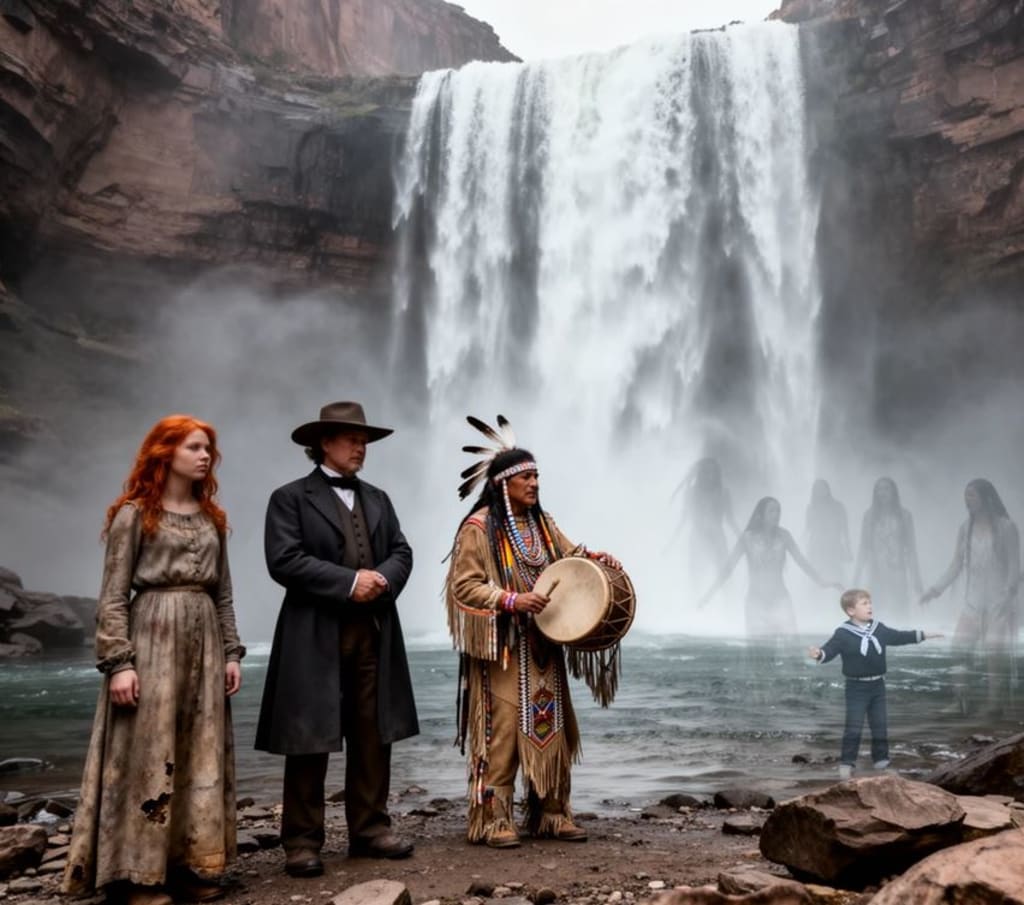
The falls were beautiful. And amazing. And loud. And they looked deadly, even under the noon sun.
I can imagine what this place looks like at night, or in the thick soup fogs we get. I didn’t want to find out first hand, though.
We found a nice spot in the sagebrush, with a bit of shade, to eat a trail meal. Nothing to write home about, but Ma did pack thick slabs of cured ham for us.
We stared at the falls. Now what?
Pastor kept squinting, shaking his head, squinting. I’m sure it was hard to see a ghost in the sun, but we were this far, what could we do?
The strange answer came in the form of an insistent drum beat, that we could feel, over, under, through, the incessant beat of the falls. Pastor whipped his head around, and I followed suit.
An Indian was coming down the mountain path.
Now, I’d seen pictures in books, but the real thing was even more amazing. Beads, buckskin, fringe, even an eagle feather, maybe two, bobbing to his stride. Strong, powerful, tapping out a rhythm that went with the power of the falls. Not against it, acknowledging it, blending with it, asking without demanding.
Compared to the pastor – well, there was no comparison. I almost laughed, since we were taught we were the superior species. I wondered what other lies we held dear in our “traditions.”
He paced towards us at a steady beat, toe-heel, toe-heel, in the manner of his ancestors. Even in the way he moved, it was like the grace of a crouching puma. He beckoned us to follow with a twist of lips and nose, as is customary with his people. We got up, followed him down to the basin.
The sky grew dark.
A cloud appeared at the top of the mountain, just like when the storms would come rushing at us and over the plain. But this time, no thunder, or lightning. Just wind, and blocking out the sun, a welcome shading.
Apparently the pastor did finally see a ghost, because he stiffened. I heard nothing over the drum and roar of the falls.
But the drum beat changed, and if I listened, I could hear words. Almost. Extra beats added to the thrum formed concepts in my mind. To the pastor: You have the power to see, but do not wish it. Will you give it to the girl, who needs it?
Almost immediately: Yes!
Put your hands on her head, as if giving a blessing.
And he did, and the drum beat changed. An insistence, an urgency, a thing that must be done now, a transfer, a task, a long-delayed burden. Setting down, taking up, nothing new under the sun, a commission transferred.
And something flowing, from one to the other, a brightening, a quickening, a life-giving river soaking up my senses, making them complete.
Did I know what it was to see before? I could See.
The cloud, the mist it kicked up, was enough for me to see the shapes.
Many Indians, many of them. Jumping Pool apparently had a history. Through the drum song, I could see the shape of their history – lovers that leaped, sacrifices to save their tribe, maidens in despair when their beloved took another. They stayed – to keep a lonely white boy company, when they could have been gathered to their ancestors ages ago.
I could reach to him with my heart, use the drum beat to carry my words over the power of a mighty waterfall.
“David Elias McDair, do you want to come home?”
The little boy’s face lit up with joy, and he wanted to come, but was bound. To something still here? Something I could pick up?
I got closer to the edge, slippery-wet rocks surrounding a very deep pool. “Show me. Where is it?”
He pointed, a little ways from me. I took great care crawling over the rocks, to a hand-sized smooth stone he was pointing at urgently. I picked it up, put it in my pocket. And saw a glint in the sand under it.
An identity bracelet, gold, with his name on it, in elegant script. I closed my fingers over it.
The Indian ghosts erupted in joy, jumping and tossing David in the air. On impulse, I picked up a dozen pebbles, one for each Indian ghost in the group. I made my way back to the drummer, who was smiling – Indians smiled! – and dropped them into the pouch slung across his chest, which he indicated with eyes and nose. Then he turned, still with a steady beat, and walked away, on the trail, up the mountain. The brave warriors and maidens followed, in single file.
I felt a ghostly child’s hand holding mine.
The cloud and mist faded.
I smiled at the pastor, stripped of his gift, who looked immensely relieved to get rid of the burden. Still a coward, but he did the right thing – even if it was to get rid of the responsibility. At least I could see what I was doing now.
I nodded, clutching a bracelet. Evidence of a life lived. “Let’s go home.”
About the Creator
Meredith Harmon
Mix equal parts anthropologist, biologist, geologist, and artisan, stir and heat in the heart of Pennsylvania Dutch country, sprinkle with a heaping pile of odd life experiences. Half-baked.
Enjoyed the story? Support the Creator.
Subscribe for free to receive all their stories in your feed.
Comments
There are no comments for this story
Be the first to respond and start the conversation.