
The Gates We Invent
A Lighthearted Question About Heaven, Hell, and Human Nature

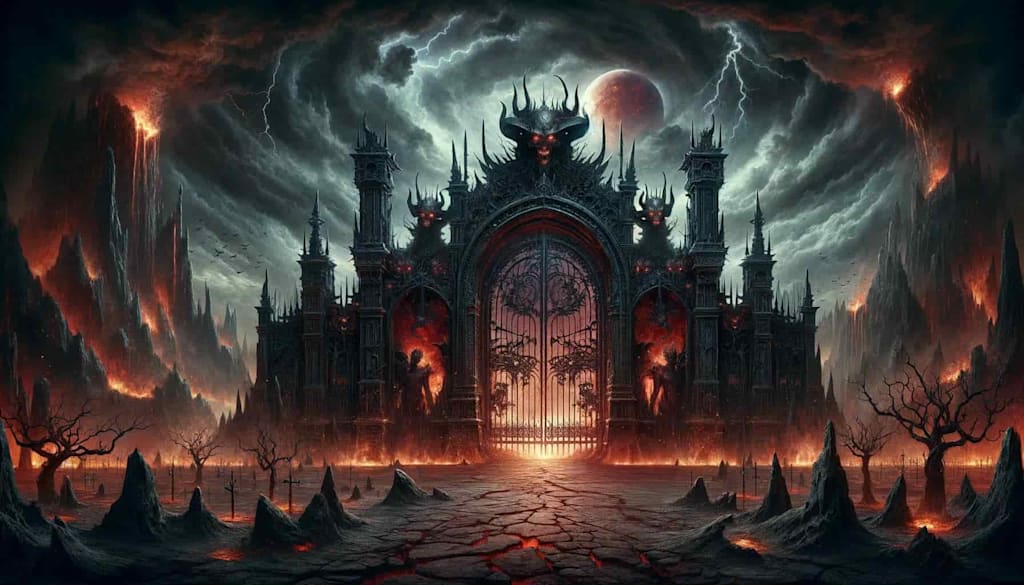
Most of us have seen the image countless times.
On one side, there are magnificent golden gates shining through the clouds. Angels stand nearby, everything bathed in warm light. On the other side, towering iron gates rise from flames and darkness, guarded by creatures that look like they haven't smiled in centuries.
The picture is so familiar that we rarely stop to question it.
But one day I found myself wondering:
Why does the afterlife need gates at all?
Think about it.
If heaven is supposed to be perfect and hell is supposed to be impossible to escape, why would either place need fences, walls, locks, or guards? The idea seems strangely human for places that are supposed to exist beyond human limitations.
A gate serves a practical purpose. It keeps people in. It keeps people out. It controls movement.
That makes perfect sense for a neighborhood, a military base, or a theme park.
But eternity?
I'm not so sure.
The World's Most Famous Entrance
Somewhere along the way, popular culture turned heaven into the ultimate gated community.
The image is remarkably consistent.
There are clouds.
There are gates.
There is usually a long staircase.
And standing nearby is Saint Peter, apparently assigned the task of checking names for all eternity.
Imagine the job description.
Position: Gatekeeper of Heaven
Requirements: Infinite patience.
Benefits: Eternal employment.
Vacation Days: None.
Every day—or whatever passes for a day in eternity—another soul arrives, and Peter checks the list.
After a few thousand years, you'd think the process could be automated.
Surely a place capable of creating galaxies could manage a better admissions system.
Yet the gate remains.
The Other Gate
Hell doesn't escape the same architectural obsession.
For some reason, depictions of hell almost always feature enormous doors, iron bars, chains, locks, spikes, and walls.
It's as if the designers worried someone might wander out during lunch.
But if hell is truly the realm of ultimate punishment, wouldn't leaving be impossible regardless of the security measures?
Who exactly are the gates protecting?
The residents?
The management?
The surrounding property values?
The more you think about it, the stranger it becomes.
Maybe the Gates Aren't Real
Perhaps we've been looking at the whole thing incorrectly.
Maybe the gates were never meant to be physical structures.
Maybe they're symbols.
Humans understand doors.
We understand thresholds.
We understand the feeling of crossing from one phase of life into another.
Graduations have doors.
Weddings have aisles.
New jobs have entrances.
Even birth begins with a passage from one world into another.
Perhaps the gate isn't there to keep anyone in or out.
Perhaps it's there because every important transition in human life feels like walking through a doorway.
If that's true, the gates tell us more about ourselves than they do about heaven or hell.
The Problem With Eternal Entertainment
Another thought occurred to me.
What if the gates are there because eternity is a very long time?
Every description of heaven focuses on perfection.
No pain.
No stress.
No deadlines.
No bills.
No traffic.
All wonderful things.
But eventually, a curious person starts asking questions.
Can I explore?
Can I visit another galaxy?
Can I learn something completely new?
Can I hear a style of music that has never existed before?
At some point, even paradise might benefit from a little variety.
And if the answer is no?
Well, suddenly the gate becomes much more understandable.
Not because people want to get in.
Because they might occasionally want to see what's outside.
Human Beings Love Boundaries
The truth is that we build gates everywhere.
Physical gates.
Social gates.
Economic gates.
Psychological gates.
We create membership requirements, exclusive clubs, private communities, passwords, permissions, and access codes.
We divide the world into insiders and outsiders.
People who belong.
People who don't.
Perhaps that's why our stories about the afterlife include gates.
Not because heaven needs them.
Not because hell needs them.
Because we need them.
The gate represents order.
It represents certainty.
It reassures us that someone is in charge.
A universe without gates feels unpredictable.
A universe with gates feels organized.
Even if the organization makes very little sense.
The Most Boring Job in Eternity
Of all the questions this leaves us with, one remains my favorite.
Who guards the gates?
Whether it's Saint Peter at heaven's entrance or some unfortunate soul assigned to hell's front desk, neither role sounds particularly exciting.
Imagine standing in the same place forever.
No promotions.
No career changes.
No coffee breaks.
Just gate duty.
For eternity.
Suddenly, the people inside might not be the ones we should feel sorry for.
Maybe the real punishment is working security at the edge of existence.
A Final Thought
The longer I think about heaven and hell, the less interested I become in the gates themselves.
What fascinates me is why humanity keeps drawing them.
Maybe the gates symbolize judgment.
Maybe they represent choice.
Maybe they simply help us visualize ideas that are too large and mysterious for the human mind to fully grasp.
Or maybe someone, centuries ago, looked at an endless afterlife and thought:
"You know what this place needs? A really impressive entrance."
And everyone else just went along with it.
Either way, the next time you see a painting of golden gates in the clouds or iron doors rising from flames, take a moment to wonder.
Not what's behind them.
But why we felt the need to build them there in the first place.
About the Creator
Kiya Verma1
✍️ Storyteller | 📚 Research Enthusiast | 🌍 Curious Mind
Sharing insights, practical knowledge, life lessons, and digital discoveries. Passionate about writing content that informs, inspires, and helps people solve real-world challenges.
Enjoyed the story? Support the Creator.
Subscribe for free to receive all their stories in your feed.
Comments
There are no comments for this story
Be the first to respond and start the conversation.