
The Funeral for Unfinished Things
Some dreams deserve a second chance. Others deserve a proper goodbye.

The Funeral for Unfinished Things
Some dreams deserve a second chance. Others deserve a proper goodbye.
The first thing we buried was a sourdough starter named Kevin.
"He had so much potential," said the man holding the jar.
"How old was he?" someone asked.
"Nine days."
"Good Lord. Taken too soon."
We all tried to look appropriately sad.
Then Kevin's owner started laughing, and the rest of us completely lost it.
And that, somehow, was the beginning of the strangest and most unexpectedly wonderful Tuesday evening our little town had seen in years.
A Very Unusual Invitation
It started with a handwritten flyer taped to the door of the Bellwether Community Center.
THE FUNERAL FOR UNFINISHED THINGS
Bring something you started but never finished. We'll give it the goodbye it deserves.
Tuesday, 7 PM.
Refreshments provided.
I nearly walked past it.
Then I saw the refreshments part.
Look, I'm not proud of this, but free cookies have convinced me to attend events that my own friends couldn't drag me to.
Besides, I had plenty of unfinished things.
An online photography course. A half-painted kitchen chair. A gym membership that was still taking money from my bank account, despite having seen me exactly three times.
And then there was the novel.
Ah, yes.
The novel.
The one I'd been "working on" for four years.
Twenty-three pages. Seventeen different openings. A folder on my laptop called FINAL_VERSION, followed by another called ACTUAL_FINAL_VERSION.
You know how it goes.
I was going to become a writer.
Instead, I'd become extremely good at renaming documents.
So I printed the first chapter, stuffed it into my bag, and went to the funeral.
Nobody Expected Thirty-Seven Mourners
Mrs. Bell, the retired librarian who organized the event, stood at the entrance wearing a black cardigan and a cheerful expression.
She was seventy-two, had the energy of a woman half her age, and possessed a remarkable ability to make ordinary people feel slightly unprepared for life.
"Welcome!" she said, handing me a paper flower.
"Is this supposed to be sad?"
"Only if you want it to be."
"Did someone actually die?"
"Hopefully not. We're only insured for crafts."
I liked her immediately.
Inside, thirty-six other people had gathered around folding tables covered in white sheets.
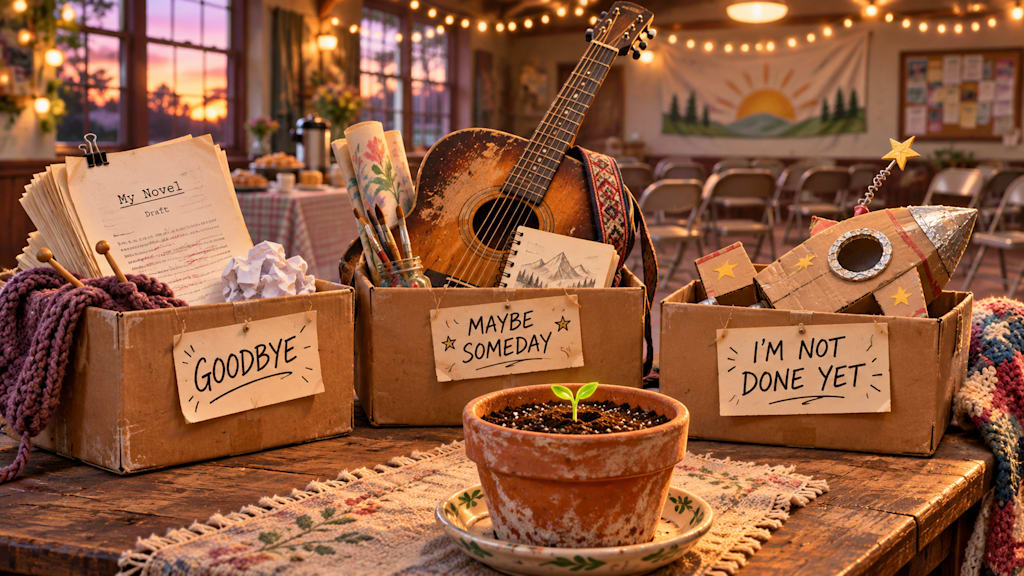
At the front sat three cardboard boxes, a microphone, and a suspiciously large chocolate cake.
A little boy was holding what appeared to be half a cardboard spaceship.
An elderly gentleman had brought a guitar with three strings.
One woman had a sweater with only one sleeve.
And then there was Kevin.
Poor Kevin.
His funeral was brief.
His owner explained that he'd become obsessed with baking bread after watching a documentary.
For nine glorious days, he'd fed Kevin, monitored his growth, and talked about fermentation as though he'd discovered a new branch of science.
Then he'd forgotten to feed him.
"He smelled like a gym sock when I found him."
Mrs. Bell nodded solemnly.
"Many great relationships end because of poor communication."
We laughed so hard that someone knocked over a chair.
Kevin was laid to rest in a flowerpot.
Nobody cried.
Well, except the gentleman who laughed while drinking coffee and accidentally inhaled it.
The Things We Carry Around
After Kevin, the stories became surprisingly interesting.
Mr. Harris, a retired bus driver, brought his battered beginner's guitar.
"I bought this when I turned sixty," he explained. "Told my wife I'd learn to play her favorite song."
"Did you?" Mrs. Bell asked.
"No. Learned two chords and gave myself a blister."
"How long ago was that?"
"Eleven years."
A woman in the second row raised her hand.
"I'm his wife."
Everyone turned.
"I've been listening to those same two chords for eleven years," she said. "At this point, I'd settle for a third."
The room erupted.
Mr. Harris smiled, looking a little embarrassed.
Then something unexpected happened.
He picked up the guitar and tried to play.
It sounded terrible.
Absolutely terrible.
But his wife began humming along anyway.
I don't think a single person in that room was smiling more than she was.
Next came a young woman carrying a box full of fabric.
She'd planned to make her wedding dress.
Then the wedding had been canceled.
She'd kept the fabric for two years because she couldn't decide what to do with it.
"Burn it!" someone suggested.
"Sell it!" said another.
An older woman near the window spoke up.
"That fabric would make beautiful curtains."
The young woman looked at her.
For a moment, nobody said anything.
Then she began to laugh.
"You know what? It really would."
By eight o'clock, we'd heard stories about abandoned gardens, unfinished puzzles, a failed attempt to learn Italian, and a man who had bought a treadmill that now served as a very expensive coat rack.
But something was changing.
People had arrived carrying objects they were embarrassed about.
Now they were showing those objects to complete strangers.
And nobody seemed particularly interested in judging anyone.
Then Came the Spaceship
The little boy stepped up to the microphone.
His name was Oliver.
He was ten.
And his cardboard spaceship had been sitting unfinished in his bedroom since summer.
"I was making it with my granddad," he said.
The room grew quieter.
"He moved away, and we didn't finish it."
Mrs. Bell crouched beside him.
"Would you like to say goodbye to it?"
Oliver looked at the spaceship.
Then at the cardboard boxes.
Then back at Mrs. Bell.
"Not really."
She smiled.
"That's perfectly fine."
He hesitated.
"Can I just finish it instead?"
There was a pause.
Then someone near the back said, "I have silver paint in my car."
Another person offered glue.
Mr. Harris said he knew how to make a spaceship engine out of a paper cup.
Oliver's eyes widened.
And just like that, our funeral had its first resurrection.
Mrs. Bell looked at the three cardboard boxes at the front of the room.
She took out a marker and began writing.
On the first box, she wrote:
GOODBYE.
On the second:
MAYBE SOMEDAY.
And on the third:
I'M NOT DONE YET.
"Well," she announced, "it appears we've misunderstood our own event."
My Turn
I considered leaving.
Not because I was bored.
Quite the opposite.
I'd spent the evening laughing at other people's unfinished dreams, nodding sympathetically at their disappointments, and pretending I wasn't carrying twenty-three pages of my own.
But now Mrs. Bell was looking directly at me.
"You've been holding that envelope all evening."
I glanced down.
She was right.
"I wrote something," I said.
"What sort of something?"
"A novel. Or the beginning of one."
"How long have you been working on it?"
"Four years."
"How many pages?"
"Twenty-three."
Mrs. Bell raised an eyebrow.
"That's a very relaxed writing schedule."
A few people chuckled.
I did too.
Then I surprised myself by saying something I hadn't admitted out loud before.
"I think I'm scared to finish it."
"Why?"
I looked at the envelope.
"Because right now, in my head, it's still a really good book."
Nobody interrupted.
"If I actually finish it, I might find out it's just... ordinary."
Mrs. Bell considered that for a moment.
"Could be."
I wasn't expecting that.
"Excuse me?"
"It might be ordinary. It might even be dreadful."
"You're not very good at motivational speeches."
"Never claimed to be."
She smiled.
"But is there something in it you still like?"
I thought about my main character.
Nora.
A woman who worked in a little bookstore and dreamed about escaping her perfectly predictable life.
I'd written her into the middle of a rainy evening, then left her standing behind the counter for four years.
Actually, when I thought about it, that was rather cruel.
"Yes," I admitted. "I still like her."
"Then perhaps she deserves another chapter."
From the back of the room, Oliver raised his hand.
"Does she have a spaceship?"
"No."
"She should."
For the second time that evening, I laughed so hard I nearly cried.
The Last Box
By the end of the night, something remarkable had happened.
The first cardboard box was almost full.
People had decided to let go of projects they no longer cared about.
The second contained things they weren't ready to revisit.
But the third box?
That one was nearly empty.
Not because people had given up.
Because they'd taken their things home.
Mr. Harris carried his guitar out with plans to replace the broken strings.
The young woman left with her fabric and the phone number of someone who knew how to sew curtains.
Oliver had recruited three adults to help finish his spaceship on Saturday.
And I stood in front of the boxes, still holding my envelope.
Mrs. Bell approached me.
"Have you decided?"
I looked at the box marked GOODBYE.
Then MAYBE SOMEDAY.
Finally, I looked at the third.
I'M NOT DONE YET.
"I think I'll take it home," I said.
"Excellent."
"Although I still have absolutely no idea how the story ends."
Mrs. Bell picked up her handbag.
"Neither does your character, by the sound of it."
I smiled.
Then she added, "And I sincerely hope you don't put a spaceship in it just to please Oliver."
Wednesday Morning
The next morning, I opened my laptop.
There were seventeen versions of my novel waiting for me.
I deleted sixteen.
Not because they were terrible.
Well, some of them were.
One opening involved a sunrise so dramatically described that even the sun would probably have found it embarrassing.
But I kept the first version.
The messy one.
The one where Nora was standing in her bookstore while the rain hammered against the windows.
And then I wrote something new.
A customer walked through the door.
He was soaking wet.
He carried a suitcase.
And he asked Nora a question she couldn't answer.
I stopped typing.
For the first time in months, I actually wanted to know what happened next.
So I kept writing.
Three pages.
Then four.
By lunchtime, I'd written more than I had in the previous six months.
Was it brilliant?
Absolutely not.
There was a conversation that made no sense, a character who changed names halfway through, and an entire paragraph about an umbrella that probably deserved its own funeral.
But I was having fun.
I'd forgotten that part.
Somewhere along the way, I'd become so worried about writing something worth reading that I'd stopped enjoying the act of writing altogether.
I didn't finish my novel that Wednesday.
I didn't get a publishing deal.
Nobody called to tell me I was secretly the next great literary genius.
I just wrote another page.
And, for once, that felt like enough.
One Last Thing
On Saturday morning, Mrs. Bell sent me a photograph.
It was the flowerpot where we'd buried Kevin.
Something small and green had begun growing in the soil.
I stared at the picture.
Then I messaged her.
Me: Is that supposed to happen?
Mrs. Bell: No, dear. It's a weed.
Me: Oh.
Mrs. Bell: Would you like me to pull it out?
I thought for a second.
Me: Maybe leave it for now.
A moment later, she replied.
Mrs. Bell: That's what I thought.
I put down my phone, opened my laptop, and went back to the bookstore where Nora was still waiting.
She had a customer to deal with.
And this time, I wasn't going to leave her there for four years.
About the Creator
Ahmet Kıvanç Demirkıran
As a technology and innovation enthusiast, I aim to bring fresh perspectives to my readers, drawing from my experience.
Enjoyed the story? Support the Creator.
Subscribe for free to receive all their stories in your feed. You could also become a paid subscriber, letting them know you appreciate their work.
Comments
There are no comments for this story
Be the first to respond and start the conversation.