
The Forest Remembers
She entered the fairy wood by mistake

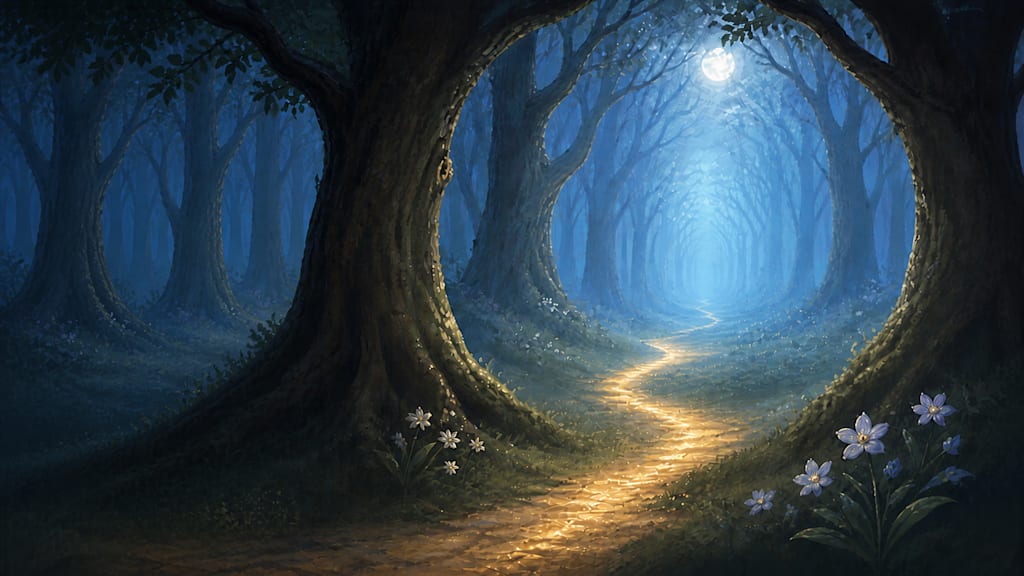
Clara knew the path had gone wrong when the trees began to lean toward her as though they had been waiting all afternoon for the pleasure of noticing her.
They did not move like ordinary trees, bending under wind or weather, but with a slow and deliberate interest that made the skin between her shoulders tighten. Their branches curved inward above the track, and their leaves turned pale, shivering softly in the silver-green light, as if the whole wood had opened a hundred quiet eyes.
Behind her, the road to Harthmere had disappeared.
It had not faded into mist, nor curved behind a hill. It was simply no longer there, as though the world had closed a door behind her and decided the village, the fields, and the muddy little road she had known all her life were none of its concern.
Clara stood with one hand clenched around the handle of her basket and tried very hard not to make the sort of sound that would tell the forest she was afraid.
She had only meant to cut through the old wood.
Everyone in Harthmere knew better than to do that, which was exactly why she had done it.
Her mother had always said there were places that did not belong to human beings, and that a sensible person did not go wandering through them just because the road was shorter. Her father crossed himself whenever he passed the old trees. Her brother had once dared her to leave a ribbon tied to the first oak and then refused to come with her when she took him seriously. Old Nan Vey claimed she had heard music in the wood as a girl and returned home with snow in her hair, though it had been midsummer when she left.
Clara had listened to all of them and decided, privately, that adults often wrapped fear in warnings because fear sounded more respectable when it was dressed up as wisdom.
Now the air smelled of rain, wild honey, and something bright and sharp, like lightning trapped beneath the bark.
“I can be sensible,” she murmured, though the words sounded embarrassingly small beneath the watching trees. “I can be perfectly sensible, now that there is something worth being sensible about.”
The forest rustled, though no wind touched it, and Clara had the horrible feeling that it was amused.
She tightened her grip on the basket looped over her arm. Inside were a loaf of bread, a jar of blackberry jam, and a small strip of white linen. They were ordinary things, useful things, things that belonged in a village where geese hissed in the lanes, and people argued over the price of onions.
They did not belong in a place where silver light pooled between roots and flowers opened as she passed, turning their dark centres toward her like watchful pupils.
A laugh drifted down from above. Clara spun so quickly that the basket struck her hip.
A girl stood on a branch overhead, though “girl” was only the nearest word Clara’s mind could offer. She had the shape of a girl, slight and graceful, with long limbs, skin pale as milk, and hair that fell around her shoulders in ripples of green-gold. Her eyes were enormous, the colour of the ocean, and behind her shoulders rested wings so fine and translucent they might have been spun from glass.
The strange girl tilted her head, studying Clara with open curiosity. “You make a great deal of noise for someone who is trying not to be noticed,” she said.
Clara swallowed. “I was not aware I was being watched.”
“That is often when watching is most easily done.”
Clara glanced at the trees, then back at the fairy on the branch. “Am I still in the old wood near Harthmere?”
The fairy stepped down from the branch as lightly as a falling petal. “You are in the forest of the Fair Folk, which your kind touches only at the edges and only when the world is thin enough to make mistakes.”
Clara stared at her. “I came through from the road.”
“No,” the fairy said gently, and there was something almost pitying in her voice. “You came through from the mortal world.”
The words seemed to empty out the air around Clara. She glanced back again, searching for any sign of the road, but there was only the narrow path curling between white roots and black trunks, glittering faintly as if dusted with crushed stars.
“I did not mean to,” Clara said.
The fairy’s smile curved, beautiful and unreadable. “Meaning a thing matters less here than arriving.”
Clara drew in a slow breath and tried to steady herself. “Then I would like to leave.”
“I imagine you would,” said the fairy, as though this was a very reasonable desire and also one that did not matter. “My name is Elarienne, and if you wish to leave with your shadow still attached and your heart still beating in its proper rhythm, you should come with me.”
Clara hesitated, because every village tale she had ever heard insisted that one ought to be careful with the Fair Folk, but the fairy had given her name with such smooth confidence that Clara felt suddenly foolish keeping her own locked behind her teeth.
“I’m Clara,” she said at last, and then, because her mother had raised her to be polite even when frightened, she added, “Clara Vale.”
Elarienne’s gaze lingered on her for a moment, unreadable and bright. “Clara Vale of the mortal road,” she said softly, as if testing the shape of it. “Yes. I thought you had the look of someone who had wandered through a door without seeing the handle.”
Clara looked at the trees, which had gone unnervingly still, and then at the golden path that had begun to open beside Elarienne’s feet.
“Where are you taking me?”
“To the Court of Leaves.”
“I would prefer not to go to any court at all.”
Elarienne’s expression warmed with something like sympathy, though it did not quite reach her strange bright eyes. “Preferences are fragile things in old forests.”
Clara thought of running, but the path behind her had already changed, and the forest looked like a place where running meant the trees would enjoy themselves, not that she would escape.
So, she followed Elarienne.
The path did not behave as a path should. It curved without turning, rose without climbing, and sometimes seemed to fold over itself so that Clara could glimpse impossible things between the trunks. A river ran upward over a bank of black stones, glittering as though the water were full of stars. A stag passed between the trees with white candles burning in its antlers, each flame steady despite the dampness of the air. A woman made of bark sat beside a pool, combing beetles from her hair and humming a tune that made Clara’s heart clench.
A child sat crying beneath an ash tree, his clothes old-fashioned and damp, his small hands pressed over his face.
She took one step toward him before Elarienne caught her wrist. “Do not answer sorrow that has learned to feed,” the fairy warned.
“He is only a child.”
“He was only a child when he first began crying there,” Elarienne said, and her voice lost all its softness. “Now he is mostly hunger, and he has had nearly a century to practise sounding helpless.”
The boy looked up. His eyes were dark hollows filled with slow white moths.
Clara stepped back onto the path and did not leave it again.
By the time the trees opened before them, she had stopped trying to understand the forest and had begun instead to list the things she must not do. Do not touch what shines too brightly. Do not answer anyone who weeps beside water. Do not follow music. Do not accept anything offered by a hand with too many fingers. Do not look too long at faces that seem familiar.
The clearing beyond the trees was not truly a clearing at all, but a hall grown rather than built. Roots rose like pillars from the earth, branches knitted themselves into arches overhead, and lanterns hung in clusters of blue and gold, casting a light too lovely to be comforting. At the far end of the hall stood a throne made from a living tree, and upon it sat a woman with a crown on her head and hair that drifted around her as though moved by a current no one else could feel.
The Queen of the Court of Leaves was beautiful in the way storms were beautiful when watched from far away.
Up close, Clara felt only the urgent need to survive her attention.
Elarienne bowed low, her glasslike wings folding neatly behind her, and Clara copied the gesture a breath too late.
The gathered court murmured.
Some of them were almost human in shape, delicate and bright, with luminous skin and eyes like wet jewels. Others were stranger: one had feathers in place of hair, another wore a cloak stitched from sleeping birds, and one creature near the edge of the hall had no face at all beneath its crown of red berries. Their shadows moved restlessly across the root-woven floor, not always in the same direction as their bodies.
The Queen looked at Clara as though she were a riddle someone had left on her doorstep. “A mortal girl has crossed into my forest,” she said, her voice musical and cold.
Clara forced herself to lift her head. “I crossed by mistake.”
A ripple of laughter moved through the court, not cruel exactly, but curious and bright, as if she had said something childish in a language they enjoyed.
The Queen rested one long hand against the arm of her throne. “There are few mistakes in places as old as this.”
“There are many mistakes where I come from,” Clara retorted before she could stop herself, and then she felt the whole court sharpen around her.
Elarienne went very still beside her.
The Queen’s eyes flashed silver, but after a moment her mouth curved. “A mortal with brambles under her tongue,” she said. “How refreshing.”
Clara could not tell whether this was approval or a threat, so she held her basket tighter and chose silence.
“You wish to return to the human world,” the Queen said.
“Yes.”
“To your smoke, your iron, your church bells, and your little roads that pretend the earth belongs to them.”
Clara did not like the way the court whispered after each word, tasting her world as though it were something rustic and amusing.
“I wish to go home,” she said.
The word passed through the gathered fair folk like a draft through leaves.
Home.
Home.
Home.
By the time it faded, it no longer sounded like a place where fires burned low and mothers scolded with relief in their hands. It sounded like an old spell with half its meaning lost.
The Queen leaned forward. “What will you offer the forest for your return?”
Clara thought of every story she had ever dismissed, every warning tucked into every village tale. Do not eat fairy food. Do not dance to fairy music. Do not promise what you cannot measure. Do not believe beauty means kindness.
She lowered her gaze to the basket. “I have bread,” she said, because panic had made her practical.
A creature with beetle-black eyes drew back. Elarienne glanced at the basket, and for the first time since they had met, Clara saw something like concern cross her face.
“Human bread?” the Queen asked.
Clara nodded.
“Made with salt?”
“Yes.”
A faint hiss passed through the court, and several of the fair folk shifted away as Clara drew the loaf from her basket. The smell rose into the enchanted hall, warm and plain and stubbornly human.
For the first time since entering the forest, Clara’s eyes stung.
The Queen watched her face. “That is not only bread,” she said.
Clara held it close. “No.”
“What is it, then?”
Clara almost answered before caution caught her tongue. It was food, but it was also labour, family, comfort, and the life she had not understood she loved until the forest placed its strange shining hands around her. “It belongs to me,” she said.
The hall grew quieter. The lanterns dimmed until the shadows between the roots looked deep enough to drown in.
The Queen leaned back, her crown bright against the woven branches above her. “You came into what was not yours,” she said, “and yet you carry something of your world strongly enough that my court recoils from it.”
Clara did not know what to say.
“Silence is wise,” Elarienne murmured beside her.
The Queen’s gaze moved to the fairy, then back to Clara. “The forest will let you go.”
Clara’s breath caught. “What will it take from me?”
The Queen smiled and the court rustled with approval. “There is the beginning of understanding.”
Clara wished, suddenly and fiercely, that she had stayed on the road no matter how long it took to reach the village.
“You may return to your mortal home,” the Queen said, “but no one passes through a true door and remains entirely on one side of it. You have entered the forest, and though it will open for you now, it will remember you.”
Clara’s mouth felt dry. “What does that mean?”
“It means that when the moon rises, some part of you will hear the leaves speaking beneath the wind. It means that ordinary roads may feel too blunt beneath your feet, and ordinary rooms may feel too small around your bones. It means that the forest will not need to keep you here, because longing is often a stronger tether than chains.”
“I do not want to long for this place.”
“Few mortals know what they long for until it begins calling them by another name.”
Clara looked to Elarienne, hoping for denial, but the fairy’s expression had softened into something almost sorrowful.
“Can I resist it?” Clara asked.
The Queen’s smile did not change. “You may try.”
Behind Clara, the hall opened into a path that had not been there before. At its far end, impossibly near and achingly familiar, lay the muddy road to Harthmere. Smoke curled beyond the hedgerows and the bells of the chapel rang the hour with blunt human certainty.
Home waited at the end of the path.
Elarienne touched Clara’s sleeve, lightly enough that it might have been a falling leaf. “When you reach your side, do not look back,” she said.
Clara gave a breathless, humourless laugh. “That is one warning I have heard before.”
“Most warnings survive because someone ignored them first.”
Clara looked at her more closely. In the strange glow of the court, Elarienne seemed less like a creature made only of beauty and danger, and more like someone who had once been frightened herself.
“Why did you help me?” Clara asked.
Elarienne’s smile flickered and faded. “Because the first time I crossed into a place that was not mine, no one explained the rules until I had already broken them.”
Before Clara could ask what she meant, the roots shifted beneath her feet and the court began to dissolve into light and leaf-shadow.
She ran.
The path stretched longer than it should have, and the forest called after her in voices that almost belonged to people she loved. Her mother cried her name from behind a stand of white birches. Her brother laughed somewhere to her left and told her she was going the wrong way. Her father’s voice murmured a prayer so close to her ear that she nearly turned from instinct alone.
Clara kept her eyes on the muddy road ahead.
Then her mother called again, broken with fear. “Clara, please, come back.”
Clara stopped so suddenly that her skirt tangled around her knees. The village road waited only a few steps away, rain falling across it in silver threads, while behind her the forest held its breath.
Every part of her wanted to look back. Love pulled at her harder than fear. What if her mother had followed her into the forest? What if the path ahead was false? What if the thing behind her was not a trick, but her mother lost and weeping among the roots?
Then Clara remembered that her mother never said please when she was frightened. Her mother said now. She said move. She said don’t you dare, girl, with love tucked beneath every hard edge.
Clara ran forward.
She fell to her knees in the mud, gasping as cold rain struck her face and soaked through her sleeves. The old wood stood behind her, dark and ordinary, with no silver light between the trees and no golden path beneath the roots.
For a moment, she stayed where she was, pressing one hand to the road because the mud was real, the rain was real, and the ache in her knees belonged to the world she understood.
The basket was still looped over her arm. The bread was still inside. The strip of white linen, however, was gone, and in its place lay a single pale leaf veined with gold.
Clara did not look back. She walked home through the rain. Lamplight warmed the cottage windows and smoke rose from chimneys. Harthmere had never looked so dear or so small.
By the time she reached her own door, her mother was already running toward her.
There was crying after that, and scolding, and her father barring the door before sunset, and her brother sitting wide-eyed at the table while Clara told them only that she had lost the path in the old wood and found it again by mercy or luck.
No one asked many questions after that. Perhaps they saw enough in her face.
That night, Clara lay awake beneath her quilt while the house settled around her and rain tapped gently against the roof. Her mother and father slept in the next room. Her brother snored softly near the hearth.
Everything was as it had been. Yet nothing sat in its proper shape.
The shadows near the window seemed deeper than shadows ought to be. The wind moved through the thatch with a rhythm almost like speech. Beyond the fields, beyond the road, beyond the last fence of Harthmere, the old wood waited with an awareness she could feel even through the walls.
Clara turned onto her side and shut her eyes.
Silver light bloomed behind her lids.
She opened them again.
On the little table beside her bed, the pale leaf glimmered faintly, its golden veins pulsing as though some small heart was beating inside it.
She should have thrown it into the fire. She knew that. She should have woken her mother, confessed every word the Queen had spoken, and begged her father to lock the shutters until dawn. She should have buried the leaf in the churchyard or dropped it into running water or done any of the sensible things people did in stories when enchantment followed them home.
Instead, she reached for it.
The moment her fingers touched the leaf, the room seemed to breathe. The walls did not move, but Clara felt how close they were. The ceiling seemed lower than it had that morning. The cottage, which had always been warm, safe and wide enough for every dream she had known how to have, now felt like something carefully folded around her.
The wind slipped under the door, brushed across the floor, and carried with it the scent of rain, honey, and lightning beneath bark.
Clara sat up slowly.
The forest was calling.
She dressed without lighting a candle. She opened the door slowly enough that the hinges gave only the smallest sigh. Then she stepped into the night while her family slept behind her, warm and human and impossibly far away.
The village lay silver beneath the moon.
Clara walked past the well, past the sleeping geese, past the chapel with its iron bell hanging dark and silent in the tower. The road was cold beneath her bare feet, and every step toward the old wood felt like a choice she was making and a choice that had already been made for her.
At the edge of the trees, she stopped.
For one breath, it was only a wood. Then, between two ancient trunks, a path opened, smooth and golden beneath the roots.
A figure waited in the silver light, with wings like glass and hair that gleamed green-gold beneath the moon.
Elarienne smiled as though she had known all along that Clara would come. “I wondered how long the mortal world would hold you,” she said.
Clara should have turned back. She understood that perfectly. But understanding, she was beginning to learn, was not the same as freedom.
So, she stepped into the forest.
About the Creator
Emilie Turner
I’m studying my Masters in Creative Writing and love to write! My goal is to become a published author someday soon!
I have a blog at emilieturner95.wordpress.com and I’ll keep posting here to satisfy my writing needs!
Enjoyed the story? Support the Creator.
Subscribe for free to receive all their stories in your feed. You could also become a paid subscriber, letting them know you appreciate their work.
Comments
There are no comments for this story
Be the first to respond and start the conversation.