
The Fiction of Ronna Curtis
How the Dead Become Stories

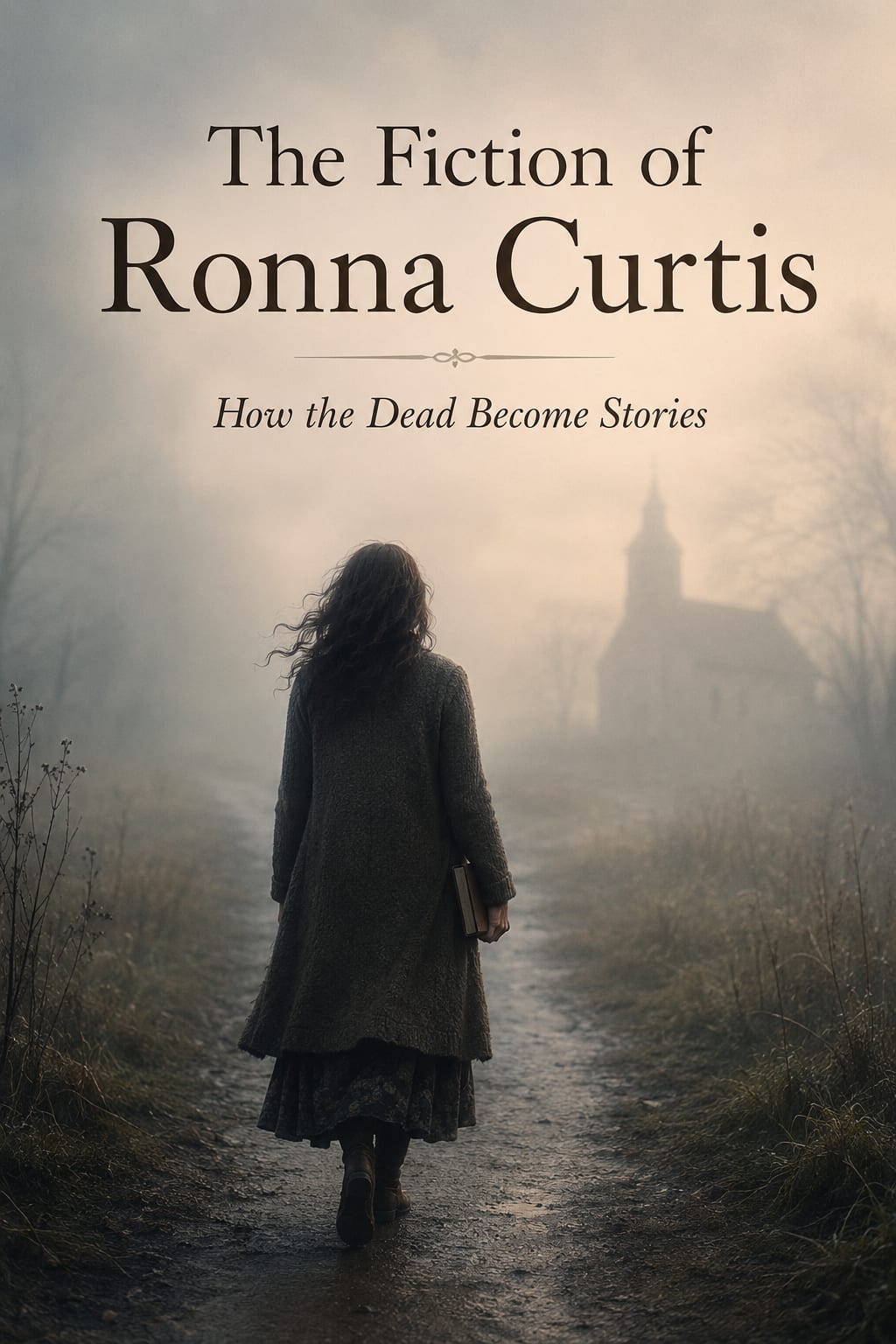
The Fiction of Ronna Curtis
By the time Ronna Curtis became important, she had been dead for twelve years.
This improved her considerably.
While alive, Curtis was described by neighbors as kind, imaginative, deeply sentimental, and prone to carrying too many books at once. One former colleague reportedly called her “the sort of woman who cried during school assemblies and then apologized for it.”
In death, she became much more interesting.
A literary mystic.
A theologian of grief.
A hidden architect of modern symbolic fiction.
A Southern chronicler of sacred domesticity.
A feminist of quiet resistance.
An accidental philosopher.
One dissertation described her as “an interpreter of the liminal threshold between pedagogical structure and metaphysical longing.”
No one has convincingly explained what that means.
Curtis herself likely would have laughed.
Or thanked them politely before changing the subject.
Posthumous fame tends to reward the dead with complexity they were denied in life.
The living woman, insofar as records suggest, was simpler.
She loved stories.
She believed words mattered.
She thought children deserved adults who listened carefully.
She kept notebooks.
She prayed.
She worried.
She occasionally bought books faster than she could read them.
And, according to one family anecdote, she once became emotionally attached to a fictional fox.
Critics have made much of that fox.
________________________________________
I. THE OFFICIAL VERSION
The accepted narrative begins, as these things often do, with hardship.
Ronna Curtis, literary scholars say, transformed private sorrow into symbolic fiction of remarkable tenderness and spiritual depth.
This is likely true.
It is also incomplete.
Biographers adore suffering because suffering organizes a life into something narratively respectable.
It is much easier to explain a writer through tragedy than through curiosity.
Harder still through joy.
Nearly impossible through contradiction.
Curtis's fiction often concerned grief, yes.
But grief was not the whole country.
She also wrote about children imagining impossible worlds, creatures in mist, outsiders arriving where they did not belong, mothers remembering absurdly specific details, protective instincts, strange faith, classrooms, hidden courage, and ordinary people who kept going despite not knowing what came next.
Scholars call this thematic consistency.
Friends might have called it personality.
________________________________________
II. WHAT THE CRITICS SAID
Professor Elaine Mercer, writing twenty years after Curtis’s death, argued that her background in education fundamentally shaped her literary imagination.
“Curtis understood how people learn to decode symbols,” Mercer wrote. “It makes perfect sense that her fiction repeatedly interrogates the human impulse to decode suffering.”
This sounds intelligent.
It may even be true.
But it also sounds suspiciously like someone who had discovered a phrase she was determined to use in an academic journal.
Another critic interpreted Curtis’s recurring animal imagery through eco-theological trauma theory.
Another through maternal attachment studies.
Another through post-evangelical symbolic fragmentation.
One conference panel devoted forty-three minutes to discussing a fox that appeared in only three stories.
This is what literary scholarship does when left unsupervised.
Perhaps the most persistent interpretation framed Curtis as fundamentally obsessed with death.
This misunderstands her almost entirely.
She was not interested in death.
She was interested in endurance.
Death merely clarified certain questions.
________________________________________
III. THE WOMAN THEY INVENTED
In biographies, Ronna Curtis always writes at night.
Always by lamplight.
Always exhausted.
Always after caring for everyone else.
There is usually tea.
Sometimes rain.
Occasionally an old sweater.
This version of her has become wildly popular.
It is also, at least in part, fictional.
No one seems entirely certain where the image originated.
A single unsigned essay published years after her death described her writing “while the house slept.”
From this, apparently, an entire mythology emerged.
Soon she became a near-saintly domestic novelist whose every sentence was written through sacrifice.
It is not impossible.
But neither is it verifiable.
The truth is less elegant.
Writers write when they can.
Sometimes while tired.
Sometimes while procrastinating.
Sometimes instead of folding laundry.
Sometimes because a story refuses to leave them alone.
Curtis likely belonged to this far less poetic category.
But ordinary truths disappoint people.
Myths sell better.
________________________________________
IV. FROM THE ARCHIVE
When portions of Curtis’s notebooks were eventually released, they complicated everything.
Critics expected polished philosophical reflections.
What they found instead included grocery reminders, fragmented story ideas, teaching observations, prayers, shopping lists, and occasional emotional honesty written with no apparent intention of publication.
A sampling:
Need more coffee.
Child in second row guessed instead of decoding again. Must remember confidence and skill are not the same thing.
Fox in churchyard? Why does that image stay with me?
Faith is not certainty. Maybe that’s why people confuse the two.
If grief has a sound, I think it’s ordinary conversation continuing.
Band-Aids do not heal insecurity.
That final line inspired three academic essays.
One called it “a devastating critique of cosmetic identity construction.”
Another interpreted it as commentary on evangelical perfection culture.
A third insisted it symbolized national denial.
It may simply have referred to acne.
The dead cannot clarify.
This is deeply convenient for critics.
________________________________________
V. THE FAITH QUESTION
Religious readers claimed Curtis as one of their own.
Secular readers insisted her work transcended religion.
Critics argued over whether her symbolism reflected doctrine, longing, inherited language, or unresolved metaphysical uncertainty.
The answer appears to be yes.
Curtis’s faith, if her private writings are to be believed, was neither simplistic nor performative.
It was lived.
Quietly.
Imperfectly.
Without much interest in spectacle.
She did not write stories where belief solved everything.
Her characters prayed and remained uncertain.
Loved and lost.
Hoped and doubted.
This frustrated readers looking for cleaner moral architecture.
Life rarely provides it.
Curtis seemed to know that.
One unpublished note reads:
Faith is not pretending darkness isn’t there. Faith is refusing to call darkness permanent.
For once, the critics may have gotten it exactly right.
________________________________________
VI. THE STORIES THEMSELVES
Readers encountering Curtis for the first time often expect solemnity.
Then they discover humor.
Warmth.
Children behaving strangely.
Tender absurdities.
Unexpected imagination.
She understood something many literary writers forget:
People in pain are still funny.
Children facing uncertainty still invent games.
Mothers carrying devastating grief also remember pimples, awkward conversations, misplaced toys, unfinished errands, and ridiculous habits.
Sorrow is rarely elegant while it is being lived.
That realism gave her fiction unusual emotional credibility.
She did not arrange suffering for aesthetic effect.
She noticed its texture.
That is harder.
And rarer.
________________________________________
VII. WHAT THEY MISSED
The strangest omission in critical writing about Curtis is joy.
Not because her work ignored sorrow.
But because critics often behave as though sorrow is automatically more meaningful.
The private materials suggest someone far more playful than her reputation allows.
A woman who imagined impossible worlds.
Who cared deeply about literacy and children.
Who could be emotionally intense and immediately self-aware about it.
Who found symbolism everywhere.
Who loved stories enough to keep making them.
Who was neither tragic saint nor literary mystic.
Just human.
Which may be less marketable.
And far more true.
________________________________________
VIII. FINAL CORRECTION
In the end, perhaps the most honest statement about Ronna Curtis is this:
Everyone made her into what they needed.
Critics made her profound.
Religious readers made her faithful.
Skeptics made her questioning.
Scholars made her theoretical.
Publishers made her marketable.
Strangers made her mythic.
Readers made her personal.
Perhaps that is inevitable.
Death removes the author from the argument.
Silence invites interpretation.
But truth is more stubborn than reputation.
The truth is that Ronna Curtis was likely both smaller and larger than all of it.
Not a symbol.
Not a thesis.
Not an invented saint writing under lantern light.
A woman.
A teacher.
A storyteller.
A believer.
A doubter.
Someone who understood that words shape how we survive.
Someone who knew children deserve truth spoken clearly.
Someone who suspected imagination is not escape, but endurance.
Someone who loved deeply enough to leave fingerprints on her work.
That should be enough.
It rarely is.
Still—
if the dead are fortunate—
somewhere beneath the essays, the myths, the invented biographies, and the scholarly overreach…
the real story remains.
Waiting.
About the Creator
Ronna Curtis
Ronna Curtis, Ladybug, is the name I go by when publishing a book. For any books I write, I will show 2 to 4 chapters; the rest of the book or stories will be offered to subscribers. Contact information is [email protected]
Enjoyed the story? Support the Creator.
Subscribe for free to receive all their stories in your feed. You could also become a paid subscriber, letting them know you appreciate their work.
Comments
There are no comments for this story
Be the first to respond and start the conversation.