
“No gifts this year,” Tess said. “Just one little favor.”
Her brother Doug lowered the bottle of wine he was holding.
“Define little.”
“It’s not expensive.”
“That’s what people say before asking you to help them move.”
Their mother, Carol, stood at the kitchen counter arranging slices of ham on a platter. She glanced over her shoulder.
“Is this why you said not to bring anything?”
“I said not to bring gifts.”
“You said not to bring gifts,” Doug repeated. “You didn’t say anything about favors. That feels like a loophole.”
“It’s one hour,” Tess said. “From each of you. Alone. With a pen and paper.”
Her sister Ellen looked up from removing a piece of ribbon from a present she had already brought.
“Is this a team-building exercise?”
“No.”
“Because I’ve done those. They’re never one hour.”
Tess took a folder from her bag and placed it on the table. It was a plain blue folder, the kind used for insurance claims or tax documents. Doug looked at it with immediate suspicion.
“I want each of you to write down everything you remember about why Uncle Ray left.”
The kitchen went quiet.
Outside, a neighbor’s inflatable reindeer leaned drunkenly against a mailbox. Somewhere down the street, a carol played through a speaker with a blown-out bass.
Carol put down the serving fork.
“Why are we talking about Ray?”
“Because I found something.”
“What?”
“I’ll show you after you’ve written.”
Doug gave a short laugh. “You’ve managed to turn Christmas into a deposition.”
“I work in insurance investigations. It’s a habit.”
“Your habit is ruining Christmas.”
Tess ignored him. “I want you to write what you remember. Not what you heard someone else say. Not what you think you’re supposed to remember. Your own memory. Don’t discuss it with each other first. Don’t check old messages or photographs. Just write. Put your name on the envelope, seal it, and bring it here tonight.”
Ellen folded her arms.
“And then?”
“Then you read it aloud.”
“To whom?”
Tess looked at her mother.
“I’ve invited Ray.”
The serving fork slipped from Carol’s hand and struck the counter.
Doug stared at Tess as if she had announced that she had invited the IRS.
“You invited him here?”
“For dinner.”
“On Christmas Eve?”
“Yes.”
“Without asking anybody?”
“It’s Mom’s house,” Tess said. “I asked Mom.”
Carol looked at the floor.
“You asked me whether I was comfortable having an extra guest,” she said. “You did not say who.”
“I thought the name might change the answer.”
“It does.”
“I know.”
Doug pushed his wine away. “I have a gift card in my car. I would like to exchange it for this favor.”
“Do you have the receipt?” Tess asked.
“Unfortunately, no.”
The family story had never been particularly complicated.
Twenty-two years earlier, their grandmother died and left an estate worth a little over forty thousand dollars. Ray, her younger son, had been executor. The money disappeared. Ray was accused of taking it, and when he failed to produce a satisfactory explanation, the family cut him off.
Their father, Gerry, had called Ray a thief.
Their mother had called him selfish.
Doug had called him a drunk, although Tess had no idea how he knew that. Ellen had said Ray had always been unreliable.
Tess had been twelve. She remembered a shouting match, a slammed door, and her father standing in the driveway with his face red. She remembered Ray putting a suitcase in the trunk of an old Buick. She remembered asking where he was going.
“Somewhere else,” he had said.
She had never seen him again.
For years, the story had served its purpose. It explained why there were no visits, no birthday cards, no family photographs with Ray in them. It gave the adults a villain and the children a warning.
Then, three weeks earlier, Tess had been clearing boxes from her grandmother’s old house. The house was being sold, and her mother had asked her to sort through the papers.
In a metal cash box beneath a stack of tax returns, Tess found a bank statement, a photocopy of a cashier’s check, and a folded sheet of paper.
The check showed that $41,500 had been transferred from her grandmother’s estate account to a business account belonging to Gerry.
The folded paper was an IOU.
I acknowledge receipt of $41,500 from Ray Halvorsen, to be repaid from the sale of inventory by October 1.
It was signed by Gerry.
Underneath, in a different hand, someone had written:
If this goes wrong, tell your mother it was my decision.
Tess read it several times.
The money had not disappeared into Ray’s pockets. Ray had used it to save Gerry’s hardware store from a tax debt. The arrangement had been improper, and Gerry had never paid it back. When the money was discovered missing, Ray had taken the blame.
The paper did not say why. It did not say what Ray and Gerry had discussed in the driveway. It did not explain why Carol had allowed the family to believe the lie for more than two decades.
But Tess knew enough to start asking questions.
She also knew enough not to ask them all at once.
The first question had come from a woman named Mara Halvorsen, who had found Tess through social media.
I’m Ray’s daughter, she had written. I know this is strange, but Dad had a heart attack last year. I’m trying to put together our family medical history. Does your side have any history of heart disease? He told me not to contact you, but I thought I should try.
Tess had stared at the message.
She had never known she had a cousin.
She had written back. They spoke for twenty minutes. Mara was thirty-seven, a teacher, and had two children. Ray was alive. He was living outside Syracuse. He had spent twenty-two years telling his daughter that his sister’s family did not want to see him.
When Tess asked why, Mara said, “He said it was easier if we didn’t ask.”
That was when Tess decided the family needed to stop confusing silence with an answer.
By seven-thirty, the envelopes were on the dining-room table.
Doug’s was thick and lumpy, as if he had written a complaint and then tried to fold it into submission. Ellen’s was sealed with a piece of tape. Carol’s was thin.
Tess had prepared her own envelope, too. It contained a copy of the IOU and the bank statement.
“You’ve numbered them,” Doug said, examining the envelopes.
“For reference.”
“Of course you have.”
“Please don’t write on them now.”
“I wasn’t going to.”
“You’re holding a pen.”
Doug put it down.
Ellen glanced at the blue folder. “What happens if someone doesn’t want to read theirs?”
“Then they don’t.”
“What happens if someone doesn’t want to participate?”
“Then they don’t.”
“What happens if someone says something hurtful?”
Tess paused.
“Then we deal with what they said.”
Ellen gave her a tired smile. “That’s not much of a plan.”
“It’s the best one I have.”
The doorbell rang.
Carol gripped the back of her chair.
Tess stood. “That’s Ray.”
Doug looked at his sister. “You did it.”
“I said I invited him.”
“I thought you were bluffing.”
“I’m not very good at bluffing.”
Tess opened the door.
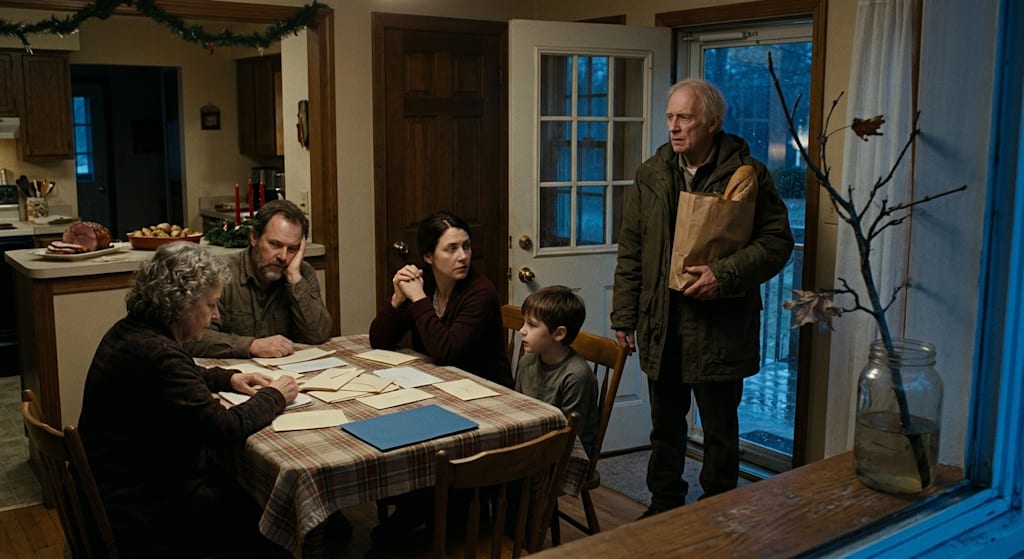
Ray looked older than she remembered. His hair was almost entirely white, and he carried a small paper bag with a loaf of bread inside. His coat was too thin for the weather.
“Hello, Tess.”
“Hi, Ray.”
He looked past her into the house.
“Is everybody here?”
“Everybody.”
He nodded, as if he had expected nothing else.
“I brought bread. Your grandmother’s recipe. I know it’s probably not as good as hers.”
Tess stepped aside.
“It’s good to see you.”
Ray gave her a cautious smile.
“I wasn’t sure you’d think so.”
No one hugged him.
Carol stood by the dining-room table. Doug remained seated. Ellen said hello in the careful tone she used with strangers who had arrived at the wrong appointment.
Ray placed the bread on the counter.
“I’m not going to stay long,” he said.
“You’re invited to dinner,” Tess replied.
“That’s kind of you.”
“It wasn’t my invitation to make alone,” Carol said.
Ray looked at his sister. “I know.”
For a few seconds, nobody spoke.
Then Tess brought out the envelopes.
“Before we eat, I’d like us to do the thing we agreed to do.”
Doug muttered, “Some of us did not agree.”
“You wrote yours.”
“I was under duress.”
“You were offered the option to decline.”
“Emotional duress.”
Tess placed the envelopes in the middle of the table.
“Who wants to go first?”
Nobody moved.
Ray glanced at the envelopes, then at Tess.
“What is this?”
“I asked them to write down what they remember about why you left.”
Ray’s expression changed.
“You don’t have to do that,” he said.
“I know,” Tess replied.
Doug sighed, opened his envelope, and unfolded several sheets of paper.
“I’ll go. Get it over with.”
He cleared his throat.
“I remember the store was in trouble. Dad was worried about the taxes. Ray was handling Grandma’s estate, and then the money went missing. Dad said Ray had taken it. I remember Dad saying that he had trusted him.”
He stopped.
“That’s what I remember.”
Tess waited.
Doug looked down at the paper.
“I also remember Dad telling me not to ask questions. I was working at the store then. I knew we were behind on bills. I knew Ray had been around a lot. I thought he was helping. I didn’t know about the money until afterward.”
“Did you know Dad had borrowed it?” Tess asked.
“No.”
“Did you suspect?”
Doug rubbed his forehead.
“I suspected something. I didn’t want to know what.”
Ellen opened her envelope.
Her statement was longer. She read it slowly, stopping twice to take a breath.
“I remember hearing Mom and Dad arguing in the kitchen. Dad said Ray had saved him and that nobody could ever know. Mom said the family would never forgive him if they found out. Dad said Ray had offered to take the blame.”
She looked at Carol.
“I was sixteen. I didn’t understand the money, but I understood enough to know we were being told a story. I was angry at Ray for leaving, but I was also angry at Dad. I never said anything because I thought Mom would fall apart.”
Carol looked down.
Ellen folded the paper.
“I’m sorry, Tess.”
Tess said nothing.
The next envelope was her mother’s.
Carol picked it up but did not open it immediately.
“I have written this before,” she said.
Doug looked at her.
“What?”
“In my head. Hundreds of times.”
She unfolded the paper.
“Ray did not steal the money. He used it to help Gerry. Your father had run the store into debt and was afraid of losing it. Ray moved the money, believing Gerry would pay it back. When Gerry couldn’t, Ray said he would take responsibility. He thought he could protect his sister, his niece and nephews, and the business your grandfather had started.”
Her voice became quieter.
“Your father asked him to do it. I knew. I let everyone believe otherwise. I told myself it was temporary. Then the years passed, and telling the truth became harder than keeping the lie.”
She looked up at Ray.
“I was ashamed. I was angry with Gerry, and I was angry with you for letting him do it. I told myself you had chosen to leave.”
Ray stared at the table.
“I did choose to leave.”
“You could have come back.”
“You could have called.”
Carol’s face tightened.
“I know.”
For the first time that evening, Ray looked directly at her.
“I waited for you to call.”
Carol pressed her lips together. She nodded once.
Tess looked at the envelopes. Three versions of the same event. Three different kinds of silence.
Then she looked at Ray.
“Do you want to say anything?”
Ray shook his head.
“Not until I see what you found.”
Tess opened her blue folder and took out the copies.
She placed the bank statement and IOU in front of him.
Ray read them without touching them.
“Where did you find these?”
“In Grandma’s cash box.”
He gave a small, sad laugh.
“I wondered where that had gone.”
“You knew it was there?”
“I put it there. I thought someone would find it eventually.”
“Why didn’t you tell us?”
Ray looked at her.
“Your father was ashamed. He had built that store with his own hands. He had three children. He thought that if the truth came out, he’d lose everything. I thought I could carry it for him.”
“You let us think you were a thief.”
“Yes.”
“You let me think you were a thief.”
Ray’s eyes did not leave hers.
“I’m sorry, Tess.”
She had expected an explanation. She had expected him to become angry, or defensive, or to insist that he had been a hero.
Instead, he just looked tired.
“I wasn’t a hero,” he said. “I made a bad decision. I lent money that wasn’t mine to lend. I let your father make a promise he couldn’t keep. Then I left because I couldn’t stand sitting across from your mother and pretending it hadn’t happened.”
“Why didn’t you come back after Dad died?” Tess asked.
“I thought about it.”
“Why didn’t you?”
Ray looked at Carol.
“Because I didn’t know whether I was still family.”
Nobody answered.
The youngest member of the family had been sitting quietly at the far end of the table. Marcus, Ellen’s nine-year-old son, had been told he could play on his tablet until dinner. He had stopped playing some time earlier.
He raised his hand.
Everyone turned.
“Am I allowed to say something?”
Ellen smiled faintly. “Of course.”
“I don’t know why Uncle Ray left.”
Nobody spoke.
“I didn’t know he was my uncle until today. But Mom has a picture of him in the garage. She sometimes looks at it when she’s looking for the Christmas decorations.”
Ellen covered her mouth.
Marcus shrugged.
“I think we should put the picture somewhere better.”
Nobody moved.
Then Ray laughed. The sound surprised him. Not polite. Not bitter.
“I’d like that,” he said.
Dinner was late.
They ate ham, potatoes, and the bread Ray had brought. It was slightly too dense and had a bitter crust, but Carol asked for the recipe anyway.
Doug made a joke about the family needing an independent audit of the gravy. Ellen told him to stop being an idiot. Marcus asked Ray whether he had ever owned a motorcycle.
The conversation stayed awkward, but it kept going.
After dinner, Ray stood by the back window.
“Still got the maple?” he asked.
Carol looked outside. The tree stood near the fence, bare branches against the winter sky.
“It’s getting old,” she said.
“Gerry and I planted that.”
“I know.”
“Thought it would never grow.”
“It grew.”
Ray nodded.
“The house is being sold in March,” Tess said.
“I heard.”
“The buyers may take it down.”
Ray watched the branches move in the wind.
“Could I take a small cutting before then?”
Carol turned toward him.
“Of course.”
It was the first thing she had offered him all evening without being asked.
They went outside together. Doug found a pair of gardening shears in the shed, and Ray chose a thin branch from the lower part of the tree. He held it carefully, as if it were something fragile.
“I’ll see whether I can get it to root,” he said.
“Maybe it will,” Tess replied.
“Maybe.”
On the way back inside, Carol touched his sleeve.
“Ray.”
He stopped.
“I should have called.”
He looked at her for a long moment.
“Yes,” he said.
She nodded. He did not tell her it was all right.
Later, after Ray had left with the branch wrapped in newspaper, Doug came into the kitchen carrying his coat.
“I still think this was a terrible Christmas favor,” he said.
“It was unusual.”
“Unusual is asking someone to bring dessert. This was a family audit.”
“You got to write something down.”
“I want to return the favor. Do you have the receipt?”
Tess smiled.
Doug paused at the door.
“For what it’s worth,” he said, “I’m glad you found the papers.”
“Me too.”
“I should have asked more questions back then.”
“You were young.”
“I was twenty-two.”
“You were young.”
He gave her a look, then left.
Tess collected the envelopes from the table. She placed them in the blue folder with the copies of the documents. For a moment, she considered writing CLOSED on the cover.
Instead, she left it blank.
Her mother was washing the dishes. Ellen was helping Marcus put on his coat. The house was full of the ordinary noises of a family preparing to go home.
Carol looked over.
“Next year,” she said, “we’re doing presents.”
“Fine.”
“And no more favors.”
“Agreed.”
Carol dried her hands and hesitated.
“Would you give me Ray’s number?”
Tess took out her phone.
“Of course.”
Her mother nodded, then returned to the dishes.
On the windowsill sat a small glass of water. Tess had put the maple cutting in it when they came inside. Its bare twig leaned against the glass, not yet rooted, not yet dead.
She had asked for one favor instead of gifts. She had expected a difficult evening. What she got was messier: Doug had suspected, Ellen had overheard, Carol had known, and Tess had been the only one left outside the lie.
The truth did not fix twenty-two years. The people at the table did not become different people because they had finally said what happened.
But the story changed. Ray had not stolen the money and vanished. He had made a bad decision, carried someone else’s shame, and waited too long to come home. Now the family knew.
The cutting on the windowsill had no roots. Not yet.
Tess decided that was enough for Christmas.
About the Creator
Jin
Writer of reamstories
https://reamstories.com/jin
Enjoyed the story? Support the Creator.
Subscribe for free to receive all their stories in your feed. You could also become a paid subscriber, letting them know you appreciate their work.
Comments
There are no comments for this story
Be the first to respond and start the conversation.