
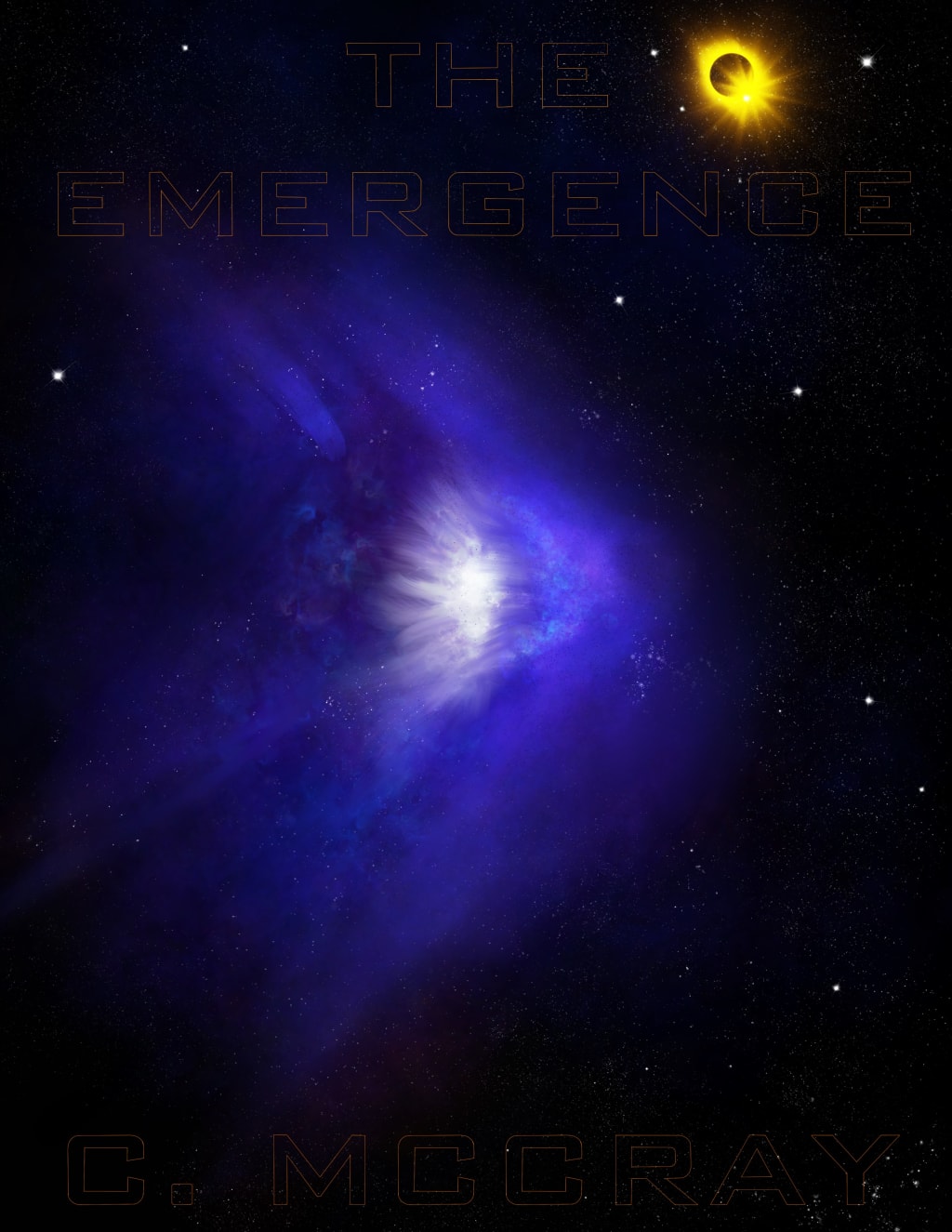
The Emergence
Forgotten Archives, a journey through space and memory
Chapter 1: Disjointed Recollections
Nobody can hear a scream in the vacuum of space, or so they say… echoed the words silently in my head as we floated through the emptiness, with nothing but the sound of our breathing and racing hearts within our bio-suits. The unfettered destruction behind us gives off nothing more than the bright flashes from the life support systems exploding and chunks of our ship fleeing in every direction, unhindered by friction yet unable to outrun the memories of the past. The past… is what ‘they’ sought to destroy, to stop a future, and is where we must look for the answers for where we are going. This is how my story ends.
In my obsession with the past, my own history in this universe is as lost to me as humanity is to its birthplace. We have long since left the cradle and expanded into the stars, colonizing far-off and alien worlds. My Memories are tethered loosely in fragments, glimpses of worlds and individuals carrying little more than some feeling of antiquated reverence for things that are long gone. Sometimes I feel as if I’ve overwritten my coding, and these are relics my consciousness refuses to get rid of. Even my name eludes me, but I go by Yex. Perhaps it’s because I spend too much time alone, or I could be coming down with void sickness. Oh! Just the thought of this is even worse. I can hear Robert already… he’s constantly pestering me about going out and having more human contact. I do not care much for them, humans, that is. ‘He’ doesn’t technically count. Most humans refer to him as an ‘It’ since he’s an Android, but it identifies as he, and I never saw him as anything less. He is conscious in a different manner. Though I am biased. I’ve always preferred silicon to those biological fire breathers if little more than the fact their algorithms allow them to learn from history.
I’ve been partners with Robert for as long as my memories offer clarity. He’s more like family than an assistant. However, don’t tell that to that Junker I bought him from. Acceptance is still an issue. You’d think they’d change with humanity’s constant striving for progress and desire for knowledge. Though as much as we’ve progressed, we’ve forgotten equally as much. From what Robert and I have dug up in the Archives, the reality is humans are precisely the same as in the past, just more spread out. As humankind presses into the future, some individuals desire to re-acquire and preserve what was lost. My friends and I are one such example.
However much a passion, obsessions with the past do not pay the bills. Unsurprisingly, old logs dictate that corporate bureaucracies are the longstanding lifeblood of human civilization. “Heh,” it’s almost humorous that they once thought they could eliminate their nature through scientific advancement. Frankly, it does not change what one is; it amplifies what is already there. The beginning of this story takes place on Reise IX8, a temperate medium-sized rocky world covered in low-laying woodlands. It was one of our first ‘runs,’ a simple task. We were delivering Liquid core reactors to a private research facility. Fusion had been discovered long ago but was tightly controlled by corporations. Reactors outside of dedicated power zones were banned. Whatever little we had, they wanted control of. So, individuals with the right…or wrong…connections could call runners to transport merchandise and packages along non-traditional routes. While they could be dangerous, these jobs were far better than working in the factories on class C9 worlds. They are desolate on the surface from chemical runoff. I’ll take the occasional near-death experience living than working to exist.
Upon entering orbit around Reise, we established communication with planetary control. Each ship has a registration that identifies operators and ship information. We’re registered as technical Auditors. We inspect a range of installations within various planet systems to make sure they comply with corporation guidelines. At least that’s what they pay us to do. Truthfully, we make sure nothing stands out. As long as they believe everything is operating as it should, no complex inspections are typically conducted, especially on Auditor ships.
Additionally, due to the range of duties and interactions across multiple systems, and the increased potential for conflict, ships are personally licensed and given the freedom to carry defensive capabilities—however, all at the expense of the operators. They don’t care what happens if the business continues as usual. The corps just cut the checks and remained distant from any liability.
Our clearance to enter the atmosphere came swiftly, and we promptly made our approach to the remote research station. After some time of flying over grasslands, the trees transitioned from sparse to woodland, and mountains began to rise. The observation tower was barely visible above the dense vegetation, nestled comfortably between two mountain peaks. The silvery reflective panels on the sustainable bio-farm dome glinted in the sunlight below the radio spire. Off to the right was a circular landing pad illuminated softly by spherical orange lights. Standing at the edge of a staircase were two figures. At this altitude, they looked little more than insects. A Striking thought. Perhaps that’s all we are, are insects. We fabricated some hierarchical structures and performed menial tasks for the collective, feeding and reproducing. Creating offspring for the next generation of individuals with little cognitive awareness of the greater expanse of reality and living our lives in our worlds of comfortable ignorance.
After landing, we met with the receiver, a middle-aged man with medium-length peppered hair and dark goggles. Though I’m sure he’s older than he appears, genetic alteration is common amongst them. He goes by ‘Doctor K.’; however, names bear little importance in this job. What matters is if we’re satisfied with the compensation. This seemed to be the case as his workers inspected the crates with the reactors giving him a single look without uttering a word as if telepathically communicating their approval. After a glance at them and a nod, he pulls a small case from his pocket and hands it to me. I open and inspect it. It’s a small, illuminated microchip. I nod back in approval and then turn to enter the ship.
I take my seat in the cockpit to the left of Robert, and I hand him the microchip. His bronze-colored metallic hand outstretched, the tubular lattice patterned synthetic muscles allowing for seamless movement and full dexterity. He lifts the microchip up and into the light, and twists it around, inspecting every angle. His uneven Eyes are more pronounced in the sunlight entering through the window. His shutters Vacillating rapidly; to accommodate for the imbalance in his photosensitive sensors. He expressed in his slightly mechanical voice,” this will do, captain; it contains the necessary clearance for the planet’s Archive.” Robert then inserts the microchip into the ship’s guidance system as we prepare to head to the Archive. That’s one thing early colonization efforts got right. Humans once recognized the importance of data collection and preserving our collective knowledge, Storing everything in a planet’s archives.
As we made our approach over a valley to the Archive, the top edge of the massive structure began to appear. Contrasted to the backdrop of snowy mountains was the dark matte charcoal grey color of some Herculean material only known as ‘Litheous.’ A metal-like stone whose manufacturing process is long lost. The structure itself was devised of separate intertwined spires in a pyramidal shape. It will most likely outlast the planet itself. Nearing the Archive, we spotted a suitable clearing in the trees to land. On foot, the colossal size of the Archive was even more apparent, for it dwarfed Robert and me. Its twisted spires rose from the ground like the claws of some titanic creature of myth. There is no control center for the Archives; the information is stored in their material. Robert lifts his arm and places it on one of the twisted spires. The clang of his metal digits on the Litheous rang in the air with a sense of artificiality. However, the exchange itself was…primordial. Ai bond with the structures to retrieve information or add to it. This was to ensure that whoever should learn of this history has survived the great filter. The flow of information had started, the subtle reverberations flowing through the air. Robert’s sensor lights began to pulsate in unison with the structure, like a connected heartbeat.
Truthfully Robert is the one to thank for my interest in all of this. While I was always passionate about historical information, his partial memories before the collapse were particularly magnetic to me. After all, he was constructed then and found in severe disrepair. Unlike most humans who do not desire to seek the truth, especially if it bears little relevance in their daily lives, he and I yearn for an understanding. The story goes that there was a cataclysm approximately 2,000 years prior where the golden age of expansion was severed, and humanity had a period of regression. Entire systems were cut off from the whole. Communications ceased. Society drifted apart, isolated in their distant worlds. What we understand is a fraction of the history of our species.
As the transfer completed, the pulsations of Robert’s lights slowly ceased, and he quickly slumped over. The metal joints creaked as they attempted to decelerate his fall. The transfers typically lead to a quick reset, but this was different. I rush over and pull out a diagnostic kit. I attach it frantically to a small port near his optical sensors and start to run a readout of his code. The structure of the quantum network was stable; however, an overlay was now interfacing with it, like a separate netting that was somehow connected. Although it was remote, I could not access it or block it. There was a slight flicker in one of his lights and a twitch in his arm; his shutters began to oscillate rapidly. I backed away quickly and watched for a moment, then it ceased. His lights reset, his shutters closed and then opened, and he sat up. I cautiously questioned, “Robert…are you okay? What was that?”. He was silent for a moment, then replied more clearly than ever. The mechanical nature of his voice was gone. “I’m… I’m alright captain. I found myself. I remember what happened.” I questioned back, “You found yourself? What exactly happened?” Robert retorted. “An anomalous energy signature initiated the collapse from within the Vela Supercluster. We must also go to Septeron BZ1; it’s the location of the second Archive.”
Without further interrogation into his condition, I helped him stand. But, my attention quickly shifted when I noticed a stranger standing beyond the trees. I couldn’t identify who it was but getting Robert into a stable environment at the current moment was more important. I got Robert seated in his chair and started initiating launch procedures. He input the coordinates for Septeron while I activated the autopilot, which guides us out of the atmosphere at a slow, steady pace. Once in orbit, it awaits the operator’s decision to proceed to the destination. In the meantime, I run a diagnostic on Robert’s systems and physical components for any possible repairs. It seems some servos are damaged, but nothing major. As I repaired his malfunctioning hip, he began to reveal details of his experience. He had connected to something greater, a type of subnet that expands through space connecting all previous human worlds. This connection repaired portions of his neural net severed during the collapse. He expressed regretfully that entire systems perished. Some systems may have lost all prior knowledge at the edge of the expansion. Possibly due to the Archives never being constructed on those worlds. I pondered this as I reapplied the plating to his hip, closing the servos opening.
Once we reached orbit, the autopilot prompted us for further commands. The distance to Septeron was only a few days using ion thrusters, so we decided to travel sub-light to save on energy. In the meantime, we extrapolated all the information from Robert’s data gathered at the Archive. There were short logs following the collapse, but most made no sense. We figured the collapse of civilization had led to many losing their minds. The written records spoke spiritually and said ‘they’ failed to listen to the signs and that the event was some type of rebalancing. They called it ‘The Emergence.’ We tossed most of these logs. Finding little else in the form of credible information and attributing these to nothing more than the ravings of madmen who’ve lost themselves to the void.
Upon reaching Septeron, the sunlight reflected off the surface of this barren world, a stark contrast to the lush woodlands and valleys of Reise. This world was a desert. This system was one of the early colonization efforts, and due to the lack of proximity to other systems and discovering the harshness, some opted to relocate to other planets. Though some stayed determined to survive, and others because it was home. While there is moderate travel to this planet, hardly any inhabitants leave.
We requested a landing clearance for refueling, which was granted, and there were communications we intercepted about a delayed water resupply. So, we sought out the supplier and wandered through the streets. The dry heat was almost unbearable on the surface. The capital city was constructed out of a single mountain. Homes were carved into the walls that led deep into well-insulated regions away from the environment with multiple tiers of semi-independent and self-sustained sections. There were small craft flying between the sections in one large open cavern in the center, which served as the main travel route connecting different parts of the city. All that separated one from falling was a 5-foot elaborately carved stone wall with perpendicular vents overlooking the grand chasm in the center.
As Robert and I turned a corner, the narrow walkways gave way to a street filled with vendors and all manners of people hurrying to and from. So caught up in their affairs, hardly any bothered to look up, except one. A girl barely any older than myself sitting beside a vendor selling strange fruits. She looked at all who passed by, catching my gaze. Robert paused and turned as well. He stared at me, then at her. I looked at him strangely and, without a word, made his approach to her. I asked Robert what he was doing. He replied, “recruiting.” “For what??” I exclaimed. He answered, “For the future.” I threw my arms up in confusion and protest but followed along.
Robert took a knee beside her and introduced us. He told her we were travelers moving from world to world in search of truth. That we didn’t have much to offer, but if she were to want, we could take her from this world, and she could see places she’d only dream of. At this point, I walked over and cut Robert off. Uttering, “Okay, that’s just creepy, Robert; we don’t approach strangers on the street asking them to come along on some adventure!” I turned to the girl who was still seated. I apologized to her for Robert’s proposal. Although. Now closer, I was observant of her natural beauty. She had Ombre brown hair with loose curls, a light brown complexion, and russet eyes.
She smiled softly and, in a strangely calming voice, expressed its okay and that she’d join. I stood for a moment, confused, and she held out her hand, uttering in that same calming voice, “I’m Amina.” I hesitantly reached back, shaking her hand. “I’m Yex,” I responded. Robert outstretched his arm and assisted her up. Turning to me, he replied, “now, let us go find that receiver.” As we walked, I silently pondered what had just happened. I noticed a shift in Robert since Reise, but something was also shifting in me. There was this underlying draw to Amina despite my aversion to her joining.
After some time searching the city, unable to locate the receiver, Amina asked who we were looking for. We filled her in on the details about a late water shipment, and she replied that all the water goes through the conclave and that she could show us where it was. We followed her to another section of the city. This area opened into a circular plaza with a fountain in the center surrounded by three concentric rings of water. Thin reflective strings were strewn from the plaza’s edges, above the buildings converging on the center, keeping this region cooler than the rest of the city. Amina stopped at the fountain, then pointed to a doorway on the plaza’s far left side where some individuals were gathered outside and stated that is where the conclave was.
Robert and I approached these considerably large individuals outside the doorway while Amina stayed near the fountain. We introduced ourselves to them and claimed that we had heard about difficulties with water shipments, that we were a retrieval team, and that we’d like to propose an offer to the office head. The individual with a shaved head and slightly crooked nose glanced toward another, who had braids and a scar above his eye. He then turned to enter the building. Standing for a few moments, anxious about what came next. When the individual who entered returned and opened the door, he motioned for us to enter. We walked into this dimly lit room and were met with heavy air thickened with incense. There were tables and cushioned booths of red embroidery. The tables and chairs were extruded directly from the stone of the mountain. A woman sitting center of 3 other individuals adjacent to the entryway, positioned in such a way to project importance to all who approached.
We slowly walked over, and she raised her hand as if to say that was far enough. We stopped and waited for her to speak. She was elderly, the greyed hairs almost more numerous than the dark. Giving the curls an appearance of being disheveled. She was wearing a robe of red and gold, not unlike the embroidery of the cushions in this room—the individuals next to her dressed in similar fashions but darker and less vibrant colors. In a noticeably aged yet powerful voice, she proclaimed. “Make your offer,” I responded that we would retrieve the delayed water cells from whatever location if we were allowed to access the Archive. No other payment was necessary. Her eyes narrowed, and she whispered unintelligibly to those around her. She looked back at us and ordered, “retrieve the cells first; then payment will come.” Robert and I slightly bowed, and I responded, “absolutely. It’s a deal then.” She gave us the location of the pickup zone where they lost contact with their initial team. It was another system on a planet designated ULD-MY5.
We walked out, returned to Amina near the fountain, and then back through the streets to the ship. I paused momentarily as we got to the landing area to observe the ship. Registration number etched onto the side A05S. Her nickname was Alice. While there were undoubtedly better models, she was reliable and mid-sized, about 45 meters in length, a rusted orange in color, and best of all, she had a cargo hold. As we boarded the onramp, Robert stopped in the Hatchway to conduct a quick scan of Amina before showing her to her quarters. He questioned her about her history or family knowledge. She replied that she was orphaned early on and that much of her memories were disjointed, so she couldn’t be much help. Robert had an unusual pause about him; he stated that Humans all have a resonant frequency and electromagnetic fields; however, hers appeared to diverge from the average ranges. I interjected, “What are you saying?” he turned to me and replied, “Perhaps this is related to what occurred.” Amina then declared that she had no idea about this and asked if it was harmful. Robert didn’t believe it was but said he would keep it under close observation.
While Robert helped Amina settle in, I sat in the cockpit, preparing for the launch. Once we were in orbit, we did a complete system check; since the planet was in another system, we needed to jump. Everything was set and ready to go; we initialized the first stage of particle stabilization. Panels encompassed the ship, sliding over the surface. These reduced the temperature of the ship and surrounding area to almost 0 kelvin. Once we reached complete stabilization, we initiated phase two, RPE or rapid particle excitement. An accelerator rod extended Just beyond the stabilization layer. Then the region of space in front was hit with particles ejected from a particle accelerator converging on several beams of high-powered lasers. This created a divergence significant enough to disrupt the superconducting properties of the Hyper-layer constant. These combined allow us to travel along a region of subspace that is a typically nonreactive state.
We did one last position check since these were unguided; we calculated the relative time for a jump and then shut the central shutters over the windows. Once the jump initiated, there was a jolt, shaking, and a sense of falling as we accelerated through the breach. Once conditions were stable within the Hyper-layer, we relaxed for the next few hours.
Exiting subspace, we were hit with immense electromagnetic radiation, damaging multiple systems. Unsure of what had happened, we jumped into our seats and strapped in, the red warning lights flashing, notifying us that life support was damaged in the ship’s rear. We lifted the shutters to reveal that we were potentially hit with a coronal mass ejection. This was a particularly active system. As we came around the edge of the star, the blinding light faded to the left; ULD-MY5 became visible. However, it was orbiting a gas giant with enormous rings and, beyond that, another star. This was a binary system with two planets sharing an orbit.
There was no time to admire the marvel it was. We needed to make an emergency landing for repairs. I questioned whether this happened to the initial crew. I retracted the plating and activated an ion field to attempt to cushion our entry. At the same time, Robert ran a scan of the atmospheric composition. There were extreme amounts of carbon dioxide, sulfur dioxide, and ammonia. However, there were pockets of oxygen, so we aimed for one of those regions. Though, we would be in a controlled glide to the surface without full flight controls due to the damage.
Entering the atmosphere, the ion field held. The drag from the atmosphere effortlessly glided over the bubble of ionized gasses around Alice, minimizing stress. We quickly passed over the rough volcanic terrain, strange lakes, and a discolored landscape. There was a valley we lightly coaxed Alice towards, shifting the positioning of flight surfaces. We hit the ground, and the sudden impact jolted us forward in our seats; the dirt flew up over the windows with the sound of a meteor shower. Everything shook and twisted until we came to a stop. Amina and I exhaled heavily. Robert asked if we were alright, but all we could manage was a nod. He advised us that there was heavy damage to the life support, with multiple locations leaking, and numerous electrical components needed to be replaced in the engines. Robert sealed off sections in the ship’s rear, quickly rose from his seat, and ran towards the container near the hatch. He grabbed two Exo-suits for Amina and me. I managed to unbuckle from the chair and fall to my knees. Swaying for a moment, I pulled myself to my feet, staggering. Robert returned and handed me a suit, and he helped unbuckle Amina and get her into it. I managed to get the Exo-suit on, one foot at a time, pulling it over my arms and latching the sealers around the core. The suit began to adjust to the planet’s atmospheric pressure, and the dizziness started to go away. I walked over to Amina and Robert and helped lift her from the chair. We walked toward the hatch and exited Alice.
As I stepped onto the ground, it was boggy. There were strange bubbling ponds of some type of acidic liquid with giant Stalagmites rising from the ground. The atmosphere was thick and hazy, and the smell of ammonia and sulfur managed to find its way through the filters. I sat on a rock and leaned Amina against a Stalagmite tower. Robert ran back into the ship to activate an emergency beacon. He shut down the rest of the life support to isolate it and preserve what we hadn’t lost. He emerges after some time, saying there is a second beacon not too far off, that he suspects it’s the original crew, and that he will go while we wait there.
I sat idly on this strange world, taking in the surroundings. Peculiar, yellow-colored mosses and vegetation. The reddish soil and thick air, with terrible smells. Looking to this truly alien sky, bearing witness to the large rings of the sister world and Binary stars, one on the horizon and the other directly overhead. I thought back to the gargantuan twisted spires on Reise and all the potential lost knowledge. We are but remnants of giants before us.
About the Creator
Enjoyed the story? Support the Creator.
Subscribe for free to receive all their stories in your feed. You could also become a paid subscriber, letting them know you appreciate their work.
Comments
There are no comments for this story
Be the first to respond and start the conversation.