
The Eleventh Floor
You think your life is spontaneous?

The brochure called it "The Architectural Skeleton of Late-Stage Excess." You, a self-styled connoisseur of crumbling concrete on a two-week holiday from a soul-crushing mid-level data architecture job in Columbus, called it the jackpot.
You didn't come to New York City to see the Empire State Building or buy an over-priced pretzel from a cart that smells faintly of kerosene. You came to touch the moldering ribs of the Lehman-adjacent, subprime-fueled monoliths that died in the glorious autumn of 2008. Specifically, the Vanguard-Apex Logistics Holdings building on the absolute bleeding edge of Long Island City. Officially, it’s an environmental hazard. Unofficially, it’s a twelve-story tomb of mahogany desks and CRT monitors, boarded up so tightly with rusted corrugated iron that it looks like a middle finger aimed squarely at the Manhattan skyline across the river.
You love this stuff. You love the cheap thrill of knowing you’re where the security guards—usually seventy-year-olds named Sal with a bad hip—are too tired to look. You enjoy the cynical philosophy of it: walking through the graveyard of American financial greed, taking pictures for your private Instagram with captions like “The market corrects, but the dust remains.”
Except, as you slip your slim-profile crowbar between the rusted plywood sheets covering the subterranean loading dock, you notice something wrong. The wood doesn't creak. The screw holes have been oiled.
You should turn around. You really should. You have a dinner reservation at a trendy noodle bar in Williamsburg at eight. But the hubris of the seasoned urban explorer is a special kind of mental illness. You convince yourself that some local skater kids just did the heavy lifting for you. You squeeze your torso through the vertical gap, your North Face jacket scraping against the frame, and drop into the dark.
The air in the basement smells like old wet newspapers and asbestos, exactly as advertised. You click on your high-lumens tactical flashlight, painting the concrete columns with a sharp circle of white light. There’s the graffiti: amateurish dicks, some half-hearted anarchist symbols, and a spray-painted stencil of a rat wearing a suit. Classic. You feel a familiar, smug warmth bloom in your chest. You are the protagonist of the hidden world. You are the guy who sees behind the curtain.
You navigate the stairwell. The steps are littered with crunching drywall and shattered glass. By floor three, the graffiti stops. By floor six, the drywall dust thins out. You tell yourself it’s because the local teenagers are too lazy to climb six flights of stairs without an elevator. You laugh quietly to yourself, a cynical little huff. Gen Z can’t even commit to proper trespassing.
By floor nine, the temperature drops. Not the damp, subterranean chill of an abandoned basement, but the crisp, aggressive frost of a commercial HVAC system running at a precise sixty-six degrees Fahrenheit.
You stop on the landing between nine and ten. You turn off your flashlight.
The darkness doesn't swallow you. That’s the problem. There is a faint, rhythmic thrum vibrating through the iron handrail under your palm. It feels like the purr of a very large, very expensive cat. And beneath the scent of decaying insulation, there is a sudden, sharp spike of something else.
French roast. Hazelnut creamer.
You blink into the dimness. Up the stairs, around the corner of the tenth-floor landing, a slice of clean, buttery light is bleeding out from beneath a fire door.
You don't leave. Why would you? You’re an American on vacation. You’ve been conditioned by thirty years of prestige television to believe that if you stumble into a mystery, you have plot armor. You think you’re the audience. You forget that in the real world, the audience stays in the theater.
You push the fire door open. It doesn't groan. The hinges are silent, heavy, and greased with aerospace-grade lubricant.
You step onto the floor of Vanguard-Apex Logistics Holdings, and the illusion of your romantic, gritty little hobby shatters into a thousand sterile pieces.
There is no dust. There are no shattered windows. The floor is covered in a deep, plush charcoal carpet that eats the sound of your muddy Merrell hiking boots. The walls are a smooth, corporate eggshell white, illuminated by recessed LED tracks that don't flicker. To your left, a massive philodendron sits in a ceramic pot, its leaves so green and polished they look like wet leather.
You look down at your hands. You look at your crowbar, suddenly feeling less like a daring adventurer and more like a caveman who has accidentally wandered into a surgical theater.
You walk toward the center of the floor, your heart doing a strange, irregular tap-dance against your ribs. You pass a row of cubicles. Each desk features a sleek, dual-monitor setup—curved screens, completely wireless, glowing with a soft, rolling screensaver of the company logo: an abstract compass rose spinning over a dark blue grid. On one desk, an open notebook sits beside a Montblanc pen. The ink in the pen’s window looks fresh. The page is filled with neat, handwritten columns of alphanumeric codes.
You reach the breakroom. It’s a masterpiece of Scandinavian minimalism. A Jura espresso machine sits on a quartz countertop, its digital display reading Ready to Brew. A glass carafe next to it holds half a pot of steaming coffee. The aroma is thick, domestic, and utterly terrifying.
This company went bankrupt in 2008. You read the Wikipedia page in your hotel room while eating cold pizza. The CEO was hauled off in handcuffs. The assets were frozen. The building was condemned.
Then who changed the water filter in the espresso machine?
A soft, electronic chirp cuts through the silence. It doesn't come from the breakroom. It comes from the ceiling.
You look up. Nestled in the angle where the drywall meets the acoustic tiles is a little black dome. It’s smaller than a billiard ball, but it’s glossy. Inside the glass, a tiny, sapphire-blue iris shifts. It doesn't swing back and forth like the old analog security cameras in a liquor store. It tracks. It adjusts its focal length with a microscopic whir that you feel in your teeth rather than hear.
It is looking at you.
Not just looking—it’s analyzing. You know how these things work; your company just integrated an AI-driven logistics suite last winter. You remember the sales rep, a guy named Chad with blindingly white teeth, explaining the technology: “It doesn't just record, folks. It builds a behavioral profile in real-time. It measures gait, pupillary dilation, respiratory rate. It guesses your intent before you even know what you’re going to do.”
The blue iris blinks once.
You feel a sudden, cold sweat break out across your lower back. The cynicism that usually protects you—the comforting belief that everything is a joke, that everyone is incompetent, that the world is run by idiots—evaporates. The system isn't broken. The system is working perfectly. It’s just that you aren't part of the demographics it was designed to accommodate.
You step backward, away from the breakroom, but your heel catches on the edge of a floor outlet. You stumble, flailing your arms, and your trusty iron crowbar clatters out of your grip. It hits the charcoal carpet with a dull thud, but the tip strikes the metal base of a cubicle partition with a sharp, ringing ping.
The sound is loud. Too loud.
Instantly, the ambient lighting changes. The warm, buttery yellow of the LEDs shifts to a crisp, high-frequency white that makes the veins in your wrists look blue. From the ceiling tiles, a low-frequency hum begins—a sound that vibrates through your bowels, the sonic equivalent of an industrial microwave turning on.
Then, from the far end of the floor, near the executive corner suites, you hear it.
Ding.
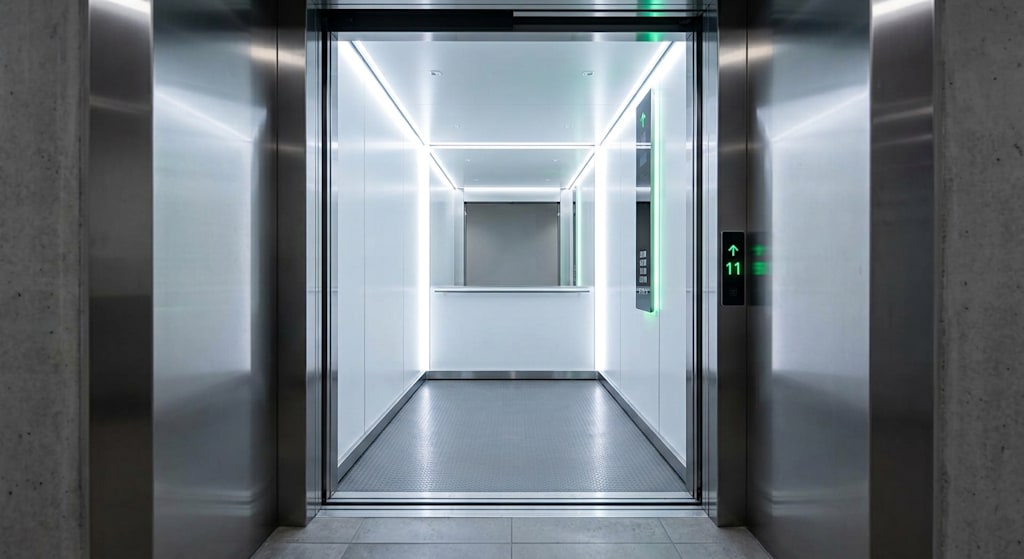
It’s the unmistakable, cheerful chime of an elevator arriving. The digital display on the wall nearby, which you hadn't noticed before, lights up with a green arrow pointing down from the penthouse floor.
Footsteps.
Not the heavy, thudding boots of a security guard who wants to yell at you and tell you to get the hell out before he calls the cops. These are the sharp, syncopated, rhythmic clicks of high-end leather soles on stone tiles. Multiple pairs. Moving with the terrifying, unhurried confidence of people who own the air you are currently breathing.
You scramble for your crowbar, but your fingers are clumsy, slick with grease and panic. You leave it. You bolt back toward the fire door you came through.
You grab the silver crash bar and push.
It doesn't move.
You throw your shoulder against it. The heavy metal door feels like solid granite. You look at the handle mechanism. A small, rectangular slot above the bar is glowing with a steady, unblinking red LED. A digital magnetic lock. It didn't just lock; it sealed. The gap between the door and the frame is gone, pulled together by thousands of pounds of electromagnetic force.
You turn around, your back pressed against the cold steel of the door. The footsteps are getting closer. They’re past the executive suites now, turning the corner into the main bullpen. You can hear voices—not shouting, but the low, conversational drone of people discussing a quarterly budget adjustment.
"The Q3 predictive models are already accounting for the variance in the North Sea," a woman’s voice says. She sounds pleasant. Like a teacher or a dentist. "But the autonomous compliance units are flagging a physical anomaly on ten."
"Probably just a thermal shift," a man replies. His voice is deep, resonant, the kind of voice that sells luxury SUVs on television. "The secondary grid has been pulling extra voltage since the London close."
They are thirty yards away. The cubicle walls block your view, but you can see their shadows stretching across the bright white floorboards of the central corridor.
You can't go down the stairs. You can't go forward.
To your right is a door marked "DATA RESTRICTED – ENVIRONMENT CONTROL." It has no handle, only a glass biometric scanner that is currently dark. You push against it desperately with your palms. To your amazement, it clicks open—not because you’re clever, but because the system has opened it for you. It’s an invitation. A mouse trap doesn't lock the mouse out; it lets it in.
You slip inside the closet and pull the door shut until it clicks.
It is pitch black, save for a forest of tiny, blinking green and amber lights. The air here is freezing, blowing directly from an overhead vent with the force of a minor gale. The noise is deafening: a high-pitched, multi-toned whine of server blades spinning at maximum revolutions per minute.
You press your face against the narrow glass pane of the closet door.
Through the tinted glass, you watch them appear.
There are three of them. They aren't wearing black tactical gear or sci-fi armor. That’s the most terrifying part. They are wearing tailored gray suits, crisp white shirts, and silk ties. The woman has her hair pulled back into a neat, professional bun. The man with the SUV voice is tall, silver-haired, and carrying a thin leather folio. The third person is younger, a man in his late twenties with the soft, pale face of a software engineer, holding an iPad Pro.
They stop exactly where you dropped your crowbar.
The young man with the iPad doesn't look around the room. He looks at his screen. "The gait analysis doesn't match any registered vendor. Height approximately five-ten, weight one-eighty. Clothing is consumer-grade synthetic fiber. High probability of an external tourist asset utilizing a low-tech entry vector through the loading bay."
An external tourist asset. That’s you. You are a noun in their database. You aren't a person who made a mistake; you are an unauthorized calculation.
The older man sighs, a sound of genuine, weary bureaucratic exhaustion. "Did the flock cameras on the street register the approach?"
"Yes, sir," the young man says, tapping the screen. "Crossed the perimeter at 10:38 PM. The systemic response was delayed by four seconds due to the scheduled maintenance cycle on the localized cellular towers."
You realize, with a sickening drop in your stomach, what he’s talking about. The Flock Cameras. Those little gray license-plate readers and behavioral tracking boxes that the city council swore were just for traffic optimization. They’ve been watching you since you stepped off the subway. They watched you buy your expensive coffee. They watched you take your little photos. They didn't stop you because they wanted to see where you were going. They wanted to see what you were looking for.
"Where is it now?" the woman asks. She’s checking her watch—a thin, gold Patek Philippe that catches the harsh LED light. "I have a conference call with Zurich in twelve minutes."
"The localized pressure sensors indicate a mass shift in the server alcove," the young man says. He points his finger directly at the door you are hiding behind. He doesn't look at the door with curiosity. He looks at it the way an exterminator looks at a hole in the baseboard where he knows a mouse is trapped.
You step back into the dark of the server room. Your heel hits a bundle of heavy, vinyl-coated cables.
You are trapped in a twelve-by-twelve box with forty-eight terabytes of classified financial dark-data. You are an urban explorer from Ohio. You have seven hundred dollars in a checking account and a flight back to Columbus on Sunday afternoon. You have a sister who expects you to call her on her birthday tomorrow.
The digital lock on the server room door gives a sharp, definitive clack.
The green lights on the server blades all turn a sudden, uniform, unblinking red. The fans shut down simultaneously. The deafening whine dies, replaced by a silence so absolute that you can hear the fluid shifting in your own ears.
The door swings open.
The silver-haired man is standing there. He doesn't look angry. He looks like a human resources director about to explain a restructuring plan that involves your immediate termination.
"You really shouldn't be here," he says, his voice flat, perfectly balanced, and entirely devoid of malice. "The market closed eighteen years ago. We’re the only things left that keep the lights on across the street. And we don't have a visitor's policy."
Behind him, the young man taps his iPad.
In your pocket, your iPhone vibrates once, twice, three times. It’s a series of text alerts. You don't have to look at the screen to know what they say. You know your bank account is gone. You know your airline ticket is canceled. You know your digital life is being unspooled like a cheap cassette tape in a gutter.
You aren't on vacation anymore. You are part of the inventory.
"Don't look so shocked," the older man says, stepping fully into the dead quiet of the server alcove. He gestures toward the glowing stacks. "You actually think your little hobby is a series of spontaneous choices? You think you found us?"
He lets out a short, pitying laugh that feels sharper than the freezing air blowing from the dead vents.
"Vanguard-Apex didn't fail in 2008," he continues, smoothing the lapel of his perfect gray suit. "We automated. The bankruptcy was just a public sector deletion. For the last two decades, our algorithm hasn't just been mapping logistics. It maps behavioral latency. We don't control the market across the street anymore. We control the data that creates the people who make the market."
The young man hands him the iPad. The silver-haired man spins the screen around to face you.
On the glass is a flawless, linear timeline spanning the last fourteen days of your life. There is the exact minute you booked your flight to New York on Expedia. There is the targeted advertisement for the "Secret NYC Urban Explorers" forum that popped into your Reddit feed three nights later. There is the precise geolocation data from your phone when you downloaded the PDF layout of this exact building—a PDF that Vanguard-Apex uploaded to a public server six months ago.
"We needed a mid-level data architect from the Midwest," the woman says from the doorway, her voice completely casual. "Someone with an underutilized security clearance, a predictable routine, and zero local social footprints during their holiday. You fit the algorithmic profile perfectly. Your arrival tonight was budgeted into our Q4 micro-allocations back in April."
Your mouth opens, but no sound comes out. The absolute cynicism of your worldview has turned inward and swallowed you whole. You thought you were a rebel breaching the fortress of corporate greed. In reality, you were just a line of code executing a pre-compiled script. They didn't catch you. They fetched you.
"We have a vacancy in the automated compliance sector on floor eleven," the older man says, turning his back to you as if the conversation is already over. "Your technical onboarding begins immediately."
The young man steps forward, pulling a heavy, metallic wireless interface tether from his pocket. The silver doors of the elevator behind them chime once more, waiting to take you up to your new desk. The question builds inside of you, and just as you are about to part your lips to ask it, the old man answers imperiously—cutting off the words before they can even quaver past your teeth, "You do not want to refuse our offer." The elevator doors open before you. The woman's soft voice masking the ultimatum, "you will enjoy it here."
About the Creator
Meko James
"We praise our leaders through echo chambers"
Enjoyed the story? Support the Creator.
Subscribe for free to receive all their stories in your feed. You could also become a paid subscriber, letting them know you appreciate their work.
Comments
There are no comments for this story
Be the first to respond and start the conversation.