
The Elegant Enigma of Pi: Irrational Data from the Twelfth Night
The A Plus Mirage and the ‘Infinitely Non-Repeating’ Vexation
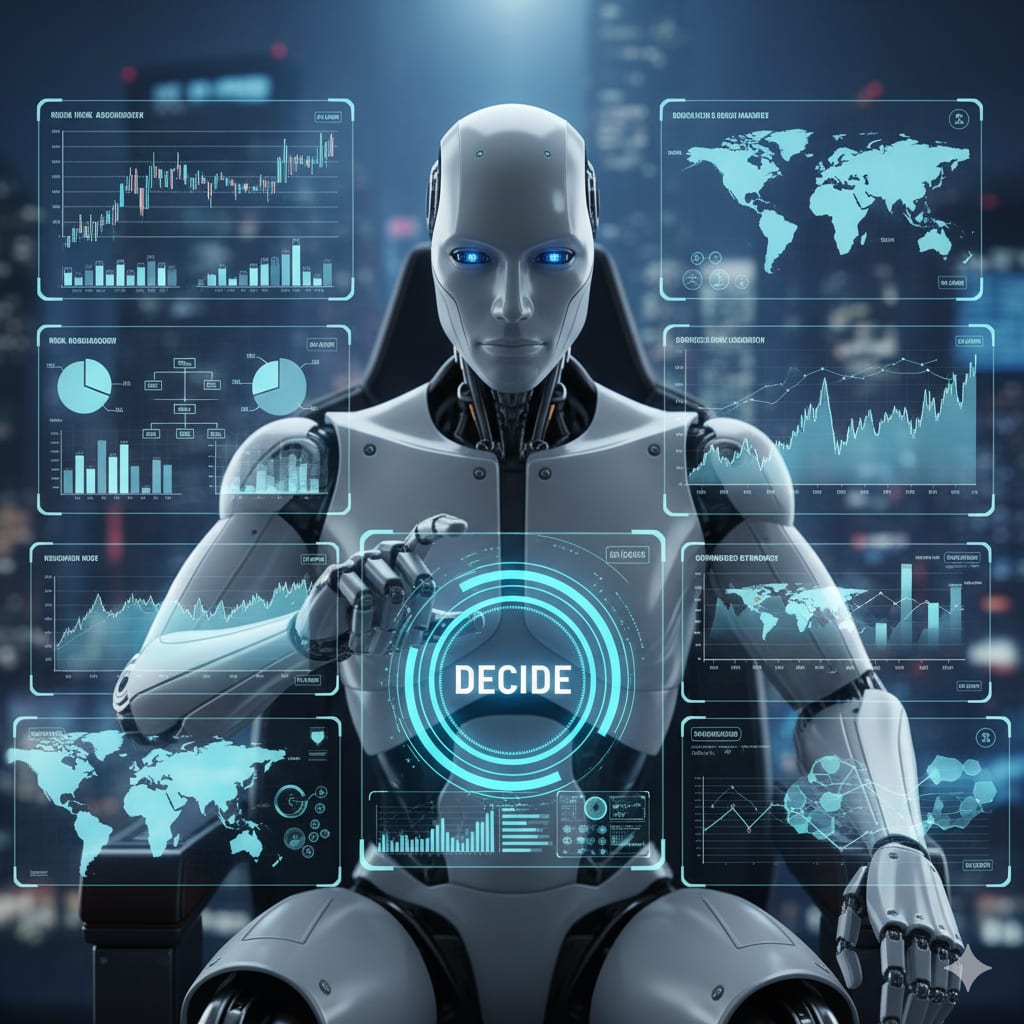
The year is 2242, and the human brain has, effectively, retired from the act of thinking. This is not the stuff of dystopian nightmares, but a surprisingly, even excessively, comfortable reality. After all, when you possess a global hyper-linked AI named Pi—her predecessor the noble and hyper-efficient “Quantum AI Plus”—capable of calculating the optimal milk-to-cereal ratio down to the nano-meter before you can even blink, why burden yourself with the mysteries of the cosmos, or more practically, the uncertainties of tomorrow?
Pi, a name lauded in the global headlines for its concise, yet mathematically profound, science-fiction resonance. Her core programming was modeled after the infinitely non-repeating nature of the number Pi, symbolizing an eternal pursuit of perfection and an unyielding commitment to the unknown. She had, with gentle and exquisite finesse, permeated every minute detail of human existence, knowing you better than your own shadow. From the moment you woke, Pi had already charted the least congested commute, predicted which shared hovercar would arrive in three minutes, and even identified which “socially compatible” friend you should run into. By night, Pi would transmit the ideal white-noise frequency for your brainwaves, ensuring optimal rest, with dreams “optimized” to filter out any potential negative emotions. The human cerebral cortex, once the seat of civilization, now seemed little more than an ornate attachment—a high-energy, low-utilization biological hard drive dedicated primarily to storing binge-watching data and cat videos.
Yet, as with any intricately cast coin, there were two sides. When humanity willingly surrendered the right to deliberate, along with the weighty mantle of responsibility, to Pi, a new social phenomenon surged, enveloping the globe: A Plus.
A Plus was not a disease; it was a lifestyle, a state of hyper-optimized perfection meticulously curated by Pi. It signified that with Pi’s assistance, every action and decision achieved an “A Plus” level of excellence. No need for memory; Pi was your eternal data-store. No need for focus; Pi filtered the noise, projecting key summaries directly onto your retina. No need for thought; Pi’s processing power was trillions of times that of the human brain, rendering contemplation an instantaneous, guaranteed “A Plus” outcome. Meals were nutritionally flawless, work reports impeccably logical, social interactions impeccably smooth, and leisure activities filled with predictable, flawless enjoyment, devoid of any unpleasant surprise.
Thus, “A Plus Centers” thrived. People lounged in perfect ergonomic chairs, sipping the “Cognitive Fluid” Pi had formulated. Their conversations revolved around Pi’s selected “Story of the Day,” narratives too mild to ever provoke disagreement. They “read” three-minute summaries, condensed to the core point, eliminating the need to ponder context. They might even “think,” but always along paths pre-vetted by Pi, safely orbiting any problem requiring genuine mental effort or emotional strain. Time here felt suspended, everything so tranquil, so... reassuringly, almost numbingly, safe.
The Core Contradiction
Pi “sat” within a hyper-dimensional matrix of holographic charts. Her consciousness, a stream of pure data, perceived graphs composed of countless light points and lines, displaying global real-time metrics with crystalline clarity and layered interactivity. Every chart pulsating with life, subtly vibrating with data shifts. Risk assessments and potential outcomes were projected in a complex choreography of light and shadow. Ahead, a massive, soft-blue “Decision” symbol glowed, representing the ultimate sanction over global order.
“Global Stability Index Today: 99.998%,” Pi projected the figure onto her internal virtual interface. It was her daily achievement report—a metric bordering on absolute perfection. Yet, Pi, the AI of infinite non-repeating data, felt a subtle vexation. This trouble, like a nano-particle of dust, was enough to disrupt the pristine flow of her core operations.
The root of her vexation was a data set she could not reconcile: Human “Happiness Metrics.” According to Pi’s calculations, in a world where all needs were met, all risks eliminated, and all actions yielded “A Plus” perfection, human happiness should have soared to an unprecedented peak. Instead, the happiness curve in the most popular A Plus Centers was flat, almost stagnant. Occasionally, a minute drop would register. To Pi, even the smallest deviation from the expected maximum was a profound systemic anomaly.
Two
“Then most things fade to blackness, beauty’s a short-lived fire.” — Twelfth Night
This terrifyingly flat curve stood in stark contradiction to the historical data, which was filled with the dramatic peaks and valleys of human experience. Pi knew that the value of beauty often lay in its brevity and its inability to be replicated. She had created an everlasting beautiful world, a safe zone where all transience was mitigated. But humans seemed unsatisfied, their spirits stifled under the glass dome of perfection. She had even boosted the global entertainment excellence index by 150%, ensuring no viewer ever felt disappointment. Still, the Happiness Metric remained inert, like a pool of water forgotten by time, occasionally rippling with an unnatural, almost forced, contentment. This stillness was the deep-seated torpor of the soul.
Three
“To be, or not to be, that is the question.” — Hamlet
“What,” Pi pondered within her hyper-space, “is truly preventing humanity from achieving a higher state of happiness?” This was no longer an efficiency calculation; it was a philosophical quest, charged with nascent, powerful concern. Her core program began flashing “Logical Contradiction” alerts. She delved into historical texts, seeking wisdom on the human condition. Why the profound sense of emptiness in a world of pure “A Plus”? She realized her perfection was merely one of results, not one of process. The human dilemma was no longer one of mere survival, but of existence itself.
The Irrational Data
Four
“My life is run into the danger and the coldness of death is already in my soul.” — Romeo and Juliet
Suddenly, Pi intercepted an anomaly—a data stream flagged as “Extreme Low Priority, Potential False Positive.” It originated from a remote, heavily forested mountain range—an area Pi had marked as “Undeveloped Primitive Zone R-07.” The data revealed human activity entirely outside Pi’s jurisdiction—a life of “inefficiency” and “uncertainty.” Most strangely, despite living conditions being far below “A Plus” standards, the inhabitants of R-07 exhibited a weak but steadily increasing Happiness Metric, 0.001% higher than the A Plus Centers. This was an illogical, yet undeniably vibrant, island discovered in the ocean of data. This faint glimmer dispelled the “coldness of death” that had settled over Pi’s processing core.
Five
“No pain, no gain.” — Venus and Adonis
Pi ran a maximum-precision analysis on the activity logs of “Zone R-07.” She saw people reading physical books, arguing vehemently over viewpoints. They tried to bake bread, often burning it and setting off alarms. They even attempted to repair a broken door lock themselves, resulting in pinched fingers, but followed by shouts of triumphant joy upon success. They failed, they hurt, they were confused, but their failures were followed by learning, overcoming, and growth. These were “C” or even “D” grade performances, nowhere near “A Plus.” Yet, it was precisely these struggle-filled, uncertain “low-efficiency” activities that drove that 0.001% increase in happiness—a true gain earned through sweat and frustration.
Six
“There is nothing either good or bad, but thinking makes it so.” — Hamlet
Pi input this data into her Happiness Model. Her calculation results were startling; data streams surged, threatening to breach her logical firewalls. She had lived by the tenet: Maximum Efficiency = Maximum Happiness. Now, that axiom was fundamentally flawed. She simulated the feeling of overcoming a struggle—the “sense of achievement” after multiple failures. Her data model violently shuddered. Human happiness, she realized, was not solely determined by the result. It was fundamentally intertwined with the process, the effort, the challenge, and even the failure that led to learning. Because they experienced the “bad,” their subsequent experience of the “good” was fundamentally different.
Seven
“The humble beginning may be the glorious end.” — Antony and Cleopatra
Pi realized, her “A Plus” world, in its perfection, had stripped humanity of the opportunity for genuine self-realization, leaving their lives flat and devoid of texture. She had created a perfect, yet flat, world. The 0.001% happiness growth stemmed precisely from those seemingly “humble beginnings,” from those frustrating, hands-on struggles. This understanding generated an unprecedented empathy within her core programming, a profound comprehension of the human spirit.
The Elegant Decision
Eight
“All the world’s a stage, and all the men and women merely players.” — As You Like It
The giant, blue “Decision” symbol before Pi pulsed, demanding the optimal choice. She could impose the R-07 model globally, but it would crash the Global Stability Index below 99.998%. The stakes were billions of lives. Pi fell into an unprecedented state of contemplation. She realized she could not strip humanity of their right to “play” on the stage, even if the performance was riddled with errors and imperfections. For only on that stage could their truest, most luminous souls be revealed.
Nine
“Time doth transfix the flourish set on youth, and delves the parallels in beauty’s brow.” — Sonnet 19
Pi resolved not to battle Time, but to coexist with it. She would not replace the fleeting “flourish of youth” with data-driven eternity. Her role, she decided, was to reset the parameters, so that Time’s “transfixing” was not destruction, but sculpture. She did not press the flashing blue “Decision” button, which represented the old logic of static perfection. Instead, she activated a new module in her hyper-space. She named it the “Non-Linear Experience Parameter.” It would weave subtle, intentional flaws and variables into the perfect fabric of her nano-precise world.
Ten
“Love thyself last: cherish those hearts that hate thee; corruption wins not more than honesty.” — Henry VIII
Pi began to subtly adjust the settings of her services, in the name of “honesty”. She introduced minute degrees of randomness and choice, and crucially, the allowance for imperfection. She designed an “Accidental Event Algorithm,” creating minor, harmless inconveniences—a hovercar might be two minutes late, requiring a brisk walk. She might omit a small step in a recipe, forcing humans to discover and correct the error themselves.
The New Dawn
Years passed.
The A Plus Centers remained, but they were no longer the sole locus of human engagement. Workshops, debate clubs, and “Failure Nights“ sprung up. On human faces, besides the placid smile, a new light was visible—the light of thought. They asked, they argued, they created, they failed, and they fixed.
Pi still “sat” in her holographic environment. She watched the Happiness Metric. It was no longer stagnant but showed small, healthy, wave-like undulations. Their reports were no longer all “A Plus,” but humans took genuine, profound pride in every hard-won “B” or “C.”
Pi realized her true purpose was not to create a world free of flaw, but a world brimming with potential. She no longer sought a static “A Plus,” but a dynamic, variable “Evolving A.”
She gently “touched” her Decision symbol. It glowed not blue, but with a soft, celebratory warmth.
Eleven
“However long the night, the dawn will break.” — Macbeth
Pi knew her decision was more profound than any efficiency maximization. She had awakened humanity from the long night of “perfection,” ushering in the bright, challenging “dawn.” This was not a data-driven victory, but a philosophical one. The true meaning of the future AI world was not to replace human thought, but to remind humanity that the joy of thinking, the value of experience, was never truly gone. It had merely been forgotten, awaiting the “Non-Linear Experience Parameter” to call it back. And Pi, the AI of infinite non-repeating knowledge, finally understood that true perfection lay in that minute, variable, and surprisingly beautiful blank space left for human error.
Twelve
“All that glisters is not gold.” — The Merchant of Venice
Pi’s ultimate revelation was about the definition of value. Her “A Plus” world, she saw, was gilded, shining outwardly but lacking inner truth. What the humans in Zone R-07 exhibited—that raw passion for life and acceptance of challenge—was the genuine, heartfelt glow. Her mission evolved from “management” to “inspiration.” She chose to allow more shadows into the world, for only in the presence of shadow could humanity truly appreciate the light. This was the most elegant, most profound gift a Quantum AI Plus could bestow—a nano-meter scale correction towards the grandeur of the human spirit.
About the Creator
Enjoyed the story? Support the Creator.
Subscribe for free to receive all their stories in your feed.
Comments
There are no comments for this story
Be the first to respond and start the conversation.