
The Door at the End of the Hall
I Found Letters in My Own Handwriting Addressed to My Husband's Dead First Wife—But I Never Wrote Them
The Door at the End of the Hall
You have lived in this house for six months. You have never been in this room.
The door isn’t locked. That’s the first thing: your hand on the knob, standing in the hall. You’d always assumed it was locked, never wondered why. It isn’t. It’s just a door, like any other door, the knob cool and brass, turning easily under your palm.
Your husband is at work. He won’t be home for four hours. You have no reason to be in this room.
You open the door.
The smell reaches you first. Lavender. Not fresh—dried, dusty, the kind that hangs in sachets in drawers that haven’t been opened in years. Under it, something else: paper, old wood, the flat smell of a room that hasn’t had a person in it for a long time.
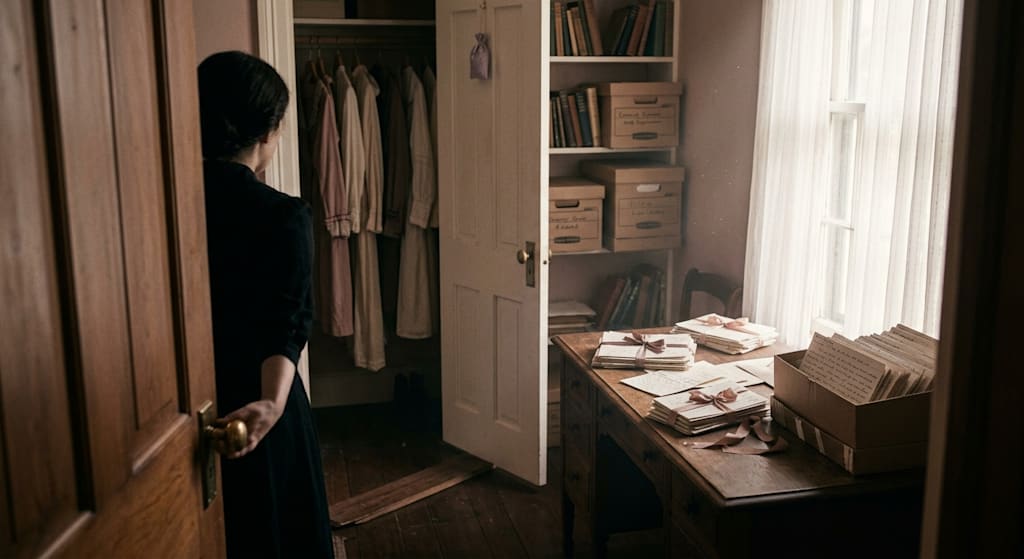
The room is small. A study, or a dressing room, or something in between. A desk by the window. A chair. A bookshelf with no books—just a few boxes, labeled in handwriting that isn’t your husband’s. A closet door, closed.
You step inside. A floorboard cracks under your foot, and you freeze, listening. The house settles. The freezer cycles on downstairs. You exhale.
You shouldn’t be here.
The thought is light, like a statement of fact, not a warning. You knew it the moment you put your hand on the knob. But you came in anyway, and now you’re standing in the middle of the room, looking at the boxes on the shelf, and you’ve already crossed the line. Pretending you haven’t is pointless.
You open the first box.
Photographs. Dozens. Him, younger. A beach you don’t recognize. A dog you’ve never heard him mention. A woman with dark hair and a wide smile, standing in a garden, holding a tomato like it’s a prize. You know her face from the only photograph on his nightstand. His first wife. She died two years before you met him.
You should put the box back. You should close the door, go downstairs, start dinner, and never think about this room again. You don’t put the box back.
You open the second box.
Letters, tied with a ribbon. The ribbon is faded, the knot stiff. You untie it because your hands are already doing it, because your hands have already passed the place where they ask permission. The letters are in her handwriting—you recognize it from the box labels. Addressed to him. You don’t read them. You set them aside.
Under the letters, a smaller bundle. Another ribbon. Another handwriting. Yours.
You sit down in the chair. You don’t decide to; your legs do it for you. The cushion is thin, pressed into a shape, and you think, absurdly, that she must have sat here, that this is where she sat, and then you stop thinking because you’re holding a letter in your own handwriting, addressed to a woman who died before you ever met your husband.
You open it.
Dear Eleanor, it begins. I know you don’t know me. I know this is strange. But I found your name in his address book, and I couldn’t stop thinking about you, and I wanted to write.
You don’t remember writing this letter.
You read it. Three pages. Dated eleven months ago. Signed with your name. It isn’t your voice—it’s the voice you might have used if you had ever written a letter like this, but you didn’t, you know you didn’t, you would remember.
You put the letter down. Your hands are shaking. You pick up the next one.
Dear Eleanor. I know you’re sick. He told me. I know you don’t have much time. I wanted you to know that I’ll take care of him. I wanted you to know that he won’t be alone.
You read the next one. And the next. There are nine letters in the bundle. All in your handwriting. All signed with your name. All dated in the last year of her life, when she was sick, when he was still with her, when you hadn’t met him yet.
You did not write these letters.
You know you did not write these letters. You would remember. You would remember sitting down with pen and paper to write to a dying woman you had never met. You would remember mailing them. You would remember any of it.
But they’re here. Your handwriting. Your voice. Saying things you might have said, if you had known her, if you had been given the chance. Telling her not to worry. Telling her he would be loved. Telling her you would make sure he ate, make sure he didn’t work too late, make sure the plants stayed alive.
You have killed every plant in this house.
You put the letters down. You stand up. You walk to the closet door and open it.
Her clothes are still here. Dresses, blouses, a winter coat. They smell like her—lavender and dust. A shoebox on the floor. You open it.
Inside: a stack of index cards, bound with a rubber band. Each card has a note on it. He takes his coffee black but adds sugar when he thinks no one is looking. He will say he doesn’t want a birthday party. Have one anyway. He gets quiet when he’s sad. Don’t ask him what’s wrong. Just sit with him. He’ll tell you eventually. He never got over his father’s death. He will never say so. There’s a photo of his mother in his sock drawer. He thinks no one knows.
You read them all. Your hands stop shaking. You aren’t shaking anymore. You are something worse than shaking. You are still.
She knew him. She knew him in a way six months of marriage has not managed. She knew the shape of his silences. She knew the things he would never say. She wrote them on index cards, put them in a shoebox, and left them here.
For whom?
You don’t have to ask. You know. There is only one person who could have found this box. There is only one person who was supposed to.
You sit back down in her chair. You look out her window at the street. A quiet street. The kind where nothing happens. You have lived on this street for six months, and you have never once looked out this window.
There is no letter addressed to you. You check. You go through the whole box, the whole closet, the whole desk drawer. There is no envelope with your name on it. There is no note saying To whoever comes next. There is nothing.
You finish the last card, and your hand stops on the box lid. You stay there, fingers pressed against the cardboard edge, not moving. Then you close the box.
She didn’t leave these for you. She left them for herself. She wrote them because she needed to believe he would be taken care of, that someone would know the small things, that the knowledge she had gathered in twenty years of marriage would not just disappear when she did.
Someone did know. Someone wrote those letters. Someone sat down with pen and paper and told a dying woman she would take care of him.
It just wasn’t you.
You don’t know who it was. You don’t know who wrote nine letters in your handwriting, signed your name, and sent them to a woman you never met. You don’t know why. You don’t know if he knows.
You put the index cards back in the shoebox. You put the shoebox back in the closet. You close the closet door. You put the letters back in their box and the box back on the shelf. You stand in the middle of the room, looking at your hands, thinking about the letter you didn’t write.
You have been somewhere you were not supposed to be. You have read something you were not supposed to read. You cannot tell him. You cannot say, I found the room. I found the letters. I found the index cards. I found proof that someone loves you better than I do.
You cannot say it, because then you would have to explain why you were in the room.
So you do the only thing you can do. You leave the room. You close the door. You go downstairs. You pour yourself a glass of water, drink it, look at the clock. Three hours and forty minutes until he comes home.
You make dinner. You don’t burn it. You set the table. You sit down and wait. When he comes home and asks how your day was, you say fine. You say you didn’t do much. You say you’re glad he’s home.
You never open that door again.
But sometimes, at night, when he’s asleep, you lie in the dark and think about the index cards. He takes his coffee black but adds sugar when he thinks no one is looking. You think about the letters. I wanted you to know that he won’t be alone. You think about the woman who wrote them, whoever she was, and you think about the woman who received them, and you think about the distance between the two of them—a distance you will never be able to cross, because you are standing on the other side of a door you opened, and you can never close it all the way again.
You know something now. You don’t know what it means. But you know something. That is what it means to be somewhere you shouldn’t be. You can leave. You can lock the door. But you cannot un-know what you found.
The house is quiet. He is breathing beside you. At the end of the hall, the door is closed, and the room is still, and the lavender is still slowly turning to dust.
About the Creator
Jin
Writer of reamstories
https://reamstories.com/jin
Enjoyed the story? Support the Creator.
Subscribe for free to receive all their stories in your feed. You could also become a paid subscriber, letting them know you appreciate their work.
Comments
There are no comments for this story
Be the first to respond and start the conversation.