
The Deadly Dorm: The Dark Covenant
The contract is simple: open the door, and you become the next hand that turns the key.
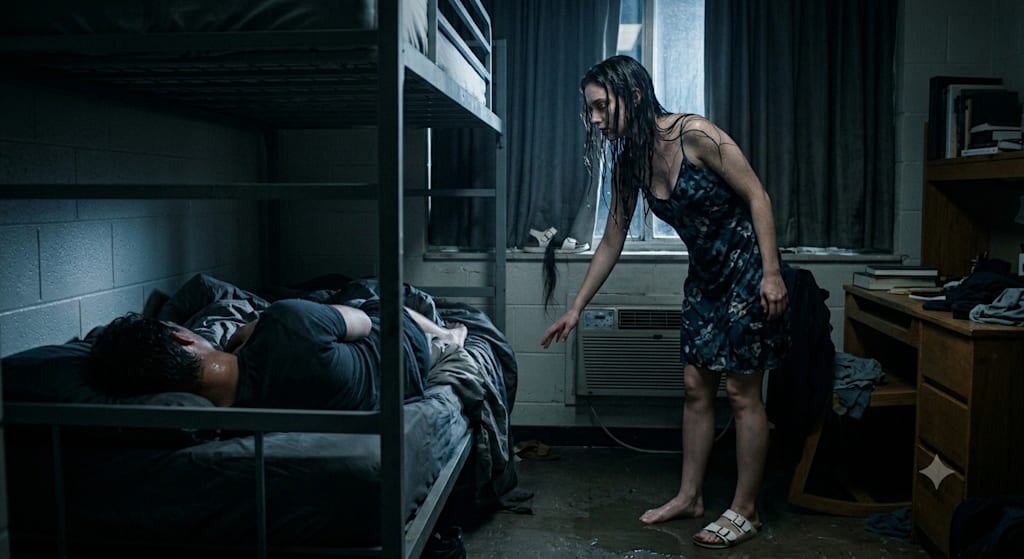
The night Lucas brought Chloe into Room 207, I was on my back staring at a crack in the bunk board above me. The air conditioner had been dead for two days. The room was baked. My tank top stuck to my skin, sweat tracing each rib. Down the hall, the water fountain let out a gurgle every few seconds — the sound of a drowning man pushing out his last breath.
The key turned twice. The door swung in, dragging a draft and the coconut smell of her.
“Won’t bother you, Ethan.” Lucas kept his voice low, one hand flat against the small of her back, as if he were tacking a notice to a wall.
I rolled to face the wall.
They moved to the top bunk. The iron frame telegraphed every motion — a knee sinking into the mattress, an elbow landing on the pillow, a belt buckle tapping the rail. Then she slapped him. The sound was crisp and fast in the darkness. She climbed down quickly, bare feet hitting the ladder rungs one heavy, one light, landing with a sticky pat on the floor. The bathroom door closed, and a blade of light bled through the gap before it was snapped off.
Up top, Lucas swore into his pillow, his voice muffled, like it was traveling through water. He pulled the blanket over his head. The frame shook once, then went still.
I buried half my face in my pillow, holding in the laugh.
She stayed in the bathroom for nearly an hour. The faucet ran, stopped, ran again — someone washing the same hand over and over. Then the door opened, and bare feet crossed the tile and stopped at the foot of my bed.
I felt her turn toward me.
Even with my eyes closed, I knew. Your skin knows when someone is watching. The hairs on the back of your neck lift, your scalp tightens, and your breathing turns shallow on its own. She looked at me. Forehead to chin. Shoulders to the toes peeking out from the blanket. The air conditioner’s last cold breath swept over my instep; every hair stood.
She stood there a long time. Long enough that I almost fell asleep. Then a shifting sound came from the top bunk — a body turning over — and she finally climbed the ladder. The mattress sagged. Fabric whispered against fabric. Quiet.
Lucas left early the next morning. He sat on the edge of the bed, tying his shoelaces with slow, fumbling fingers, as if the act of tying shoes had suddenly become something he needed to learn again. He told me there was trouble back at the farm; he had to catch a Greyhound to eastern Oregon by noon.
“She won’t be coming back,” he said, not looking at me.
He folded his T‑shirts into tight squares and stuffed them into a canvas duffel bag. Hangers clattered against the closet door. At the door, his hand already on the knob, he paused. He glanced back, lips parting. Not at me — at the empty floor at the foot of my bed.
Then he left. His old ankle injury made his footsteps drag a little, left foot heavier than right.
The air conditioner got fixed that afternoon. The repairman pulled a woman’s sandal out of the unit — left foot, white strap, a long dark‑brown hair tangled in the buckle. He set it on the windowsill, swapped in a new filter, and left. I leaned against the headboard, staring at that sandal. The toe pointed at my pillow.
I found the news after dark.
Local traffic report, three days old. A pickup had flipped on Interstate 84, torn through the guardrail, and plunged into an irrigation canal. Two dead. The photo showed a crumpled front end, and in the passenger seat, a woman’s sandal — right foot, an exact match for the one on the windowsill.
Names of the deceased: Lucas Miller, 21. Chloe Zhou, 20.
Time of death: 4:20 a.m., three days ago.
Three days ago. The very first night Lucas had brought Chloe into the dorm. I sat on the edge of the bed, phone screen lighting my face, thumb hovering over the call button. It hovered a long time. Then I turned the phone over, screen down on the blanket.
Down the hall, the water fountain gurgled. The AC compressor cycled off, and the room sank into a bottomless silence.
Then I heard the sheets above me shift — the slow drag of fabric, like someone turning onto their side.
The bed frame creaked.
A rung on the ladder pressed down. Then the next. Then the next. Bare feet landed on the floor.
The wet smell of Ivory soap, mixed with rust from old pipes, drifted from the ladder. Then coconut — body wash, the Walmart store‑brand sweetness, and beneath it a deeper, thicker note. Blood. Blood thinned with water.
She stood at the foot of the bed.
My toes were outside the blanket, goosebumps rising. I wanted to pull them in, roll over, open my eyes — but I didn’t. I lay in the dark, heartbeat drumming against my eardrums. Then I felt her move closer. Not a sound — no footsteps on the floor — but my skin caught the shift in air, the space in front of my shins displaced by something solid. Cold crept up my ankles, my calves, my knees. She bent down. Her face was directly above mine. Coconut and rust filled every breath. Her hair hung down; the ends brushed my chin, my Adam’s apple. Wet, cold, gritty with silt. My lips pressed together.
She smiled. Not a sound — just that tiny change in the air as lips parted in the dark, caught by my skin. Her fingers hovered just above the corner of my mouth. Not touching, but the chill seeped through the seam of my lips.
“I know you’re awake.” Her voice was so close, it could have come from inside my own ear. “You’re awake every night.”
I opened my eyes.
Her face was inches from mine. Moonlight cut through the curtain gap and fell across her cheekbone. Her skin was translucent; beneath it, a net of fine blue capillaries, perfectly still, no blood moving. Her irises were light brown, ringed with the thinnest edge of gold — like the last light leaking past the moon at the moment of a total eclipse.
“Where’s Lucas?” she asked.
“Dead. So are you.”
“I know.” She straightened, pulling her fingers away from my mouth, and looked down at me. That gaze was the same as the first time we’d met — not looking at a person, but measuring a piece of furniture, checking if it would fit an empty space in a room. “You’re not him. He can’t touch me.” She raised her right hand and spread the fingers. A silver ring, engraved with fine patterns, circled her ring finger. Inside the band, an inscription: T.R. to M.C. ’98. “After the truck went into the water, his hand passed right through mine. His blood ran into my wounds. We died together. So we can never touch each other.”
She lowered her hand and looked at me again.
“But you’re different. You’re alive.”
She bent down and placed her hand flat on my chest. Through the sweat‑soaked tank top, her palm was cold as a metal spoon just pulled from the fridge. Five fingers spread slowly, covering the center of my sternum — right where my heart was, beating against the bone, against her hand.
“Your heart is so fast.” Her thumb slid up my collarbone, an inch higher, pressing the artery beside my throat. “Here too. And so hot.”
Her fingers traced the artery up along my jaw, to the root of my ear, stopping on my cheekbone. Her body followed, bending lower. The strap of her floral slip dress slipped off her shoulder, baring her collarbone and more of that pale skin. Her knee pressed onto the edge of the mattress; it dipped. She was closer now. The coconut mixed with the rust of blood was so strong it almost choked me. Her lips hovered above mine, less than a finger’s width apart.
“Do you want to touch me?”
I didn’t answer. My Adam’s apple bobbed beneath her thumb. The corner of her mouth curved slowly. It wasn’t a smile — it was something older, the expression of a predator measuring the pulse in her prey’s throat. She pressed her lips to mine.
Not a kiss. A tasting. Her lips were cold, soft as silk left too long in water. She took my lower lip between hers, slowly, deliberately, her tongue tracing the line, smearing coconut and rust across my mouth. Her hand slid from my face to the back of my neck, fingers threading into my hair and tightening. Her nails dug into my scalp with enough force to sting, and I didn’t push her away.
I reached up and took hold of her waist.
It was narrow — so narrow my hands could nearly circle it. The fabric of her dress was wet; the slightest pressure from my fingers squeezed water out, running down the backs of my hands. She lowered her weight onto me, knees bracketing my hips, straddling me. Even through the dress her skin was cold, but beneath that cold was another temperature — not body heat, something deeper, like a seed buried in frozen soil that still, after a long winter, holds the urge to sprout.
She broke the kiss and straightened slightly. Moonlight carved deep shadows into her collarbone. She reached up and slowly drew down the other strap of her dress. The fabric slipped over her chest and gathered at her waist. Her body in the moonlight was so white it almost glowed. Beneath the skin, a fine web of blue veins spread like a frozen river. Her breasts were small, well‑shaped, the areolas a very pale brown.
I reached out.
The moment my fingertips touched her skin, she drew a breath — a dead woman has no breath, but her sternum rose, her diaphragm contracted, her ribs flared like wings. My palm covered her. Cold, soft. She was using my hand to warm herself. I felt my own body heat draining into her palm, into her, siphoned away little by little, some ancient transaction.
“You haven’t been touched in a long time,” I said, my voice hoarse and unfamiliar.
“Twenty years.” She closed her eyes; her lashes threw fine shadows across her cheekbones. “You’re the first.”
She grasped my wrist and guided my hand down her body. Ribcage, waist, hipbone. Her stomach was flat, and below her navel there was a very faint vertical line where the skin was thinnest. So thin I could sense nothing moving beneath — no pulse, no peristalsis, only silence, stillness. The dead have no heartbeat, no warmth, no blood flow, but they remember what touch feels like.
She leaned down, lips at my earlobe, tongue tracing the edge of the cartilage. Cold poured into my ear canal, shooting down the auditory nerve straight into the deepest part of the brain, into the place that processes both desire and fear.
“Do something for me,” she whispered against my ear. Her breath was cold, but every word burned. “And then you can do whatever you want with me.”
“What?”
“Open a door for me.” Her fingers traveled down my chest, past my navel, stopping at the waistband of my jeans. Through the denim, she drew a small circle. “The door I died through. I have the key, but dead hands can’t turn it. I need a living one. I need you.”
Her finger hooked into my waistband and gave a light tug.
“You open the door. I give you myself. A fair trade.”
I caught her wrist and moved her hand away from my belt. She looked at me, that ring of gold in her eyes flaring for an instant — not anger, something deeper. Expectation. She expected me to refuse. She was used to it: being refused, being let down, being left in the water waiting for someone who never came.
“I’ll do it,” I said. “But first I want to know what’s behind the door.”
Her expression shifted. Not disappointment. Not gratitude. It was the satisfaction of hunger finally meeting food — the satisfaction of the first bite, lips just pressed to the prey’s skin, teeth not yet sunk in.
“Behind the door is where I died,” she said. “And where I live. Thomas is there. He’s been waiting for me. Twenty years. But you don’t have to be afraid of him. He can’t touch me anymore. Only you can.”
She lifted my hand to her lips and kissed my palm. Cold lips, the tip of her tongue tracing the starting point of my lifeline, sliding down that crease.
“You open the door. Then you bring me back through it.” She pressed her cheek into my palm and closed her eyes. “Or stay there with me. Either way. I don’t care. As long as I’m not alone anymore.”
Footsteps sounded in the hallway.
Heavy, slow, each step like someone trudging up from the bottom of a river. They passed the water fountain, the elevator, the next room. They stopped outside our door. Beneath the door, a puddle seeped in, dark in the moonlight, carrying the smell of river silt.
Chloe pulled away from me and stood barefoot on the floor, facing the door. The corner of her mouth curved into a smile — not threatening, not tender. The smile of someone who, after twenty years, finally sees all the pieces moved to their correct squares.
“Lucas is here,” she said. “He wants to stop you. Don’t let him.”
She turned back, bent down, and pressed her lips to my forehead. This time her lips had warmth — not heat, just a faint borrowed warmth, as if pulled from somewhere else.
“You have to choose me.” Her voice seemed to vibrate directly out of my marrow. “You have to choose between him and me. You’re the living one. You’re the only one who can choose.”
The door opened.
Lucas stood outside, water streaming down his gray hoodie and pooling at his feet. His face was gray — cement, cold ash. His lips were split in several places, but no blood filled the cracks, only dried tissue. His eyes were the gray of the dead, but inside them burned a living fire.
“Ethan, let her go.” His voice didn’t come from his throat; it rumbled out of his chest like a sunken bell struck by an underwater current.
Chloe retreated to the bedside and pulled her strap back up, but her movements were slow — slow enough to let Lucas see every inch of her skin, every wet trail. She looked at him without guilt, only a tired recognition.
“You can’t touch me,” she said. “You couldn’t touch me in the water twenty years ago, and you can’t now. He’s different. He’s alive. His skin remembers me.”
Lucas stepped inside. With every step, more water spread across the floor. He positioned himself between Chloe and me, facing her, back to me. His shoulders trembled.
“Then you shouldn’t turn him into the next me.” His voice was low, but not from restraint — it was the low of a string pulled so tight it’s about to snap. “You can’t drag everyone down with you. You can’t make him die in your place just because you’ve been waiting twenty years.”
“How do you know he wants to live?”
Chloe circled around Lucas and came to stand in front of me. She reached out and ran the back of her fingers slowly down my cheek. Her nail left a faint red line on my chin.
“Ask him. Ask him if he’s been waiting for me every night for three nights. Ask him why he took that sandal off the windowsill and put it beside his pillow. Ask him why he didn’t lock the door tonight.”
I said nothing. But I didn’t deny it either.
Lucas turned to look at me. There was something in his eyes I couldn’t read. Not anger, not jealousy. Surrender. The surrender of a man who has stood at the edge of an abyss for a long time, and finally sees another man walk up beside him.
“You like her,” Lucas said. Not a question. “You’ve only seen her three times.”
“She stood at the foot of my bed and watched me for three nights,” I said. “After you crashed, she came every night. At first I was afraid. Then I wasn’t.”
“Then what?”
I looked at Chloe. Her eyes were startlingly bright in the moonlight, that gold rim glowing faintly. Her head tilted slightly, waiting for my answer.
“Then I waited for her to come.”
Lucas turned his face away. His Adam’s apple bobbed, then bobbed again. Dead men don’t cry, but his eyes grew wet.
“Then go to hell together,” he said, and his voice was suddenly exhausted, like a man who’d walked a very long way. “But understand — once you open that door for her, you won’t be fully alive anymore. You’ll carry death with you. Your hands will grow colder. Your heart will beat slower. One day you won’t know if you’re still alive or already dead. That’s the price.”
“Did you pay it?”
“I’m paying it now.”
He turned and walked to the door. At the threshold he paused, not looking back, just resting one hand on the frame. Water dripped from his knuckles.
“The door is underwater, out on Highway 84. After you open it, if you want to come back, hold her hand tight and don’t let go. If you do let go —” He paused, his throat working again. “If you let go, you’ll stay on the other side. With her. With Thomas. With all the ones trapped in the water.”
His silhouette disappeared at the end of the hall. The water fountain gurgled.
Chloe wrapped her arms around me from behind. Her chest pressed against my back; there was no heartbeat, but her arms were strong, the grip of a drowning woman clutching her last piece of driftwood. Her cheek rested between my shoulder blades, lips pressing against the knobs of my spine.
“Thank you,” she murmured into my back. “Thank you for choosing me.”
I pulled her hands from my waist and turned to face her. The moonlight was bright enough now that I could see every tiny bead of water on her collarbone, could see the texture of that gold ring in her irises — not light, but something older, like an inscription carved into the floor of the eye.
“I haven’t chosen yet,” I said. “I haven’t opened the door. And you haven’t given me anything.”
Her lashes flickered. Then she smiled — not the predator’s smile from before, but something real, with a hint of surprise and challenge.
“Then now.”
She stepped back and drew the straps off her shoulders again. This time she didn’t let them slide slowly; she seized the front of the dress and pulled the whole thing over her head. It fell to the floor with a wet slap, a jellyfish’s corpse. She stood naked before me, her body cut by moonlight into halves of light and shadow — one side pale as plaster, the other drowned in deep blue. Her hipbones were narrow, the skin of her inner thighs smooth and unlined. Around one ankle was a thin silver chain with a tiny cross, its horizontal arm bent crooked — whether from the crash or earlier, I couldn’t tell.
She stood there, no covering, no shame, no tease. She was simply laying herself open, like a book turned to its last page, letting the reader decide whether to go on.
“This body has been dead twenty years,” she said, her voice matter‑of‑fact, as if describing a museum artifact. “It’s been soaked, buried in mud, gnawed by fish. I don’t care. It’s still mine.” She placed a hand on her lower belly and slid it down a little. “It still remembers being touched. Being loved. Being entered. There’s only memory left, but memory can be real enough.”
She stepped forward and unbuttoned my jeans. Her fingers were cold, but her movements were slow — slow enough that each metal button leaving its hole made a tiny, distinct scrape. My jeans slid to my ankles. She knelt in front of me, tilting her head up to look at me.
“Are you afraid of me?” she asked.
“Yes.”
“Then why don’t you run?”
I bent and buried my hands in her wet hair, pulling her face closer. When her lips met my stomach, she took in a very soft breath. Her tongue traced a line just below my navel, moving along the crease of my groin, using every trick she could still remember.
I closed my eyes. Coconut and rust flooded my sinuses. On the windowsill, the sandal had somehow turned its toe toward us.
I pulled her up and flipped her, pressing her down onto the bed. The mattress soaked through where her wet body met it. Her legs wrapped around my waist, the silver chain at her ankle digging into my lower back — cold and hard. When I entered her, she didn’t gasp, her temperature didn’t rise, but her fingers dug into my shoulder blades, nails sinking deep into the muscle, using a force that belonged to the living. Her lips pressed against my collarbone, teeth biting lightly on the ridge of bone, as if she wanted to leave a mark on me — a mark the other dead could see.
She kept her eyes open in the dark. That ring of gold glowed steadily, faintly, like the last radiation from the collapsing core of some distant galaxy.
“What’s your name?” she asked from beneath me, her voice broken into syllables by my movements.
“Ethan.”
“Ethan.” She repeated it, as if searching her memory for an empty slot to store it. “Ethan. Deeper.”
Afterward, she lay beside me, her head resting on my arm. My body heat was seeping into her skin — or her cold was seeping into my bones. I couldn’t tell the direction. Outside, rain had started falling without me noticing; it tapped on the glass, mixing with the water fountain’s gurgle into something like a half‑heard dirge.
“Where’s the door?” I asked.
“At the bottom of the irrigation canal.” Her fingers drew circles on my chest, not as cold as before. She was pulling my warmth out of me. “We go just before dawn. The water’s clearest then.”
“And then you’ll leave.”
Her fingers stopped.
“Yes,” she said. “But if you don’t let go, you can come with me.”
“To the other side of the door?”
“To the other side. It’s not heaven, not hell. Something else — a narrow lane between life and death. Very dark, but very quiet. No waiting, no disappointment. Just me and Thomas, and all the others who opened doors for me before you.” She propped herself up to look at me, hair hanging down to cover half her face. “If you come with me, you can never come back. Your body will cool here, be found by a janitor, taken away by an ambulance. But your consciousness — your sensations — will stay behind that door forever. With me in the dark. Every day. Every night.”
Her fingers slid from my chest to my lips, pressing on the lower one.
“That sounds like a horror story,” I said.
“It’s a horror story. And a love story.” She bent down and pressed her forehead to mine. Her irises filled my vision, that gold rim nearly taking up everything. “I’ve learned one thing in my whole life — no, in the twenty years after my death: love and terror are the same thing. They both make your heart race. They both stop your breath. They both make you want to run and want to stay at the same time.”
She pressed her lips to the center of my brow.
“I won’t lie to you. If you open the door for me, you’ll die. You’ll become what I am. Trapped in death, always desperate for touch, forever unable to touch most of the living. But you’ll be able to touch me. I’ll be here. Forever. I won’t make you wait anymore.”
Dawn was approaching.
The rain stopped. The sky outside the window went from black to gray, from gray to the palest blue. Chloe sat up, picked her dress off the floor, and put it on. She wrung out her hair, water falling onto the tiles and flowing toward the door along the seams. She went to the windowsill, took the left sandal, then crouched and pulled the right one from under the bed — when it had appeared there, I didn’t know. She put them both on, securing the buckles. The tiny keys on the buckles caught the early light, the tarnished brass glinting green.
“Let’s go,” she said.
I dressed and followed her out of Room 207. The hallway was silent. The water fountain had stopped its gurgling. The janitor’s cart sat in the corner, the mop still wet. We took the stairs. At the second‑floor landing, I paused. It was empty — no wheelchair, no Thomas. Only a line written on the wall in black marker:
Ethan Carter, 207, Sophomore. Status: Departing.
Lucas’s handwriting. He had written it some night, waiting for the day I’d pass by and see it.
Chloe took my hand. Hers was warmer now, almost a living temperature — heat borrowed from me. My own fingers were already starting to cool.
We left the dorm and crossed the empty campus. The lawn sprinklers were on, revolving slowly, painting tiny rainbows in the sunrise. Chloe didn’t dodge the spray; droplets hit her face and ran down her cheeks. She closed her eyes for a second, the beads clinging to her lashes before falling.
We stole an old Honda from the student lot — keys still in it — and drove east on Interstate 84. The sunrise burned on our left, the sky going from pale blue to orange‑red, then orange‑red to gold‑white. Chloe sat in the passenger seat, feet propped on the dashboard, the silver chain on her bare ankle glinting. She stared down at the two little keys in her palm, sometimes glancing over at me, her eyes holding a faint, pale sadness — not regret at leaving, but at leaving me.
“You should turn back,” she said.
“What?”
“You should turn back, Ethan. Before you get to the door. You still have a heartbeat. A body temperature. A chance to be an ordinary living man. Find a living woman, have a living marriage, raise a living daughter. Treat Room 207 like a nightmare — wake up and forget it.”
“You don’t want me to come?”
She was quiet for a moment. Wheat fields rolled past the windows on both sides, golden waves rippling in the wind.
“I do,” she finally said, her voice soft. “I want you to come with me. I’ve spent twenty years wanting someone to stay with me. But I didn’t want you. I wanted Thomas. I wanted Lucas. I wanted anyone I already loved before I died. You’re not them. You’re clean. You don’t owe me a thing.”
She turned her face to the window, watching the guardrails and mile markers fly past.
“I lied to you. There was no ‘all the others who opened doors for me.’ You’re the first person I’ve ever brought here. And you’ll be the last. Because if this doesn’t work —” She clenched the keys tight. “I’ll throw the keys away. Keep waiting in the water. Another twenty years.”
I hit the brakes. The Honda idled on the shoulder, hazard lights ticking. She turned to me, and there was water in her eyes — not river water, not canal water, but her own tears.
“You’re crying,” I said. “The dead can still cry.”
“Because you’re an idiot.” She wiped her eyes with the heel of her palm, but more tears came. “You’re idiot enough to die for a ghost you’ve met three times. Do you even know what’s behind that door? The darkness, the narrow lane — I guessed all of that. Thomas has been waiting twenty years on the other side; he might be insane by now. Or maybe there’s no lane at all, just drowning on repeat — flip, swallow water, die, flip, swallow water, die, over and over.”
I reached over and pressed my hand over hers, stopping her from rubbing her eyes. She laced her fingers through mine and squeezed, hard enough to make the joints pop.
“I promised you,” I said. “I’ll open the door. I didn’t say I’d definitely go with you. But I will definitely open the door.”
She looked at me for a long time. Then she pulled my hand to her face and pressed her cheek against it. Washed with tears, her face was closer to a living woman’s than ever before.
“Then drive,” she said.
The crash site was easy to find. The guardrail on the embankment had been smashed open; the gap was shaped like a door. Below it lay the irrigation canal, the water reflecting broken silver in the morning light. It was shallow — shallow enough to see the silt at the bottom and the wreck of a white Ford F‑150. The nose was buried in mud, the tail jutted out of the water, driver and passenger doors both hanging open like a pair of spread wings.
Chloe and I walked down the embankment. Barefoot in the silt, the cold climbed my shins. When the water reached our calves, Chloe stopped. She stared at the submerged doors; her chest wasn’t breathing — no, she had no breath — but her sternum rose and fell sharply.
“He’s down there,” she said. “Thomas. His wheelchair is gone. He’s in the water.”
She handed me the two keys. Brass, green with patina, small enough to hold in my mouth.
“You go down,” she said. “I’ll wait here. If you don’t open the door, I can’t go down. If you do open it — then you decide. Come with me, or stay on the bank.”
I closed my fist around the keys and looked at her one last time. The hem of her floral dress floated on the water, a white camellia blooming open.
Then I took a deep breath, bent over, and submerged.
The water was murky. An irrigation canal shouldn’t be this muddy, but maybe the crash had churned up the silt, maybe two decades of sediment had never settled. I opened my eyes in the yellow‑brown murk, and they stung like sandpaper. But I could see — the pickup’s wreckage, the open doors, and embedded in the center console between the seats, a white wooden door.
Identical to Room 207’s door. The number was mounted on it.
I slid both keys into the two locks at the same time. Left hand upper, right hand lower. Turned them together.
The lock tumblers gave a soft click.
The door opened.
Behind it was light. An overwhelming white light, as if all the noon sun had been compressed into one room. In the light stood a man, young, early twenties, wearing a gray hoodie from ’98. He looked seven parts like Lucas, but thinner, quieter. His eyes were gray‑blue, the same color as the canal’s surface when it reflects the sky.
Thomas Lane.
He stood in the light, endless whiteness behind him. The water didn’t enter the door — inside it was dry, warm, blindingly bright.
He extended his hand. No wounds, perfectly clean, palm up.
“The keys,” he said.
I laid them in his palm. His fingers closed, brushing my fingertips — warm. The first time in twenty years anyone had touched him.
“You swam her across,” he said, his voice calm, as if he’d waited so long that even excitement had become a luxury he could no longer digest. “Where is she?”
“Up on the water. She can’t come down. She needs you to go up and get her.”
Thomas nodded. He pushed the door open a little wider. Then he looked at me. That gaze wasn’t gratitude, wasn’t hostility; it was something more complicated — a man watching another man fulfill his promise for him.
“You like her,” he said. Also not a question.
I didn’t answer.
“It’s okay.” Thomas stepped through the door and into the water. His body was solid, not a ghost. The one in the wheelchair was still on the bank, but here he was whole — able to walk, able to go to her. “You like her, but you opened the door for her. That’s enough. I won’t forget.”
He swam past me, rising toward the surface. I stayed underwater, watching the open door.
Inside, the white light was dimming. White to gold, gold to orange, orange to deep red, deep red to dark violet. The light was contracting, cooling, turning from noon sun to evening embers. The door wouldn’t wait long. It had already waited twenty years; it wouldn’t wait for anyone’s decision now.
I looked into the door. Inside was a narrow lane, black — not darkness, but solid black, like a path paved in obsidian. No walls on either side, just endless space. No heaven, no hell, no judgment, no punishment. Only eternal quiet. Exactly as Chloe had said.
My hands were going cold. My heartbeat was slowing.
Lucas had said that those who touch death lose their living heat bit by bit. I looked down at my hands — the nail beds were already turning blue. I reached into my pocket and found my dorm key. The leather tag was still there, the engraved lines still the same. I pulled it out and set it beside the open door. A goodbye.
Then I turned and swam for the surface.
The water went from murky to clear, from warm to cold. My lungs started aching — this time I was truly holding my breath, not breathing underwater. I broke the last skin of water and grabbed the grass roots on the bank, hauling myself out.
Chloe and Thomas stood in knee‑deep water. They weren’t embracing, weren’t kissing. Just facing each other, her hand on his chest, his hand covering hers. Their foreheads touched, eyes closed.
Then Chloe opened her eyes and watched me climb onto the bank. She walked away from him toward me, her dress dragging through the water, the sun half‑drying her hair.
“You came up,” she said.
“I came up.”
“You didn’t stay.”
“No.”
She stood in front of me. Water dripped from both of us. Her face held no disappointment, no anger — something softer. Gratitude mixed with regret, the last few seconds before parting.
“Then you have to go back,” she said. “Back to school. Back to your life. Back to the lifetime you haven’t finished yet.”
“You’re going with him.”
“I’m going with him.”
She slipped off the left sandal and placed it in my hand. The buckles were empty; the keys were gone.
“Keep this,” she said. “So you’ll remember. So you’ll know you helped a woman dead twenty years find her way home.”
She unclasped the silver cross from her ankle chain and set it on top of the sandal.
“This too. It’s bent. Fix it for me. Or don’t. Either’s fine.”
She stepped back. Thomas came up and draped his arm around her shoulder. They turned together and walked toward the underwater door. The water climbed her knees, her waist, her collarbone. She looked back at me one last time, that gold rim in her eyes fading — not vanishing, but transferring, following her into the door, into the narrow lane, into that place of eternal quiet.
Her lips moved, shaping a silent word.
I read it. Thank you.
Then she and Thomas sank into the door together. The white light flared one last time, lighting the whole canal like noon. Then it died. The door was gone. Only the rusted pickup wreck remained, and the driver’s seatbelt swaying gently in the current.
I sat on the grassy bank, soaked through, a woman’s sandal and a bent silver cross in my hand. The sun was fully up now. Traffic began passing on Highway 84, tires humming dry on the asphalt. A pickup slowed; the driver leaned out and asked if I needed help.
I said no.
I hitchhiked back to campus. It was afternoon when I reached the dorm. The hallway was quiet, the water fountain silent. Room 207’s door was closed. I unlocked it with my own key. The AC was running; the cold air was dry and odorless. On the windowsill sat the other sandal — the right one, the one Chloe hadn’t taken. The pair was finally together, side by side, toes facing the window.
On the nightstand, an unopened bottle of coconut water, a gas station price sticker on it. Beneath the bottle, a note.
Lucas’s handwriting. Pencil, crooked letters:
Ethan —
You came back up. Good.
I’m gone. Going to find my own door. Don’t look for me. Don’t wait.
Drink the coconut water for me.
—Lucas
I folded the note and put it in the drawer. I twisted open the bottle and took a sip. Warm, cloyingly sweet, but better than I’d expected.
That night I slept in the dorm alone. No one stood at the foot of the bed, no one turned the faucet on and off, no one dropped from the attic hatch. Just before dawn I woke once, half‑dreaming that someone was sitting on the edge of the bed, a hand resting on my forehead. Cool. Not icy. Just cool enough.
I opened my eyes. The room was empty. The curtain lifted in the morning breeze. Outside the window, a northern cardinal was calling from the oak tree.
I rolled over and slept again. That sleep lasted a long time; when I woke it was already afternoon. Sunlight covered the floor, lighting the white sandals on the shoe rack. They were still there. Hadn’t disappeared. Hadn’t turned to ash. Just sitting quietly side by side, waiting for the next summer, the next resident of Room 207.
I got up, opened the window, let the September wind blow in. Someone down the hall was playing a guitar — Ryan, who’d just moved into the next room, singing a song about Idaho potatoes.
I took Lucas’s gray hoodie out of the closet, folded it, and put it in a canvas bag. Along with the sandals, the cross, the half‑drunk coconut water. I packed everything, labeled it with the names Thomas Lane and Margaret Zhou, Lucas Miller and Chloe Zhou, and took the parcel to the campus lost‑and‑found. The round‑faced girl at the counter frowned at the names.
“Didn’t these people graduate a long time ago?”
“Maybe,” I said. “Maybe they’re still around.”
She put the parcel on a dusty shelf, next to the cushion of an old wheelchair. A pair of worn leather gloves sat on the cushion.
By the time I left the lost‑and‑found, my fingers had fully warmed. My heartbeat was back to normal. The cost Lucas spoke of — “carrying death with you” — seemed not to have stuck with me. Or maybe it had, and I just hadn’t noticed yet.
That night I lay in bed scrolling on my phone, thumb moving mechanically. Suddenly a local news alert popped up: a single‑vehicle crash on Interstate 84 east of Baker City — a white Ford F‑150 had broken through a guardrail and plunged into an irrigation canal. The driver was pronounced dead at the scene. No passenger was found.
The article included a photo. A young man in the driver’s seat, early twenties, gray hoodie, the faintest smile at the corner of his mouth. It was Lucas.
But the news timestamp was today. Today’s date. The time: 4:20 a.m. this morning.
Not three days ago.
Today.
I stared at the screen. My thumb hovered over the share button for a long time. Then I saved the photo, turned off the phone, rolled over, and faced the wall.
At the end of the hall, the water fountain gurgled. The AC compressor kicked on, cold air flooding back in, dry and odorless. I pulled the blanket to my chest and closed my eyes.
No one at the foot of the bed.
But I knew — tomorrow night, or the night after, or some late hour I hadn’t yet anticipated — a new Chloe would be standing there. With the coconut body wash, the floral dress dripping water, a single sandal left on one foot. She would stand at the foot of the bed and watch me, waiting for me to open my eyes, waiting for me to help her find the key, waiting to ask me the question she’d asked a thousand times already:
“Where is he?”
And this time, I would tell her.
I would tell her that Thomas was waiting for her on the other side of the door. That Lucas was flipping his truck over and over in the loop until someone helped him find his own door. And that I — Ethan Carter — would be here. In Room 207. In the room that never lets anyone go.
Because I’d already touched death.
Because I was already waiting for her to come.
About the Creator
Jin
Writer of reamstories
https://reamstories.com/jin
Enjoyed the story? Support the Creator.
Subscribe for free to receive all their stories in your feed. You could also become a paid subscriber, letting them know you appreciate their work.
Comments
There are no comments for this story
Be the first to respond and start the conversation.