
The Day the Internet Predicted Everyone's Death
A mysterious website appeared overnight and it started predicting the exact time people would die.

A Normal Morning
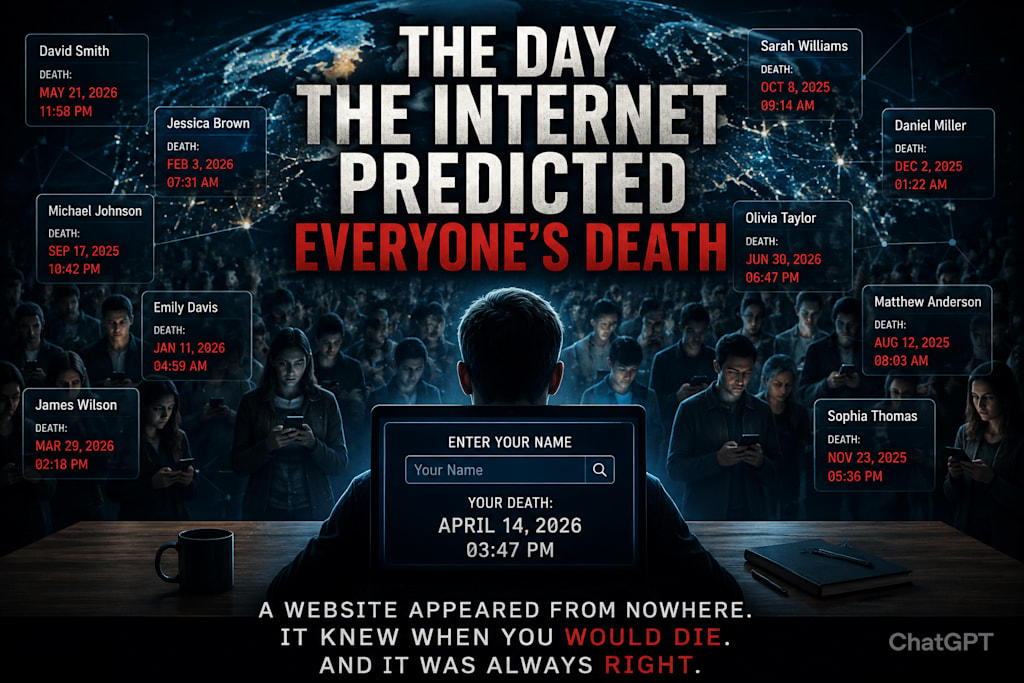
The morning began like any other. People woke up, checked their phones, scrolled through social media, and prepared for work or school. Nothing seemed unusual until a strange website appeared online. Nobody knew who created it or how it had suddenly become accessible in every country at the exact same time. The site's design was incredibly simple. Visitors saw only a search bar and a single instruction: Enter your name to discover the exact date and time of your death. Most people assumed it was another internet hoax designed to attract attention. Within hours, millions of curious users began entering their names.
The First Predictions
At first, the website seemed harmless. Users received dates ranging from decades in the future to the following year. Many laughed and shared screenshots online. Social media platforms quickly filled with discussions, memes, and jokes about the mysterious prediction site. However, the mood changed dramatically when reports began appearing from around the world. Several people who had received predictions for that same day died at the exact times listed on the website. The coincidences were disturbing, but many still believed they were random events amplified by online speculation.
The Accuracy Becomes Impossible
As the day progressed, more predictions came true. News channels began reporting cases of individuals who had died precisely when the website had predicted. Some deaths resulted from accidents, others from medical emergencies, and a few occurred under circumstances nobody could explain. By evening, statisticians and researchers had reviewed thousands of cases. The probability of the website being correct by chance was effectively impossible. Panic began spreading across the internet. What had started as a curiosity was becoming something far more terrifying.
The Global Obsession
Within twenty-four hours, nearly every person with internet access had visited the site. Governments attempted to block it, but the website remained accessible everywhere. Technology companies claimed they had no idea where it was hosted. Cybersecurity experts failed to identify its creators. The site seemed immune to every attempt at removal. Meanwhile, millions of people became obsessed with their predictions. Some canceled vacations. Others quit jobs, ended relationships, or made life-changing decisions based entirely on the date displayed on their screens.
The Man Who Tried to Escape
One story captured global attention. A wealthy businessman in London received a prediction stating that he would die in a car accident at 3:15 p.m. three days later. Determined to prove the website wrong, he locked himself inside a secure underground shelter with no access to vehicles. Journalists monitored his actions closely. At exactly 3:15 p.m., a delivery truck lost control on a nearby street and crashed into the building above him. The impact caused part of the structure to collapse. He died instantly. The website's prediction had been correct.
The Fear of Knowing
As more predictions came true, society began changing. Some people refused to check the website, believing ignorance was preferable to certainty. Others became consumed by the knowledge of their death dates. Mental health services were overwhelmed. Religious leaders struggled to explain what was happening. Financial markets became unstable as investors reacted to widespread uncertainty. Across the world, a single question dominated every conversation: if death was unavoidable, what was the point of knowing when it would happen?
The Unexpected Discovery
Several days later, a group of independent programmers made a surprising discovery. Hidden within the website's source code was a message. Unlike the rest of the site, it appeared intentionally concealed. After translating portions of the code, they uncovered a sentence that shocked the world. It read: The predictions are not causing the deaths. They are only revealing them. The statement suggested that the website possessed knowledge rather than power. Somehow, it knew the future but wasn't responsible for creating it.
The Countdown Begins
One week after the website appeared, a new feature was added. Every visitor could now see a global countdown displayed at the top of the homepage. The timer showed exactly thirty days remaining. No explanation accompanied it. Speculation exploded across the internet. Some believed it marked the site's disappearance. Others feared it counted down to a global catastrophe. Governments formed emergency task forces while scientists searched desperately for answers. Yet no one could determine the purpose of the timer.
The Final Day
When the countdown finally reached zero, billions of people watched simultaneously. For several moments, nothing happened. Then the website changed. The search bar vanished. The death predictions disappeared. In their place appeared a single message addressed to humanity. The statement explained that the experiment had ended successfully. It claimed that people had spent their entire lives fearing death without truly understanding life. By revealing the future, the website had forced humanity to confront its greatest fear. Then the message ended with three words: Now live differently.
A World Transformed
The website disappeared immediately afterward. Every attempt to recover it failed. No backups existed. No records identified its creators. Yet its impact remained. In the months that followed, people began reevaluating their priorities. Many spent more time with family and friends. Others pursued dreams they had postponed for years. The knowledge that life could end unexpectedly became impossible to ignore. Although fear had initially dominated public reaction, something else eventually replaced it: perspective.
The Remaining Mystery
Years later, nobody knows who created the website or how it obtained information that should have been impossible to know. Researchers continue studying archived screenshots and surviving data, searching for clues. Some believe it was an advanced artificial intelligence. Others suspect a government experiment or something beyond human understanding. The truth remains unknown. What is certain is that humanity changed forever on the day the internet predicted everyone's death. The website may have vanished, but the question it forced the world to confront still remains: if you knew exactly how much time you had left, would you live your life any differently?
About the Creator
Robert Redford
i create powerful, easy-to-read articles on everything from history and world events to technology, lifestyle, and thought-provoking ideas. If sparks curiosity, I write about it. Always exploring, always delivering something worth reading.
Enjoyed the story? Support the Creator.
Subscribe for free to receive all their stories in your feed.
Comments
There are no comments for this story
Be the first to respond and start the conversation.