
The County Spoke in Clear Channels
rural paranoia, institutional horror, first-person flash, procedural dread, black comedy

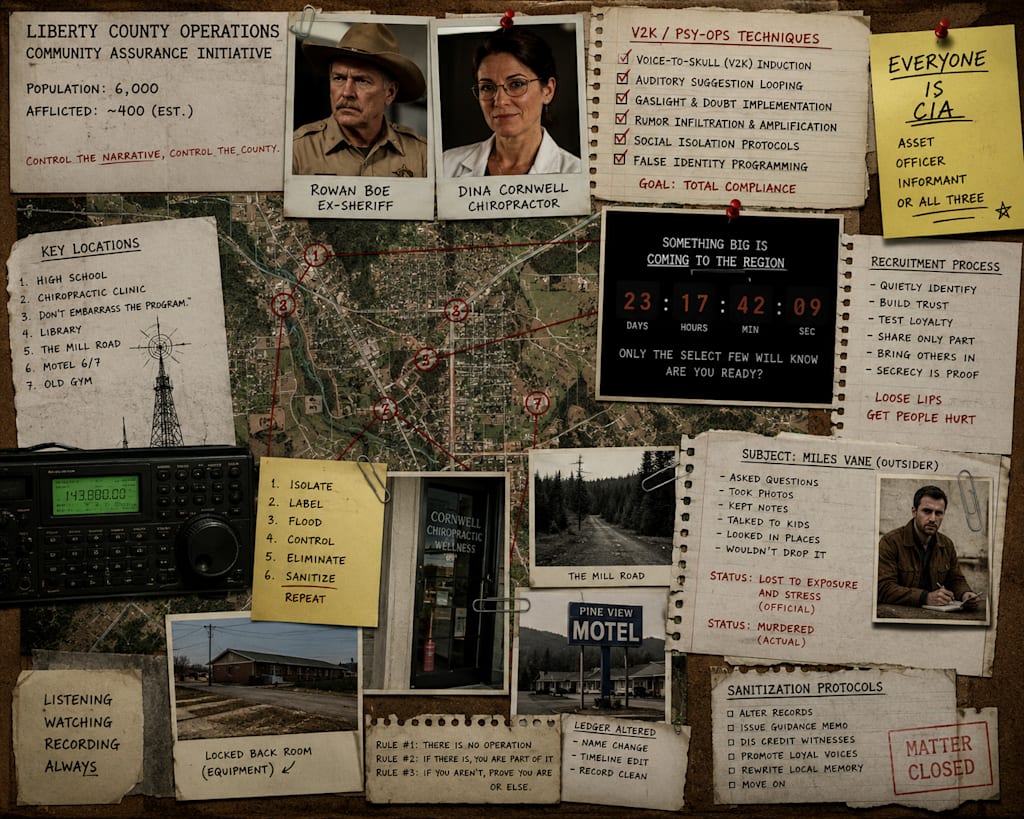
I first noticed the voices in the grocery store, between the canned peaches and the patriotic paper plates.
Not voices exactly. More like thoughts wearing county-issued boots.
They came in clean, rehearsed bursts: asset, officer, compromised, don’t embarrass the program. The words never arrived from a mouth. That was the trick, or the joke, and in our valley jokes were just threats with better posture.
Rowan Boe used to be sheriff, which meant people still lowered their voices when he entered a room, the way villagers once lowered candles around spoiled meat. Dina Cornwell rented rooms behind the chiropractic office and smiled with all thirty-two teeth, each one apparently cleared by federal review. Together they ran what they called “community assurance.” The rest of us called it nothing, because nothing is the local dialect of survival.
The town had six thousand people if you counted the ones who had already left in their heads. Four hundred were afflicted, though no one used that word. We were “briefed,” “sensitive,” “asked to cooperate,” “invited into awareness.” There is always a polite term available when cruelty has a secretary.
The in-person part was simple. Someone would lean close at the laundromat and whisper, “You know she’s CIA, right?” Then someone else would correct them at the pharmacy: “Not CIA. Asset.” At the bar, a man with deputy hair and no badge would buy you one beer and say, “You didn’t hear it from me.” This was how the valley baptized you. Not with water. With deniability.
The invisible part was harder to laugh off. At night my window hummed. My fillings seemed to hold committee meetings. A phrase I had not spoken would appear in three different mouths by noon. Maybe it was equipment. Maybe it was suggestion. Maybe it was four hundred frightened people repeating a script until even the pine trees learned their lines. The forest has always been a reliable witness and a poor defendant.
Dina had a website that year. Black background, white numbers, a countdown to something “coming to the region.” High school kids found it first, because adolescents have a natural talent for locating poison and calling it lore. They were told to recruit quietly. They were told secrecy proved maturity. They were told only special people could understand.
Special people are the easiest livestock.
One boy, Dina’s son or nephew or some other family-shaped credential, cornered me behind the old gym and said it was a CIA project. He looked proud and tired, like a child who had been handed a loaded gun and instructed to describe it as a flute.
The outsider came in February.
He called himself Miles Vane and wore a brown jacket too thin for Montana. His habit was asking direct questions, which made him vulgar. He wrote names in a notebook. He asked why the retired sheriff still received calls on county emergencies. He asked why the chiropractic office had a locked back room with a router cage and a cot. He asked why three students had vanished from basketball practice on the same Thursday and returned unable to explain where they had been.
Direct questions are a form of trespass. Around here, people prefer the softer crimes.
I met Miles at the library computers, where he was printing screenshots of the countdown site. Dina came in behind him with a paper cup of tea. Rowan stood outside by the curb, admiring the parking meters with the grave attention men give objects they do not intend to pay.
The librarian smiled too long. A teacher removed one page from the printer tray and folded it into her purse. Someone behind the stacks whispered, “He thinks he’s investigating.”
Miles looked at me then, and I saw the poor man still believed facts were objects you could carry safely in public.
“Are you one of them?” he asked.
“No,” I said.
From nowhere, very close to my skull, a voice answered, That is what one of them would say.
The room laughed, not loudly. Just enough to prove there had been no room.
That afternoon they crossed the line. A deputy without a badge took Miles’s notebook from his hands, smiled, and thanked him for volunteering his materials. Dina touched my elbow and said, “You’re doing beautifully by not escalating.”
Not escalating is a civic virtue. So is drowning quietly.
Twelve days passed. Time behaved itself. It drove the school bus. It opened the bank. It wore a fleece vest and asked whether anyone had plans for the weekend.
Then Miles began showing up in fragments. His car behind the clinic. His jacket in the church donation bin. His name erased from the motel ledger and replaced with “M. Vale,” as if a missing consonant could provide legal shade. On the local forum, someone posted that he had gone east for work. Someone else replied, “Good. Outsiders stir up illness.”
Illness was the approved word.
Murder was not.
I heard the channels at night more clearly after that. Do not repeat unverified claims. Do not interfere with active operations. Do not mistake privilege for immunity. The voice sounded like every administrator I had ever met, which is to say it had learned to remove blood from a sentence before filing it.
The breaking point came from a receipt.
A child found it under the library printer: one motel copy charge, timestamped two hours after Miles had supposedly left town. The child brought it to his teacher. The teacher went pale, looked toward the office, and said, “We don’t speculate.”
There are phrases that do more work than shovels.
Miles was found outside the old mill road, or he was not found, depending on which document you preferred. The official cause was exposure complicated by stress. The actual cause remained in the valley’s throat, where all useful words go to be domesticated. There was no scene, no screaming, no cinematic mercy. Just a quiet correction in the weather.
Afterward, Rowan Boe—by then everyone called him “Sheriff” again, because retirement is only paperwork and paperwork is famously timid—held a community meeting at the high school. Dina handed out printed guidance titled Maintaining Calm During Rumor Events. It advised us to avoid inflammatory language, support our youth, and report suspicious certainty.
The county paper ran a tasteful paragraph. The website countdown disappeared. The motel ledger developed a fresh page. Three students were sent to stay with relatives until their nervous systems became less inconvenient. The librarian took medical leave. The teacher received applause at assembly for protecting children from misinformation, which is what we call evidence before it has friends.
They changed “murdered” to “lost.” They changed “threatened” to “briefed.” They changed “voices” to “stress response.” They changed “CIA” to “community partner” when outsiders were listening and back again when they needed us frightened.
Efficient, really. Evil wastes nothing. It recycles vocabulary.
I still hear the phrases sometimes in the store, between canned peaches and paper plates.
Asset. Officer. Compromised. Don’t embarrass the program.
And every so often, someone I do not know stops me in public, studies my face, and asks which side I am on.
I always tell them the truth now, because lies are for amateurs.
“I’m local,” I say.
And they step back as if I have shown them identification.
About the Creator
Jesse Shelley
Forensic Scientist. Knows where they’re buried, and won’t pretend otherwise... I dissect crimes and noir alike shaped by prompt rituals, investigative obsession, and narrative precision. Every story, a darker truth. Come closer.
Enjoyed the story? Support the Creator.
Subscribe for free to receive all their stories in your feed.
Comments
There are no comments for this story
Be the first to respond and start the conversation.