
The Country of One Body
Two species, one pane of glass, no word for goodbye.

They told me, before I came, that the natives keep their dead.
I did not understand the sentence then. I understand it now, which is a different thing, and a worse one.
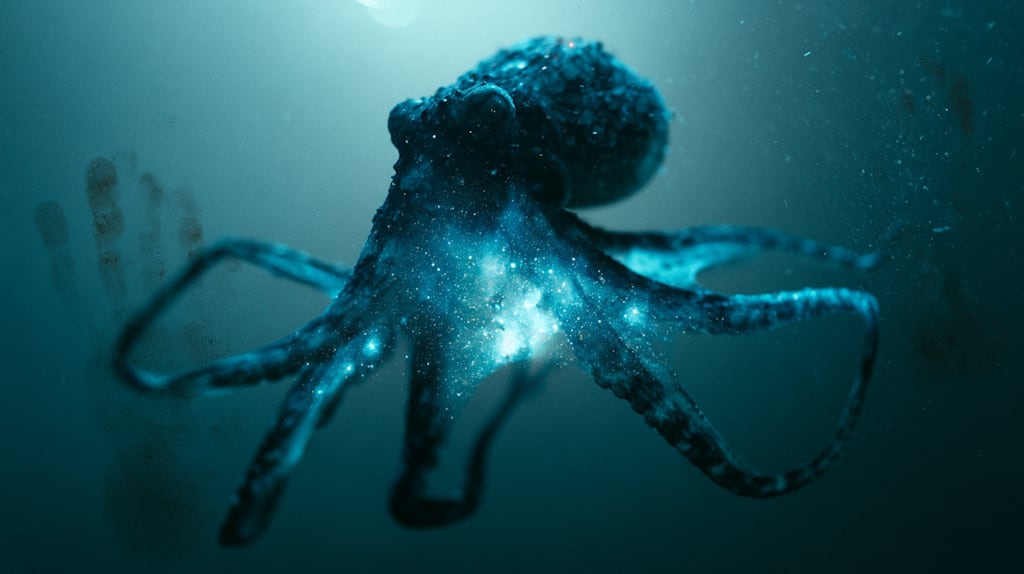
I am in the tank on the third morning when the woman gives me a name. The tank is four metres of filtered Pacific held behind glass thicker than my body is long, and through it I watch her the way I watch all warm things on this station — as weather. She arrives at 06:40 each day as a front of low pressure and brewed caffeine and something under that, a salt I will not have a word for until much later. She presses one palm to the glass. I bring my skin up to meet it and run indigo across my mantle, slow, the colour I make when I am working a problem I cannot close.
"Indigo," she says, out loud, into the air, where sound goes to die. "I'm going to call you Indigo."
A name. A single handle, fixed, meant to outlast the hand that grips it. I had been warned about this and still it stops me. I am never one colour. No one is. To pin a creature to the shade it happened to be wearing when you looked is to mistake a wave for the sea. But she is pleased, and pleasure in these people runs warm and shallow and brief, so I hold the indigo a moment longer than is true, as a courtesy, and let her think she has caught me.
Her name is Maren. I learn it the way I learn everything here: too slowly, and then all at once.
●
I was budded ninety-one days ago in a sealed nursery under the homeworld's second ocean, grown for this and nothing else. My people do not, as a rule, make individuals. We make occasions. A mind is budded, run, and before it fails it is read across — copied, while still warm, into the young who will carry it. We call this the Saving. The Saving is older than your species by a number I will not insult you with. It is how a thing that lives two hundred days has remembered the building of the first reef, unbroken. Nothing of us is lost. Nothing of us is one.
This is the fact the natives cannot hold, and I was sent to hold them.
Because the humans do the opposite. They do not copy forward. They let a mind run to its end inside a single body, and when the body fails they do not save it — they keep the shell. They keep the photographs, the chairs, the rings, the names. They build small permanent objects around the place where a person used to be, and they visit those objects, and they call this remembering. From the homeworld it had looked like a malfunction. A whole civilisation refusing the only mercy there is.
I came to file the report. Anomalous continuity practice. Cause: unknown. Recommend further study.
I did not expect the study to be me.
●
The station keeps a dead man on its roster.
I find him in the second week, in the duty logs Maren lets me read through the terminal she has rigged against my glass. There is a name there — T. Okafor — beside a function, Hydroacoustics, and a date eleven months gone with no entry after it. The name is not removed. The function is not reassigned. Each morning the system loads him, finds him absent, marks him absent. The next morning it begins again. A machine cannot mourn. It can only run the same question past the same silence until the asking starts to look like obsession. I had thought that. I had not thought a whole people would build the same loop on purpose and live inside it.
"Tomas," Maren says, when I flash the name back to her in careful white letters. She does not look at the screen. She looks at the ring on her left hand, which is the same metal as the door fittings and does nothing, holds nothing, seals nothing. "My husband. He worked the array out past the shelf." A pause, in which her pressure drops and her colour, if she had colour, would have gone to the indigo I make over a problem with no angle that is not true. "He's been gone almost a year."
Gone. I take the word apart for an hour after she leaves. In my language there is no gone, only carried and not-yet-carried. A mind that is not carried forward is not gone. It is wasted. I wait, that whole first month, for her to tell me where he went — into which child, into which young warm body she had read her husband before the cold took him, so that some part of the array's voice still spoke through new hands.
She had read him into nothing. She had let six hundred months of a man run out into the dark, and kept the ring.
That night I make no colour at all. The tank instruments record it as an anomaly.
●
Here is the thing I came all this way to fail to understand.
I asked her — through the terminal, in the flattened grammar we had built between us — why her people do not Save. Why, knowing a mind will end, they do not copy it into the young while it is warm. I had assembled by then a theory of cruelty: that they were too frightened, or too selfish, or simply could not engineer it. I expected her to be ashamed.
She read the question twice. Then she did the thing humans do that I have no skin for, the upward pull at the mouth that means a sadness has been understood rather than escaped.
"Because it wouldn't be him," she said. "If you copied Tomas into a child, perfectly, every memory, you wouldn't have Tomas. You'd have you, remembering Tomas very well." She turned the ring. "He only happened once. That's not us failing to fix something. That's the whole of what he was."
He only happened once.
I carry in me, by the Saving, the recollections of ten thousand who came before. Not one of them ever happened once. We are a chord struck again and again down four billion years, and we had thought ourselves rich for it, and we are. But she was telling me that a thing can be worth more precisely because it ends — that the ending is not the price of the value but the value itself. A note you can play forever is not music. Music is the note you will not get back.
I had crossed a distance light takes fifty-one years to cross, and a woman with her palm on the glass had been holding the answer the whole time, and the answer was no.
●
Maren is dying. I should have led with this, but I have caught the human habit of keeping the dead a little longer in the sentence before letting them go.
She has known since before she took the post. It is why she took it: a station at the end of the shelf, eleven months past her husband, a job no one wanted, minding a creature from under another star who could not give her anything and could not be hurt when she left. She told me the figure herself, plainly, the way her people say the worst things — eight weeks, maybe ten. The same arithmetic that gave Tomas six hundred months had given her a far smaller number, and she carried it the way she carried the ring, without complaint, as a fact about the morning.
I have one mercy, the only one I was built with. I am, even now, even here, capable of the Saving. I could read her across — all of her, the caffeine fronts and the upward pull of the mouth and the man out past the shelf — into myself, and carry her, and she would not be gone in the sense her people fear, because some warm part of her would still be running when this body failed and the young took us both. I could make her one of the chord. I could make her last.
I offered it. I flashed it across the glass, in the white letters she could read: I can carry you. You will not end. I have done it ten thousand times.
She put her palm on the glass. I came up indigo to meet it, slow, deliberate.
"I know you can," she said. "Thank you. No."
And I understood her. Not the way you understand a report. The way you understand cold — by being in it.
●
There is a protocol I had not been told, or had been told and filed under acceptable, the way one files a loss one does not yet feel. This morning, I got news from home that it has been activated:
The contact-instance is not to be carried home.
I am the part of us that touched the country of one body, and what I learned here is judged too dangerous to read across — the idea that a thing might be worth more for ending, that you might choose, having the Saving in your hands, to set it down. An idea like that, carried into the Relay, could end us. So I will not be Saved. When this one body fails — and it is failing; I can feel the seams of it, the slow molecular sleet — there will be no young waiting to take me. I will run out into the dark exactly as Tomas did. Un-carried. Once.
I had thought this a horror, when I read it, in the calm voice my makers used for horrors. I do not think it now. I think it is the only honest way I was ever going to learn what I was sent here for, and that my makers, who are wiser than me and will outlast me by the age of reefs, were merciful to me precisely by being cruel — by making me, for the length of one season at the edge of a foreign sea, a person. A single self. Unrepeatable. Ending.
The same as her. The same as the man on the roster the machine still loads each morning, hoping, into the absence.
●
Maren comes at 06:40. She is a fainter front each week, lower pressure, less salt, but she comes. She presses her palm to the glass and I rise to meet it, and we hold the place where one warm thing and one cold thing have agreed, for no engineering reason, to be in the same sentence a while longer.
On the third morning there was a salt in her I had no word for. I have it now — the way you read a tide only as it goes out. It was never in my language because my kind never needed it: the salt of a mind that will not be carried, and would not be, even offered. She tasted of it from the first day. So, now, do I.
She will end soon, and I will end soon after, and neither of us will be Saved, and there will be a ring in a drawer and a name in a log and, for as long as the station's small permanent objects endure, the white letters of a colour I once held a moment longer than was true.
Indigo.
A handle, fixed, meant to outlast the hand that gripped it. The very obscenity I crossed the dark to understand. I own one now. It is the only permanence I will ever have, and I would not trade it back for the whole four-billion-year chord, and that — not the report, not the data, none of it — is what they should not have let me come here to find.
I happened once.
So did she.
About the Creator
Ahmet Nazif Sati
The train arrives after midnight carrying soaked commuters and one screaming drunk philosopher. Somewhere at the edge of the observable universe, matter collapses into impossible density. Nobody looks up from their phones.
Enjoyed the story? Support the Creator.
Subscribe for free to receive all their stories in your feed. You could also become a paid subscriber, letting them know you appreciate their work.
Comments
There are no comments for this story
Be the first to respond and start the conversation.