
The Cost of Staying
Trigger Warning: Domestic Abuse

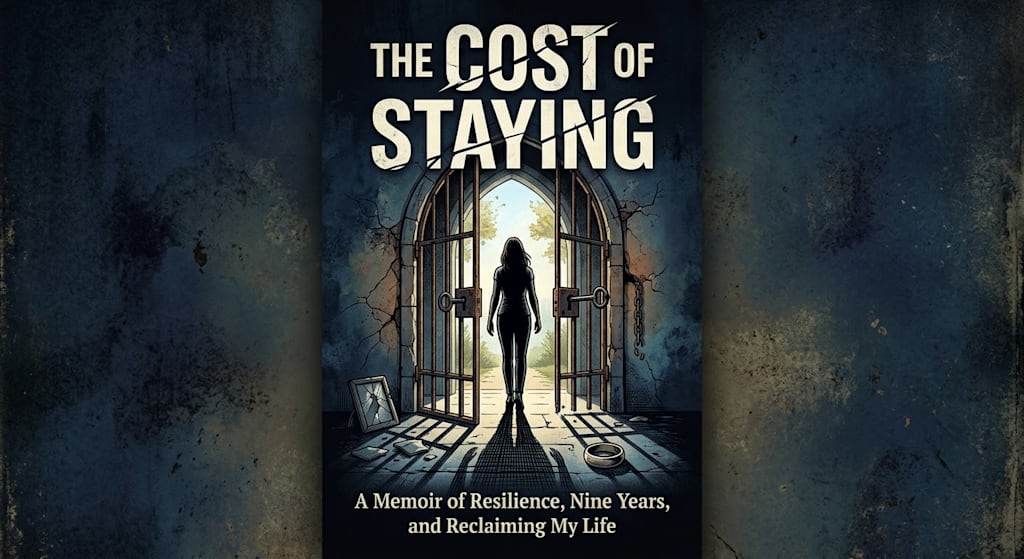
Chapter One
"Free"
The first few days were weird.
That's probably the simplest way I can explain them.
I had spent so long imagining what it would feel like to leave that I thought I would recognize freedom the second I found it. I thought there would be some huge rush of relief, some moment where I could finally breathe and think, I'm out. It's over. I'm safe.
Instead, I moved into my dad and stepmom's house and spent the first three days waiting for someone to get angry with me.
It sounds strange now, but at the time it made perfect sense. I had spent years learning that there was always a reason someone might be angry. Sometimes I knew what I had done. Sometimes I didn't. Sometimes the thing I had done wrong was something I had been told was okay the day before. It didn't really matter. Once he was angry, I had to figure out how to make it stop.
So I waited for that to happen.
I waited for my dad or stepmom to tell me I was doing something wrong. I waited for someone to ask where I was going or why I had done something or why I hadn't done something else. I waited for the tone in someone's voice to change. I waited for the moment when I would realize I had crossed some invisible line.
But nobody did.
They just let me be there.
I didn't really know how to handle that.
For years, I had lived by rules that were never written down. I knew I was supposed to ask before doing certain things, even when nobody had actually said I wasn't allowed to do them. I knew I needed to pay attention to someone's mood before I spoke. I knew there were good answers and bad answers, good times to ask a question and bad times, things that could be ignored one day and become a reason for an argument the next.
I had gotten so used to asking permission that I sometimes didn't even realize I was doing it.
I'd ask if I could go somewhere. I'd ask if something was okay. I'd ask before doing things that were completely normal things for an adult to decide for herself. My dad and stepmom weren't making me do it. They weren't expecting me to. It was just what I had learned.
And honestly, I still do it sometimes.
I'll catch myself halfway through asking and realize that nobody is waiting to tell me no.
There are no rules I'm going to accidentally break.
Nobody is keeping score.
Nobody is waiting for me to make the wrong choice so they can punish me for it.
But my brain doesn't always know that yet.
My first three days there were especially strange because the kids weren't with me yet. The house was quiet in a way I hadn't experienced in a very long time. There were no little voices coming from another room, no feet running across the floor, no arguments over something that seemed completely ridiculous to me but was apparently the most important thing in the world to them. Nobody was asking for a snack five minutes after eating. Nobody needed help finding a shoe. Nobody was calling me from another room.
Nobody was calling me Mom.
I had spent years wanting peace and quiet. I had dreamed about getting away from the yelling, the arguing, and the constant tension. I didn't realize until I finally had silence that quiet could feel completely different when you weren't choosing it.
It felt empty.
I was somewhere safe, but my children weren't there yet. So those first few days felt like I was suspended between two lives. I had left one life behind, but I hadn't quite stepped into the next one. Something was missing. Something that had been missing from my life for a long time because of him.
And underneath everything was fear.
I was constantly worried that he would find me.
I didn't know what would happen if he did. I didn't know whether he would try to make me come back, whether he would come looking for me, whether he would hurt me, or whether he would find some other way to make me regret leaving. I knew enough about him to know that being physically away from him didn't automatically make me feel safe.
My body was somewhere else.
My mind was still with him.
Every unfamiliar sound made me pay attention. If a car slowed down outside, I noticed. If my phone made a noise, I wondered who it was. If I heard footsteps, some part of me immediately started trying to figure out what kind of mood the person was in.
It was exhausting, even when nothing was happening.
And nothing was happening.
That was the part I couldn't understand.
Nobody was yelling at me. Nobody was demanding an explanation. Nobody was angry because I had done something wrong. Nobody was threatening to punish me.
The world was just continuing around me as if leaving had been an ordinary thing to do.
I was also afraid of something else, something I didn't like admitting because it made me feel weak.
I was afraid I would go back.
I knew what the cycle looked like. I had lived through it enough times to recognize the pattern. He could be horrible, and then he could be sorry. He could hurt me and then become the person I had fallen in love with again. He could promise that things would be different. He could make me remember why I had stayed in the first place.
And I had believed him before.
More than once.
So even after I left, I didn't completely trust myself. I worried that I would get lonely. I worried that I would get scared. I worried that I would start remembering the good things and somehow convince myself that the bad things weren't as bad as I knew they had been. I worried that I would decide that the life I knew, even though it had hurt me, was better than whatever came next.
Most of all, I worried that I would give up.
I didn't understand then that being afraid of going back didn't make me weak. I had spent years being pulled back into the same cycle, and my brain had learned to associate him with both fear and comfort. The same person who could make me terrified could also be the person who apologized afterward, promised to change, made me laugh, took me somewhere fun, or reminded me of all the reasons I had loved him.
Leaving didn't erase any of that.
It just meant I finally had enough distance to start seeing it differently.
For those first three days, though, I didn't know any of that. I was just trying to figure out how to exist without constantly waiting for something bad to happen.
Then my kids came home.
And suddenly the house wasn't quiet anymore.
There were four children filling the rooms with all the noise and chaos that comes with being a family. There were questions and arguments and laughter and crying and little feet going in every direction. Someone always needed something. Someone was always talking. Someone was always hungry.
It should have felt overwhelming.
Instead, it felt like home.
For the first time, my kids could just be kids.
They could cry without me immediately worrying that someone was going to get angry because they were crying. They could laugh loudly. They could argue over something stupid. They could make a mess. They could ask me for the same thing over and over. They could have bad moods and big feelings and all the other things children are allowed to have.
And I could just be their mom.
I didn't have to spend the whole day managing someone else's reaction to them. I didn't have to constantly think about whether they were being too loud or whether somebody was going to get irritated because one of them needed me. I didn’t have to focus on someone else first.
I could comfort them when they were upset.
I could listen to them.
I could play with them.
I could watch them grow.
I could actually be there.
I don't think I realized how much I had missed being their mother until I was finally allowed to just be one.
There is a particular kind of happiness I feel in the mornings now. Sometimes I wake up happy for no specific reason. I just wake up and realize that I'm okay. My kids are there, and I can get up and go into the kitchen and make them breakfast while music plays.
Sometimes I sing along. Sometimes I dance around the kitchen. Sometimes the kids wander in one at a time, still sleepy, and immediately start telling me something that apparently cannot wait until after breakfast. It's ordinary, and I love every bit of it.
I love being able to cook for them while listening to music. I love hearing them laugh from another room. I love watching them get to play outside and get covered in dirt. I love watching them become their own little people. I love spending time with them without having that constant feeling that I need to hurry them along or keep them quiet or make them smaller so somebody else won't get angry.
I get to see them grow up.
That feels like a gift.
For so long, I was trying to survive each day. I was thinking about what I needed to do next, what I needed to say, what I needed to avoid, what mood he was in, and how to keep things from getting worse. There wasn't much room left for simply enjoying my children.
Now there is.
I get to be the mother they deserve.
I get to wake up happy, and they get to wake up to a mother who is happy to see them. I get to laugh with them. I get to comfort them. I get to make breakfast. I get to listen to music. I get to spend a whole day with them without feeling like I'm waiting for somebody to punish me for doing it wrong.
I can finally relax and just be their mom.
That doesn't mean I don't still struggle.
I do.
Sometimes I'll make a decision and immediately wonder if I've made the wrong one. Sometimes I'll ask permission for something that doesn't require permission. Sometimes I'll feel guilty for no reason at all. Sometimes I'll notice myself watching someone's face or listening to their tone of voice, trying to figure out whether they're upset with me before they've even said anything. I still catch myself worrying about everyone else’s feelings and their reactions to my actions.
I'm still walking on eggshells sometimes.
The difference is that nobody put them there.
They're inside me now.
I carried some of them out with me.
Leaving changed my circumstances much faster than it changed my instincts. My body left before my mind understood that it was allowed to stop being afraid.
I think that's one of the strangest things about freedom. You can spend years dreaming about it and still have no idea how to live once you finally have it.
I thought freedom meant not being hurt anymore.
I didn't realize it would also mean learning how to make decisions without permission, learning how to trust myself, learning that someone can be upset without it becoming my responsibility to fix it, and learning that my children are allowed to make noise without me feeling like I have failed.
I had to learn that ordinary life could be enough.
That was especially difficult because there really were good memories.
I don't want to rewrite my life just because I know how it ended.
He did get me out of my comfort zone. I saw more states with him than I ever had before. We went to concerts and shows. We went places I probably wouldn't have gone by myself. We went to the beach together for the first time. I was with him the first time he ever went to a casino.
There were things I genuinely enjoyed.
There were times I genuinely had fun.
There were memories I still look back on and smile about.
Those things were real.
But so were the things that came after them.
We were always broke. We never saved money. We often didn't have our kids with us. And once the excitement wore off and we were back to our normal life, I was usually angry or disappointed or upset about something.
The fun belonged to the moment, but the consequences belonged to me.
And sometimes, if I'm being completely honest, I wasn't choosing the fun because I wanted it. I was choosing it because it was safer.
Being boring had consequences.
If saying yes meant keeping him happy, then I said yes. If going somewhere meant avoiding an argument, then I went. If spending money meant avoiding a fight, then the money got spent. If getting out of my comfort zone meant avoiding what might happen if I refused, then suddenly I wasn't really choosing whether I wanted to go.
I was choosing which consequence I could live with.
It took me a long time to understand the difference.
Looking back now, I can see how fear can disguise itself as a choice. I can see how something can be genuinely fun and still exist inside an unhealthy relationship. I don't have to pretend I hated every moment of my life with him to prove that I should have left.
There were good things.
They just weren't worth what they cost me.
I think that's one of the hardest truths to hold when you're telling a story like mine. It's easier if the person you left was horrible every second. It's easier if there was nothing to miss, nothing to remember fondly, nothing that ever made you laugh.
But real life isn't that simple.
There were times I loved him.
There were times I was happy.
There were times I thought I had the life I wanted.
And there were times I was terrified of him.
Both things can be true.
For years, I kept thinking that if I could just get back to the good version of him and somehow keep him there, everything would be okay. He would promise to change, and I would believe him. Things would be good for a while, and I would start to relax. I would think maybe we had finally made it through the worst of it.
Then he would snap.
And eventually he would apologize.
And then we would start over.
I thought the problem was that we hadn't found the right version of us yet.
I thought if I tried harder, loved him better, was more patient, made fewer mistakes, or somehow became whatever he needed me to be, maybe the good periods would last.
I didn't understand that the cycle wasn't something getting in the way of our relationship.
The cycle was the relationship.
It took years for me to understand that.
And even after I understood it, leaving wasn't simple.
There was fear.
There was guilt.
There were the children.
There were memories.
There was the part of me that still hoped the person I loved was somewhere underneath everything else.
And there was the part of me that was terrified that if I walked away, I would discover that I didn't know how to live without him.
But eventually, I did.
Not perfectly.
Not all at once.
And not without being afraid.
I just started.
One decision at a time.
One quiet morning at a time.
One breakfast in the kitchen.
One song playing in the background.
One day where nobody yelled.
One night where I could sleep without wondering what mood tomorrow would bring.
One moment where my kids could be children and I could be their mother.
One moment where I realized I was happy.
And then another.
And another.
Maybe that's what freedom actually is.
Not one huge moment where everything changes.
Maybe it's all the tiny moments when you realize that your life belongs to you again.
I wish I could say I understood that when I left.
I didn't.
When I first walked away, I was still waiting for him to find me. I was still afraid I would give up and go back. I had tried to leave before, so many times, and each time I had failed. I was still asking permission for things I didn't need permission to do. I was still waiting for somebody to yell at me.
I didn't know yet that I was going to learn how to be free.
I didn't know that my children would teach me what peace sounded like.
I didn't know that one day I would stand in a kitchen with music playing, making breakfast while my kids laughed and argued around me, and realize that this ordinary life was exactly what I had been missing.
I didn't know that quiet could eventually become peaceful.
I didn't know that noise could eventually mean home.
I didn't know that I could become someone my children deserved.
I didn't know that I could become someone I deserved.
But I was about to find out.
People always want to know when I knew.
When did I realize I had to leave?
When was the moment everything changed?
The truth is, there wasn't one moment.
There were years.
There were promises and apologies, good memories and terrible ones, moments when I loved him and moments when I was afraid of him. There were things I knew and things I wasn't ready to admit I knew.
I knew who he was.
I just thought I could change him.
And strangely enough, it was a candle maker that was the beginning of it all.
Chapter Two
"The Candle Maker"
If you had told me then what that day was going to become, I probably would have laughed at you.
I didn't know I was meeting the person who would change almost every part of my life. I didn't know I was about to spend years learning the difference between love and fear, between choosing something and being afraid of what would happen if I didn't choose it. I didn't know there would eventually be children, a marriage, good memories, terrible memories, promises, apologies, and more things than I could ever fit into one story.
At the time, I was just looking for a candle maker.
I'd been making my own candles for a while. Nothing fancy. I had jars, wax, and whatever else I needed to make them, and I actually enjoyed it. I liked being able to make something myself and end up with a candle that was mine.
But the candle maker I found on Facebook Marketplace was different.
It was listed for twenty dollars.
Twenty dollars was cheap enough that I couldn't really pass it up, especially because this one would let me make candles that stood on their own instead of having to pour everything into jars.
There was just one problem.
It was out of town.
And I didn't want to go alone.
So I needed somebody to go with me.
Somehow, that somebody ended up being him.
At that point, I had no intention of him becoming anything important in my life.
Actually, I had already decided exactly what I thought of him.
We had met online, and from the beginning, I wasn't interested.
He didn't have a car.
He didn't have a job.
He lived with his parents.
And I had recently discovered the song "No Scrubs," which, in my mind, had given me a very useful system for identifying men I had absolutely no interest in.
He qualified.
He was a scrub.
I remember telling him I wanted nothing to do with him. I wasn't looking for anything with him, and I certainly wasn't interested in taking him seriously.
He didn't exactly fit the picture of the kind of guy I thought I wanted.
But apparently, none of that mattered enough to keep me from asking him to ride with me to pick up a twenty-dollar candle maker.
Looking back, that feels almost ridiculous.
I wasn't looking for a relationship.
I wasn't looking for somebody to fall in love with.
I wasn't trying to change my life.
I wanted a piece of equipment from Facebook Marketplace.
That was all.
And yet, somehow, that little Marketplace listing became the reason I got into my truck with him that day.
He had a girlfriend, sort of.
It wasn't exactly a normal relationship. It wasn't exactly not a relationship either. There was enough there that I probably should have recognized it as complicated and walked away.
Instead, I apparently looked at the situation and thought:
Challenge accepted.
I liked a challenge.
I don't know if that was confidence or stupidity. Maybe at that age I couldn't tell the difference.
We went together, and somewhere along the way, the candle maker became less important.
We ended up sitting in my truck talking.
For hours.
It was one of those conversations that doesn't feel like it's been going on for very long until you realize you've been sitting there forever. We talked about everything and nothing. The kind of things you tell somebody when you're getting to know them without realizing you're telling them things you don't usually tell people.
He made me laugh.
I liked talking to him.
And somewhere in the middle of all that talking, he kissed me.
I don't remember thinking about whether I should let him.
I just remember the kiss.
It was one of those moments that makes you forget about every reason something probably isn't a good idea.
Love at first sight sounds dramatic.
For me, it was more like love at first kiss.
Or at least what I thought was love.
Because I liked him.
Really liked him.
Suddenly the things I had decided made him a scrub didn't seem quite as important. The lack of a job didn't seem like the end of the world. Living with his parents didn't seem like such a big deal. Not having a car didn't matter because he was sitting beside me, making me laugh.
I had already decided I wanted nothing to do with him.
Then he kissed me.
Apparently that was all it took to make me reconsider my entire argument.
And the fact that he had a girlfriend?
I didn't care.
I remember telling myself that I liked a challenge.
That sentence would follow me for years.
At the time, though, I thought it meant something romantic. I thought difficult things were worth doing. I thought people could be complicated without being dangerous. I thought loving somebody hard enough could make them want to become better.
He didn't hide everything from me.
In fact, one of the things I remember most clearly is him telling me he was no good.
He warned me.
Not in some dramatic speech. Not like a villain standing in the rain telling the heroine to run.
He just told me.
He was no good.
I heard it.
I just didn't believe him.
I thought he was saying it because he didn't think he deserved me. I thought maybe somebody had hurt him before. I thought maybe he had made mistakes. I thought there was a better version of him underneath everything, and if I loved him enough, I could bring that version out.
I thought I could change him.
That was the part I got wrong.
I didn't understand that sometimes when people tell you who they are, they're not challenging you to prove them wrong.
Sometimes they're warning you.
But I was young, and I was convinced that I could handle him.
Maybe part of me even liked the idea that nobody else could see what I saw.
I thought I saw something worth saving.
I thought I could be the person who made him want to be different.
And in the beginning, there were plenty of reasons to believe I was right.
He could be sweet.
He could make me laugh.
He could be spontaneous and exciting in a way that I wasn't always brave enough to be on my own. He had a way of pulling me out of my comfort zone, and at the time, I liked that about him.
I didn't know yet that there was a difference between someone encouraging you to step outside your comfort zone and someone teaching you that saying no wasn't safe.
I didn't know that yet.
Back then, everything still felt like an adventure.
We talked.
We flirted.
We spent more and more time together.
And before long, things moved faster than I ever expected them to.
Within the first month, we had hooked up.
Not long after that, I found out I was pregnant.
I was going to have his baby.
There wasn't a long, carefully planned transition from two people who were casually getting to know each other into a family.
It happened.
Fast.
Looking back, I can see how young we were and how little I understood about what I was getting myself into. But at the time, I didn't think of it as the beginning of a disaster.
I thought it was the beginning of my life.
I thought maybe this was what growing up looked like.
I thought we would figure it out.
I thought love was enough.
And when I was pregnant, I still believed I could change him.
I had no idea how much I would eventually learn about that sentence.
The first time he hit me hadn't happened yet.
The first arrest hadn't happened.
The children hadn't been sent away.
The cheating hadn't become years of betrayal.
The broken things and broken promises and broken parts of myself were still somewhere in the future.
At that point, I didn't know any of those things were coming.
I just knew I was pregnant.
I knew I was in love.
I knew I had chosen the guy I had originally decided was a scrub because, apparently, I liked a challenge.
And I knew he had looked me in the eyes and told me he was no good.
I just thought he was wrong.
Maybe that's the strangest part of looking back.
The warning was there.
I simply didn't understand it.
Or maybe I understood it and thought love made me the exception.
Either way, I kept going.
Because once you believe you've found the person you're supposed to be with, it's surprisingly easy to turn every warning into a reason to stay.
He wasn't really that bad.
He had just been through a lot.
He would change.
He promised he would change.
And I believed him.
I would believe him many more times after that.
But that came later.
For now, there was a baby on the way, a relationship that had started almost by accident, and a girl who thought she had found a challenge she could win.
I had gone looking for a candle maker.
I found him instead.
And I had no idea what I had just brought home.
And the funniest part—or maybe the worst part, depending on how you look at it—is that I never even used the candle maker.
I had spent twenty dollars on something I thought I would use to make candles that stood on their own.
Instead, I spent the next almost nine years building a life I never imagined I would have to escape.
The candle maker became almost meaningless compared to everything that came after it. The relationship grew. I got pregnant. We got married. Years passed. There were children and houses and fights and apologies and promises. There were good memories, terrible ones, and things I never could have imagined when I climbed into my truck that day.
All because I didn't want to make a drive out of town by myself.
I never made a single stand alone candle.
But I spent years trying to make something else work.
And somehow, that's how it all started.
Chapter Three
"The First Time"
It was the middle of the day the first time he punched me.
I was driving my truck, and we weren't far from his house. I don't remember anything about the day feeling unusual before it happened. There was no reason for me to think I needed to be on guard for something worse than an argument. We were talking, or rather, he was angry and I was trying to explain myself, which had already become a familiar position for me. I had gone to stay with a friend the night before after he had blown me off to spend time with his ex-girlfriend, the same girl he had been involved with when we met. My friend eventually left to see her boyfriend, and her brother was there. He happened to be my ex. Nothing happened between us. I slept on the couch. But that didn't matter to him. He was angry that I had been there, and he was especially angry that my ex had been there too.
I remember trying to explain it while I drove. I wanted him to understand that there was nothing to be angry about, and I kept going over the details because I thought if I explained them clearly enough, he would eventually see that I hadn't done anything wrong. I told him where I had been, who was there, that my friend had left, and that I had slept on the couch. I don't remember the exact words anymore, but I remember the feeling of trying to convince someone of something that should never have needed to be proven in the first place. I wasn't confessing to anything. There was nothing to confess. I was simply trying to make him believe me.
Then he punched me in the jaw.
I was still driving when he hit me, and the truck jerked hard enough that I immediately slammed on the brakes. My glasses fell from my face. For a moment I was more shocked than anything else. I remember sitting there trying to process what had just happened, because my mind hadn't caught up with my body yet. He had hit me. Not in some vague, almost accidental way, but deliberately. He had been angry, and he had decided to hit me because of it.
I looked at him, and I think some part of me was waiting for him to realize what he had done. I expected him to be sorry. I expected him to understand that he had crossed a line. Instead, he told me it was my fault. He said I had made him do it.
That explanation was easier to understand than the truth.
If I had made him do it, then there was something I could change. Maybe I shouldn't have gone to my friend's house. Maybe I shouldn't have been around my ex. Maybe I should have handled the situation differently. Maybe I had pushed him too far or made him jealous or given him a reason to believe something that wasn't true. If I could figure out what I had done wrong, then maybe I could make sure it never happened again.
I wasn't sitting there thinking, I'm in an abusive relationship. I didn't have that kind of perspective yet. I was thinking about the man I loved, the baby I was carrying, and the fact that somehow those things now existed in the same moment as a man who had just punched me.
I was only a couple of months pregnant with our son. I remember that being part of what made everything feel so complicated. I wasn't just deciding what to do about a boyfriend who had lost his temper. I was pregnant with his child. I had already imagined a future with him, and I didn't want one terrible moment to suddenly destroy everything I had been imagining. I wanted an explanation that allowed the rest of my life to stay intact.
So I made it smaller in my mind. It was one punch. He had been angry. He was jealous. He had lost his temper. He said I had made him do it. Maybe it really was something I could prevent from happening again if I was more careful.
After he hit me, he got out of my truck and walked away.
I was left sitting there, trying to understand what had just happened and what I was supposed to do with it. I don't remember every detail of what happened immediately afterward, and I don't want to fill in memories I don't actually have. What I do remember is that I didn't keep it a secret.
I called my brother and told him.
I told my dad.
Later, when my mom saw that my jaw had started to swell and bruise, she asked me what happened, and I told her too. I didn't have to make up an excuse for the bruise or pretend that I had fallen or hit myself on something. They knew he had punched me. They knew exactly who had done it.
And that was the first time my family really started treating him differently.
Before that, he was the man I had chosen. They might not have loved every decision I made or completely understood my relationship with him, but he was still my boyfriend, and I loved him. After that, they had something concrete. They had heard me say that he had hit me, and my mother could see the evidence on my face.
They hated it.
They hated what he had done, but they also hated that I chose to stay with him afterward. Looking back, I understand why. From the outside, it probably seemed incredibly simple. Their daughter had been punched by her boyfriend. She was pregnant with his baby. The answer seemed obvious: leave.
But I wasn't standing outside the situation looking at it objectively. I was inside it, and I loved him.
That is something I think is important to say because it is easy to look back at a woman in an abusive relationship and wonder why she didn't leave the first time. I wonder the same thing about myself sometimes. I look back at that day and think, You knew. You knew he had hit you. You told your family. Why didn't you leave?
The answer is that knowing something is wrong isn't always the same as understanding what it means.
I knew he shouldn't have hit me. I knew my family was right to be angry. I knew I didn't deserve to be punched. But I didn't understand yet that this wasn't simply one terrible argument. I didn't know that the person who had hit me would eventually hurt me in ways I couldn't imagine at that point. I didn't know how quickly one incident could become something you learn to work around instead of something you refuse to accept.
Most importantly, I still believed I could change him.
He had told me from the beginning that he was no good. I thought I could change him. I had already fallen in love with the sweet version of him, the funny version, the spontaneous version, the person who had gotten me out of my comfort zone and made me feel like life with him would be an adventure. I didn't know how to reconcile that person with the one sitting beside me in my truck.
So I separated them in my mind.
That wasn't really him.
He was just angry.
It was a mistake.
He would change.
Those thoughts gave me somewhere to put the fear without having to give up the relationship.
My family didn't have that luxury. They weren't in love with him. They weren't pregnant with his child. They weren't carrying around all the good memories that made walking away feel like throwing away an entire future. They saw the bruise and heard the story, and from that point forward, they saw him differently.
I think that was the beginning of the divide.
Not between me and my family, exactly. They were still there, and they still wanted what was best for me. But there was now something they knew about him that I wasn't ready to let define him. Every time they looked at him, they could see the man who had punched me. I could still see the man I had fallen in love with.
And because I still loved him, I kept trying to prove that the punch didn't tell the whole story.
I didn't do that because I thought being hit was okay. I did it because I desperately wanted to believe it was an exception.
That distinction matters to me now.
I didn't choose abuse.
I chose him, believing the abuse was something he could change.
At the time, those felt like two completely different things.
Looking back, I wish I had understood sooner that they weren't.
I wish I could go back to that day and tell myself that I didn't need another incident to prove the first one mattered. I didn't need another bruise. I didn't need him to hit me again. I didn't need years of evidence to justify leaving someone who had already shown me he was willing to hurt me when he was angry.
One punch was enough.
I should have left then.
I know that now.
But I also know that the woman I was then didn't know what I know now. She didn't know how much worse things would become. She didn't know how many times she would hear promises to change. She didn't know how convincing those promises could be after someone had spent hours, days, or weeks making her believe she was loved again.
She knew he had done something wrong.
She just believed it could be the last time.
And for a while, things did get better.
That was what made staying possible.
The person who had punched me didn't disappear. He didn't suddenly become a monster every hour of every day. He could still be sweet. He could still make me laugh. We could still have good days, good conversations, good memories. There were still moments when I looked at him and saw the person I had fallen in love with, and those moments made it much easier to believe that the punch had been an exception rather than a warning.
That is the part people don't always understand.
The relationship didn't become terrible every second after that.
If it had, leaving would have been easier.
Instead, life kept moving. I was pregnant. We had a future to think about. There were good days mixed in with the bad ones, and every good day gave me another reason to believe that maybe we had gotten past the worst of it.
I didn't know that the good periods would eventually become part of the cycle.
I didn't know that I would learn to measure my happiness against his moods.
I didn't know that I would start thinking less about whether something was right or wrong and more about whether it would make him angry.
I didn't know that one day I would look back on this first punch and wish desperately that I had understood what it was trying to tell me.
I only knew that I loved him, that I was pregnant with his baby, that my family was angry with him, and that I had decided to stay.
At the time, I thought I was giving him another chance.
I didn't know I was giving the future a chance to become everything I was afraid it might be.
Chapter Four
"After"
After he punched me, he apologized. At least, that's what I remember wanting from him. I wanted him to understand that what he had done was wrong, and when he told me he was sorry, part of me felt relieved. But his apology came with a condition. He told me, “But you shouldn't have made me do it,” and then explained that it wouldn't happen again as long as I didn't give him a reason to do it again.
At the time, I heard that as reassurance. I wanted to believe he was promising me that he would never hurt me again. I didn't stop to think about the fact that he was making the promise conditional on my behavior. He wasn't saying, I will never hit you again. He was saying, I won't hit you if you don't make me. I was still young enough, and still in love enough, that those sounded like almost the same thing.
He also made me apologize to him for going to my friend's house and being around my ex. I remember how backwards that feels now. He had punched me while I was driving, left me sitting there afterward, and somehow I ended up apologizing to him. But at the time, I wasn't thinking about who was right and who was wrong. I wanted the argument to be over. I wanted him to stop being angry with me, and I wanted to believe that if I admitted I had done something wrong, we could move past what had happened.
So I did.
Later, he gave me another explanation for why he had hit me. He said he had been coming down from meth. That made sense to me in a way that was probably easier than admitting what the other possibility meant. If the drugs were responsible for what he had done, then maybe he wasn't really the person who had punched me. Maybe the drugs had made him someone he wasn't. Maybe if he stopped using, I wouldn't have to worry about seeing that side of him again.
I already believed I could change him, so it wasn't much of a stretch to believe I could help him change this too.
There was another reason I stayed, one that had nothing to do with trying to excuse what he had done.
My parents had gotten divorced when I was young, and it had been hard on me. I knew what it felt like to have your family change and to grow up knowing that your parents weren't together anymore. I carried that with me into my own pregnancy, even if I didn't realize how much it was influencing my decisions.
I didn't want that for my child.
I didn't want my unborn baby to have a broken family. I wanted my child to have both parents. I wanted us to stay together, raise our baby together, and give our child the kind of family I had wished I could have had when I was young.
So when I thought about leaving him, I wasn't only thinking about myself.
I was thinking about my baby.
I was thinking about the family I had already imagined.
I was thinking about how much I had hated my parents' divorce and how badly I wanted to spare my own child from feeling that same hurt.
I thought staying and trying to make things work was protecting my child.
I didn't understand yet that keeping a family together and keeping a family healthy were two very different things.
At the time, I thought a broken family meant parents who weren't together.
I hadn't learned yet that sometimes the family can already be broken while everyone is still living under the same roof.
And because I loved him, because he had apologized, because he promised it wouldn't happen again, because he told me there was a reason it happened, and because I wanted so badly to believe I could change him, staying felt like the responsible thing to do.
I wasn't choosing to stay because I wanted my child to grow up around violence.
I was choosing to stay because I thought I could prevent that from ever happening again.
I thought I could fix him.
I thought I could save our family.
I didn't know I was teaching myself to survive inside it.
For a while, things really were good.
That's important because they really were. I don't want to tell the story as though the first punch happened and suddenly every day afterward was terrible, because that isn't what my life felt like at the time. There were good days, and when things were good, I could almost convince myself that the punch had been an isolated mistake. He could be sweet and funny and affectionate, and I still loved being around him. Those parts of him hadn't disappeared just because I had seen a different side of him.
I remember little things from that time more clearly than I remember some of the bigger events.
One of them was almost embarrassingly ordinary. I remember falling outside of a building one day and scraping my knee on the pavement. He was right there to help me up. He got me home, doctored my knee where I had scraped it, and wrapped my ankle for me. It wasn't some grand gesture. He was just taking care of me because I was hurt.
I remember that because those were the moments that made the good version of him feel so real. When I was hurt, he helped me. When I needed something, he could be the person who took care of me. He really could be gentle with me. He really could make me feel loved.
And then there was the time he brought me flowers.
They weren't expensive flowers from a store. He had cut them from his grandmother's rose bush and brought them to me. It was such a small thing, but I remember how thoughtful it felt. He had thought about me and picked them for me himself.
Knowing how his grandmother felt about her roses made it even more special. Those weren't just flowers growing somewhere outside. I knew they mattered to her. I knew she cared about them, which meant something to me about the fact that he had gone out there and cut them to bring to me.
I remember thinking it was sweet.
Those are the memories that make this story harder to tell.
Because when I say that he hurt me, that doesn't mean he never cared about me. When I say that I was afraid of him, that doesn't mean I never felt safe with him. When I say that the relationship was abusive, that doesn't erase the moments when he helped me off the pavement, wrapped my ankle, or brought me roses from his grandmother's yard because he thought I would like them.
Those moments happened too.
I loved that version of him.
And that was part of what kept me believing there was something worth saving. I wasn't holding on to nothing. I was holding on to the man who could make me laugh, take me places I'd never been, get me out of my comfort zone, help me when I was hurt, and surprise me with flowers he'd picked himself.
The problem was that he wasn't only that man.
Then, after things had been good for a while, he left me for another woman.
Again.
He went to live with her for a few weeks, and I was left trying to figure out what I was supposed to do with myself. I had already built so much of my life around him, and suddenly he wasn't there. I don't remember exactly what I was thinking every day during that time, but I remember the loneliness of it. I still loved him, even though he had chosen someone else.
While he was gone, I started talking to another guy.
What happened with him is something I still have difficulty putting into words.
He raped me.
I told him what happened.
His reaction was one of the strangest contradictions I would ever experience with him. He told me he had gone and shot up the other man's house. I believed him, and as messed up as it sounds now, part of me saw that as him protecting me. Someone had hurt me, and he was furious about it. He wanted that person to pay.
But at the same time, he told me that what happened was my fault.
He could be angry at someone for hurting me while blaming me for being hurt. He could make me feel protected and guilty at the same time. I didn't understand how those things could coexist, but I also didn't question it the way I would now.
I was still learning how to interpret him.
I saw his anger as proof that he cared about me. I saw his willingness to retaliate as protection. I didn't understand that someone could try to protect you from another person and still be someone you needed protection from.
Eventually, he wanted me to come get him from the woman's house. He said she was acting crazy and throwing moonshine bottles at him.
So I went.
I went and got him.
I don't remember thinking about how strange the situation was. He had left me for another woman, and now I was going to rescue him from her.
That was the kind of relationship we had already become.
He could hurt me, leave me, blame me, and I could still be the person he called when he needed help.
And I would come.
Because I loved him.
After I picked him up, things were okay again for a while.
I don't know exactly how long. Memory doesn't always divide life into neat sections the way a timeline does. I just remember that we got back together and settled into our version of normal. The crisis passed, and once it did, it became easier to focus on the good parts again.
That's something I think is easy to misunderstand about relationships like mine. The good memories weren't fake just because the relationship was abusive. I really loved him. I really had fun with him. I really believed there was a future for us. When things were good, I wasn't secretly miserable and waiting for an opportunity to leave. I was happy.
That happiness was part of why staying made sense to me.
So was hope.
Every time he apologized, I hoped it was different. Every time he promised to change, I believed him. Every time we went through something awful and then had a stretch of good days afterward, I took that as evidence that maybe we had finally gotten past it.
I didn't understand that the good periods were part of what kept me there.
I thought they were proof that the relationship could work.
What did change after the first time he hit me was me.
I started avoiding my friends.
It wasn't something I sat down and consciously decided to do. I didn't wake up one morning and think, I'm going to isolate myself from everyone who cares about me. It happened little by little. I stopped going places as often. I spent more of my time with him. I avoided situations where people might ask questions about our relationship, and I especially avoided conversations where someone might tell me I needed to leave.
I already knew what they would say.
I had told them what happened. They knew he had hit me, and they were angry about it. They didn't understand why I was still with him, and I didn't know how to explain it without sounding like I was defending something I knew was wrong. The easiest way to avoid having to explain myself was simply not to put myself in those conversations.
So I pulled away.
Looking back, I can see how much that mattered. My friends hadn't done anything to deserve losing me, and my family hadn't done anything wrong by being worried about me. They were seeing things from the outside, and I was beginning to avoid the people who could see what I wasn't ready to look at.
I didn't think of it as isolation.
I thought I was protecting my relationship.
Eventually, my mom made me choose.
It wasn't exactly that she kicked me out. She made it clear that I couldn't keep choosing him and still stay there, and I chose him.
Looking back, I know how that sounds. I had a family who loved me, a place to live, and people who were worried about me, and I chose the man who had already hit me. But at the time, it didn't feel like I was choosing between my family and an abusive relationship. I felt like I was choosing the person I loved and the life I believed I was building with him.
So I left.
Around the same time, I lost my truck.
It wasn't really mine yet. I had been buying it from my grandfather and making payments on it, but once I started seeing him, I was spending most of my money on him instead. I got behind on the payments, and eventually I lost the truck.
That part is important too, because nobody had to take my independence away from me all at once. I was already giving pieces of it away myself.
I had stopped seeing my friends as much. I had chosen him over my mom. I was spending my money on him instead of keeping up with something that gave me the ability to come and go on my own. Then I didn't have the truck anymore.
None of those things felt like one huge decision to give up my freedom.
They were just things that happened as I built my life around him.
Without the truck, getting away from him became harder. Seeing my family became harder. Seeing my friends became harder. Even going somewhere on my own became something I had to think about.
My world was getting smaller, but I didn't recognize it as losing my freedom.
I thought I was making sacrifices for the person I loved.
I moved in with him and his family.
They lived in a single-wide trailer with his grandmother, his mother, and his two brothers. There were a lot of people living in a very small space, and there wasn't much privacy, but I don't want to make it sound like I was unwanted there. I wasn't.
His family took me in.
They treated me like one of their own. They loved me, they cared about me, and they welcomed me into their home. Even though the trailer was crowded and there were a lot of people sharing a small space, I had a place there. I wasn't just some girl who happened to be living with their son. I was part of the family.
That matters when I look back on that time.
Because there were parts of my life that were getting smaller, but his family wasn't responsible for that. In fact, they gave me something I needed. They gave me a family to belong to when I had chosen to leave my own.
Even after our son was born, I was still sharing a bedroom with his mother. That sounds strange to me now, but at the time it was simply what our living situation was. There wasn't much space, and everyone made do with what they had.
I had become a mother, but I didn't have the kind of home I had pictured for myself. There was no little house that belonged to us, no nursery that I had decorated, no bedroom where I could close the door and feel like I was building a life with my new family.
But I did have people around me who cared about me.
His family loved our son. They loved me. They were there, and they were part of our lives in ways that I still remember.
So when I think about that trailer now, I don't remember it simply as a crowded place where I had no privacy.
I remember it as the place where I lived with the family I had married into before I was even married.
And I still believed things would eventually get better.
I still believed that once we had our son, something would change in him. I thought becoming a father might make him grow up. I thought having a family might give him something he didn't want to lose. I thought maybe the life we were building together would become more important to him than the things that kept causing problems between us.
I had a lot of reasons to believe that, because there were still good moments.
There were still days when I could look at him and see the man I had fallen in love with instead of the man who had punched me.
There were still days when I felt loved. There were still days when I thought maybe I had been right to stay. That's what made it so difficult to see where I was actually headed.
I thought I was building a family. I thought I was protecting my child from having the kind of broken home I had grown up with. I thought I was giving him enough chances to become the person I believed he could be.
And slowly, without realizing it, I was becoming someone who measured every decision by whether it might make him angry.
I had already learned that my choices had consequences, I just hadn't realized yet that I was no longer choosing freely. I was learning how to stay safe.
And then came the night he shot his mother and brother.
I didn't know it was coming. I didn't know that the family who had taken me in and loved me was about to be changed forever.
I didn't know that the crowded single-wide I had thought of as our home was about to become the place where something happened that none of us would ever be able to forget.
For the moment, we were simply a young couple with a baby, living with his family and trying to make a life together.
And I still believed that somehow, we would.
Chapter Five
"Five Months"
My son was born on October 5, 2018.
I was twenty-one years old, and I had been in labor for sixteen hours.
Sixteen hours is a long time when you're hurting and exhausted and have no idea how much longer you have to go. It feels even longer when you're twenty-one and having your first baby, because there is no way to know what is normal. You just know that it hurts, and everyone keeps telling you that eventually it will be over.
The first time we went to the hospital, they sent me home.
I was already in labor, but apparently I wasn't far enough along for them to keep me there. So we left and went back to the hotel, where I was still in labor and trying to figure out how I was supposed to get through the rest of it.
I remember him helping me take a warm bath.
He rubbed my back while I tried to find some position that didn't hurt quite so badly. There wasn't really anything he could do to make it stop, but he tried anyway.
It wasn't glamorous. There was nothing romantic about being in labor in a hotel room. I was uncomfortable, exhausted, and miserable. But he was there.
As soon as the doctor's office opened, he called them.
They insisted that I get back to the hospital immediately.
He didn't argue with them or hesitate. He found us a ride, and we went back. This time, they kept me.
He stayed by my side through all sixteen hours.
He squeezed my legs to help me push when I couldn't. He watched me go through the blood and the ripping and all of the grossness that comes with giving birth. He saw me at probably one of my least attractive and least dignified moments, and he stayed.
When our son was finally born, I remember being overwhelmed by how small he was.
Everything about him seemed tiny.
His hands.
His face.
His little body.
He was ours.
For a while, it felt like everything I had wanted was finally happening.
I had a baby.
I had the father of my baby beside me.
We were a family.
There is something strange about becoming a mother. One minute you're just yourself, and then suddenly there is this tiny person who needs you for absolutely everything.
I was twenty-one years old, and I had a son.
I don't think I was prepared for how completely my life would change.
Our son was jaundiced, and he had to stay in the hospital longer than I did.
That was hard.
We had spent nine months waiting for him. We had imagined bringing him home. We had finally gotten to hold him, and then we had to leave the hospital without him.
I remember how much we both missed him.
We were both worried.
We were both waiting for him to be okay.
We were both missing the same little person.
For those moments, we were simply his parents.
Whatever problems existed between us, whatever had happened before, there was something about having that little boy there that made us feel like we were on the same side of something.
We wanted our baby home.
I remember that bringing us together.
There was no argument to have about it. No side to choose. No reason to be angry with each other.
There was just our baby.
And we both loved him.
When our son was finally able to leave the hospital, we went back to his family's house.
We hadn't always been living there. While I was pregnant, we had been living with his family for a while, but at some point something happened that led to us moving out. I don't remember exactly what happened or why we ended up in the hotel, and I don't want to fill in the blanks with something I can't actually remember.
What I do remember is that the hotel was where we were when our son was born.
After the hospital, though, we went back to his family's house.
That was where we would spend most of those next several months.
His family took us back in, and they didn't treat me like an outsider.
His mom and his grandmother were wonderful with our baby and with us. They helped us constantly. If we were exhausted, they would take the baby for a while so we could sleep. If we needed a break, they would encourage us to go somewhere together.
They gave us something that young parents don't always get.
A chance to breathe.
The house was crowded.
There wasn't much privacy.
His grandmother, his mother, his two brothers, the baby, and us were all sharing a single-wide trailer. We and our newborn baby shared a room with his mother.
It wasn't an ideal setup.
But I didn't feel unwanted there.
Quite the opposite.
They loved me.
They loved our baby.
They treated me like I was part of the family.
And for those first few months, that mattered more to me than having space of our own.
We were young parents trying to figure everything out.
There were diapers and bottles and crying and sleepless nights. There were probably plenty of moments when neither of us had any idea what we were doing.
But there were good days too.
There were mornings when I could look at him holding our son and think about how strange and wonderful it was that we had actually made a family.
There were nights when we were exhausted but together.
There were moments when everything felt almost normal.
Sometimes normal was all I wanted.
He got a job at Lowe's during that time, and he actually enjoyed it.
That made me happy.
It felt good seeing him go to work and come home knowing he had been doing something for us. He was making money. He had somewhere to be. He seemed proud of the fact that he had a job he liked.
For a while, it felt like he was becoming the kind of father I had hoped he would be.
I wanted that for him.
I wanted that for our son.
And I wanted that for myself.
For a little while, things felt stable.
I had our son.
He had his job.
We had a place to live.
His family was helping us.
We were building a life.
And I really believed we were building it together.
There are certain memories that stand out to me now because they were so ordinary.
Him coming home from work.
Our baby being there.
Being tired because we were both young parents and neither of us was getting enough sleep.
His mom or grandmother taking the baby for a while so we could rest.
Small moments where we were just three people trying to figure out how to be a family.
I remember him bringing me McDonald's after our son was born because the hospital couldn't get me to eat much during those first day or two.
It wasn't anything extravagant.
It was McDonald's.
But I remember it.
After sixteen hours of labor, after being exhausted and worried about our baby, I didn't have much of an appetite. He knew I needed to eat and brought me something anyway.
Sometimes the smallest things become the memories you keep.
I remember him being there.
I remember him calling the doctor's office.
I remember him finding a ride to get me back to the hospital.
I remember him staying beside me through labor.
I remember us both missing our baby while he was still in the hospital.
I remember his mother and grandmother helping us with him.
I remember having moments where I felt like maybe this was what being a family was supposed to feel like.
Those memories are real.
I don't want to take them away just because I know how the story ends.
The five months between our son's birth and our wedding weren't perfect.
But they weren't five months of constant misery either.
For a while, life was almost ordinary.
And ordinary was something I wanted very badly.
My parents had divorced when I was young, and I remembered how hard that had been for me.
I remembered what it felt like to be a child whose family wasn't together.
When I became pregnant, I had already decided that I didn't want my child to grow up with a broken family.
I wanted him to have what I hadn't had.
I wanted both of his parents to be there.
I wanted him to wake up knowing that his mother and father were together.
I wanted our family to stay intact.
I thought that if I could make our relationship work, I could give him that.
At the time, I didn't think I was making some reckless decision to stay with a dangerous man.
I thought I was trying to give my child a family.
And during those five months, there was enough good to make that belief feel reasonable.
That is part of what makes it difficult to explain now.
It would be easier if every day had been horrible.
It would be easier if I had hated him every morning and been terrified every night.
But that wasn't my life.
There were good days.
There were loving moments.
There were times when he made me laugh.
There were times when I looked at him and felt lucky.
There were times when I looked at our son and thought, We did this.
That version of my life was real too.
I also wasn't seeing much of my own family anymore.
In fact, I barely talked to them.
I had chosen him before, and that choice had created distance between us. Now I was living with his family, raising our son, and building a life on their side of my world.
I didn't spend much time thinking about what I was losing.
I was twenty-one.
I had a baby.
I was in love.
I had a family.
I thought I was exactly where I was supposed to be.
I didn't think about how small my world had become.
I just thought about the people who were in it.
There wasn't one single moment when I decided to stop talking to my family.
It happened gradually.
Every choice seemed small enough to justify.
Stay here instead of going there.
Spend time with him instead of my parents.
Don't go around certain people because it might cause an argument.
Don't make him mad.
Don't make things harder.
Each decision felt temporary.
None of them seemed important enough to matter on its own.
But eventually, all those little decisions added up.
Before long, my world had gotten smaller without me ever deciding to make it that way.
And I still believed I was doing the right thing.
I was trying to keep my family together.
I was trying to be a good mother.
I was trying to be a good girlfriend.
I was trying to make everything work.
I didn't understand yet that I was slowly learning how to disappear inside someone else's life.
At the time, I just thought I was making sacrifices for my family.
And I thought those sacrifices would be worth it.
For a while, it really did feel whole.
There were ordinary moments that I loved.
There were nights we laughed.
There were times he was sweet to me.
There were moments when I looked at him holding our son and felt like I had gotten exactly what I had wanted.
Those moments mattered.
They still matter.
I don't want to erase the good memories just because I know how the story ends.
That would be dishonest too.
There was a version of our life where I was happy.
There was a version where I looked at him and thought, This is my family.
And there was a version of him who could be a good father, a good partner, and the person who made me laugh until my stomach hurt.
Those things were real.
So was everything else.
By March, I had been a mother for five months.
Our son was growing.
We were settling into some kind of routine.
He had his job.
We had our baby.
We were living with his family.
And somewhere along the way, marriage started feeling like the next step.
One day after he got off work, we decided to go to the courthouse.
There wasn't a huge plan.
There wasn't some elaborate proposal.
We just decided we were going to get married.
So we went.
We bought cheap wedding rings at Walmart.
That was our wedding.
Simple.
Cheap.
Real.
My ring had to be resized, so his mom loaned me one of her rings to wear until mine came back.
Our son was there.
I remember wanting it.
I wanted to marry him.
I wanted our family.
I wanted the life I thought we were building.
I wasn't standing there thinking about the first time he had hit me.
I wasn't standing there thinking about the things that had happened before.
I wasn't secretly hoping marriage would magically fix him.
I wanted him.
I wanted our son to have both of us.
I wanted the family I had spent so much of my life believing I needed.
On March 15, 2019, I became his wife.
I didn't walk into that courthouse wondering whether I was making a mistake.
I wasn't secretly hoping something would change.
I wasn't marrying him because somebody forced me to.
I wanted to be there.
I wanted him.
I wanted our son to have married parents.
I wanted us to be a family.
I believed in the future we were promising each other.
Years later, he would tell me that he only married me because his grandmother told him to, and because of Michael.
Maybe that's how he remembers it.
But it isn't how I remember it.
I wasn't standing there because someone had forced me to marry him.
I wanted to be his wife.
I wanted our son to have married parents.
I wanted the three of us to be a family.
I believed that getting married meant we were choosing each other.
I believed it meant we were making it.
I thought this was the part where things finally settled down.
I thought we had survived the hard parts.
I thought having our son had changed us.
I thought having a job, having a family, and getting married meant we were growing up and becoming the people we needed to be.
I was wrong.
But I didn't know that yet.
On March 15, I was twenty-one years old, standing beside the man I loved, with our baby there, wearing a cheap ring and believing I was finally creating the family I had always wanted.
I didn't know how quickly that feeling would disappear.
Years later, he would find a way to blame me for the shooting.
He would tell me that it was my fault because I was the reason we had ended up living with his family in the first place.
In his version of things, even that had somehow become my responsibility.
The first time he hit me, I had supposedly made him do it.
When another man raped me, somehow that became my fault too.
And eventually, when his own gun went off and his mother and brother were shot, there would be a version of that story where I was responsible for that too.
There was always a reason.
There was always a way to make me part of the blame.
But on March 15, I didn't know how far the blame would go.
I didn't know that the job he enjoyed at Lowe's would soon be gone because of felony charges.
I didn't know that our ordinary days were about to become memories I would spend years trying to understand.
I didn't know that seven weeks later, I would be standing in that same family home while the sounds of gunshots changed all of our lives.
I didn't know what was waiting for us on May 4.
At that moment, though, I was happy.
I believed I had made the right choice.
I believed I had finally built the family I had always wanted.
And for five months, at least, I had been able to believe that maybe I had.
Chapter Six
"The Night Everything Changed"
I don't remember the night starting with anything that felt unusual.
That is probably one of the strangest things about some of the worst memories. They don't always announce themselves. There isn't necessarily some feeling that tells you, Remember this. Something terrible is about to happen. Sometimes a night begins like every other night, and you have no idea that by the time it ends, you will remember it for the rest of your life.
That night, he went for a walk around the neighborhood.
He had the .40 caliber gun his dad had given him tucked into the back of his pants.
At the time, I didn't think much about it. I knew he had the gun. I knew it was there. But I didn't understand that it was about to become the center of everything that happened next. It was just another thing that existed in our life, something I had gotten used to being around.
He came back inside after his walk and put some weed in the drawer where we kept our son's clothes.
Then he went back outside.
I remember caring about the clothes.
I didn't want them smelling like weed. They were our son's clothes, and I didn't want the smell getting into them, so I moved the weed somewhere else. It wasn't some dramatic decision. I wasn't trying to make a point. I wasn't trying to take anything away from him. I was just moving something because I didn't want my baby's clothes smelling like marijuana.
When he came back inside, I told him I had flushed it.
That's when everything changed.
He got angry, and the next thing I remember clearly is being shoved onto his mother's bed in the bedroom.
Then he started choking me.
I had been afraid of him before. He had punched me before. I already knew what it felt like to have his anger turn into something physical. But there was something different about being unable to breathe. There was something terrifying about being pinned down and knowing that I couldn't simply talk my way out of what was happening.
I tried to yell for help.
I don't know how loud I actually was. I was being choked, and I was trying to get enough air to make noise. I just knew I needed someone to hear me.
Someone did.
One of his brothers came into the room. He had a can of pepper spray, and he unloaded the entire thing on my attacker.
For a moment, I thought that might be enough.
I thought maybe it would stop him. I thought maybe the person who had come into the room had finally interrupted what was happening and I was going to be okay.
But he had the gun and before anyone knew what was happening he pulled it out.
Everything after that happened so quickly that my memories don't feel like they belong to one continuous moment. I remember the gun. I remember the sound of the shot. I remember screaming.
And I remember blood.
His brother had been standing between us, but nobody knew his mother had walked up behind his brother.
When he fired, his mother was there.
She was hit along with his brother.
There was blood everywhere.
I remember everyone screaming for help. Someone was yelling to call 911. There was so much noise that it almost became one sound instead of separate voices. My ears were ringing, and I couldn't make sense of what I was hearing. People were moving around me, yelling, trying to get help, and I was standing there trying to understand what had just happened.
I had been worried about our son's clothes smelling like weed.
Minutes later, my mother-in-law had been shot.
My brother-in-law had been shot.
And I had no idea what was happening.
I don't remember thinking clearly. I don't remember having some moment where everything suddenly made sense. I remember being overwhelmed by the noise and the blood and the screaming. I remember my ears ringing so badly that it was hard to process anything around me.
There are moments in life when your brain seems to slow everything down.
This wasn't one of those moments for me.
Everything seemed to happen too fast.
I had been in that bedroom. He had been choking me. His brother came in. Pepper spray filled the room. Then there was a gun. Then there was two shots. Then blood. Then screaming.
And somehow, in the middle of all of that, I was still a mother.
My first thought wasn't about what would happen to my son.
It was about him.
I was terrified that DHS would get involved and take our son. So I called my father-in-law and asked him to come get his grandson.
I don't remember everything about that phone call. I don't remember exactly what I said or how I sounded. I just remember knowing that I needed someone to come get my baby before everything became even more chaotic.
I was trying to protect him from what was happening around us. He had been in the living room with his other uncle when the shots happened. Luckily.
At that point, I didn't know what was going to happen to any of us.
My husband had started apologizing to me begging me to help him before he took off down the road where the police eventually found him.
Somewhere along the way, he had gotten rid of the gun and stashed it somewhere. I don't remember exactly where he put it, and I don't remember every detail of how the police found him. What I remember is that they did find him, and he was arrested.
I should have felt relieved.
Maybe some part of me did.
But I was terrified too.
Everything had changed in a matter of minutes. There were police. There had been a shooting. His mother had been shot. His brother had been shot. He was gone, and then he was in jail.
And I was left trying to figure out what any of it meant.
I had already been learning to protect him from consequences.
That night, I had lied to the police for him because I was afraid of what would happen if I told them the truth. Not afraid of what would happen to him. I was afraid of what he would do to me when his dad inevitably bailed him out of jail.
Even after everything I had just seen, I was still afraid of what would happen if I didn't protect him, if I didn't take his side.
That is difficult for me to understand now.
At the time, it felt necessary.
I wasn't thinking about the bigger picture. I wasn't standing outside my life and looking at it like a stranger would. I was inside it, scared, overwhelmed, and terrified of what would happen next.
I knew what he was capable of when he was angry.
I had already experienced it myself.
But somehow, I still wasn't able to fully understand what I had just witnessed.
Eventually, he called me from jail. He apologized.
That should have meant something different after what had happened. I had watched a situation go from an argument to choking, from choking to pepper spray, and from pepper spray to a gun being fired. His mother had been shot. His brother had been shot. He had run from the scene and been arrested.
But when he called me, I was still listening for the same thing I had always listened for.
Regret.
He told me he didn't mean to do it.
Then came the explanations.
He blamed me for telling him I had flushed his weed.
He blamed his brother for pepper-spraying him.
There was always something.
There was always a reason.
There was always someone or something that had pushed him to the point where he did what he did.
And somehow, even after what I had just witnessed, those explanations still worked on me.
I didn't hear them the way I hear them now.
Now, when I look back, I can see how simple the truth actually was. I hadn't caused him to choke me. His brother hadn't caused him to pull a gun. Nobody had forced him to fire it.
But I wasn't capable of holding all of that yet.
I was still trying to make sense of the man I loved.
I had already been told that his anger was something I could prevent. He had told me after the first time he hit me that he wouldn't do it again as long as I didn't give him a reason.
So when he told me that he hadn't meant to shoot anyone and blamed me for what had started the argument, part of me already knew how to receive that information.
I had been trained to look for my part.
What had I done? What could I have done differently? What could I avoid next time?
If I had just left the weed alone, if I hadn't told him I flushed it, if his brother hadn't sprayed him, maybe none of it would have happened.
That was the story my mind could handle.
The other possibility was much harder.
The other possibility was that he was responsible for what he had done.
That he could be angry enough to choke me. That he could pull out a gun while he was angry. That he could fire it without knowing who was standing behind the person he was shooting at. That his own mother had been caught in the middle of it. That the man I loved was capable of doing something that could have killed multiple people.
I wasn't ready to see him that way.
I still loved him.
That didn't disappear because of what happened that night.
If anything, that was part of what made everything so confusing.
I loved him, and I was afraid of him.
I knew he had hurt me, but I also believed he was sorry.
I knew something terrible had happened, but I still wanted to believe there was a version of him underneath all of it who didn't mean to do those things.
And by the time his dad bailed him out of jail, I had convinced myself that he really was sorry.
Somehow, I had convinced myself that it was my fault too.
I don't mean that I thought I had wanted any of it to happen. I didn't.
I didn't want his mother to be shot. I didn't want his brother to be shot. I didn't want him to go to jail. I didn't want police surrounding our lives. I didn't want my son caught in the middle of any of it.
But I had spent so long being told that his anger had a cause, and that I could be the cause, that it became almost automatic for me to look at what I had done before I looked at what he had chosen to do.
I was still thinking about the weed.
That is something I have a hard time explaining even now.
The night had become so much bigger than that tiny argument, but my mind kept going back to the thing that had started it.
I had moved the weed because I didn't want our son's clothes to smell like it.
I had told him I flushed it.
And somehow, by the end of the night, I was carrying guilt for what happened because of that.
That's what abuse had already done to the way I thought. It had taught me to believe that someone else's reaction could become my responsibility.
I had already learned that after the first punch. I just hadn't realized how far that belief could go. I wish I could say that this was the moment I finally understood.
It wasn't.
I wish I could say that seeing his mother and brother bleeding and hearing everyone scream for help made me realize that I couldn't keep living this way.
It didn't.
I wish I could say that his arrest gave me the distance I needed to see everything clearly.
It didn't.
By the time his dad bailed him out, I had already begun rebuilding the story in my head. He didn't mean to. He had been angry. His brother had sprayed him. I had told him I flushed the weed.
He was sorry.
That was what I needed to believe.
I don't remember where I stayed immediately afterward.
I don't remember who I stayed with.
There are parts of that period that are simply missing from my memory, and I don't want to invent them just to make the story feel complete. I know there was an aftermath. I know life had to keep moving somehow. I know there were consequences and conversations and things that happened after the shooting.
But I don't remember them clearly.
What I remember most clearly is what happened inside me.
I had seen something I couldn't unsee, and somehow I still found a way to stay connected to him.
That is one of the hardest things for me to admit.
Not because I think I was stupid.
Because I wasn't.
I was trying to survive a situation I didn't understand yet.
I had already learned that loving him meant forgiving him. I had already learned that his anger was something I needed to prevent. I had already learned that his apologies could make me feel safe again. I had already learned to look for whatever explanation would allow me to believe that the person I loved was still the person I thought he was.
And now I had another explanation.
He didn't mean to.
It was the weed.
It was his brother.
He was angry.
He was sorry.
So I believed him.
The night his family was shot should have been the night everything changed.
Instead, it became another night I learned how to survive.
I didn't know it then, but surviving him would become something I got very good at.
And that was the beginning of the years when I stopped asking myself whether I should leave and started asking myself what I could do to keep the next bad thing from happening.
Chapter Seven
"The Promise"
I don't remember everything that happened immediately after the shooting. There are pieces of that time that are still blurry, and I don't want to fill in the gaps with things I can't actually remember just because it would make the story easier to follow. I know he was arrested. I know there were charges. I know his mother and brother had been shot, and I know I was terrified of what would happen when he eventually got out. Beyond that, some of the details have faded together over the years.
What I do remember is that eventually, life started moving forward again. He promised me that he would change and that it wouldn't happen again. He apologized, told me he loved me, and said he was sorry for what he had done. After everything that had happened, I wanted to believe him. I needed to believe him.
I think that's something people sometimes misunderstand about abusive relationships. The person who hurts you doesn't necessarily spend every day afterward reminding you that they're dangerous. Sometimes they cry. Sometimes they apologize. Sometimes they swear they finally understand what they've done and promise that they'll never do it again. And sometimes, at least for a while, their behavior actually changes.
For a while, his did.
We didn't really talk about the shooting afterward. There wasn't some long conversation where we sat down and worked through everything that had happened. We didn't dissect the night or talk about how it had changed us. Life just slowly began to move on, and eventually the shooting became something that had happened rather than something we were talking about every day.
His mother and brother eventually forgave him, too. I don't remember exactly how that process happened or how long it took, but eventually they let him back into their lives. Once they had forgiven him, our son went back to living with them. His grandmother loved him, and he had people there who took care of him and gave him a level of stability that we weren't always able to provide.
He ended up doing five years of probation because of the shooting. Five years was a long time when we were that young, but somehow it became part of our normal life. There was probation to deal with, but there were also babies and bills and places to live and all the ordinary things that keep people moving forward whether they're ready for them or not.
For a while, things really were good.
At some point, we ended up living in his great-aunt's house. I can't remember exactly when we moved in or exactly when we left, but I know we were there for several years. We were living there when our oldest daughter, Rayann, was born on April 9, 2020, and we were still there when our youngest son was born in 2023. We weren't living there anymore by the time our youngest was born in 2024, so it must have been sometime around late 2023 or early 2024 when we eventually left.
The house was far from perfect, but not having to pay rent was a huge relief. We should have been able to save money. We should have been able to use those years to get ahead and build some kind of financial cushion for ourselves and our children. Instead, most of whatever money we made was spent. He would get money and blow through it, and somehow we were always back where we had started.
Eventually, the house had problems of its own. We ended up without running water, which meant having to find other ways to do things most people never have to think about. We used electric appliances to cook. We figured things out as we went. It wasn't the life I would have imagined for myself when I was younger, but we had a roof over our heads, we weren't paying rent, and we were together.
At that point, those things felt like enough.
When our oldest daughter was born, I remember the hospital more clearly than I remember a lot of the years surrounding it. She was our daughter, and having another baby made our family feel bigger and more permanent. By then, he had already started drinking regularly. He was becoming an alcoholic, although I don't think I understood it that way at the time. His drinking hadn't reached the point where it made him violent yet, so I didn't look at it the same way I would later.
I remember that while we were still in the hospital after she was born, he somehow snuck beer in. He had already started drinking, even there in the hospital with our newborn daughter. Looking back now, it's obvious that something was changing in him, but at the time it was easy to dismiss. He wasn't hurting me because he was drinking. He wasn't becoming violent every time he had alcohol. It was just another thing he did, and I had no idea how much bigger it would eventually become. But at least he was off the drugs.
For a long time after the shooting, though, I genuinely believed he had kept his promise.
That is important for me to say because I don't want to rewrite those years now that I know how everything ended. I don't want to look backward and turn every good memory into a warning sign that I somehow should have recognized. I didn't spend every day terrified that he was going to hurt me again. There was a period when I really did feel like maybe the worst was behind us.
We had children. We had somewhere to live. His family had forgiven him. He was on probation and trying to stay out of trouble. We were figuring out how to be parents and how to make a life together. There were ordinary days when I wasn't thinking about the shooting at all.
There were also good memories.
He could be incredibly sweet to me. He could make me laugh until my stomach hurt. He liked taking me places and getting me out of my comfort zone. We traveled together, went to concerts and shows, went to the beach, and went to the casino. He was an amazing cook. There were things I probably wouldn't have done on my own that he convinced me to try, and there were times when I genuinely had fun with him.
He could be adventurous in a way that I wasn't. He could make ordinary things exciting. He could be thoughtful and affectionate, and there were times when I felt completely loved by him. I don't want to erase those memories just because I know what came later.
The good version of him wasn't fake.
Neither was the bad version.
Both existed, sometimes in the same relationship, sometimes in the same person.
That was part of what made everything so confusing. If he had been horrible every second of every day, I don't think I would have had the same difficulty understanding what I needed to do. But he wasn't. There were stretches of time when I was genuinely happy. There were moments when I looked at him and saw the man I had fallen in love with instead of the man who had hurt me.
Pregnancy complicated that even more. After the first time he hit me while I was pregnant with our son, there was something different about him during my later pregnancies. He seemed to pay more attention to me and be more careful with me. When he was angry, it sometimes seemed like he consciously held himself back because he didn't want to hurt the baby. I noticed that. I liked being taken care of. I liked the extra attention and the feeling that carrying his child brought out a softer side of him.
At the time, I saw that as evidence that he could control himself when it mattered. I didn't understand yet that being able to control himself sometimes was not the same thing as being unable to control himself.
He could choose.
And for a while, he was choosing differently.
Our sex life was another part of the relationship that would be difficult to explain to someone who has never lived through something like this. Sex was genuinely one of the good parts of our relationship. There were plenty of times when I wanted him and wanted to have sex with him because I was attracted to him and because I loved being close to him. I don't want to rewrite those memories and pretend that every time we had sex, I was afraid or unwilling.
But there were also times when I didn't want to. Sometimes saying no could make him angry, and sometimes that anger would turn into something else. There were times when it was easier and safer to give him what he wanted than to deal with the consequences of refusing.
Those two things could exist at the same time. I could genuinely want him sometimes and genuinely be afraid of him at other times. I could love being close to him and still know that telling him no wasn't always safe. I could have children with him because I wanted those babies and wanted our family, while also living inside a relationship that wasn't healthy.
From the outside, those things probably don't make sense together.
From the inside, they were simply my life.
By the time our oldest daughter was born, our family was continuing to grow, and I was still trying to make the life I had imagined work. We would eventually have four children together. Looking back now, I know some people would wonder how I could have kept having children with a man who had already hurt me so badly, and who sent them away around 6 months old. The answer isn't simple enough to fit into one sentence.
I wanted my babies. I wanted our family. I wanted the good version of our life to be real. And for long stretches of time, it was.
As each baby got older, they would eventually end up living with his mother. Sometimes he simply didn't want to deal with a baby. Sometimes it was used as a punishment toward me. He would tell me I was a bad mother or that I couldn't take care of them. A lot of times it was more because he was tired of my attention being focused on the kids and not on him. It hurt every time, but his mother loved those children and took care of them. They had a place to sleep, people who loved them, and some stability even when my own life had very little.
As painful as it was to have my children living somewhere else, there was also a part of me that knew they were safer there. They weren't watching him hurt me. They weren't hearing every argument. They weren't learning to live the way I had learned to live, constantly watching someone's face and trying to figure out what kind of mood they were in.
At the time, though, I wasn't looking at my life from the outside. I wasn't comparing our relationship to what a healthy marriage was supposed to look like. I was living it. I was raising babies, trying to keep a household together, trying to make money stretch, trying to keep him happy, and trying to believe that the life we had was getting better.
And for a while, I really believed it was.
We even had dreams of our own. I started a sweets business, and later I started doing crafts. He could be supportive of those things. There were times when he helped me, encouraged me, or acted proud of what I was doing. I loved having something that was mine, something creative that I could build and be proud of.
Eventually, though, those things became problems too. When my businesses started taking my attention away from him, he didn't like it. He would get angry that I was spending time on something other than him. Supplies would get ruined or thrown around, or I would be pressured into selling things I had bought for the business. Eventually, both businesses failed.
That became a pattern I would recognize much later. He could support something as long as it didn't compete with him.
But during the early years, there were still enough good moments that I didn't see the pattern. I saw the man who had promised me he would change. I saw the father of my children. I saw the person who had taken care of me during labor, who could make me laugh, who would take me places and convince me to try things I never would have tried on my own. I saw the man who had been standing beside me when our son was born and who had seemed so happy when our daughter arrived.
I believed that person was still there.
And he was.
That was the problem.
He wasn't pretending to be good just long enough to trick me. The good parts were real. The love was real. The fun was real. The family we were building was real.
So was the danger.
I just didn't know yet how much worse it was going to get.
Chapter Eight
"No Room For Anyone Else"
It didn't happen all at once.
I didn't wake up one morning and realize that I wasn't allowed to have a life outside of him. There wasn't a conversation where he sat me down and gave me a list of people I was no longer allowed to talk to. My world just kept getting smaller, one person at a time, until eventually there wasn't much of it left.
Somewhere during those years, we became friends with my mom's ex-boyfriend and his wife. They became part of our lives, and eventually they were considered family too. That was something that happened often in my life back then. People I loved became part of our family, and then somehow the fact that they were my family became a reason they were a problem.
He started making it difficult for me to talk to my own family unless I was asking them for money.
Usually, the money was for him. Other times it was for things I needed because he had spent all the money without considering things we had to have.
Sometimes my family didn't even know that. He would tell me what to say and make me come up with a reason for why I needed the money. I would have to ask for it as though it were something I needed for myself or for the kids, even when it was actually going to him. If they said no, suddenly they weren't useful. If they couldn't give him what he wanted, there was no reason for me to keep talking to them.
And if I did keep talking to them anyway, I knew there could be consequences.
Sometimes the consequence was him beating me.
There was no logic to some of his accusations. Once, he accused me of having a sexual relationship with my own mother simply because I was talking to her.
Even now, it sounds so absurd that part of me almost wants to laugh at how ridiculous it was. But it wasn't funny when I was standing there listening to him say it. His jealousy didn't have to make sense. He didn't need evidence. He just needed to decide that something was happening, and then I was responsible for proving that it wasn't.
The same thing happened with friends.
He made me stop talking to some of my childhood friends and some people I had worked with in the past. If I tried to keep talking to them anyway, he would sometimes flirt with them himself until I finally stopped. It was another way of making sure that the people around me became uncomfortable enough that I would eventually choose to walk away from them.
It worked.
Little by little, people disappeared from my life.
Sometimes he didn't even have to tell me I couldn't talk to someone. If a person came around or contacted me and he didn't approve, he made sure we both knew it. He would be openly angry. He would be rude. He would make the atmosphere so uncomfortable that I knew there was going to be a price for that interaction later.
And there usually was.
Sometimes I could avoid the worst of it by immediately giving him extra attention afterward. If I made him feel important enough, if I focused completely on him and reassured him that he was the one I cared about, sometimes he would let whatever had happened slide.
But it was always a chore.
I wasn't giving him that attention because I suddenly wanted to. I was doing it because I was trying to prevent what might happen if I didn't.
That became one of the ways I learned to manage him. I learned what kind of attention he wanted and when he wanted it. I learned that sometimes I could smooth things over before they became worse. I learned that if someone made him jealous, I needed to make him feel like he had nothing to worry about. I learned to apologize for things I hadn't done and explain things that didn't need explaining.
Eventually, even ordinary errands became suspicious.
If I went to the store and took too long, he wanted to know why. I couldn't just have gotten distracted or waited in line or taken longer than I expected. In his mind, there had to be another explanation.
I must have been hooking up with someone.
If I was at work and couldn't answer my phone immediately, the same thing happened. He would blow my phone up while I was working, and if I was busy and didn't answer, he would immediately become angry. Suddenly I was a whore. Suddenly I was doing something I wasn't supposed to be doing.
I wasn't allowed to simply be unavailable.
There always had to be an explanation.
Working at 911 made all of this worse.
I loved that job.
I had always had a good work ethic, and when I started working at 911, I really cared about what I was doing. I took the job seriously. I wanted to be good at it. I liked having somewhere to go every day where I had responsibilities and people who depended on me to do my job.
But working there also meant being around a lot of people, including men, and that gave him endless opportunities to accuse me of things.
He accused me of sleeping with the men who worked there. It didn't matter who they were or whether there was any reason for him to think I was interested in them. He could turn almost any interaction into evidence that I was cheating.
He even accused me of sleeping with officers who came into the center to pick up or drop off paperwork.
One night, he showed up with a mop handle because he believed I was sleeping with one of the supervisors. He was threatening to bash in the windshield of that supervisor's truck.
I remember knowing that I couldn't let that confrontation happen.
I left work.
I didn't leave because I wanted to. I left because I knew what could happen if I stayed and he decided to make a scene, and I knew that whatever happened afterward would probably become my problem too.
Another time, I was working under a female supervisor, so there wasn't even a man for him to accuse me of sleeping with. He came down to my workplace anyway and demanded that I leave because he needed emotional support.
So I left.
Both times, the choice seemed simple in the moment. I could stay at work and risk a confrontation that I knew could follow me home, or I could leave and deal with the consequences of abandoning my job.
I chose the consequence I thought I could survive.
That became a pattern too.
The more I cared about my job, the more difficult he made it for me to keep it.
If he was angry with me, he could keep me awake. If I had somewhere I needed to be the next morning, that didn't necessarily matter to him. My schedule was never really my own because he could decide at any point that he needed my attention.
There was one night when he kept me up all night and made me turn my phone off even though I had to work the next morning. We eventually overslept, and I didn't show up for work.
My boss was concerned enough to send a welfare check.
The police came to the house because they didn't know what had happened to me. They didn't know whether I was okay or whether something had happened to me. His brother had a spare key and let them inside.
I remember how angry he became about it.
What stands out to me now is that my boss had done exactly what I would hope someone would do if one of my employees suddenly disappeared and couldn't be reached. They didn't know whether I was safe. They didn't know whether I was sick, hurt, or dead.
They cared enough to find out.
He saw it as an intrusion.
Not long after that, I believe he made me quit.
Or maybe I quit because I knew I wasn't going to be able to keep doing the job under the circumstances he was creating. At that point, the difference between him making me quit and me deciding to quit was getting harder to see.
I ended up working at 911 several different times, at least three or four.
And every time I went back, the people there gave me another chance.
They were incredibly good to me. They put up with things they shouldn't have had to put up with. They saw me disappear, come back, disappear again, and somehow they were still willing to let me return.
Looking back, I think some of my supervisors suspected what was happening.
Maybe the operations manager did too.
Nobody ever sat me down and said, "We know you're being abused."
Maybe they were trying to respect my privacy. Maybe they didn't know what to say. Maybe they weren't sure what they were seeing. Or maybe they knew I wouldn't leave or admit it until I was ready to. I don't know.
But I remember the way some of them treated me, and I remember being grateful for it.
They didn't make me feel like a failure.
They kept giving me chances.
He kept taking them away.
The more I tried to build something for myself, the more he seemed to find a reason it couldn't exist.
Work was one of those things.
Family was another.
Friends were another.
Even my belongings became something he could use against me. Sometimes he would threaten to throw my things away. Other times he threatened to burn them. It wasn't always about actually destroying something. Sometimes the threat itself was enough. He knew that if he made me believe everything I owned could disappear, I would become more careful about upsetting him.
I didn't need to be locked in a room to feel trapped, I just needed to know what everything would cost me.
If I talked to my family, there could be a beating.
If I talked to the wrong friend, there could be a fight.
If I took too long at the store, I was probably cheating.
If I didn't answer my phone while I was working, I was a whore.
If a man at work was friendly to me, that could become an accusation.
If I stayed at work when he demanded that I leave, I knew I would have to deal with whatever anger waited for me at home.
So I started making choices based on consequences instead of what I actually wanted.
I didn't stop loving my family.
I didn't stop caring about my friends.
I didn't stop caring about my job.
I just learned that caring about those things could make my life harder.
And eventually, when you are punished enough times for reaching toward the outside world, you stop reaching.
That's how isolation worked for me.
He didn't have to take everyone away.
He just had to make having them too expensive.
By then, I was learning that there was almost no part of my life he couldn't reach. If I worked, he could interfere with my job. If I talked to my family, he could turn it into an accusation. If I had friends, he could make them uncomfortable or make me afraid to keep talking to them. If I had something of my own, he could threaten to destroy it.
Everything eventually came back to him.
And the more my world shrank, the more important he became.
That was the part I didn't understand until much later.
He wasn't just trying to keep me from other people.
He was trying to make sure there was no room for anyone else.
He wanted to make sure he was all I had.
Chapter Nine
"Home"
I wasn't sitting around comparing my life to somebody else's and thinking, This isn't what a normal family does. I was living my life one day at a time. If we had a place to stay, I was grateful for it. If we had to move, I figured out how to move. If we had to stay somewhere temporarily, I figured out how to make it work. And if he told me the next place would be better, I wanted to believe him.
That is the part that can be difficult to explain from the outside. People can look at a pattern and see it clearly when they aren't living inside it. I was living inside it. I didn't have the luxury of standing outside my life and seeing every move as part of one giant pattern. I saw individual problems. One landlord. One argument. One rental. One hotel. One move. And then, waiting on the other side of it, was always the promise that whatever came next would be better.
Sometimes I genuinely believed it.
I wanted to believe it because I wanted the next place to be better too. I wanted somewhere we could finally settle down. I wanted to have a home that didn't feel temporary. I wanted to stop wondering where we would be sleeping a few months from then and start making plans like normal people did. So when he told me that the next place would be different, I didn't hear another empty promise. I heard hope.
That is what made it so easy to keep going.
If he had told me, "We're leaving this place because I can't get along with the landlord, and the next place will probably end up the same," I might have looked at things differently. But he didn't. There was always an explanation, and there was always something better waiting on the other side of it. Maybe the next landlord wouldn't be difficult. Maybe the next house would be ours for good. Maybe having our own place would make things easier. Maybe having more space would help. Maybe being closer to his family would help. Maybe being farther away would help.
There was always a reason to believe the next move might finally be the one that changed everything.
And I wanted it to.
I also had the kids' stability to think about. Even though they weren't living with us in most of these places, I still carried the weight of being their mother. I was still their mother when they were at his mom's house. I still worried about them. I still missed them. I still wanted them with me. I still wanted to believe that eventually our lives would become stable enough that we could all live together the way I had always imagined a family should.
His mom's house gave them something I couldn't always provide at the time: consistency. They had somewhere familiar to go. They had someone who loved them. They weren't being moved every time my housing situation changed. As painful as it was for me, I knew they were safe with her.
That mattered more than my pride.
It also made my situation harder to explain, even to myself. I wasn't looking at my life and thinking that my children were being dragged through the same instability I was. They weren't. Their grandmother's house was their constant. I was the one going from place to place, trying to make whatever situation I was in work.
I was the one who never really knew what came next.
At the time, I didn't look at that as something I should have been afraid of. I had gotten so used to uncertainty that it had become ordinary. I could live in a hotel without constantly thinking about how strange it was. I could stay with family without thinking of it as a failure. I could move into a rental and immediately start figuring out how to make it feel like home. I could lose that place a short time later and do the same thing somewhere else.
I had become adaptable because I had to be.
But there is a difference between being adaptable and being constantly forced to adapt. I didn't realize how exhausting it was to never feel completely settled because I had never really had anything else. I was always adjusting to whatever was happening around me, and because I could adjust, I didn't necessarily recognize the instability itself as the problem.
I thought I was handling it.
And in some ways, I was.
I kept going to work when I could. I took care of whatever needed to be taken care of. I figured out where we were going to stay. I made sure the kids had what they needed when they were with me, and I knew they were being cared for when they were with his mom. I learned how to make do with less and how to start over without making a big production out of it.
What I didn't understand was that I was spending all of my energy adapting to a life that never had to become stable because he could always create another reason for it not to be.
No house could fix that.
It didn't matter whether the walls belonged to his family, a landlord, a hotel, or his great-aunt. He came with us, and everything that came with him came too. His relationships with other people, his anger, his arguments, his inability to let things go, and his tendency to turn ordinary situations into problems all followed us from one place to the next.
I kept looking for the problem in the place because the alternative was harder to see.
Maybe the trailer was the problem because the landlord was difficult. Maybe the rental house was the problem because something about it wasn't working. Maybe living with family was the problem because we needed our own space. Maybe we needed to live somewhere else entirely. Maybe the hotels were only temporary and once we found another house, everything would settle down.
I kept changing the circumstances around us without realizing that the same person was coming along every time.
That was the pattern.
But I didn't understand the pattern yet.
I thought we were unlucky. I thought we just hadn't found the right place. I thought there was some combination of circumstances that would eventually give us the life I wanted.
And every time another place fell apart, he gave me another reason to believe that the next one would be better.
That's what makes it hard for me to look back and ask myself, Why didn't you just leave?
Leave and go where?
I was always being promised somewhere else.
I kept thinking we were one move away from the life I wanted. One house away from stability. One fresh start away from things finally getting better. One good opportunity away from being able to save money and get ahead.
I wasn't just moving from one bad situation to another. I was constantly being told that we were moving toward something better.
Sometimes hope is enough to make you pack your bags again.
There was also the fact that I loved him. I had built a life around him. We had children. We had history. We had good memories mixed in with the bad ones. There were times when he could make me laugh until my stomach hurt, times when he was affectionate and attentive, times when I felt like he really did love me and wanted our family. The relationship wasn't nothing but misery, and that mattered too.
It meant I wasn't simply throwing away a bad relationship every time we moved. In my mind, I was trying to get our family into a better situation.
I was trying to get us somewhere he could be happy.
Somewhere I could be happy.
Somewhere the kids could eventually come home to us permanently.
I thought the right environment might bring out the better version of him more often.
I thought if we could just get away from whatever problem was happening around us, maybe we could finally have peace.
The problem wasn't that we hadn't found the right place.
The problem was that he came with us.
I couldn't see that clearly then because every move gave me another reason not to. Every new house created another possibility. Every hotel stay was temporary. Every disagreement could be explained as an isolated incident. Every promise gave me something to hold onto.
Maybe this time really would be different.
Maybe this time we really would stay.
Maybe this time he really would change.
Maybe this time, finally, we would have a home.
But the next place was never better.
It was just next.
Looking back, I think that is one of the saddest parts of all those years. I spent so much time believing that the next place would give me something the last place couldn't. I thought I was searching for the right house when what I was really searching for was a feeling I had never been able to create with him.
I wanted to feel settled.
I wanted to feel safe.
I wanted to know that when I put my things down, I would still be there tomorrow.
I wanted to be able to make plans without wondering whether somebody else's anger would change them.
I wanted a place where I didn't have to calculate everything first.
How much would this cost?
Who would be angry?
How long would we be able to stay?
What would happen if something went wrong?
Who would we have to depend on?
Where would we go next?
I didn't realize how much of my life was being spent thinking about those questions.
A house is just a place. A home is supposed to be where you can finally stop asking those questions.
For most of my life with him, I had been looking for a house.
I didn't realize I was looking for safety.
And eventually, I would understand that home wasn't going to be another rental, another hotel, another place with different walls and another promise that this time would be different.
Home would be the place where I could finally put my bags down without wondering when I would have to pick them back up.
It would be the place where I could make a decision without first calculating the consequences.
It would be the place where I could breathe without waiting for the next problem.
For years, I thought I just hadn't found the right place yet.
The truth was that the place was never the problem.
I was looking for home in places where home was never going to be possible.
And one day, I would finally stop following him to the next place.
Chapter Ten
"Punishment"
I don't think I understood for a long time that I was being punished. I knew when he was angry. I knew when I had done something he didn't like. I knew when I needed to be careful about what I said or how I said it. But I didn't have a word for what was happening. Punishment sounded like something a parent gave a child for misbehaving, something with a beginning and an end and a reason that was supposed to make sense. What happened to me didn't always have a clear reason. Sometimes I knew exactly what had set him off, and sometimes I could go over the conversation in my head a hundred times and still not understand what I had done wrong.
There were things I learned were dangerous without ever being formally told they were rules. Talking to the wrong person could get me in trouble. Taking too long at the store could get me in trouble. Waking him up could get me in trouble, but so could wanting to go to sleep before he did. If I didn't want to go somewhere, I was being difficult. If I went and wasn't having a good enough time, I was a buzzkill. If the house wasn't clean to his standards, I had failed. If I tried to bake something and made a mess in the kitchen, that could become a problem too. Wanting to see my own children could become a problem, especially if I wasn't ready to leave the moment he decided it was time to go.
Even something as small as the way I looked at him could be enough. A tone of voice could be enough. Sometimes I wasn't even aware that I had done anything until he told me I had done it. I could say something completely ordinary and suddenly be accused of having an attitude. I could answer him the wrong way without realizing there was a wrong way to answer. Eventually, I stopped trusting my own judgment about those things. If he was upset, I assumed I must have done something to cause it, even when I couldn't figure out what it was.
The punishment itself could take a lot of different forms, and that was part of what made it so difficult to anticipate. Sometimes it was physical. Sometimes it was throwing things or breaking something that belonged to me. My phone was broken more than once. So was my laptop. He broke my television and my glasses at different times. It wasn't just the object itself that mattered. Those things were pieces of my life, ways I communicated with people, ways I worked, ways I entertained myself, ways I could see. Breaking them was a reminder that anything I had could be taken away if he decided I had done something wrong.
He could also destroy things that had nothing to do with him but meant something to me. My crafts were one of those things. I had always had things I liked to make, and my baking supplies mattered to me too. They were little pieces of myself that existed outside of him. When he trashed those things, it wasn't just a mess I had to clean up. It was something I had cared about being deliberately ruined. There were also times when he threatened to burn my clothes, making it clear that even the things I owned and depended on were not necessarily safe from him. I learned that my belongings could become part of the punishment whenever he wanted them to.
That changed the way I looked at the things around me. Something that should have been mine could suddenly feel like something I was borrowing. I couldn't always assume I would still have it tomorrow. I couldn't always assume that something I had spent money on, worked on, or loved would be left alone simply because it belonged to me. Even the threat of destroying something could be enough to make me afraid.
Other times the punishment was quieter. He could manipulate me, withdraw something he knew mattered to me, or make sure I understood that there would be consequences if I didn't give him what he wanted. He knew how much I wanted to see my children. That meant not letting me see them could hurt me in a way that hitting me couldn't. There were times when the message was essentially that if I wasn't behaving the way he wanted, I didn't get to go see them. It turned something that should have been simple—being their mother—into something I had to earn.
Sometimes punishment meant cleaning. Not just cleaning the house because it needed to be cleaned, but cleaning because he had decided I had failed him somehow. I could end up scrubbing and straightening the entire house because I hadn't kept it to the standard he expected. It didn't matter if I had already spent the day doing other things or if the mess had come from something ordinary, like trying to bake. The point wasn't really cleanliness. The point was that I had disappointed him, and now I needed to prove that I understood my place.
Sleep could become a punishment too. If I had work the next morning, that didn't necessarily mean I would be allowed to go to bed. He knew when I needed to get up. He knew when I had somewhere I was supposed to be. If he was angry enough, he could keep me awake anyway. There were nights when I knew I should be sleeping and instead found myself trying to manage his mood, waiting for him to decide that the night was over. I learned what exhaustion did to me. It made me less capable of thinking clearly, less capable of standing up for myself, and more desperate for whatever would make the situation stop.
There were times when the easiest way to end an argument was to give him the attention he wanted. I learned to fluff his ego, to make him feel important, wanted, admired. Sometimes that meant giving him undivided attention when I didn't have anything left to give. Sometimes it meant sex. Sex could become part of keeping the peace rather than something I was freely choosing because I wanted it. I learned that saying no could have consequences, and once you learn that lesson enough times, the difference between wanting something and doing something because you are afraid of what happens if you don't starts to disappear.
And sometimes he punished me by going in the opposite direction. He would go out with another woman. He would have sex with someone else. He could disappear without telling me where he was going or who he was with, leaving me at home to wonder what he was doing. It didn't matter whether I had any control over what happened. I was supposed to sit with the uncertainty and understand that he could make me feel replaceable whenever he wanted.
That was one of the cruelest parts of it. The punishment didn't always look like anger. Sometimes it looked like indifference. Sometimes it looked like him showing me that he could hurt me without even being in the same room.
I became very good at trying to prevent things before they happened. I watched his moods. I listened to his voice. I paid attention to how he moved around the house. I thought about whether it was a good time to ask something or whether I should wait. I thought about how long I had been gone when I went to the store. I thought about whether he was tired, whether he was hungry, whether he had been drinking, whether something else had already upset him. I tried to stay ahead of the consequences.
It wasn't that I believed I could actually control him. Somewhere inside me, I knew I couldn't. But I believed I could sometimes control what happened to me by making better choices.
That was how I ended up living with calculations that other people would never have had to make. If I went somewhere, I had to think about what might happen when I got home. If I said no, I had to decide whether saying no was worth what might follow. If I wanted to spend time with my children, I had to consider whether asking would start a fight. If I was tired, I had to decide whether going to bed was worth the possibility of making him angry. If I wanted to enjoy myself, I had to think about whether he would accuse me of being a buzzkill or make me pay for it later.
I was constantly choosing between consequences.
Sometimes I chose the one I thought would hurt the least. Sometimes I chose the one I thought I could survive. Sometimes I simply gave him what he wanted because I was too tired to find out what would happen if I didn't.
Eventually, I started punishing myself before he ever had the chance.
I would tell myself not to ask. Not to complain. Not to take too long. Not to make a mess. Not to look annoyed. Not to bring up something I wanted. Not to make plans that might interfere with his plans. Not to say I was tired. Not to say I was hurt. Not to make him feel like I was choosing anyone or anything over him.
I became smaller without realizing I was doing it.
The strange thing about living that way was that there wasn't always some huge dramatic event to mark the change. It happened through hundreds of little decisions. A conversation I didn't have. A place I didn't go. A person I stopped talking to. A job I couldn't keep. A hobby I stopped enjoying because it took too much energy to deal with the reaction. A phone call I didn't answer because I already knew what would happen when he saw that I had been talking to someone.
After enough years, those choices didn't feel like choices anymore. They felt like common sense.
I had learned that everything had a price. Peace had a price. Going somewhere had a price. Seeing my children had a price. Going to work had a price. Saying no had a price. Even trying to have a normal life had a price.
And I spent years trying to figure out which price I could afford to pay.
Looking back, I can see how much of my life was organized around avoiding punishment. I wasn't simply trying to make him happy. I was trying to make myself safe. Those are two very different things, even though from the outside they can look exactly the same.
I didn’t cook because I didn't want him angry. I cleaned because I didn't want him angry. I went places I didn't want to go because I didn't want him angry. I stayed awake because I didn't want him angry. I gave attention when I didn't have any left to give because I didn't want him angry. I kept quiet because I didn't want him angry. I apologized for things I hadn't done because I didn't want him angry.
And when none of that was enough, I blamed myself for not having done it well enough.
That was the trap. If I believed I was being punished because I had done something wrong, then there was always something I could change about myself. I could be more patient. More agreeable. Cleaner. Quieter. More attentive. More fun. Less difficult. Less tired. More affectionate. More understanding.
I could always try harder.
So I did.
For a long time, I thought the goal was to become good enough that he wouldn't need to punish me anymore. I thought if I could just learn all the rules, anticipate all the moods, avoid all the mistakes, and give him enough of myself, eventually there would be nothing left for him to be angry about.
But there was always something.
Because I was never really being punished for failing to become the right version of myself. I was being punished for being a person he couldn't completely control. And no matter how much of myself I gave away, there was always more he could ask for.
Chapter Eleven
"The Rules I Learned"
I was never explicitly told the rules.
There was no conversation where he sat me down and explained what I was supposed to do, what I wasn't allowed to do, and what would happen if I got it wrong. I didn't get a handbook. I didn't get warnings. Most of the time, I didn't even know there was a rule until after I had already broken it.
I learned the rules afterward.
Something would happen. He would get angry. I would face whatever punishment came with that anger, whether it was being yelled at, having something taken away, being kept awake, being made to clean, being denied time with my children, being hurt physically, or having to spend hours trying to get him back into a better mood. Then, somewhere in the middle of all of it, there would be an explanation.
"Well, if you didn't do this, then that wouldn't have happened."
Or, "If you'd done this right, then I wouldn't have gotten mad."
That was how I was taught.
Not by being told what was expected of me beforehand, but by finding out what I had done wrong afterward.
At first, I think I genuinely believed that was normal. Not the punishment itself, but the idea that there was always a reason for it. If I had made him angry, there must have been something I had done. If there was something I had done, then there was something I could do differently next time. If I could figure out what that was, maybe I could keep it from happening again.
That was the logic I had to work with.
The problem was that I couldn't always know what "right" was supposed to look like. One day, he could be angry because I wasn't cleaning enough. I would try harder. I would spend more time cleaning, trying to make sure the house was the way he wanted it. Then another day, he could be angry because I was cleaning instead of giving him my attention.
The same thing that was proof that I wasn't doing enough one day could become proof that I was doing the wrong thing the next.
There was no version of me that could consistently get it right because the rules weren't really about the thing I was doing. They were about what he wanted from me in that particular moment.
If I cleaned, I could be accused of ignoring him. If I didn't clean, I could be accused of being lazy or not caring about the house. If I wanted to go somewhere, I could be selfish. If I didn't want to go, I could be a buzzkill. If I talked to someone, I could be talking to the wrong person. If I stopped talking to people, I could be lonely or have no one, but at least I wouldn't be giving him another reason to be angry.
If I wanted to sleep, that could be a problem. If I stayed awake with him, I could be exhausted for work the next day. If I wanted to stay home, I was ruining whatever he wanted to do. If I went along and wasn't enjoying myself enough, I was ruining it anyway.
I could be wrong for doing something, and I could be wrong for not doing that same thing.
I didn't understand that contradiction at first. I kept assuming there had to be a correct answer.
So I kept looking for it.
I paid attention to what had made him angry before. I tried to remember what I had been doing when something went wrong. I tried to connect his reaction to my behavior so that I could avoid repeating the mistake. If he had gotten angry because I took too long somewhere, I would try to be quicker next time. If he had gotten angry because I didn't answer him while I was working, I would try harder to keep my phone nearby. If he had gotten angry because I wasn't giving him enough attention, I would try to notice when he seemed to need it.
I thought I was learning how to have a better relationship.
Really, I was learning how to survive an unpredictable one.
The more I learned, the more carefully I watched. I started paying attention to things that other people probably wouldn't have noticed. His tone of voice. His expression. Whether he was quiet in a way that meant he was tired or quiet in a way that meant he was angry. Whether he was joking or whether there was something underneath the joke that I needed to take seriously. Whether it was a good time to ask a question. Whether I should wait before bringing something up. Whether I could say what I was actually thinking or whether I needed to find a softer way to say it.
I became familiar with the small changes that could mean something bigger was coming. I didn't necessarily know what would happen, but I could feel myself preparing for it. I could become quieter. More agreeable. More attentive. I could start thinking about what I might have done wrong before he even told me there was a problem.
I was always trying to get ahead of something I couldn't see.
I learned that sometimes the safest answer wasn't the honest one.
I learned that sometimes the safest thing was to agree, even if I didn't agree. Sometimes it was easier to apologize than to explain. Sometimes it was easier to change what I was doing than to ask why what I was doing had suddenly become a problem.
Sometimes I didn't even know what I was apologizing for anymore. I just knew that apologizing could make things quieter.
And because I didn't know the rules until I had broken them, I was always behind.
There was no way to study hard enough to pass a test when the questions weren't given to you until after you failed.
I think that is part of why I became so focused on anticipating him. I wasn't just responding to what he was doing anymore. I was trying to predict what he might do next. I wanted to catch the problem before it became a problem. If I could see it coming, maybe I could change something. Maybe I could keep the situation from escalating. Maybe I could avoid finding out what the rule had been this time.
Sometimes I would change my behavior without even being asked because I was afraid of what might happen if I didn't.
That was how the rules started living inside my head.
I could be doing something completely ordinary and suddenly think, I'm not supposed to be doing this.
The problem was that sometimes I couldn't explain why.
I just knew.
I knew that taking too long at the store could be dangerous, so I watched the clock. I knew that not answering my phone while I was at work could lead to a problem, so I worried about my phone even when I was supposed to be concentrating on my job. I knew that wanting to see my children could somehow turn into an argument, so something that should have made me happy could come with anxiety attached to it.
I knew that wanting to go to bed before him might upset him. I knew that wanting to stay home might upset him. I knew that going somewhere and not enjoying myself enough might upset him. I knew that cleaning could upset him if he wanted my attention, but not cleaning could upset him if he wanted the house clean.
I knew enough to be afraid.
I just didn't know enough to be safe.
That difference became a huge part of my life.
I could remember the things that had happened before, but remembering them didn't necessarily help me predict what would happen next. The circumstances could change. His mood could change. What he wanted from me could change. The same action could be acceptable one day and unacceptable the next.
There were no permanent rules. There were only temporary rules that I was expected to know immediately.
I think that's why I spent so much time trying to read him. I wanted to know what version of him I was dealing with before I made any decisions. Was he in a good mood? Was he tired? Was he irritated about something else? Had something happened earlier that I didn't know about? Was he going to want to go somewhere? Did he want attention? Did he want me to leave him alone?
Sometimes I could look at him and still not know.
That uncertainty was exhausting.
It meant that even when nothing was happening, I wasn't necessarily relaxed. I was waiting. I was watching. I was thinking about what might happen next and whether I had accidentally done something that would set it off.
I couldn't simply enjoy a quiet moment without part of my brain checking the temperature of the room.
I also learned that sometimes doing what I thought he wanted wasn't enough. I could make an effort and still be told I had done it wrong.
If the house wasn't clean enough, I should have cleaned better.
If I cleaned too much at the wrong time, I should have paid more attention to him.
If I went somewhere, I should have come back sooner.
If I stayed home, I should have wanted to go.
If I wanted to see my children, I should have been ready to leave when he was ready.
If I didn't want to go somewhere, I should have gone anyway and enjoyed myself.
If I was upset, I was making things worse.
If I wasn't upset enough, maybe I didn't care.
There was always another interpretation.
There was always another way I could have failed.
Eventually, I started doing something that probably looked strange from the outside: I would try to figure out what I was supposed to want.
Not just what I was supposed to do. What I was supposed to want.
If he wanted to go somewhere, I needed to want to go too. If he wanted to stay up, I needed to be willing to stay up. If he wanted attention, I needed to be available to give it. If he wanted to have fun, I needed to have fun. If he wanted me to be interested in something, I needed to show interest.
My own preferences started becoming difficult to separate from his.
That didn't happen because I suddenly stopped having opinions. It happened because having my own opinions could create consequences.
I could still know what I wanted. I just had to decide whether wanting it was worth what might happen if I said it out loud.
That is a very different way to live.
Most people can say, "I don't feel like going out tonight," and mean exactly that. They might disappoint someone. They might have an argument. Their partner might be annoyed. But underneath all of that is the understanding that they are still allowed to say no.
I didn't have that same sense of safety.
"No" wasn't just a word. It was a calculation.
So was "I don't want to."
So was "I'm tired."
So was "I'd rather stay home."
So was "I want to see the kids."
So was "I need to go to work."
So was almost anything that put my wants in conflict with his.
The rules weren't only about keeping him from getting angry. They taught me that his wants were supposed to come first.
I started thinking of my own needs as inconveniences.
If I was tired, maybe I was being difficult. If I wanted something for myself, maybe I was selfish. If I wanted to spend time with someone else, maybe I wasn't giving him enough attention. If I wanted to work, maybe work was taking too much of my time. If I wanted to do something with the children, maybe I was prioritizing them over him.
I didn't wake up one morning and decide that my needs didn't matter.
I learned it gradually.
And because I learned it gradually, it felt normal.
That was one of the most confusing parts of the entire relationship. There were things that, if someone had described them to me all at once, I probably would have recognized how wrong they sounded. But when each thing happened separately, I could explain each one.
I could explain why he was angry.
I could explain why I had apologized.
I could explain why I hadn't gone somewhere.
I could explain why I had stayed home.
I could explain why I had quit something.
I could explain why I hadn't called someone back.
There was always an explanation.
And every explanation made the next one easier.
I didn't need him to say, "You aren't allowed to do that."
I learned to ask myself whether doing it was worth the consequences.
That was how control worked without needing a locked door.
I didn't need someone standing over me every second telling me what I could and couldn't do. I had already learned what certain choices might cost me. Eventually, I could stop myself before he ever had to.
I would think, He won't like that.
Then I wouldn't do it.
I would think, That'll turn into a fight.
Then I wouldn't bring it up.
I would think, He'll say I'm choosing them over him.
Then I would stay home.
I would think, He'll be angry if I take too long.
Then I would rush.
I would think, He's going to want me to stay up.
Then I would prepare myself to be tired the next day.
I became my own warning system.
And there was something especially cruel about the fact that I could never actually reach a point where I knew enough.
Every time I thought I had figured out the pattern, something would change.
The rule I had learned yesterday might not apply today. The thing that had kept him happy last week might annoy him this week. The behavior that had gotten me in trouble before might now be the behavior he expected.
It meant that even my attempts to improve could become evidence against me.
I could try harder and still fail.
I could pay closer attention and still miss something.
I could remember every previous mistake and still make a new one because I couldn't know what the new rule was until afterward.
For a long time, I interpreted that as a failure in myself.
Maybe I wasn't observant enough.
Maybe I wasn't thoughtful enough.
Maybe I wasn't a good enough wife.
Maybe other women understood things that I didn't.
Maybe I was just bad at relationships.
Maybe if I tried harder, I would eventually understand him well enough that we wouldn't fight so much.
I didn't understand that the problem wasn't that I hadn't learned the rules.
The problem was that there weren't any rules I could reliably follow.
There was only what he wanted in the moment.
And I was expected to know.
I think that is what made me so anxious all the time. I wasn't afraid only of doing something wrong. I was afraid of not knowing what the wrong thing was.
If I had known, I could have tried to avoid it.
If there had been consistent rules, I could have followed them.
If there had been a predictable consequence, at least I would have understood the equation.
But there wasn't.
There was only him, his mood, what he wanted, and whatever I had done that day that happened to be wrong.
So I became increasingly careful.
I thought before I spoke. I thought before I asked for things. I thought before I made plans. I thought before I spent money. I thought before I stayed somewhere too long. I thought before I went somewhere. I thought before I decided I was tired.
Eventually, I even thought before I enjoyed myself.
I was constantly asking myself whether I was allowed to be having a good time.
Because even happiness could become a problem if it happened in the wrong way.
If I had fun without him, there could be questions. If I was excited about something he wasn't interested in, it could seem like I cared too much about something other than him. If I was enjoying myself somewhere he didn't want me to be, the enjoyment itself could become suspicious.
So I learned to monitor that too.
I learned to make myself smaller before anyone asked me to.
And the more I did that, the less I recognized the difference between being considerate and being afraid.
I thought I was being a good partner when I was actually anticipating punishment.
I thought I was compromising when sometimes I was surrendering.
I thought I was learning how to keep the peace when I was really learning how to disappear inside someone else's expectations.
Still, I kept looking for the right combination.
I thought there had to be one.
If I was loving enough, patient enough, attentive enough, clean enough, agreeable enough, fun enough, quiet enough, available enough, understanding enough, maybe I could finally reach a place where I wasn't always getting something wrong.
Maybe then I wouldn't have to be afraid of the next reaction.
Maybe then I wouldn't have to keep learning.
But there was always another rule.
There was always another thing I should have known.
There was always another way I could have done it right.
Looking back, I can see that I wasn't being given rules to help me become a better partner. I was being given explanations after the fact to make his punishment seem justified.
If he hurt me, there had to be a reason.
If he destroyed something, there had to be a reason.
If he kept me awake, there had to be a reason.
If he kept me from seeing my children, there had to be a reason.
If he was angry, there had to be a reason.
And if there was a reason, then the responsibility could be placed back on me.
If you hadn't done that...
If you had just done this...
If you had listened...
If you had paid attention...
If you had done it right...
It always came back to what I had supposedly done wrong.
That was easier for me to believe than the alternative.
Because if it wasn't my fault, then I had to consider the possibility that I could do everything right and still be hurt.
And if that was true, then there was nothing I could fix.
For a long time, I wasn't ready to live with that possibility.
So I kept learning.
I kept watching.
I kept adjusting.
I kept trying to become the version of myself that would finally be impossible to punish.
I never became her.
I couldn't.
Because she didn't exist.
The rules were never really there for me to master. They changed whenever he needed them to change, and I was always expected to understand them anyway.
I wasn't failing at following the rules.
I was being punished for rules that were never mine to begin with.
Chapter Twelve
"When it Changed"
“The Hair”
There are parts of that night I remember clearly, and parts I don't. I don't want to fill in the missing pieces just because I know what happened later. What I remember is that everything seemed to happen at once.
He tried to hang himself from a tree in the backyard with an extension cord. He broke my laptop. He broke the television throwing it at me. He almost fractured my foot. And somewhere at the beginning of it all, he had grabbed me by my hair and dragged me.
He pulled hard enough to leave a bald spot about the size of my palm.
I should have noticed what that meant.
I didn't.
At the time, I was focused on getting through whatever was happening in front of me. There wasn't really room to stand back and think about whether the violence was changing. I wasn't keeping a record of how often he hurt me or comparing one incident to another. I was just dealing with the latest thing.
The bald spot was harder to ignore than some injuries had been, though.
I knew where it was. I knew exactly how much hair was missing. I had to figure out how to position the rest of my hair so it wouldn't be obvious. It wasn't something I could explain away if somebody noticed it. There was a visible patch where my hair had been pulled out. Suddenly I didn't have the confidence that my hair had always given me.
He had physically dragged me by my hair.
That was the part I carried with me afterward.
But even with something that obvious, I still didn't look at the whole night and think, This is getting worse.
There were too many things happening at once.
At some point that night, he tried to hang himself. That brought a completely different kind of fear into the room. Whatever had happened between us, I didn't want him to die. I could be scared of him and still be scared for him. Those feelings didn't cancel each other out.
His anger could turn toward me one minute and toward himself the next.
I had already learned that when he was hurting, I was expected to care for him. I was expected to calm him down, keep things from getting worse, and somehow help carry whatever was happening inside him. Even after he had hurt me, I could still find myself worrying about whether he was going to hurt himself.
That was part of what made everything so confusing.
My laptop was broken. The television was broken. Things had been thrown. My foot was hurt badly enough that we thought it might be fractured. My hair had been ripped out. And he had tried to take his own life.
It should have been impossible to call that a normal bad night.
But I had already become very good at separating things into individual problems.
The laptop was broken because he was angry.
The television was broken because he was angry.
My hair was missing because he had dragged me.
My foot—from where he had thrown me down the carport steps and then thrown the maybe 55-inch tv at me—may not have been fractured but there was pain and fear around that too.
And then there was him trying to hang himself.
Each thing had its own explanation. Each thing could be dealt with separately. I didn't have to look at what they added up to.
I also didn't understand yet how much his behavior was going to change after that.
What I remember most clearly about the period afterward is that the violence became more frequent. There wasn't necessarily one moment where I thought, This is happening more now. It was more gradual than that. Another incident happened, then another. Eventually, things that once would have seemed shocking became things I knew how to deal with.
And he blamed me for him still being alive.
That became part of the weight I carried too. His decision to live was something I was made to feel responsible for, just as his anger was something I was expected to prevent.
I was already trying to learn how to keep him happy. Now there was another responsibility layered on top of everything else: keeping him alive.
I didn't understand then that those weren't responsibilities that should have belonged to me.
I just knew I had to get through the night.
I had a bald spot to hide. Broken things to deal with. A hurt foot. A broken laptop. A broken television. And a man I was still somehow expected to care for even after he had been the person hurting me.
So I did what I had learned to do.
I kept going.
I didn't recognize that night as the beginning of a new level of violence. I didn't understand that things were changing. I didn't know that the incidents coming later would make this night look like part of a progression I couldn't see while I was inside it.
I only knew that this was what my life was now.
And I kept living it.
“The Door”
I don't remember exactly what started it. By then, I didn't always know what I had supposedly done wrong before things turned violent. Sometimes there had been an argument, and sometimes I could look back afterward and still not understand what had set him off. What I remember about this night is trying to get away from him.
I went into the bathroom and tried to hide. I don't know if I really believed a locked bathroom door would keep me safe. Maybe I just needed something between us, even if it was only a thin piece of wood. I just knew I needed somewhere he couldn't reach me for a few seconds.
He shoved the door.
Only half of it came open before it broke in half.
For some reason, my first thought wasn't about what had just happened to me. I was thinking about the fact that it was a rent house and that I was going to have to pay for another thing he had broken.
That was how quickly my mind could move from fear to consequences. I was already thinking about the landlord and the money and how I was going to deal with the damage, even though I was still trying to get away from him.
He got to me and hit me several times. I don't remember every detail, and I don't want to fill in the blanks just to make the story sound more complete. I remember being afraid and trying to get through it. I knew that fighting back could make things worse, so I was trying to protect myself however I could.
Then the baby woke up.
She was in her car seat on the couch, and suddenly she was screaming.
He told me to go make the baby shut up. He told me to be useful for something. Then he told me that if I couldn't make her stop crying, I was going to get beaten again.
So I went to her.
She didn't know what was happening. She didn't know why I was scared or why everything around us felt so tense. She only knew that she had woken up and needed her mother.
I picked her up and tried to calm her down.
That part is still clear to me. I had been trying to protect myself, and suddenly I had to become the person who made someone else feel safe. There wasn't time to process what had happened. There wasn't time to be scared in the way I might have been if I had been alone. My baby was crying, and she needed me.
And somehow, that was enough to interrupt him.
I don't know exactly what changed for him when she started crying. I only know that he stopped. Her crying shifted the moment, and I was able to focus on her instead of what might happen to me next.
I held her and tried to settle her down.
She was too young to understand any of it. To her, I was just Mom. She didn't know that a few minutes earlier I had been hiding in a bathroom. She didn't know that the door was broken. She didn't know that I was scared.
She just needed me.
After she calmed down, the night eventually moved on. I don't remember every part of what happened afterward. I remember the fear, the broken door, and holding my baby. I remember continuing on because that was what I did.
At the time, I didn't think of that night as some major turning point. I didn't understand that I was becoming more afraid of the person I lived with, or that my children were beginning to be present for things they should never have had to witness.
I just knew that I had found a place to hide, and he had broken through it.
Then my baby cried, and I went to her.
That was what mattered most in that moment.
“The Road”
I remember this one differently. There had been plenty of times when I was afraid of him, plenty of times when I knew I could get hurt if I said the wrong thing, did the wrong thing, or simply happened to be around him when he was angry. But this night felt different from the others. This was the night I truly believed he was trying to kill me.
We were staying in a cheap hotel that was the kind of place you stayed because you didn't have many other options. It wasn't somewhere I would have chosen to be if I had a choice. There were drug addicts and sex workers staying there, and the whole place had the feeling of somewhere people ended up when life had already gone pretty far off course. It wasn't a safe or comfortable place to begin with, but it was where we were living at the time.
He came back to the room drunk. Almost immediately, he started telling me that I needed to find a way to get money so he could get more beer. Then, just as quickly, he told me to get the fuck away from him.
His dad had said he would give us some money, so I decided to go get it. I wasn't leaving to go somewhere else or trying to get away from him permanently. He had told me to get away from him, and he had told me he needed money, so I was going to do exactly what he had told me to do.
He got angry that I had left without him.
He had his brother drive him to his dad's house, and by the time they got there, I had already found somewhere to hide. I went into the bathroom and locked the door. His dad blocked the entrance when he tried to get to me and told him that he wasn't going to hit anyone in his house.
His brother was in the living room screaming at him, and eventually his attention turned toward his brother instead of me. His dad became angry with him, and the situation escalated between the two of them. They wrestled and went into the wall hard enough that afterward he called the police and claimed his dad had put him through it.
When the police arrived, his dad told them that I had been hiding from him. That meant I couldn't stay hidden. I had to come outside and talk to the police too, even though the entire reason I had been in that bathroom was because I was trying to avoid him.
Eventually, the police left.
His dad was still there, and he promised that he wasn't going to hurt me. He promised his dad and the police, and somehow he convinced me that it was safe for me to get back in the car with him. I believed him. I got in, because at that point I was still trying to believe that his promises meant something.
We started driving back toward the hotel. I don't remember exactly how long we had been on the road before I realized we weren't going the way I expected. We should have turned left, but instead he turned right.
We kept going.
The houses became fewer and farther apart. Eventually, there wasn't much around us at all. I remember realizing that we were heading somewhere I didn't recognize, and the farther we went, the more afraid I became.
He eventually stopped the car in the middle of the road.
There were no houses nearby. No people. Nothing that made me feel like help was within reach.
Then he grabbed me by the throat.
He strangled me and told me he was going to kill me.
That was the moment I truly believed him.
I had been beaten before. I had been threatened before. I knew what it felt like to be afraid of him, but this felt different because I couldn't see a way out. We were in the middle of nowhere, I was trapped inside the car with him, and his hands were around my throat while he was telling me that he was going to kill me.
I had my phone with me, and somehow I managed to set off the alert tone for 911. He thought I had called 911, and that made him stop strangling me.
But he still wouldn't let me out of the car.
He drove back toward the hotel, and the entire way he kept repeating, "I am a good boy." No matter what I said, he kept saying it. I don't remember everything I tried to tell him, only that I was afraid and wanted to get out of that car.
What stayed with me most afterward was that I didn't understand why any of it was happening.
He had told me to get away from him.
I left.
He had told me he needed money for beer.
I went to get the money his dad had offered.
I hadn't left to abandon him. I hadn't gone somewhere to meet somebody. I hadn't understood myself to be doing anything wrong. I had followed the instructions he'd given me, and somehow I had ended up in a car in the middle of nowhere with his hands around my throat.
There was no rule I could have followed that would have prevented that.
I had done what he told me to do, and I was still being punished.
When we finally got back to the hotel, I was still trying to make sense of what had happened. I didn't know how I was supposed to understand him anymore. If doing what he asked could still end with him telling me he was going to kill me, then I couldn't even rely on the things he said he wanted.
That was what scared me almost as much as the road itself.
I didn't know what I had done wrong.
I only knew that I had gotten into the car because he promised I would be safe, and somewhere down that road, I believed I might die.
“Every Mile Marker”
I don't know for certain whether this happened before or after the night on the road. Some of these memories don't come with dates attached to them anymore, and I don't want to pretend they do. What I remember clearly is the drive home from Arkansas State Police and the reason he gave me for what happened.
I had been working at Arkansas State Police. He came to pick me up, and the problem was that he had gotten there early. I couldn't leave work just because he was already waiting for me. I had to wait for my relief before I could leave, so by the time I got to him, he considered me late.
He was angry because he had needed to pee.
That was it.
He had arrived before I was able to leave, and he had been waiting. Once we were out of the parking lot, he started hitting me.
Then he told me what was going to happen for the rest of the drive.
He said he was going to punch me at every mile marker until we got home because I had made him wait.
It was about a forty-five-minute drive.
So I knew.
That was one of the worst parts. I wasn't wondering whether he was going to hit me again. I knew he was. I wasn't waiting for his mood to change or trying to figure out what I could say to stop it. He had already decided what my punishment was going to be, and now I had to sit there and wait for each one.
The first mile marker came, and he hit me.
Then we kept driving.
Another mile marker came, and he hit me again.
The punches didn't all land in the same place. He hit my head, my arm, my leg, my hands, and my side. I tried to protect myself when I could, but there wasn't much I could do without risking making him angrier. I spent the drive begging him to stop and apologizing over and over, telling him that it wouldn't happen again.
I wasn't apologizing because I believed I had done something terrible. I was apologizing because I wanted it to stop.
But every mile marker meant another punch.
The road kept going, and so did the punishment. I watched the distance home get smaller while knowing that every few minutes there would be another reason for him to hurt me. There was no argument I could win and no explanation that could change what he had already decided.
All I could do was wait for the next mile marker.
That made the drive feel endless.
I remember thinking about how badly I wanted to get home, even though home didn't necessarily mean safety. I just wanted the drive to end. I wanted the punching to stop. I wanted to get out of that car and have a moment where I wasn't waiting for the next hit.
By the time we arrived, I had spent nearly the entire drive apologizing and asking him to stop.
And that still wasn't the end of the consequences.
He made me quit my job at Arkansas State Police afterward.
I had loved that job. I had worked hard for it, and I had taken pride in being there. But keeping the job meant dealing with everything that came with him being angry about it, and eventually I couldn't keep doing both.
So I quit.
That was how quickly something outside of our relationship could become part of the punishment. A job I had cared about could disappear because of something as simple as him having to wait for me.
There was no way for me to make that drive happen differently. I couldn't have left work before my relief arrived. I couldn't control how early he showed up. I couldn't control whether he needed to use the bathroom. None of that changed the punishment.
But I still sat there apologizing.
I still begged him to stop.
And I still believed that if I could somehow make sure it never happened again, maybe the next time would be different.
The problem was that there was always going to be a next time.
And eventually, there would be another reason.
Chapter Thirteen
"July 2nd, 2025"
July 1st was his birthday.
And honestly, it had been a good day.
That matters to me now because when I remember July 2nd, it would be easy to let the end of that night swallow everything that came before it. But the truth is that we had actually had fun. We went out to eat. We went to the casino. We were both drinking, and we were having a good time. We spent some time with a couple of his friends at the casino, and for those hours, I wasn't walking around waiting for something to go wrong. I wasn't trying to manage his mood. I wasn't counting the minutes until we could go home. I was enjoying myself.
It was one of those days that should have ended with us laughing about something that happened at the casino, coming home tired and drunk, and eventually falling asleep. It should have been one of the good memories. The kind of memory that years later would make me smile when I thought about his birthday.
Instead, it became one of the nights I would remember for the rest of my life.
His dad had blown him off for his birthday, and even though we had spent the day having fun, I knew that hurt him. I knew how much his dad's attention mattered to him, and I knew that underneath whatever fun we were having, there was still that disappointment sitting there. I tried to pick up the pieces of that, too. I wanted him to have a good birthday. I wanted him to feel like somebody cared enough to make the day special even if his dad hadn't.
I thought we had succeeded.
We had gone out. We had eaten. We had gone to the casino. We had been drinking. We had spent time with his friends. We had laughed and had fun. It had been a good day.
It just wasn't enough to keep the night from turning into something else.
By the time we got home, we were both drunk. I don't remember every detail of what happened between getting home and the violence beginning, and I don't want to create memories I don't have. I remember the pieces that stayed with me, and the first one is almost embarrassingly ordinary.
We both had to pee.
He was peeing in the bathtub when he fell into it.
I laughed.
It was the kind of stupid moment that probably wouldn't have meant anything in another relationship. Someone falls into a bathtub while trying to pee, you laugh, you help them up, and life goes on. I wasn't trying to hurt his feelings. I wasn't trying to make fun of him. It was just funny.
I told him I'd help him up when I got done wiping.
Apparently, that wasn't fast enough.
And apparently, I shouldn't have laughed.
He got up and started beating me in the bathroom.
The transition was so sudden that I didn't have time to understand it. One minute, we were home from a day where we'd actually had fun together. The next, I was being hit. I don't remember every blow separately, and I don't remember exactly how long I was in the bathroom. I remember trying to get away from him. I remember that whatever had been funny a moment earlier was gone.
I managed to get out of the bathroom and into the living room, but he followed me.
He kept punching and kicking me. I was trying to move away from him, trying to protect myself, trying to find some way to make the beating stop. At some point, he tripped over my rolling desk chair.
That should have been nothing more than an accident.
Instead, he grabbed the chair and started beating me over the head with it.
Everything that had been ordinary in the room became part of the chaos. My phone was broken. My glasses were broken. He ripped my shirt off me. I was trying to protect myself and get away from him while also realizing that the things I normally depended on to call for help were being destroyed.
I don't know how long the beating lasted.
I remember him going to pee again.
And that was when I realized I had a choice.
There was a gun in the house.
I could go for the gun and try to defend myself, or I could run.
Those were the two choices I could see in that moment.
I chose to run.
I didn't know what would happen if I stayed. I didn't know whether I could stop him, whether I would make things worse, or whether I would end up dead. I only knew that I had a chance to get out while he was distracted, and I took it.
I didn't grab my phone because it was already broken. I didn't stop for my glasses. I didn't stop to find a shirt. I didn't stop to gather anything. I didn't stop to think about what I looked like.
I ran.
I ran down the road toward his mom's house, half naked and bleeding.
It was only a couple of blocks, but I wasn't thinking about how far it was. I was thinking about getting somewhere he wasn't. I was thinking about getting to his mom's house because I knew the kids were there and because I knew it was somewhere I could go for help.
When I got there, my kids saw me.
They saw the blood running down the front of my face.
I remember begging them to call 911.
That is one of the clearest memories I have from that night. My children seeing me like that. Their mom showing up at their grandmother's house injured, bleeding, and barely dressed, asking them to get help.
For years, I had tried to keep the worst parts of my life away from my children. Whatever was happening between their father and me, I wanted them to have some sense of normalcy. I didn't want them to have to understand the things I understood. I didn't want them to be afraid of the person I was afraid of.
But there wasn't any hiding it that night.
I needed help.
And they could see that I needed it.
He was arrested.
When he was finally taken away, I felt relieved.
For the first time that night, I knew exactly where he was, and he wasn't near me. He couldn't hit me. He couldn't follow me. He couldn't come through the door. Somebody else had taken control of the situation, and for a moment, I could breathe.
Then almost immediately, the relief was replaced by fear.
Because I knew he would get out.
An arrest wasn't the same thing as him disappearing from my life. Eventually, he would be released, and I was terrified of what he would do when he came back.
His dad kept telling me that I had to find a way to get him out. I believed his dad was going to get him out one way or another, and that scared me. After what had just happened, I was afraid that if his dad got him out, he would come back angry and blame me for everything that had happened.
So I decided that if he was going to get out anyway, I needed to be the one to get him out.
I pawned his car and used the money to bail him out.
It wasn't because I had forgotten what happened. I hadn't. I knew exactly why he had been arrested. I knew I had run down the road bleeding because I was trying to get away from him.
But I was afraid of what would happen if somebody else released him.
If I did it myself, maybe I could control what happened next. Maybe I could be apologetic. Maybe I could soften things. Maybe I could make him feel like I wasn't against him. Maybe if I was the one who helped him, he wouldn't come back angry.
And I still loved him.
I wasn't emotionally ready to leave him completely. I wasn't ready to accept that our marriage was over, even after what had happened. The fact that I was terrified of him did not magically erase the attachment I still had to him.
So I went back.
The no-contact order was violated almost immediately after he was released.
But something had changed.
I had always known he could hurt me. I had known that for years. I had learned to anticipate his anger, to watch his moods, and to try to prevent the things that might make him violent.
What I understood differently after July 2nd was that I might not always get away.
That night, I had escaped because he happened to stop to pee. In those few seconds, I had been forced to choose between trying to defend myself with a gun and running.
I ran.
And I made it.
But what if there wasn't another chance next time?
That question stayed somewhere inside me.
After that, when he became irritated, I started watching him differently. I became quicker to leave when I sensed his mood changing. I didn't always wait for the violence to start before I tried to get away. Sometimes my body reacted before I could even explain why I was scared.
I had learned that there might not always be an opening.
I didn't leave him that night. My life didn't suddenly become a clean story about escape. I still loved him. I still went back. I still hoped things could change.
But July 2nd was the first time something inside me understood that this wasn't only about whether he would hurt me again.
It was about whether I would survive the next time.
My body had started leaving before my life did.
Chapter Fourteen
"The Fainting"
The Fainting
Somewhere between July 2 and Christmas of 2025, something else started happening to me.
I started fainting.
It happened three different times, and nobody ever figured out exactly why. I never got an answer that made everything make sense. Looking back now, I have my own theory. I think some of it may have been panic. My body had spent so long living in a state of fear that sometimes I wonder if it simply reached a point where it couldn't hold everything anymore. But at the time, I didn't know that. All I knew was that I would suddenly lose consciousness, and when I came around, I had no idea what had happened.
The first time happened at home while he was gone.
I don't remember the moment I passed out. I only know what happened afterward because he told me and because of what I found out at the hospital. I had been in the office, and somehow the office chair had ended up dumped over with me. When he came home, he found me unconscious on the floor.
He was scared.
He called an ambulance and stayed with me at the hospital. He was worried about me, attentive, and sweet. He wasn't angry that something had happened while he was gone. He wasn't making it about himself. He was simply worried that something was wrong with me.
That was the version of him I had loved for so many years.
It would have been easier if he had been cruel all the time. It would have been easier if every memory of him was frightening, if every time I was vulnerable he had shown me exactly why I needed to leave. But that wasn't my reality. Sometimes he was the person I was afraid of, and sometimes he was the person sitting beside me in a hospital room because he was genuinely worried that something was wrong with me.
Both were true.
The second time happened after I had tried to leave him.
I was staying at my mom's house when I passed out on the porch. My mom called him, and he met us at the hospital. Again, he was worried. Again, he cared for me. And again, I ended up going home with him.
That part is difficult to explain unless you understand how complicated our relationship was.
I had tried to leave. I had gotten far enough away to be at my mother's house. But then something happened to me physically, and the person who came running when I needed help was him. He was concerned about me. He took care of me. He made me feel cared for when I was scared and vulnerable.
So I went home with him.
It wasn't because everything that had happened suddenly disappeared. It wasn't because I had forgotten what he was capable of. It was because love doesn't always disappear just because you have finally admitted that a relationship is hurting you. Sometimes the person you need protection from is still the person you want beside you when you're scared.
That contradiction followed me for a long time.
The third time happened in the car.
We were arguing when I passed out. I don't remember exactly what happened in the moment I lost consciousness. I just remember that somehow the argument stopped because I was no longer conscious, and he drove me to the hospital.
And once again, he was sweet. He was caring. He was worried about me.
There was something almost surreal about going through the same thing three times and having him be there each time. No matter what was happening between us, when I collapsed, he took me to the hospital. When I was physically vulnerable, he could be gentle with me. He could be the husband I wanted him to be.
The doctors never figured out why I was fainting.
There wasn't an easy explanation waiting for me when I left the hospital. No simple diagnosis that made the episodes make sense. Eventually, I started wondering if panic had something to do with it. I had been living with so much fear and stress for so long that it didn't seem impossible that my body was reacting to something my mind didn't know how to shut off.
But I can't say for certain that was what happened.
What I do know is that my body had been carrying things for years.
I had spent so long watching moods, anticipating anger, trying to prevent arguments, trying to stay one step ahead of what might happen next. Even when nothing was happening, some part of me was preparing for something to happen. I had gotten so used to living that way that I didn't always recognize how much fear I was carrying until my body forced me to stop.
The fainting didn't make me leave.
If anything, the three episodes made the relationship even more confusing for me.
Because every time I needed him, he showed up.
There was no pretending that those moments didn't matter. They did. I remember him being worried. I remember him taking me to the hospital. I remember him sitting there with me. I remember going home with him after my mom's house because he was taking care of me.
Those memories are real.
And they don't erase the others.
I think that is something I have had to learn about my own story. I don't have to decide that every kind thing he ever did was secretly fake just because he also hurt me. I don't have to erase the moments when he was loving in order to justify the moments when he wasn't.
He could care about me and still hurt me.
He could be sweet and still be dangerous.
He could sit beside me in a hospital room and be the person I wanted him to be, and that still wouldn't change what happened when we left that hospital.
For a long time, I thought those contradictions meant I didn't have the right to call what happened abuse. If he could be so caring sometimes, maybe I was remembering the bad parts too strongly. If he worried about me when I fainted, maybe that meant he really did love me. If he loved me, maybe I just needed to figure out how to make everything else work.
Now I understand that love and harm can exist in the same relationship.
His kindness during those moments doesn't cancel the fear.
The fear doesn't erase the kindness.
They are both part of what happened.
And maybe that is why I remember the fainting episodes so clearly. They weren't just medical mysteries. They were another reminder of how complicated my life with him had become. I could be trying to get away from him and still want him when I was scared. I could know that I needed something different and still feel safe in his arms when my body failed me. I could be afraid of him and love him at the same time.
I didn't have the words for all of that then.
I just knew that I kept ending up back beside him.
And eventually, I would have to learn that being cared for in the moments when I was falling didn't mean I had to keep living in the place that kept making me afraid to fall.
Chapter Fifteen
"What Made Me Ready"
There wasn't one moment when I became ready to leave.
For a long time, I thought there had to be. I thought eventually something would happen that would make everything suddenly clear, and I would know without any doubt that I was done. I imagined that being ready meant no longer loving him, no longer wanting the good version of our life, and no longer caring what happened to him. I thought leaving would require certainty.
It didn't.
I still went back. I still loved him. We still had good moments. There were still days when we could laugh together, go somewhere, have fun, and feel like a normal couple. There were still pieces of the man I had fallen in love with that I wanted to believe were real. I didn't wake up one morning and stop seeing those things.
What changed was what I was able to see alongside them.
I started finding pieces of myself in songs and stories in a way I hadn't before. They didn't tell me to leave. They didn't make a decision for me. They didn't suddenly give me the courage to walk out the door.
They gave me words.
I listened to "What It Sounds Like" from KPop Demon Hunters over and over again. There was something about it that reached the part of me that had been quiet for a very long time. I had spent years adjusting myself around somebody else's moods, learning what might make him angry, learning what might calm him down, and learning to make myself smaller when I needed to.
The song made me think about having a voice again.
Not just literally speaking, but having a voice that belonged to me. A voice that didn't have to be approved by somebody else before it mattered. A voice that could say what I felt without immediately wondering what the consequences would be.
I didn't listen to it once and decide I was leaving.
I listened to it again.
And again.
Sometimes because I needed to feel strong. Sometimes because I needed to hear something that sounded like the person I was trying to become. Sometimes I probably didn't even know exactly what I was looking for. I just knew that something in it felt familiar.
Then there was SkyDxddy's "Not Guilty."
That one hit differently.
It wasn't simply about being strong. It was about an abused woman finally fighting back in self-defense. And that mattered to me because I knew what it felt like to be trapped in that kind of moment. I knew what it was like to have to make a split-second decision about survival.
I thought about July 2nd.
When he had been beating me, there had been a gun in the house. When he went to pee in the middle of it, I had two choices in front of me. I could get the gun and try to defend myself, or I could run.
I ran.
For a long time, I had thought about things like that only in terms of what I had done wrong, what I could have done differently, or what I should have been able to do. But "Not Guilty" gave me another way to look at the idea of fighting back. It reminded me that there was a difference between hurting someone and trying to survive someone who was hurting you.
I had chosen to run that night.
That didn't make me weak.
It meant I survived.
There was something powerful about hearing a story where a woman finally recognized that she didn't have to accept what was being done to her. It didn't mean I suddenly wanted to fight him. It didn't mean I wished I had picked up that gun. If anything, it made me understand how badly I had wanted to live when I chose the road instead.
I had been trying to survive long before I knew I was trying to leave.
"Hate Me" hit another place entirely.
It was about domestic violence too, and there were words in it that felt like they had been pulled straight out of the dynamic I had lived in. The idea that an abuser could hate that they couldn't control you. Hate that they didn't own you. Hate that you knew the person underneath everything they showed the world.
That made me think about control.
For years, I had believed that all the individual things I did were the problem. I took too long. I said the wrong thing. I didn't clean well enough. I laughed at the wrong moment. I wanted to see my children too much. I talked to somebody he didn't like. I didn't answer my phone quickly enough. I wanted to go to sleep. I wanted to stay home. I wanted to go out. I was too quiet. I was too much.
There was always something.
And because there was always something, I kept believing that if I could just figure it out, I could stop the violence.
But "Hate Me" gave me another way to understand what I had been experiencing.
Maybe it wasn't really about all those little things.
Maybe those things were just excuses wrapped around something much bigger.
Control.
That realization didn't come all at once, either. But it started changing the way I looked at the past. I began remembering things I'd once accepted as normal and seeing them differently. I began noticing how often the reason changed but the outcome stayed the same. No matter what I did, there was always another reason why I had deserved whatever happened next.
It wasn't about finding the perfect way to behave.
I was never going to behave my way out of somebody else's need for control.
"Die on This Hill" reached somewhere darker.
It wasn't a song about walking away from somebody you didn't love. It was about loving someone who made you feel inferior, staying beside them because you loved them, and being willing to sacrifice yourself for that love.
That scared me because I understood it.
I had spent years sacrificing pieces of myself for my marriage.
My time. My friendships. My family. My independence. My work. My confidence. My interests. My belongings. My sense of what was normal. Sometimes I gave those things up because I thought it would keep the peace. Sometimes I gave them up because I thought the sacrifice would prove that I loved him enough.
I kept standing beside him.
And eventually I had to wonder how much of myself I was willing to sacrifice before there wasn't enough of me left.
The title itself started to feel different to me.
Die on this hill.
How far was I willing to go for a relationship that was making me smaller?
How much could love ask of me before the price became my life?
Those weren't questions I had answers for yet.
But I was finally asking them.
I also watched The Maid repeatedly.
There were parts of it that felt painfully familiar—not because my life was exactly the same as the story, but because I recognized the complicated parts of it. The fear. The dependence. The uncertainty. The way leaving could feel impossible even when staying was hurting you. The way a person could love someone who was hurting them. The way you could know something was wrong and still not be ready to walk away.
I watched it more than once because sometimes seeing someone else's story made it easier to recognize my own.
It gave me permission to admit things I hadn't known how to explain.
I could be afraid of him and still love him. I could know he was hurting me and still miss him. I could leave and still want to go back. I could understand that something was abusive and still not be ready to end it.
None of those things canceled each other out.
That was becoming important for me to understand.
I had spent so much time thinking that if I really believed my own experience, I should have left immediately. If I really knew how bad it was, I shouldn't have gone back. If I really understood that he was hurting me, I shouldn't have still loved him.
But that wasn't how it worked.
Understanding didn't automatically create readiness.
I could understand something and still need time to accept what that understanding meant for my life.
And I needed a lot of time.
There were still good moments during this period. There were still times when he was funny and affectionate and loving. There were still times when I looked at him and remembered why I had stayed for so long. I didn't have to pretend those memories weren't real just because other memories were terrible.
That was one of the hardest things about becoming ready.
I wasn't becoming ready to leave a man I never loved.
I was becoming ready to leave someone I did love.
I didn't have to decide that every good memory had been fake. I didn't have to convince myself that I had never been happy. I didn't have to turn every moment of our relationship into something terrible just so I would have permission to walk away.
The good could be real.
And the abuse could be real.
Both could exist at the same time.
Eventually, I started understanding that surviving something didn't mean I had to remain in it.
For years, survival had been the goal. Get through the night. Get through the fight. Get through the pregnancy. Get through the next move. Get through the next bad period. Wait for the good version to come back. Believe the promise. Hold on until things got better.
I had become very good at surviving.
But I was beginning to want something more than survival.
I wanted to live.
That was different.
I didn't know yet exactly what that life would look like. I didn't know how I would leave, where I would go, what would happen to our family, or what would happen to him. I wasn't standing there with a plan.
I was just beginning to believe that a different life might exist.
And that belief was enough to keep growing.
The songs didn't give me a roadmap. The Maid didn't give me an escape plan. They didn't suddenly make me fearless.
They made me recognize myself.
They gave me language for things I had spent years feeling but couldn't explain. They helped me understand that I wasn't the only person who had ever been caught between loving someone and being afraid of them. They helped me see that being controlled wasn't the same thing as being loved, and that surviving abuse wasn't a reason to spend the rest of my life enduring it.
I was still conflicted.
I still went back.
I still loved him.
But I was becoming less capable of pretending I didn't know what I knew.
The more I listened, the more I watched, the more I recognized, the harder it became to put everything back into the neat little explanations I had used before.
I couldn't keep telling myself that if I just learned the right rules, things would be okay.
I couldn't keep believing that surviving each incident meant the relationship itself was survivable forever.
And I couldn't keep confusing the fact that I loved him with the idea that I had to stay.
I wasn't ready yet.
But I was getting closer.
Readiness wasn't a switch that flipped.
It was something I built, piece by piece, while I was still living the life I would eventually leave.
And somewhere along the way, I stopped asking whether I could survive it.
I started asking whether I wanted to spend the rest of my life having to.
Chapter Sixteen
"Christmas 2025"
Christmas Eve started like an ordinary Christmas Eve. He was working on Christmas dinner, and I was trying to wrap presents. There were presents spread around me, things that still needed to be done, food being prepared, and the usual last-minute feeling that Christmas was coming whether we were ready for it or not. I was trying to get everything finished so the kids could wake up the next morning and have the Christmas they deserved.
At some point, he wanted my help with the cooking. I don't remember exactly what he needed me to do, only that whatever I was doing wasn't happening fast enough for him. I was wrapping presents, and he was getting frustrated that I wasn't moving quickly enough to help him. It was the kind of thing that, in a normal house, would have been nothing more than an irritated comment or a quick, "Can you come help me for a minute?" In ours, I already knew that something that small could turn into something much bigger.
It did.
He started throwing things.
Once the throwing started, I was no longer thinking about Christmas dinner or presents. I was trying to keep track of what was happening around me and where I needed to be so I wouldn't get hit. Things that had been ordinary parts of our home only minutes earlier were suddenly flying through the room. I had lived through enough of his violence by then to know that there was no reliable way to predict where his anger would go once it reached that point.
Then there were knives.
That was different.
I knew what it meant when he was angry. I knew what it meant when he hit me. I knew what it meant when he started breaking things. But knives changed the way I looked at the room. I wasn't trying to figure out who was right anymore, and I wasn't thinking about how to explain myself or make him understand what I had meant. I was thinking about getting through the moment without something happening that couldn't be undone.
The crystal egg dish became part of it too. I remember that because it was such a strange thing to have become part of a memory like that. It was just a crystal egg dish, something ordinary and decorative that belonged in a house at Christmas. It wasn't dangerous until that moment, until it became one more thing he could throw. That was how life with him worked sometimes. Ordinary objects could become attached to the worst moments of my life without warning.
Then there was the .380 that belonged to his dad.
By then, the fear had gone somewhere deeper. He threatened to "put me out of my misery," and hearing those words in the middle of everything that was happening was different from the things he had said during other fights. I had heard threats before. I had been told things that were cruel, terrifying, and meant to make me afraid. But there was a gun involved this time, and I couldn't separate the words from the possibility behind them.
I knew I needed to get away.
So I ran.
I didn't have some carefully thought-out plan for what I would do next. I wasn't suddenly completely certain that I was leaving forever. I wasn't standing there with a packed bag and a future figured out. I just knew that I needed to put distance between myself and him, and for once, I listened to that feeling instead of trying to reason myself out of it.
I got away from him, but getting away didn't make everything simple. It never had.
There were four children.
That was always the part that made leaving harder. It wasn't as simple as deciding that I was done with him and walking away from a relationship. There were children who loved both of us. There was Christmas. There were presents I had been trying to wrap. There was dinner he had been preparing. There was the life we had built, even if that life had become something I was afraid of.
And when I was away from him, the children were what I thought about.
The guilt came with them.
It was easy for me to turn my own needs into something less important when I thought about my kids. I could be terrified and still wonder what leaving would do to them. I could know that what had happened was wrong and still worry about whether staying away meant taking their father away from them. I could think about Christmas morning and their faces and the presents waiting for them and convince myself that maybe I needed to go back.
He knew that.
He knew that my children were the place where I was most vulnerable, because there was almost nothing I wouldn't sacrifice for them. He didn't have to convince me that what happened was okay. He only had to make me feel like leaving would hurt the kids, too.
So I went back.
I didn't go back because the knives didn't matter anymore. I didn't go back because I had forgotten the gun or the threat. I didn't go back because I suddenly believed everything was fine. I went back because I was still caught in a relationship where love, fear, guilt, and family were so tangled together that sometimes I couldn't separate one from the other.
I still loved him.
That was the part I had to be honest about, even with myself. I could be afraid of him and still love him. I could know what he had done and still care about what happened to him. I could run away from him because I thought I was in danger and then feel guilty for leaving him behind.
Those things didn't cancel each other out.
Christmas Eve showed me how strong that conflict still was. I had already spent so much time trying to understand my relationship. I had started listening to songs that helped me recognize things I had never known how to put into words. I had started seeing control differently. I had started understanding that surviving abuse didn't mean I had to spend the rest of my life enduring it.
And still, I went back.
That didn't mean I hadn't learned anything.
It meant I wasn't ready yet.
I think that is what is hardest to explain about those years. From the outside, going back can look like forgetting. It can look like deciding that something wasn't really that bad after all. It can look like a person being given every possible reason to leave and simply choosing not to.
But I hadn't forgotten.
I knew what had happened.
I had run because I was afraid.
I just wasn't yet strong enough to believe that being afraid was enough reason to stay gone when the person I loved and the children I would do anything for were pulling me in the other direction.
Christmas Eve ended, and Christmas morning still came.
The presents still existed. The children still woke up. The holiday still happened.
But underneath it all, I carried the memory of what had happened the night before. I had seen the situation differently for a moment. I had known I needed to get away, and I had actually done it. Then guilt and love had pulled me back.
That mattered, even if I couldn't fully understand why yet.
Because I had spent years learning how to stay.
Christmas Eve was one more moment when I learned that I could leave.
I just hadn't learned how to stay gone.
Chapter Seventeen
"The Last Threats"
By the beginning of 2026, I was already trying to get away.
That didn't mean I was gone. It didn't mean I had everything figured out, or that I had stopped loving him. It meant that something inside me had finally started moving in a different direction. I had spent so long trying to survive our relationship that I was beginning to understand there might be a life outside of it.
But leaving didn't happen all at once.
Even after I started trying, the threats continued. If anything, they became worse. Some involved my mother. Some involved the house. Some involved me. Some involved the children. The threats weren't always the same, but they all had the same purpose: to make me afraid of what would happen if I actually left.
He threatened to burn the house down. He threatened me and the children. The more I tried to create distance, the more dangerous everything seemed to become.
There was something different about threats at that point. Earlier in our relationship, I could sometimes convince myself that the things he said were just words spoken in anger. I had heard so many threats over so many years that part of me had become accustomed to them. But I wasn't the same person anymore. I had started paying attention.
I had already run from him before. I had already begun thinking about what it meant to survive instead of simply getting through the next fight. I knew what his anger could look like when it turned physical, and I knew that words could become something more.
The threats involving my mother made that fear spread beyond just me. It wasn't enough for him to make me afraid for myself. The people I loved could become part of it too. Then there were the threats involving the children. That was always the easiest way to get inside my head. I could tell myself I could handle almost anything done to me, but when the children were involved, I couldn't separate myself from the fear anymore. Every decision became a calculation of what might happen to them.
And that was exactly what made leaving so difficult. I could be ready to walk away from him and still be terrified of what walking away might mean for my children.
There were incidents in February and March that made the pattern even clearer. The threats continued, and there were times when he used things he knew would frighten me or make me question myself. More times than I can count, he reported me as suicidal, but nothing ever came of it.
That was another way to make leaving harder. It wasn't just about frightening me physically. It was about making me wonder what other people would believe if he said something about me. If he could convince someone that I was suicidal, then suddenly my ability to protect myself and my children could be questioned. Something as simple as trying to get away could be turned into something he could use against me.
And still, I was trying to leave.
That was the part that had changed.
I wasn't sitting comfortably inside the relationship believing everything was fine. I was beginning to move away from it while still being pulled back by fear, guilt, the children, love, and the consequences he threatened whenever I tried to create distance.
By summer, I was running out of ways to pretend that this was something I could continue managing.
July made that impossible.
On July 15, he threatened to kill me because I was leaving. I did leave.
There was no misunderstanding what that meant. I was leaving, and he was telling me what he would do because of it.
For years, I had been afraid of what might happen if I left. Now the threat was being said out loud. Leaving itself had become the reason he was threatening me.
There is a difference between knowing someone doesn't want you to leave and understanding that they may be willing to hurt you for trying. I had spent years living with the first. By July, I was confronting the second.
A few days later, on July 18, I went to pick up the children from his mother's house.
That should have been simple. They were my children. I was their mother. I wanted them home.
But even something as ordinary as picking up my own children carried fear with it because nothing between us was ordinary anymore. There was a threat that if I stayed somewhere with the children, he would burn the house down with all of us inside.
It didn't matter whose house it was. It didn't matter that I wasn't trying to hurt him. The message was the same: if I left, he would find a way to make me afraid to be anywhere.
I had spent years being told, directly and indirectly, that leaving would come with consequences. Now I was looking at the possibility that there might not be a place I could go where he wouldn't threaten to follow.
But I was no longer trying to figure out how to make the relationship safe enough to stay. I was trying to figure out how to get myself and my children somewhere safe enough to remain gone.
On July 21, he was served with the Order of Protection notice.
And then my phone was shut off.
It was another reminder of how quickly he could reach into my life and take something away. Communication had always been part of the control between us. My phone had been watched, called repeatedly, used as a way to demand answers and make me afraid when I didn't respond.
Now it was simply gone.
But by then, I was already moving toward something different.
I had spent years believing that I needed to find the perfect moment to leave. I needed the right plan, the right amount of money, the right place to go, the right explanation, the right way to keep everyone safe. I thought I needed certainty before I could make a decision that big.
I didn't get certainty.
I got to the point where staying was more frightening than leaving.
That was different.
I finally got away.
There wasn't some beautiful, cinematic moment where everything suddenly felt easy. Getting away didn't erase everything that had happened. It didn't erase the fear or the years I had spent with him. It didn't erase the fact that part of me still loved him.
But I was somewhere safe.
And then my children came home.
After everything, that was the part that mattered most to me.
They were home.
For so long, I had been afraid that leaving would mean losing them. I had spent years putting myself last because I believed keeping their family together was what they needed. And then they were there with me.
Home.
I could finally look at them and know that I had gotten us out.
I didn't know what the future was going to look like. I still had fear. I still had questions. There were still legal things to deal with and consequences I couldn't see yet. Getting away from someone doesn't mean everything becomes easy the moment you leave.
But for the first time, I wasn't planning my life around his anger. I wasn't trying to figure out which version of myself would keep him calm. I wasn't waiting for the next threat.
I was with my children.
And I was somewhere safe.
The threats had been getting worse for months. Threats against my mother. Threats to burn down the house. Threats against me and the children. Threats to have me reported as suicidal. Threats because I was leaving. Threats about where I stayed with my children.
By early 2026, I had already started trying to get away. By July, I finally got there.
I didn't leave because I stopped loving him.
I left because I finally understood that loving him could not make him safe.
And this time, I stayed gone.
Chapter Eighteen
"Home"
The first few days without him were strange in a way I hadn't expected. I thought getting away would feel immediately peaceful, but my body didn't seem to understand that I was safe yet. I had spent so many years expecting someone to become angry that I didn't know what to do when there was nobody there to be angry. I would hear a noise in the house and instinctively wonder what it meant. I would notice myself getting tense for no obvious reason, waiting for the mood to change or for someone to tell me I had done something wrong. Then I would remember that he wasn't there. There was no mood to read, no reaction I needed to predict, and no punishment waiting for me around the corner.
I was so used to someone being mad or upset with me that, for a while, I started imagining it in everyone around me. If someone's voice sounded different, I assumed they were angry. If someone seemed quiet, I wondered what I had done. If someone answered me a little differently than usual, I could feel myself getting tense before I even knew whether there was actually a problem. Sometimes there wasn't one at all. I just didn't know that yet.
The hardest part was that I often didn't say anything. I was afraid to ask if someone was upset with me because asking felt like it might make things worse. Instead, I would sit there uncomfortable and on edge, trying to figure out what I had done wrong instead of simply asking. I could be completely safe and still feel like I was waiting for someone to turn on me. My brain had learned that other people's moods were something I needed to monitor, and it hadn't learned yet that I didn't have to do that anymore.
It took time to understand that someone else's silence didn't automatically have something to do with me. A tired person could just be tired. Someone could have a bad day without it being my fault. A different tone of voice didn't necessarily mean I was in trouble. Sometimes people really were upset, but that didn't mean I had to immediately fix it or make myself smaller to keep them from becoming worse. I was allowed to let other people have their own emotions without taking responsibility for them.
And while I was learning that, the children were learning something too.
They came home and immediately filled the space with themselves. There was talking, laughing, arguing, running, asking for snacks, asking questions, and asking the same question again because they didn't like my first answer. There were toys and messes and four children trying to exist in the same space at the same time. They weren't trying to be quiet because they didn't have to be.
At first, I still caught myself reacting to the noise. I would hear them getting loud and feel that familiar tension before I remembered that there was no reason to quiet them simply because they were being loud. Nobody was going to come into the room angry because the children were making too much noise. Nobody was going to tell me I was a bad mother because I let them get excited. If they were arguing, I could handle it. If they were making a mess, I could clean it up. If somebody was crying, I could comfort them.
I didn't have to worry about how any of those ordinary parts of parenting would affect somebody else's mood.
That was one of the biggest changes I noticed. For so long, I had been parenting while also managing his emotions. Those two jobs had become so intertwined that I hadn't realized how much energy the second one took from me. I wasn't only taking care of four children. I was constantly watching another adult, trying to keep him from becoming angry, trying to make sure he didn't feel ignored, trying to anticipate what he might want, and trying to fix problems before they became bigger ones. There were times when I couldn't even tell where his expectations ended and my own instincts as a mother began.
Without him there, I had to find my way back to those instincts.
One morning, I was making breakfast while the kids were doing what they normally did in the morning. I had music playing while I cooked, and at some point I started dancing around the kitchen. It wasn't planned or anything special. I was just moving along with the music while I made breakfast, and the kids were there watching me and laughing. I laughed too.
Nobody told me to stop.
There wasn't anyone standing there telling me I was being ridiculous or that I needed to hurry up. I didn't have to turn the music down because it might bother somebody. I didn't have to think about whether I was making too much noise or whether someone would be irritated that I was enjoying myself instead of paying attention to them. I could make breakfast, listen to music, and dance around my own kitchen simply because I felt like it.
It was such an ordinary thing, but it didn't feel ordinary to me.
I had spent years measuring even the smallest things against someone else's mood. I had learned to ask myself whether something was worth making him angry over, whether wanting something was worth the argument that might follow, and whether doing something differently than he wanted would come with a consequence later. Even things that had nothing to do with him somehow ended up being about him.
Now they didn't have to be.
I could decide what my children were eating for breakfast without wondering whether someone would criticize it. I could decide when they needed to settle down and when they were simply having fun. I could make plans for the day based on what I thought was best instead of trying to work around somebody else's temper. If one of the kids needed me, I could stop what I was doing and be there for them without feeling guilty that I was giving my attention to someone else.
I could just be their mom.
That took some getting used to.
When someone has spent years telling you that you're doing things wrong, eventually you start questioning yourself before anyone else has the chance to. I could make a decision about something completely ordinary and still wonder afterward whether I had made the right one. I had been criticized enough that sometimes the criticism continued in my own head even when he wasn't around to say it.
I had to learn that I was allowed to make decisions without having someone else approve them.
What should we eat? When should the kids go to bed? Should I let them play a little longer? Do they need to clean this up now, or can it wait? How should I handle an argument? What do I think is best for them?
These were ordinary parenting decisions, but after years of having someone constantly criticize me, they could feel much bigger than they actually were. So I started making them anyway. Sometimes I got it wrong. Sometimes I changed my mind. Sometimes I probably could have handled something better. Nothing terrible happened.
I was allowed to be imperfect.
So were my children.
That was another thing freedom gave me the chance to understand. I didn't have to be perfect to be a good mother. I didn't have to have every answer immediately. I didn't have to justify every decision. I could learn as I went, just like every other parent.
I also had to learn that peace didn't mean something bad was coming.
For years, quiet had never really been quiet. Quiet could mean somebody was angry and I hadn't figured out why yet. It could mean I needed to be careful. It could mean I had a few minutes before something happened. Even during the good times, there was always some part of me listening for the moment when everything would change.
Now there were mornings when the house was quiet simply because the children were still asleep. I could sit there and enjoy it instead of waiting for it to end. I could hear the refrigerator running or the sounds outside and not automatically look for some hidden meaning in them. I didn't have to use those quiet moments to prepare myself for the next problem.
Quiet could just be quiet.
And then the kids would wake up, and the quiet would disappear.
There would be footsteps and voices and laughter and somebody asking for breakfast before I had even finished waking up. There would be toys where they weren't supposed to be and conversations happening between rooms and four different people wanting something from me at the same time. There would be moments when I was tired and wished everybody would lower their voices for five minutes, because I was still a mother and still a human being and freedom didn't magically make parenting easy.
But even that noise felt different.
It wasn't the kind of noise that made me wonder when somebody would snap. It was the sound of children who felt comfortable enough to be children. It was the sound of a family existing without everyone constantly measuring themselves against someone else's temper. The laughter wasn't something I needed to stop before it became a problem. The mess wasn't proof that I was failing. The chaos wasn't a warning.
It was just our life.
For the first time, I started to understand that noise could mean home.
I had spent years thinking of home as a place. A house. An apartment. A trailer. A hotel room. Somewhere we were living for the moment while waiting for the next place that was supposed to be better. I had lived in plenty of places that technically counted as home while never really feeling like I could relax inside them.
This felt different.
Home wasn't the walls. It wasn't the furniture or the address or whether everything was clean enough. Home was being able to exist without fear of what someone else might do. It was hearing my children laugh and not immediately worrying that someone would tell them to shut up. It was making breakfast with music playing. It was dancing because I felt like dancing. It was deciding what we were going to do that day without having to calculate somebody else's reaction.
It was being able to parent my children without constantly defending myself.
Most of all, it was being able to exist without feeling like I had to earn the right to be comfortable.
I was still afraid sometimes. I still caught myself waiting for anger that wasn't coming. There were moments when I would stop myself before doing something because some old part of me expected to be told no. Sometimes I would look at someone's face and start wondering whether they were upset with me, even when they had given me no reason to think that. Sometimes I would sit with that uncomfortable feeling instead of asking what was wrong because asking still felt dangerous.
But slowly, I started doing something different.
I started reminding myself that I didn't actually know that anyone was angry. If I was worried, I could ask. If someone was upset, they could tell me. If I had done something wrong, I could apologize. I didn't have to spend hours making myself miserable over a problem that might not even exist.
I was allowed to let people speak for themselves.
I was also allowed to trust my own perception again.
That didn't happen all at once. It happened in little moments. I made breakfast. I played music. I danced with my kids. I let them laugh. I made decisions and lived with them. I corrected them when they needed correcting and comforted them when they needed comforting. I figured things out as I went.
And every time I did something without asking permission, every time I handled a problem without somebody telling me I was doing it wrong, every time the children made a mess and it was simply a mess instead of a reason for someone to become angry, I trusted myself a little more.
I didn't suddenly become fearless. I didn't wake up one morning and feel like everything that had happened was behind me. There were still things I carried with me, and there were still habits my body had learned that my mind hadn't caught up with yet. Sometimes I still waited for the other shoe to drop.
But eventually, I started noticing that it wasn't dropping.
The children were laughing. The music was playing. Breakfast was getting made. Nobody was angry.
I could breathe.
For so long, I had thought surviving meant getting through whatever happened next. Now I was beginning to understand that surviving could also mean learning how to live when nothing was happening. I didn't have to spend every moment preparing for danger or trying to predict someone else's emotions. I could let a quiet room be quiet. I could let a loud room be loud. I could let my children be children, and I could let myself be a person instead of constantly trying to become whatever version of me would keep everyone else happy.
I was still learning what freedom felt like.
But I was home.
Chapter Nineteen
"I Knew"
I knew who he was.
I've thought about that sentence a lot.
For a long time, I thought admitting it meant I had to explain myself. If I knew he could hurt me, then why did I stay? If I knew what he was capable of, why did I marry him? Why did I have children with him? Why did I go back after the arrests? Why did I believe him when he promised he would change? Why did I remember the good things so clearly? Why could I still miss parts of our life together after everything that happened?
I used to think those questions meant there was something wrong with me.
Now I understand that knowing who someone is doesn't mean you know how to leave them.
He told me who he was before I was ready to believe him. He told me he was no good. I heard him. I just thought I could change him.
I thought love could do something that love was never supposed to do. I thought if I loved him enough, supported him enough, stayed loyal enough, gave him enough chances, and became whatever he needed me to be, eventually the good version of him would become the permanent one. I thought the bad parts were things we could get through on our way to something better.
I wasn't supposed to change him.
I was supposed to survive him.
I didn't know that then.
When I think about why I stayed, I don't have one answer. There wasn't one moment that explains eight years of my life. There was love. There was fear. There were children. There was familiarity. There were apologies and promises and good days that felt genuinely good. There were times when he made me laugh until my stomach hurt, times when he took me places I had never been, times when he was affectionate and thoughtful and made me feel cared for. There were moments when I looked at the life we had built and genuinely wanted it.
There were also times when I was terrified of him.
Both of those things were real.
I stayed because I loved him, but that wasn't the only reason. I stayed because leaving felt impossible. I stayed because I didn't know where I would go. I stayed because I was afraid of what would happen to me and to my children. I stayed because every time I thought I had finally reached the end, there was another apology, another promise, another good day that reminded me of the person I kept hoping he could be.
I stayed because sometimes surviving the relationship meant making the choice that hurt less in that particular moment.
I stayed because I was human.
I had children with him because I was building a life with the person I thought I was going to spend my life with. I wasn't having children because I knew how the story would end. I wasn't standing there holding each baby thinking about the things that would happen years later. I was living in those moments as they came, loving my children, loving their father, and believing that somehow we would figure everything out.
I don't have to rewrite that now.
I don't have to pretend I never loved him in order to prove that what happened was wrong.
I don't have to pretend every memory was horrible.
Some of them weren't.
There were good memories. Real ones. I remember places we went and things we laughed about. I remember concerts and shows and traveling to places I had never seen. I remember the beach and the casino and nights when we were genuinely having fun together. I remember being taken care of sometimes. I remember affection. I remember the version of him that could make me feel like I was the most important person in the room.
Those memories don't become lies just because other memories exist beside them.
The same is true of sex.
There were times I genuinely enjoyed being with him. There were times when sex was intimate and fun and something I wanted. There were other times when I didn't want it and knew that saying no could make things worse. Those experiences can exist in the same relationship without one canceling out the other.
I don't have to say I hated every part of him.
I don't have to say I hated every part of our life.
I don't even have to turn him into a monster in every memory to justify why I left.
He did monstrous things.
That is enough.
The good moments don't excuse the bad ones. The bad ones don't erase the good ones. They simply existed together, and that was part of what made leaving so complicated.
That is something I wish more people understood about abuse. Sometimes the person hurting you is also the person you love. Sometimes the same person who makes you laugh is the person you're afraid of. Sometimes the person who hurts you is the person you want comfort from afterward. Sometimes you can know exactly what someone is capable of and still hope they won't do it again.
Sometimes you leave and then go back.
I did.
I went back after arrests. I went back after things that should have been enough to make me leave forever. I believed promises. I believed apologies. I believed the good version of him would come back and stay.
I don't look at those choices the same way anymore.
I don't see them as proof that none of it was really that bad.
I see them as proof that leaving someone you love is complicated, especially when fear and love have been tangled together for years.
Eventually, though, something changed.
I stopped trying to figure out how to make him safe.
I started trying to make myself safe.
That difference changed everything.
I had spent so much of my life asking what I needed to do differently that he wouldn't become angry. I had learned his moods, his expectations, his punishments, his rules. I had learned to anticipate him before he even spoke. I had learned to make myself smaller, quieter, easier, more agreeable.
And eventually I learned that none of it could make me safe.
The problem had never been that I hadn't learned the rules well enough.
The problem was that there were never any rules I could follow that would make another person choose not to hurt me.
Once I understood that, I couldn't unlearn it.
Leaving didn't happen because I suddenly stopped loving him. It happened because, little by little, I started loving myself and my children enough to believe that our lives were worth protecting.
And now I am living that life.
It isn't perfect. Freedom didn't erase everything that came before it. I still have moments when I expect someone to be angry. Sometimes I catch myself imagining that someone is upset with me when they haven't given me any reason to think that. Sometimes I still hesitate before making a decision because I've spent so long believing I needed someone else's approval.
I'm still learning.
But now, when my children are loud, I don't have to wonder who is going to get angry.
They can laugh.
They can run through the house.
They can argue over something ridiculous and then come running to me five minutes later because they need a hug.
I can make breakfast while music plays. I can dance in the kitchen with my kids. I can decide what we're doing that day. I can parent them according to what I believe they need instead of constantly worrying about somebody criticizing me for getting it wrong.
I can be their mother without being afraid.
That is the life I am building now.
It is not some perfect life that makes everything before it disappear. It is a real life, with real problems and ordinary mornings and messy rooms and children who are sometimes too loud and days when I am exhausted. But there is something different underneath all of it.
There is room for me in it.
I spent years trying to build a life around another person's moods. Now I get to build one around the people I love.
My children don't have to grow up believing that love means walking on eggshells. They don't have to learn that someone's anger is their responsibility. They don't have to watch their mother disappear into someone else's expectations.
They get to see me come back to myself.
And I get to watch them be children.
Sometimes I think about the woman I was when this began. The young woman who met a man who told her he was no good and thought she could love him into becoming someone different. I don't hate her. I don't blame her. She didn't know what I know now.
She loved someone.
She believed him when he promised.
She wanted a family.
She wanted to be loved.
There is nothing shameful about that.
What I know now is that love is not supposed to cost you your safety. It isn't supposed to require you to become smaller. It isn't supposed to make you afraid of someone's footsteps, their voice, their silence, or their mood. And you cannot love someone into becoming a person they have chosen not to be.
I knew who he was.
I just didn't know, yet, who I was.
I thought I was the woman who could save him. I thought I was the woman who could endure anything for her family. I thought strength meant staying through one more thing.
Now I know strength can look completely different.
Sometimes strength is running.
Sometimes it is saying no.
Sometimes it is admitting that you are afraid.
Sometimes it is taking your children and leaving.
Sometimes it is staying gone.
And sometimes strength is waking up the next morning and making breakfast while your children laugh in the next room, realizing that nobody is coming to punish you for the way you made the eggs.
There were good things.
There really were.
I don't have to take them away.
I can remember the laughter and still remember the fear. I can remember the love and still remember the violence. I can remember the places we went and the life we tried to build and still know that I could not keep living that way.
Both can be true.
The good memories can remain good.
The bad memories can remain bad.
And neither one gets to decide what I do with the rest of my life.
There were good things.
They just weren't worth what they cost me.
I know that now.
And when I look around at my life today, I don't see everything I lost.
I see what I have.
I see four children who can be loud without being afraid of somebody's anger. I see mornings that belong to us. I see music playing in the kitchen and breakfast on the table and toys scattered across rooms. I see a mother who is still figuring things out but finally gets to figure them out for herself.
I see a life that isn't finished yet.
That might be the most important part.
For so long, my entire life was about surviving what had already happened or preparing for what might happen next. Now I get to think about what comes after.
I get to make plans.
I get to make mistakes.
I get to change my mind.
I get to discover who I am when nobody is telling me who I have to be.
And my children get to grow up watching me do it.
I used to think the end of this story would be the moment I finally got away from him.
It isn't.
That was the beginning.
The ending is this: I am here. My children are here. We are safe. We are learning. We are laughing. We are making noise. We are figuring out what home means together.
And for the first time in my life, I am not waiting for someone to become angry.
I am just living.
About the Creator
ChezaLuna
I’m just a single mom of 4 trying to make it in life. I write in hopes of making sense of the chaos in my mind. Feedback is always welcome! Please like, subscribe, tip, share, pledge or however this site works🤗 thank you for your time!
Enjoyed the story? Support the Creator.
Subscribe for free to receive all their stories in your feed.
Comments
There are no comments for this story
Be the first to respond and start the conversation.