
The Cold Comfort
A Case for Ice Cream as a Human Right
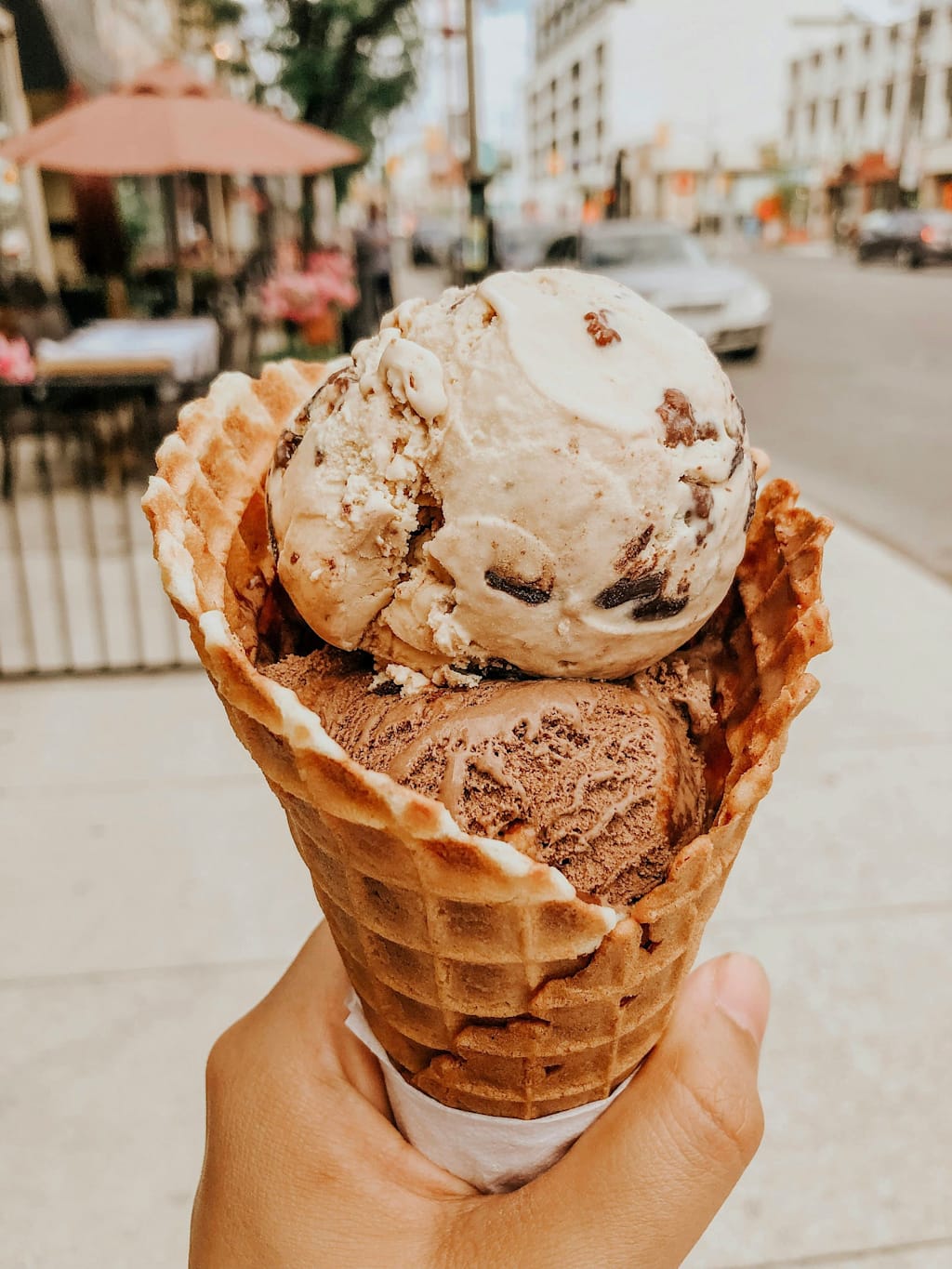
The flavor hits the sensory cells of the tongue’s papillae, and suddenly, I am floating in the clouds.
It was a hot summer afternoon. After walking in the sun for hours — shirt soaked, surrounded by a suffocating flood of people — I spotted an ice cream parlor. I have never been a particularly devoted fan of ice cream. But that afternoon, the ice in the cream was icing and was simply calling my name, and I answered.
Tasty. As cranial nerves VII, IX, and X did their wonders, transporting sweet chemical signals from tongue to brain, I swear I briefly met the inventor of ice cream and shook their hand in gratitude. Just then, I spotted a mother I had noticed at the very beginning of this hot journey. She was with her two sons, who had been screaming for ice cream since approximately the moment they were born. When they finally got their cones, their faces became entirely joyful — nothing else, just joy.
That is ice cream’s first and most reliable trick.
Ice cream is the ultimate perk of summer — the foundation of every enjoyable memory from a childhood holiday. I have heard tales of people traveling between countries, crossing distances that make no rational sense, for a single scoop. Tyra Banks opened an ice cream parlor in Australia because for her, ice cream was associated with success and celebration. Most of us understand this instinctively. We use it to celebrate, yes — but more honestly, we use it to comfort ourselves when celebration feels very far away. Our emotional attachment to this melting wonder in a cone knows no distance and very little logic. It is so unreasonably powerful that it can pull a person back from the deepest trenches of heartbreak, dragging them back into the world of the reasonably functional.
I treat this power seriously enough that I have developed my own domestic application: ice cream on whole wheat bread. It is, frankly, my most brilliant, zero-effort invention — no stove required, minimal cleanup, with infinite adaptability depending on your bread of choice.
I have eaten this more times than I am prepared to admit publicly. It is, depending on the bread, actually nutritious. This is the kind of clinical information I offer freely, as a service to humanity.
The human body is a remarkable machine, and nothing demonstrates this more clearly than its relationship with ice cream. The way it melts under its taste, oblivious of time and space. In our work lives, ice cream is the ultimate social glue — the shortcut past hierarchy, awkwardness, and the particular tension of a stressful lunch among colleagues. “Hey, let me get us some ice cream” resolves more interpersonal friction than most formal mediation processes.
Ice cream is a true equalizer. No matter who you are — a CEO or a five-year-old child — we all look the same when we’re licking a cone as it drips down our wrists. I’ve often had this theory that we should research surviving on nothing but ice cream for months. Maybe we’d develop some nutritional deficiencies, or maybe we wouldn’t; maybe it would all just work out with a little supplementation. And guess what? It’s perfect for every occasion, time, and season.
Well, perhaps not winter. I once saw a girl eating ice cream in the middle of winter, and I found myself wondering if she had a volcano spilling over inside her. Ice on ice? I’d be quaking in my boots. But because the nervous system is so complex and able to compartmentalize, even a painful brain freeze doesn’t stop the pleasure of that dopamine rush that comes with every lick.
I recently discovered that ice cream was once a luxury reserved exclusively for royalty. That history feels relevant now. As I walk through our modern cities — supermarkets on every corner, ice cream parlors somehow always in the inconvenient, distant, chaotic city center — I find myself questioning our collective priorities. If the modern world is dividing us, if social media is slowly replacing genuine human contact with its frictionless simulation, then ice cream should be the most accessible thing on earth. It should be at the front and center of every neighborhood. Not behind a bus journey. Not reserved for weekend trips downtown. Here. Immediate. Available.
I am prepared to argue that this is not an overstatement. Ice cream consumption spiked during COVID-19. It climbed during the 2008 financial crisis. In our worst collective moments, when cortisol is saturating our systems, and the future feels genuinely unknowable, we reach — globally, across cultures, without coordination — for something cold and sweet. The data does not lie. Ice cream is not a treat. It is an anchor.
It should be treated accordingly.
That hot afternoon, I finished my cone standing outside the parlor, watching the city move around me. The mother’s two sons were quiet for the first time all day, faces buried in their scoops, temporarily at peace with existence. The suffocating crowd felt slightly less suffocating. My shirt was still soaked. Nothing had changed.
Everything felt marginally better anyway.
That is the case for ice cream. It doesn’t solve anything. It just melts. But for the four minutes it takes to eat it, you aren’t thinking about your mortgage, or your inbox, or the heat. You’re just trying not to get sticky.
I believe we deserve that. All of us, regularly, as a matter of public policy.
More ice cream. Fewer problems. The math is not complicated.
This article was originally published on medium: https://medium.com/illumination/the-cold-comfort-a-case-for-ice-cream-as-a-human-right-105d2298a8a2
About the Creator
Enjoyed the story? Support the Creator.
Subscribe for free to receive all their stories in your feed.
Comments
There are no comments for this story
Be the first to respond and start the conversation.