
The City That Measured Silence
Not everything that matters can be counted—but everything counted begins to matter.

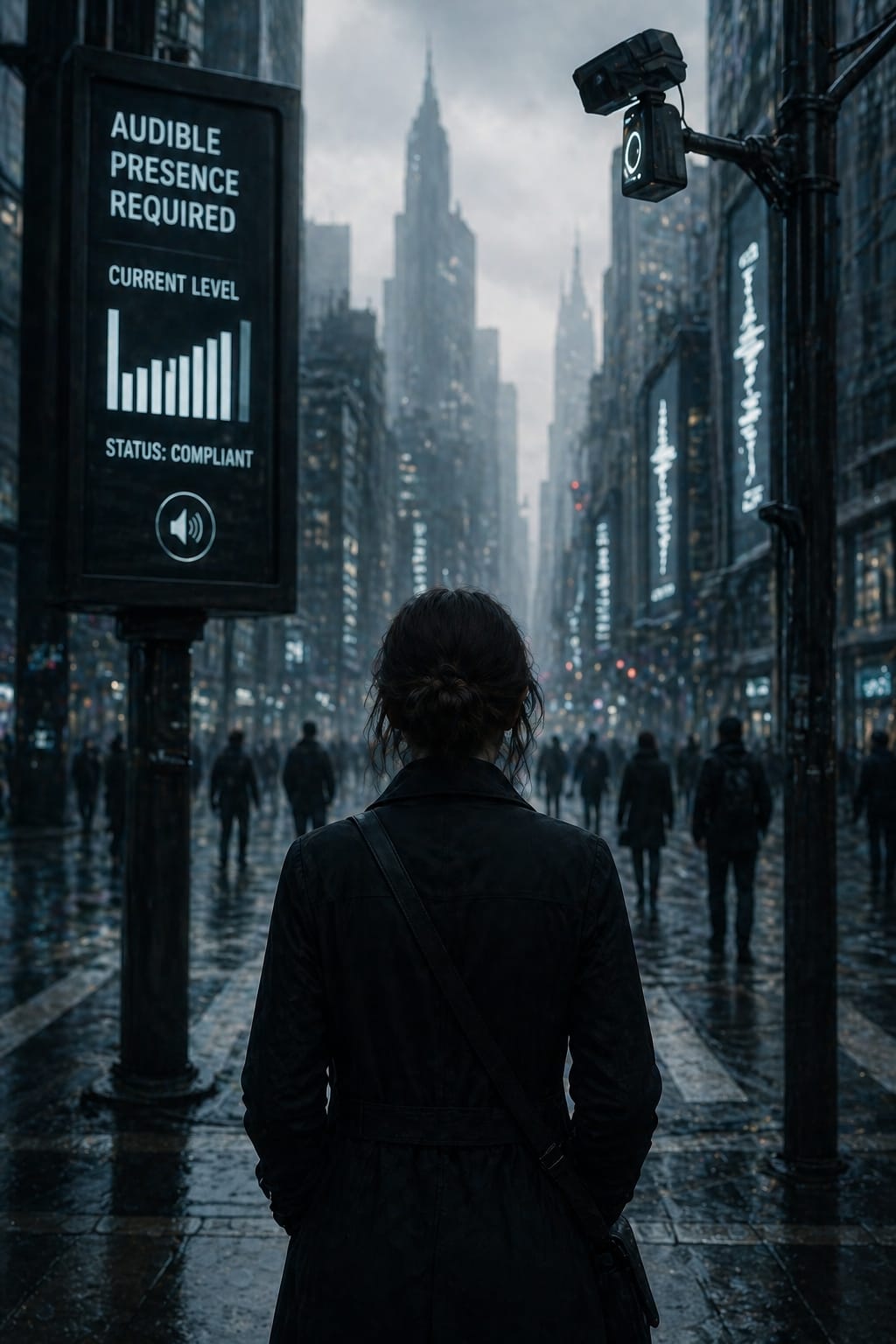
The first time the city fined her for being quiet, Elin thought it was a mistake.
She stood at the corner of Larkspur and Ninth, holding the thin slip of gray paper between her fingers, rereading the printed words as though repetition might soften them.
Violation: Insufficient Audible Presence
Duration: 17 minutes, 42 seconds
Penalty: 12 credits
Around her, the city moved in calibrated noise. Conversations rose and fell in measured rhythms. Footsteps struck pavement with deliberate emphasis. Even laughter seemed timed, its crescendos rising just enough to register.
Elin folded the paper once, then again, until it became a narrow strip she could slide into her coat pocket.
Seventeen minutes.
She tried to recall them.
She had been walking. Thinking, perhaps. Or not thinking at all. That was the problem with silence—it erased its own trace.
She looked up.
Across the street, mounted high on a lamppost, a small black sensor blinked once.
The Arithmetic of Breath
The city had not always been like this.
At least, that was what the older residents claimed—those who spoke in hushed tones about a time before the Measures, before the Bureau of Acoustic Integrity, before silence itself became suspect.
Elin had been a child when the system was implemented. She remembered fragments: her mother placing a small metronome on the kitchen table, instructing her to hum softly while doing her homework; her father practicing his “public cadence,” a way of speaking that maintained consistent decibel levels without sounding forced.
“Sound is presence,” he had said. “Presence is proof.”
Proof of what, Elin had never asked.
Now, years later, the rules were simple.
Every citizen was required to maintain a minimum level of audible activity while in public spaces. Speaking, humming, tapping fingers, even controlled breathing—all were acceptable forms of compliance.
Extended silence, however, triggered alerts.
Three violations in a week resulted in mandatory auditory training.
Five led to temporary social restriction.
Ten—
Elin stopped that thought before it formed completely.
She had never known anyone who reached ten.
At her office, the hum of compliance was constant.
Elin worked in Records Management, a department responsible for cataloging acoustic data. Rows of terminals displayed streams of numbers, each corresponding to a citizen’s daily sound profile.
She sat at her station, the faint clicking of her keyboard blending seamlessly with the surrounding noise.
To her left, Maro tapped his pen against the desk in a steady rhythm. To her right, Lise whispered fragments of conversation into an open microphone, her voice just loud enough to register without drawing attention.
Elin adjusted her headset.
On her screen, a profile opened.
Subject: K-44192
Audible Output: Below Threshold
Flag: Recurrent Silence
A small red indicator pulsed beside the data.
Elin hesitated.
Then, slowly, she muted her own microphone.
The Space Between Sounds
It was a minor infraction.
Five seconds, perhaps.
Ten.
Just enough to feel it.
The absence.
At first, nothing changed.
The office continued its low, constant murmur. Numbers flowed across the screen. The system did not react immediately—there was always a slight delay, a margin built into the algorithm.
Elin closed her eyes.
In the quiet, something unfamiliar surfaced.
Not a thought.
Not exactly.
More like a sensation—an awareness of herself not as a function within the system, but as something separate from it.
It was unsettling.
And strangely precise.
She unmuted the microphone.
The hum returned.
No alert.
No penalty.
She exhaled.
The moment passed.
But something remained.
That evening, Elin walked home more carefully.
She counted her steps, letting the soft rhythm of her shoes against the pavement maintain her audible presence. When she paused at intersections, she whispered numbers under her breath—one, two, three—just loud enough for the sensors to register.
At Larkspur and Ninth, she stopped.
The lamppost stood as it had that morning, its sensor blinking at regular intervals.
Elin looked up.
Then, deliberately, she said nothing.
Five seconds.
Ten.
Fifteen.
The city seemed to lean toward her, listening.
At seventeen seconds, she spoke.
“Still here.”
Her voice sounded different to her own ears—thinner, perhaps, or more deliberate.
She continued walking.
No fine came.
Not that night.
The Ones Who Didn’t Speak
The second violation arrived two days later.
Then a third.
Each one shorter than the last.
Each one more intentional.
Elin began to experiment.
Small pockets of silence, inserted between moments of compliance. A withheld word here. A delayed breath there.
The system responded predictably—alerts, warnings, minor penalties.
But something else began to shift.
At the edge of her awareness, she noticed others.
A woman on the tram who held her breath a second too long before answering a question. A man in the queue who let his tapping falter just slightly before resuming.
Tiny deviations.
Barely perceptible.
But there.
One evening, as Elin turned onto her street, she saw him.
He stood beneath a sensor, perfectly still.
No movement.
No sound.
For a moment, she thought he might be malfunctioning—some glitch in the system’s perception.
Then he looked at her.
And smiled.
Not broadly.
Not defiantly.
Just enough to acknowledge something unspoken.
Elin slowed her steps.
The man remained silent.
The sensor above him blinked once.
Twice.
A faint chime sounded—a warning.
Still, he did not move.
Elin felt her own breath catch.
The chime grew sharper.
More insistent.
Finally, just before the threshold tipped into violation, the man spoke.
“Good evening.”
His voice was calm, almost gentle.
Then he walked away.
Elin stood there long after he had gone.
That night, she did not whisper numbers.
She did not count her steps.
She lay in bed, listening to the quiet between the city’s sounds.
And for the first time, she wondered what it was for.
The Measurement of Absence
The summons arrived at dawn.
A clean white envelope, sealed with the insignia of the Bureau of Acoustic Integrity.
Inside, a single sheet.
Subject: Elin Varr
Notice: Behavioral Irregularities Detected
Directive: Report for Evaluation
No time was given.
Only a location.
The Bureau occupied a building at the center of the city—a structure of glass and steel designed to reflect sound as much as light.
Inside, the air felt different.
Controlled.
Measured.
Elin was led to a small room.
No windows.
No visible sensors.
Just a chair.
And silence.
She sat.
Waited.
Minutes passed.
Or seconds.
Without sound, time became uncertain.
Then a voice spoke.
“Do you find this uncomfortable?”
Elin turned.
A woman stood in the corner, her presence so still that it seemed she had always been there.
“Yes,” Elin said.
“Why?”
Elin considered.
“Because it isn’t measured.”
The woman nodded.
“Or because it is?”
The question lingered.
Elin felt something shift inside her—a recognition, perhaps, or the outline of one.
“What happens,” she asked slowly, “if nothing is recorded?”
The woman stepped forward.
“Then nothing can be proven,” she said. “And what cannot be proven cannot be controlled.”
Elin’s pulse quickened.
“Is that what this is about?” she asked. “Control?”
The woman did not answer.
Instead, she gestured to the room.
“Remain here,” she said. “As long as you like.”
Then she left.
The door closed.
Elin sat alone.
No sensors.
No requirements.
No thresholds.
At first, she spoke—softly, reflexively.
A word here. A breath there.
Then she stopped.
The silence settled.
Not heavy.
Not oppressive.
Just present.
In it, Elin felt something she had not known she was missing.
Not freedom.
Not yet.
But the possibility of it.
The Sound She Chose
When Elin left the Bureau, the city sounded different.
Not louder.
Not quieter.
Just… less certain.
She walked to Larkspur and Ninth.
The sensor blinked.
The crowd moved.
The rhythm continued.
Elin stood at the corner.
And waited.
Five seconds.
Ten.
Fifteen.
The system held.
At twenty, a chime sounded.
At twenty-five, it sharpened.
At thirty—
Elin spoke.
Not to comply.
Not to avoid the penalty.
But because she chose to.
“I am here.”
Her voice was steady.
Not loud.
Not measured.
Just hers.
The chime ceased.
The system recorded.
The city continued.
But something had changed.
Not in the sensors.
Not in the rules.
In the space between them.
Elin turned and walked on.
This time, she did not count her steps.
And when the next silence came, she did not rush to fill it.
She let it remain.
Unmeasured.
Unproven.
And, for the first time, entirely her own.
About the Creator
Cordelia Vance
Lost in the ink-stained corridors of a life lived through pages. I write to capture the whispers of ghosts we pretend not to hear and the shadows we call home. Welcome to my attic of unspoken truths.
Enjoyed the story? Support the Creator.
Subscribe for free to receive all their stories in your feed.
Comments
There are no comments for this story
Be the first to respond and start the conversation.