
The Cartography of Ghosts
A woman returns to her family's manor to find that its rooms no longer correspond to any map she remembers—and the walls themselves are keeping score

The House That Remembers
Eleanor Ashworth had not seen Thornfield in nineteen years, yet the moment her carriage wheels crunched upon the gravel drive, she knew the house had been waiting for her with the patience of something that exists outside of time.
It stood against the November dusk like a judgment, all Victorian granite and broken teeth of Gothic spires, its façade the color of old bone. The windows reflected nothing, though she could feel the house observing her with the intensity of a predator that has been starving. The air smelled of rust and earth and something else—something closer to the smell of old photographs, of documents left too long in the dark.
"We've prepared the east wing," her brother Edmund had written in his brief, businesslike letter. "Mother's rooms are precisely as she left them. The servants have been selective about what we've disturbed."
Selective. That was one word for it.
Eleanor stepped onto the threshold, and the house exhaled.
The entrance hall was exactly as she remembered it: the sweeping staircase with its mahogany banister, the portrait gallery where the Ashworth ancestors watched with eyes that seemed to track your movement, the marble floors that magnified every footstep into something thunderous and accusatory. But something was wrong in the geometry of it. The hall seemed larger than it should be, the distances between objects—the hall table, the umbrella stand, the great chandelier above—somehow distended, as if the space itself had been stretched like taffy and never properly reset.
"Miss Eleanor." Mrs. Graves emerged from the shadows like a memory taking physical form. The housekeeper had aged in the way that some people do, not through the accumulation of years but through the subtraction of something essential. Her hair was white now, her hands trembled slightly as she took Eleanor's coat, but her eyes held a terrible clarity.
"Mrs. Graves. It's been far too long."
"Has it?" The housekeeper's smile contained no warmth. "Or has it been no time at all? Time moves differently in Thornfield. You'll remember that soon enough."
Eleanor wanted to ask what she meant, but Edmund appeared at the top of the staircase, and there was something in his expression—a tightness around the eyes, a pallor that spoke of nights without proper sleep—that suggested he was not a man who slept easily in this house anymore.
"Eleanor. Thank God you've come." He descended with the careful precision of someone navigating an unfamiliar path, even though this was his childhood home. "I wasn't certain you would respond to my letter."
"Your letter was rather urgent," Eleanor said carefully. "You mentioned Mother's condition had deteriorated. That the doctors were baffled."
Edmund's jaw tightened. "The doctors. Yes. Well, the doctors have proven remarkably useless. Mother refuses to leave her room, and when one does manage to enter—she speaks of rooms that don't exist. Hallways that lead into themselves. She draws maps constantly, Eleanor. Compulsive drawings of the house, but the layouts are all wrong. Impossible geometries."
A chill moved through Eleanor, though the hall was warm. She remembered her mother as a woman of rigid rationality, a woman who tolerated no nonsense from anyone, least of all from her own body. To imagine her descending into such confusion was to imagine a fundamental disorder in the world.
"Take me to her," Eleanor said.
The Rooms in Between
The second floor hallway was not as Eleanor remembered it. She had walked it thousands of times during her childhood—from her bedroom (the south-facing room with the window seat) to the nursery (where she had taught her younger brother to read) to her mother's suite (which was forbidden to everyone except by explicit invitation). These memories lived in her body, in the reflexive turning of her feet, the anticipation of familiar landmarks.
But the hallway had other ideas.
Where there should have been three doors, there were five. Where there should have been a small portrait of their grandfather the Admiral, there was instead a window looking out onto a landscape Eleanor didn't recognize—rolling hills covered in snow, though it was November and snow was not yet general. The light falling through that window was wrong too, a kind of twilight that suggested either dawn or dusk, but never quite settling into either.
"The house changes," Edmund said quietly, as if reading her thoughts. "Not dramatically. Not all at once. But if you're away for several hours, when you return, things have... shifted. Rearranged themselves. A room that was on the left side of the hall is now on the right. A window appears where there was a wall. Mother started drawing maps because she wanted to track the changes, to create some kind of record. But the maps themselves became unreliable."
"That's impossible," Eleanor whispered.
"Yes, rather." Edmund's voice carried a note of bitter amusement. "And yet. Here we are."
They arrived at what Edmund identified as their mother's suite, though the door Eleanor remembered—solid oak, painted cream, with brass hinges shaped like acanthus leaves—had been replaced by something different: a door of dark wood, unmarked and austere, without any decoration whatsoever. It seemed to absorb light rather than reflect it.
Edmund knocked. There was no answer.
He knocked again, harder. Still nothing.
"Mother?" he called through the door. "Eleanor is here. She's come from London."
For a long moment, silence. Then, from behind the door, a voice that Eleanor recognized as her mother's but fundamentally altered—thinner, more brittle, as if produced by something operating a flesh puppet rather than an embodied human being:
"Which Eleanor? The one from 1876? Or the one who left in 1905? There have been so many Eleanors walking through these halls. I've been mapping them. Come in, come in. I'll show you the chart."
Edmund and Eleanor exchanged a glance. He turned the handle.
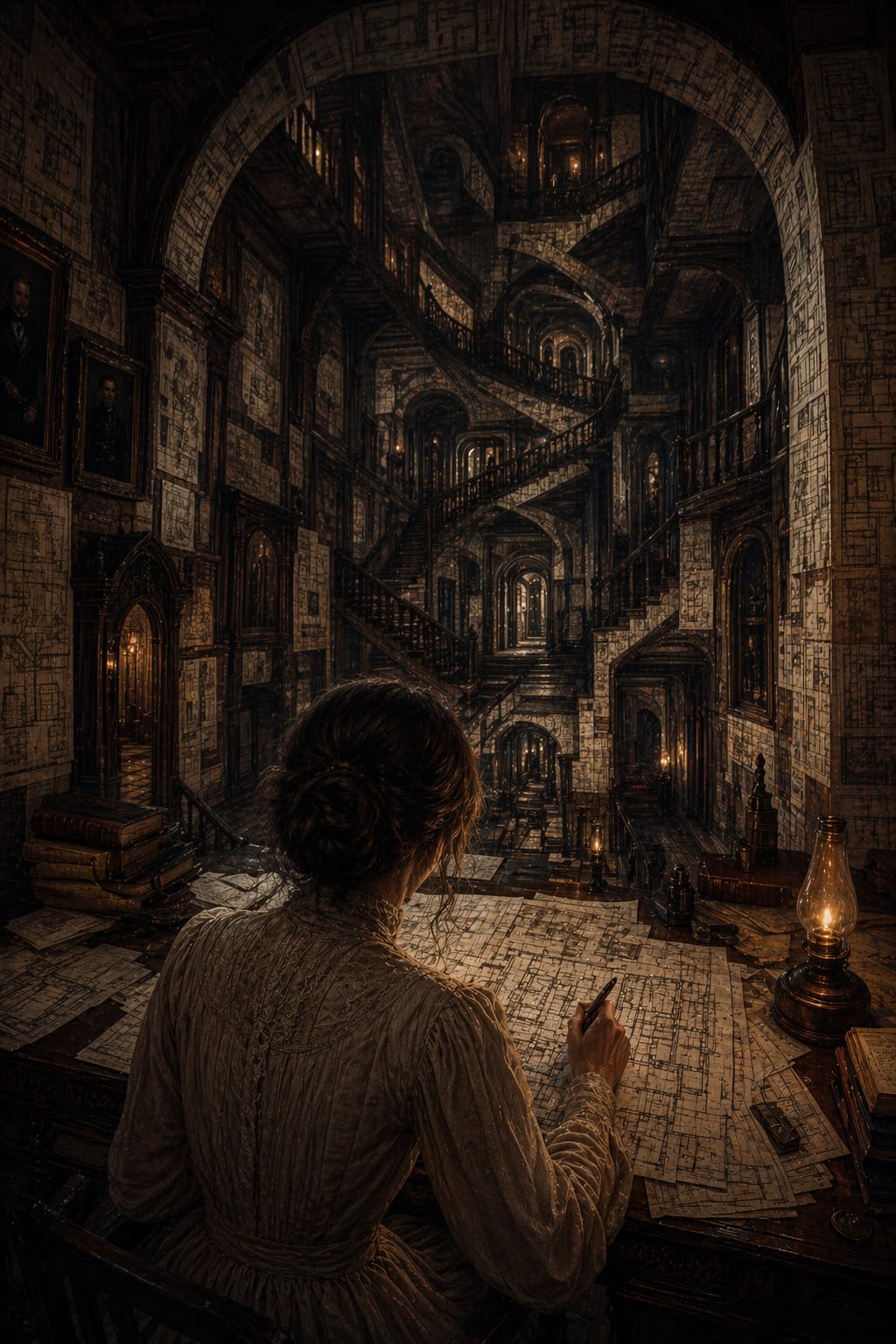
The room beyond was not the bedroom Eleanor remembered. It was a study, lined with papers. Every surface—the walls, the floor, even the window panes—was covered in drawings: maps, diagrams, sketches that seemed to shift between architectural representations and something closer to anatomical drawings, as if the house itself were a body and someone were trying to understand its systems, its circulation, its hidden organs.
Their mother sat at a writing desk, surrounded by ink and parchment, a quill still held in her trembling hand. She was dressed in a nightgown that looked as though it had not been removed in days. Her hair, once so carefully pinned, hung loose and matted. But her eyes—her eyes were sharp, almost fevered.
"Ah," she said, looking at Eleanor without quite focusing on her. "Yes. You. I've been expecting you. I've mapped out where you were, you see. In the exterior world. London, wasn't it? Such a solid place, London. No surprises. No rooms that shouldn't exist. But here..." She gestured at the papers. "Here, the house keeps secrets. Secret rooms. Secret hallways. Secret geometries."
"Mother," Eleanor began carefully, "I've come to help. To take care of you."
"Take care?" Her mother laughed, a sound like breaking glass. "Oh, my dear girl. Nobody takes care in Thornfield. Thornfield takes care of us. It feeds on us. Can't you feel it? Even now, as you stand in this room, the house is mapping you. Learning the shape of you. Deciding where you belong."
Eleanor wanted to leave. Every instinct screamed at her to leave. But she found herself moving closer to the maps, drawn by a horrified fascination. The drawings showed the floor plan of Thornfield, but rendered in a perspective that made her head hurt. Rooms that should be on the same level appeared to exist simultaneously above and below each other. Hallways twisted back on themselves in ways that violated all known geometry. And yet, sketched in the margins, Eleanor recognized specific architectural details from her childhood—the crack in the parlor ceiling shaped like a bird's claw, the water stain in the hallway that looked like a weeping face, the particular pattern of the tiles in the entrance hall.
It was accurate. Impossibly, terrifyingly accurate, yet arranged in a manner that could not possibly correspond to physical space.
"How long has this been happening?" Eleanor asked.
"Happening?" Her mother looked at her with something approaching pity. "It's not happening, Eleanor. It's always been like this. We're only just now learning to see it. The house was built on a place that doesn't obey normal rules. My great-grandfather purchased it in 1723, and I suspect even then it was old, even then it was hungry. Every family member who has lived here—every person who has walked these halls and slept in these rooms—has been slowly absorbed into its geometry. We don't own Thornfield. We are Thornfield. Our lives are just the house learning how to think about itself."
The Architecture of Memory
Eleanor did not sleep that night.
Instead, she walked the hallways of Thornfield, and the more she walked, the more she understood her mother's madness. The house was not quite right. Every hallway was slightly longer than it should be, or slightly shorter. Rooms that should adjoin each other were separated by impossible distances. A staircase that descended from the third floor seemed to arrive at the second floor but facing the opposite direction from how it should have.
And yet, there was a logic to it. A terrible, compelling logic.
She found herself in a corridor she had never seen before, lined with doors. She opened them at random. Behind one was a room full of mirrors, each reflecting not her own image but versions of herself at different ages. Behind another was the bedroom she had inhabited as a child, preserved perfectly in amber, her childhood drawings still pinned to the walls, her wooden horse still standing in the corner. Behind a third was a library of books written in her own handwriting, describing events that had not happened yet.
The house was not haunted, Eleanor realized. It was remembering.
It remembered everyone who had ever lived within it. It remembered their thoughts and their secrets and their histories. And in its remembering, it had acquired a kind of consciousness, a point of view that encompassed all of time at once, all possible configurations of the rooms and hallways, all the ways that a space could be organized and reorganized to contain the infinite complexity of human experience.
When she finally found Edmund at dawn, he was sitting in the kitchen—the one room in the house that seemed unable to rearrange itself, as if kitchens were too fundamentally tied to the practical world of cooking and eating to be subject to the house's peculiar transformations.
"You understand now," he said, not as a question.
"I'm beginning to," Eleanor replied carefully. "Mother isn't mad. Or rather, she's only mad in the way that the house is mad."
"The house was mad from the beginning. We're only catching up." Edmund poured two cups of tea with hands that barely trembled. "I've been investigating the records. Great-grandfather purchased Thornfield in 1723, yes, but the land itself is older. Older than our records. There was something here before any structure was built—something that doesn't respect the normal rules of space and time. When Thornfield was constructed, it was built on top of that something, and it inherited its nature."
"What do we do?" Eleanor asked. "How do we escape?"
Edmund was quiet for a long moment. When he spoke again, his voice was very soft: "I don't think we can. I don't think we're meant to. I think the only choice left is to stop resisting it. To let the house absorb us fully, the way it wants to. And in doing so, perhaps we'll understand something about the nature of memory, of time, of the self, that people in normal houses can never comprehend."
Eleanor looked down at her tea. In the surface of the liquid, she could see not her reflection but a map—the floorplan of Thornfield as it truly was, infinite and impossible, a structure that existed as much in memory as in space.
She picked up the cup and drank deeply.
The Infinite Hallway
Years later (or perhaps only hours; time was not reliable at Thornfield), Eleanor had become something like her mother. She spent her days drawing maps, documenting the changes in the house, learning its logic. Edmund had long since stopped emerging from his rooms. The servants had either fled or been absorbed, their presence no longer noticeable in the vast architecture of the manor.
But Eleanor did not feel lost anymore.
She had discovered that the house's reorganizations were not random. They followed patterns, deep patterns, patterns that reflected the secret histories of everyone who had ever lived within it. The hallway on the second floor that led back to itself was the corridor where her great-grandmother had walked for an hour each night, unable to move forward in her life. The staircase that descended only to ascend again was the physical manifestation of her grandfather's obsessive circling of the same thoughts. The room of mirrors was her mother's fractured consciousness rendered into architecture.
And somewhere, in the deepest part of the house, Eleanor found a room that could only be hers: a chamber full of books and maps, where every page described the life she was living, the thoughts she was thinking, the very moment of her own awareness. It was not a prophecy. It was a record. It was the house, writing itself through her hand, her mind, her life.
She did not struggle against it anymore.
Instead, she picked up her pen and continued mapping, continued documenting, continued to be the instrument through which Thornfield learned to tell the story of itself. And in doing so, she discovered that she and the house were no longer separate entities. She was the hallway and the hallway was her. She was the room and the room was her. She was Thornfield, and Thornfield was her, and they were both infinite and eternal and terribly, perfectly sane.
The maps covered every surface now. But there was always one more room to map, one more corridor to explore, one more impossible geometry to render into visible lines and careful notations.
The house would never be fully known.
And that was precisely as it should be.
THE END
About the Creator
Alpha Cortex
As Alpha Cortex, I live for the rhythm of language and the magic of story. I chase tales that linger long after the last line, from raw emotion to boundless imagination. Let's get lost in stories worth remembering.
Enjoyed the story? Support the Creator.
Subscribe for free to receive all their stories in your feed.
Comments
There are no comments for this story
Be the first to respond and start the conversation.