
The Cartography of Deception
Every lie leaves a mark. But what happens when you find one you never made?

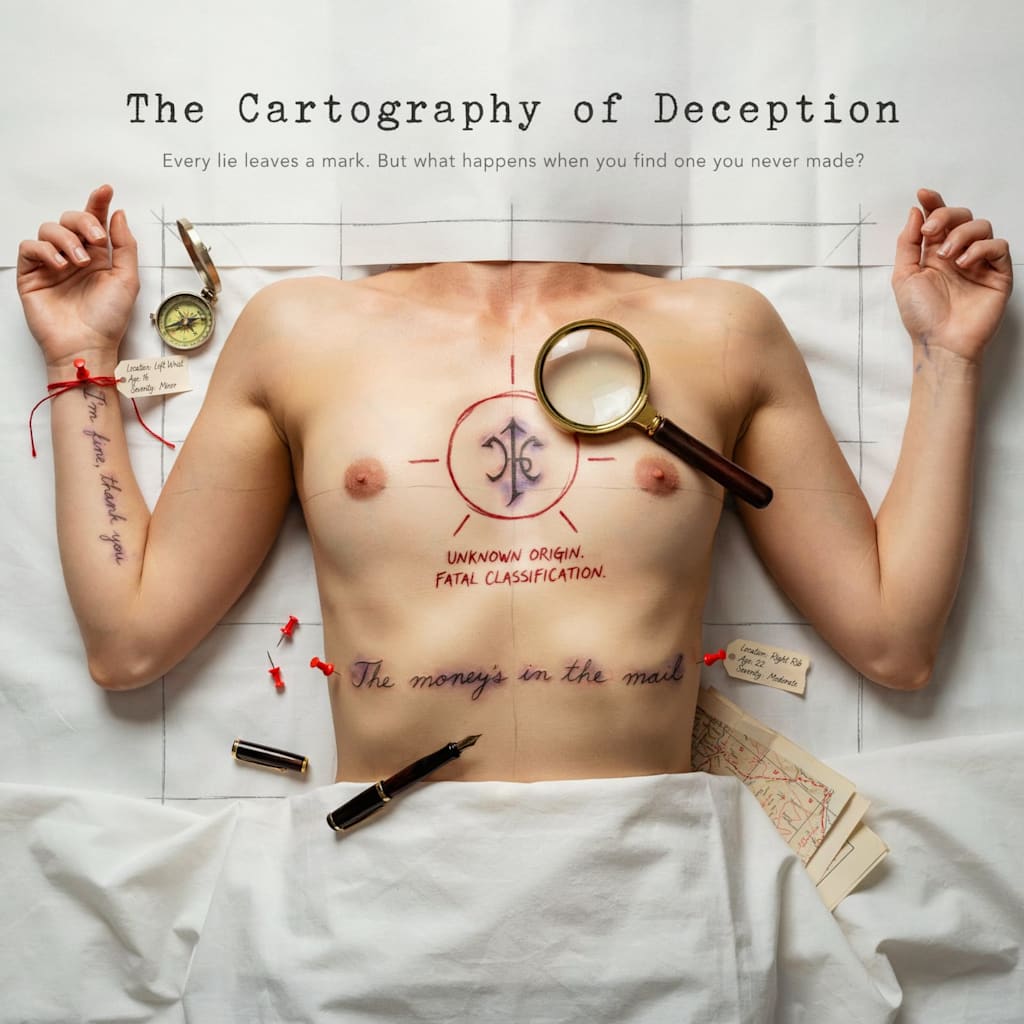
The first lie I ever told appeared on my left wrist the night I turned sixteen.
It was small, just four words in a font so delicate it looked like a vein had risen to the surface: "I'm fine, thank you." I'd said it to my grandmother that morning, brushing off her concern about the bruise on my collarbone. The bruise was from a boy at school. The lie was from survival.
By seventeen, my arms were sleeves of half-truths. "I was home by ten." "The money's in the mail." "I love you too." Each midnight, a new phrase bloomed in black ink, then faded to a bruise-like purple, then settled into something that looked like a scar but wasn't. Dermatologists couldn't explain it. Priests crossed themselves. I learned to wear long sleeves and keep my mouth shut.
By twenty-five, I was the best con artist in the city. Not because I was particularly charming—though I was—but because I had a gift for knowing exactly which lie someone needed to hear. The lonely widower needed to believe his wife was still watching. The desperate investor needed to believe in guaranteed returns. The marks weren't stupid; they were human, and humanity is a hunger that lies know how to feed.
My body became a map of my trade. Across my ribs: "This is a limited opportunity." Down my spine: "I've never done this before." On my thigh, in letters that made me blush even alone: "You're the only one."
I catalogued them like a librarian. I knew which lies had worked, which had soured, which had cost me more than they earned. The system was perfect. The system was mine.
Until the night I found the tattoo I didn't recognize.
It was a Tuesday. I remember because I'd just finished a job—an art forgery scam on a hedge fund manager who thought he was buying a lost Basquiat—and I was alone in my apartment, counting cash on the kitchen table, when the familiar itch started.
The tattoos always arrived at midnight. A prickling sensation, like ants marching under the skin, followed by the bloom of ink. I'd grown used to it. I barely looked down anymore.
But that night, the itch was in a new place. My sternum, directly over my heart.
I pulled my shirt up and watched the letters form, black and wet-looking, as if the skin itself were bleeding language.
"She's not breathing. Help me."
I stared at it. I touched it. I said the words out loud to see if they triggered memory, the way certain smells can drag a whole afternoon back from nothing.
Nothing.
I hadn't said those words. I was certain. I'd never been present for someone not breathing. I'd never called for help in my life—I was the help people called when they were desperate, the last resort, the final lie. I didn't do emergencies. I did arrangements.
But the tattoo was there, real as any of the others, pulsing slightly with my heartbeat.
I told myself it was a mistake. The universe's filing system had glitched. I'd wake up and it would be gone, or I'd remember some drunken night, some forgotten trauma, some moment my brain had kindly erased.
It didn't fade.
And by morning, it had started to hurt.
The pain was subtle at first. A tightness when I breathed. A sharpness when I lied.
I tested it. Told my neighbor her new haircut was flattering. The lie appeared on my ankle—"It really suits your face shape"—and the sternum tattoo flared like a brand pressed to skin.
I stopped lying. For three days, I told the truth exclusively. Brutal, unvarnished, career-ending truth. I told a client her investment was gone and I was the one who took it. I told a former lover that I'd faked every orgasm and most of the affection. I told my reflection that I was a parasite who had mistaken survival for living.
The new tattoos stopped. But the old one remained, and the pain deepened. It spread from my chest into my shoulders, down my arms, as if the lie were traveling through my nervous system, mapping new territory.
I started to cough. Blood, once, into a tissue I threw away without examining too closely.
I went to a doctor who didn't ask about the tattoos. I went to a tattoo artist who said the ink was "wrong, like it was coming from the other side of the skin." I went to a psychic who took one look at my chest and said, "That's not your lie. That's someone else's truth about you."
I didn't understand until I found the photograph.
It was in a box I'd kept from my mother's house, after she died. I'd never sorted through it. Grief, for me, had always been something to postpone, like a dental appointment or an honest conversation.
The photograph was black and white, creased down the middle. A hospital room. A woman in a bed, her face turned away. And a child—me, unmistakably, though I didn't remember being that small—standing beside the bed, holding the woman's hand.
On the back, in my mother's handwriting: "Lily, age 4. Saying goodbye to her sister, Rose. Rose passed that night. Lily never spoke of it again."
I had a sister.
I had a sister, and she had died, and I had been there, and I had said something—she's not breathing, help me—and someone had helped, or hadn't, and the memory had been buried so deep that only my skin remembered.
I called my aunt that night. The one who still spoke to me, who still believed I was a "travel consultant" with a busy schedule.
"Rose," I said, and the silence on the other end was its own confession.
"Your mother made us promise," my aunt whispered. "After the funeral. You wouldn't stop screaming. You kept saying you killed her. You kept saying you lied. The doctors said it was trauma. Your mother said if we ever mentioned it, you'd break completely."
"I lied about what?"
"Rose had asthma. She had an attack that night. You were alone with her. Your mother was at the store. You were four, Lily. You didn't know how to use the inhaler. You told the paramedics she was sleeping, that she'd been fine all day, that you didn't know what happened. You lied because you were scared, and by the time you told the truth, it was too late."
I hung up. I looked at the tattoo. She's not breathing. Help me.
It wasn't a lie I'd told. It was a truth I'd buried under so many layers of deception that my own body had forgotten the difference.
The pain was unbearable now. I could feel it in my lungs, my throat, the place where breath becomes words. Every lie I'd ever told had been an attempt to outrun this moment, this truth, this four-year-old girl who had been too scared to save her sister and too small to understand that some things aren't survivable.
I lay on my bathroom floor and watched the ceiling spin. The tattoos covered me now, a topography of deception, but the one over my heart was changing. The letters were rearranging, the ink running like tears, and I realized with a clarity that felt like dying that the tattoo wasn't killing me.
It was trying to save me.
She's not breathing. Help me.
Not a lie. A memory. The truest thing I'd ever said, spoken by a child who didn't yet know that the world punishes honesty more severely than deception. I'd spent twenty years becoming someone who could talk her way out of anything, and the one thing I'd needed to talk my way out of was the belief that I was irredeemable.
I picked up my phone. I called 911. I told the dispatcher my name, my address, and that I thought I was dying. The truth, for once. The whole truth. The dispatcher stayed on the line. The ambulance came. I didn't run.
In the hospital, they found an infection in my lungs, advanced, treatable. They found malnutrition, exhaustion, a body that had been running on adrenaline and fabrication for too long. They didn't find anything supernatural. The tattoos, when the doctors examined them, were just tattoos. Old, faded, inexplicable, but not malignant.
The one on my chest had changed completely by morning. It read: "I was four. I was scared. I am sorry."
I wept for three hours. The nurses were kind. They thought I was grieving the diagnosis. I was grieving the girl I'd buried under so many performances, the sister I'd never been allowed to mourn, the life I'd built on the conviction that if I was clever enough, false enough, fast enough, I could outrun the truth forever.
I couldn't.
But I could, finally, stop running.
I sold the apartment. I gave back the money I could trace. I wrote letters—real ones, on paper, with stamps—to everyone I'd deceived. Some were forgiving. Some threatened lawsuits. Some never replied.
The tattoos are fading now. Not disappearing, but becoming something else. The ones on my arms read like a history rather than a warning. The new ones—because I still lie, I'm human, I still say I'm fine when I'm not—appear and fade within days, as if my body has learned to trust me with temporary deceptions, the small kindnesses that keep society functioning.
The one on my chest remains. "I was four. I was scared. I am sorry."
I touch it sometimes, when I wake from dreams of hospital rooms and small hands in mine. I touch it and I breathe, and I remember that the map of a life isn't the territory. That I was someone before I was a con artist. That I was a child who loved her sister, who called for help, who did not cause the thing she feared she caused.
Every lie I told was an attempt to rewrite that story. To make myself the villain, because villains have control. Victims only have grief.
I am neither, I think. I am something else. A woman with scars that spell out her history. A body that learned to keep its own counsel. A person who is learning, slowly, that the truth doesn't have to be a weapon or a wound.
Sometimes it's just a door. And on the other side, finally, is air.
About the Creator
Muhammad Sabeel
I write not for silence, but for the echo—where mystery lingers, hearts awaken, and every story dares to leave a mark
Enjoyed the story? Support the Creator.
Subscribe for free to receive all their stories in your feed.
Comments
There are no comments for this story
Be the first to respond and start the conversation.