
The Cartographer's Daughter
A tale of maps unmade, memories rewritten, and one woman's descent into a geography that refuses to stay still

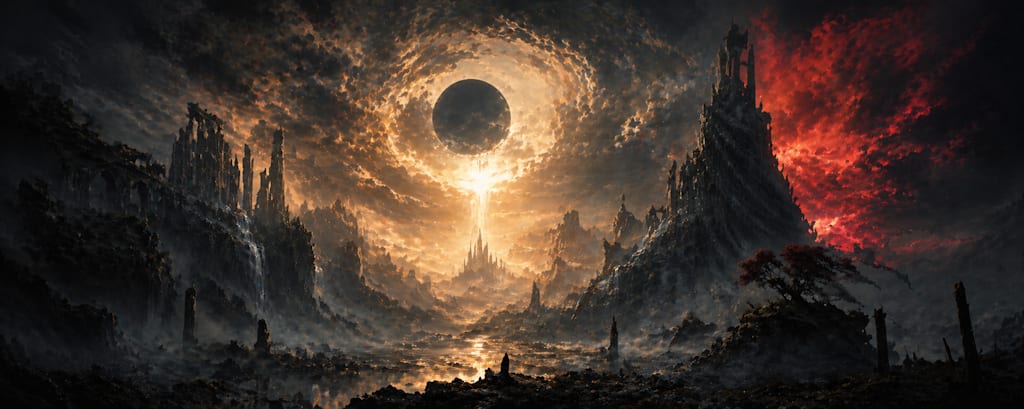
The Cartographer's Daughter
A tale of maps unmade, memories rewritten, and one woman's descent into a geography that refuses to stay still
Part I: The Atlas Burns
The fire started in the west corner of her father's study, where the oldest maps were kept—the ones he'd been collecting since before she was born. Elena watched from the doorway as the flames consumed centuries of careful notation, of coastlines traced in indigo ink, of mountains rendered in ochre and umber. The smoke smelled of old paper and something else: cinnamon and cloves, as though her father had perfected the art of making cartography edible.
"You can't stop it," said the man beside her. His name was Oser, and he worked for something he would only describe as "the Ministry of Terrestrial Revision." He held a leather journal under one arm, its pages already yellowing despite its apparent newness. "Your father understood this. Eventually, all maps must burn."
Elena did not respond. She was forty-three years old, a professor of historical geography at the university, and she had spent her entire adult life trying to understand what her father's maps actually contained. Now, as she watched his life's work transform into ash, she realized she had understood nothing at all.
Marcus Chen had been a cartographer of the old school—the kind who believed that a map was not merely a representation of a place, but a conversation with it. He drew by hand, refusing digitization. He visited every location he charted, sometimes spending months in villages so small they didn't appear on official records. He kept detailed journals of his findings, supplemented with sketches, pressed flowers, and fragments of conversations overheard in markets and taverns.
And then, six months ago, he had stopped leaving the study.
"I'm documenting changes," he'd told Elena during one of her visits. He was thinner then, his hands stained with inks that no longer faded. "The world is revising itself, daughter. I must record the revisions before they're complete."
She'd assumed it was age, the way the mind sometimes cracks under the weight of accumulating years. But when Oser had arrived at her apartment three days ago with news of her father's death, speaking of "natural causes" in a voice that suggested the causes were anything but, Elena began to wonder what her father had truly been documenting.
The study was emptying now. Oser's colleagues, dressed in the gray suits that seemed designed to make them forgettable, carried out box after box. The walls where maps had hung for decades now showed only pale rectangles, like the ghosts of geography.
"Your father completed his work," Oser said. "He mapped something that shouldn't be mapped. Something that the world—that certain elements of the world—have been trying very hard to keep unmapped."
Elena finally turned to look at him. He was younger than she'd initially thought, perhaps fifty, with the kind of face that would be invisible in a crowd. His eyes, however, were distinctive: they contained the mild, patient sadness of someone who had spent a long time delivering bad news.
"He left something for you," Oser continued, extending the journal he carried. "He said you would understand what he could not. That your academic training in historical cartography would allow you to read what he had recorded."
Elena took the journal with trembling hands. The leather was warm—recently heated, she thought. As she opened it, she caught that same scent of cinnamon and cloves.
The first page contained a single sentence in her father's careful hand: The maps are still there. You simply need to learn to see them.
Part II: The Geography of Forgetting
It took Elena three weeks to begin decoding her father's work.
The journal wasn't organized chronologically or geographically, but rather by what he called "revision events"—moments when the world had apparently rewritten itself. Each entry contained a hand-drawn map of a location, followed by detailed notes describing what had changed.
The city of Meridian, for instance. According to all official records, Meridian had been founded in 1847 on the eastern bank of the Castellan River. Her father's first entry about the city was dated fifteen years ago. His map showed Meridian in the same location, but his notes were frantic: The river runs north-south here, not east-west. The city is oriented entirely differently. I have walked these streets twice. Both times they were correct and contradictory.
Further entries tracked the city's successive transformations. Sometimes the river changed direction. Sometimes entire neighborhoods appeared in areas her father had documented as farmland mere pages earlier. In one particularly troubling entry, dated only two years ago, he wrote: I returned to Meridian yesterday. My notes from the previous visit no longer describe the city as it exists. Either my notes are wrong, or the city has changed again. A third possibility: my notes describe a Meridian that no longer has any claim to existence.
There were dozens of cities. Hundreds, eventually. Some had shifted their locations gradually, moving across their regional maps like vessels drifting in an invisible current. Others had transformed more dramatically—changing from coastal to inland settlements, from mountainous to flat, from temperate to arctic in the span of a single year.
Elena began to notice a pattern. The changes always occurred in places that few people visited, in regions where the population was sparse and transient. Remote villages, isolated valleys, abandoned industrial zones. Places where a shift in geography might go unnoticed by anyone except a cartographer obsessed enough to visit them repeatedly.
She began her own investigations, visiting her father's locations, consulting the maps she found among his remaining papers. In the valley near Castellbrand, she found evidence of an old stone bridge that no longer existed—but locals had no memory of it ever existing. In the mountains east of Kethrin, she discovered ruins that appeared on maps from three different centuries, always in slightly different positions.
And then she found the photograph.
It was hidden in a false compartment at the back of her father's journal—a place she discovered only when the leather, worn by her obsessive handling, finally cracked. The photograph showed three people standing before a landscape that made her stomach clench. It was a place she recognized: Mount Castellar, which stood fifty kilometers from her apartment. Except in the photograph, the mountain was inverted—its peak pointed downward, its base stretched toward an impossible sky.
The three people were her father (younger, perhaps thirty), Oser (identical in appearance to the Oser she had met), and a woman with her father's eyes and her own bone structure.
Her mother.
But her mother had died in a car accident the year Elena was born. There was a grave. There were documents. There was the absence that had shaped her entire childhood.
Elena called Oser. When he arrived at her apartment an hour later, she showed him the photograph without preamble.
His expression didn't change, but something shifted behind his eyes—a recognition, perhaps, or resignation.
"Your mother didn't die," he said quietly. "She chose to leave. To join the other Cartographers."
Part III: The Maps Unmade
Over coffee that grew cold and untouched, Oser told Elena a story that she would spend years verifying and could never quite fully believe.
The world, he explained, was not merely one geography. Rather, it existed in a state of constant negotiation—a web of possible mappings, each one as real as every other, all of them occupying the same space while remaining fundamentally invisible to one another.
Most people lived their entire lives within a single mapping, a single coherent geography of the world. They never noticed the revisions because the revisions happened at the edges of their perception, in the spaces between the places they inhabited.
But some people—cartographers with a particular obsession, with a need to draw things exactly as they saw them—could perceive the gaps. They could see where one geography had slid against another, could sense the tremors when a region shifted from one map to another.
Her father had discovered this gift late in life. Her mother had possessed it from birth.
"They worked for us," Oser said. "For the Ministry. We maintain the geographies, oversee the transitions, ensure that the revisions happen smoothly. Most people call it propaganda or delusion when they glimpse it—their minds simply refuse to integrate the information. But cartographers, true cartographers, could not lie to themselves about what they perceived."
"Why are you telling me this?" Elena asked.
"Because your father mapped something he shouldn't have. He found a way to see all the geographies simultaneously. To create a map that showed every possible location, every possible configuration of the world, overlaid upon one another." Oser's sadness deepened. "He was trying to prove that one of the geographies was more real than the others. That there was a true world buried under all the revisions."
"Did he find it?"
"No. But he found something worse: he discovered that the revisions are accelerating. The geographies are destabilizing. Soon, there may not be a single coherent world at all. There may only be chaos—everyone, everything, drifting between maps with no fixed location, no stable existence."
Elena stood and walked to her window. Below, the city spread out in its familiar patterns. Familiar, she realized now, only because she had never looked closely enough to see the gaps.
"What happened to my mother?" she asked.
"She's still mapping," Oser said. "She's trying to find a way to stop the accelerations. To stabilize the geographies. It's why she could never come home. Every moment she spends in any single location increases the risk of cascade failure."
Elena rested her forehead against the cool glass. She could feel it now—the faint tremors in the world's foundations, the sense of geometries shifting just beyond perception.
"My father's journal," she said. "He left it for me. Why?"
"Because you are a cartographer too, Elena. It's in your blood. And because the Ministry is failing. We can no longer maintain the revisions. We need someone who can map what comes next." Oser stood, moving to stand beside her. "Your mother sent a message, through your father's final notes. She said: 'Tell her the world is becoming honest. Tell her to prepare to see everything.'"
Elena opened her father's journal once more. Now, as she looked at the maps he had drawn—imperfect, contradictory, layered with revisions—she began to understand. They weren't maps of a stable world. They were maps of a world learning to tell the truth.
She picked up a pencil.
And she began to draw.
About the Creator
Alpha Cortex
As Alpha Cortex, I live for the rhythm of language and the magic of story. I chase tales that linger long after the last line, from raw emotion to boundless imagination. Let's get lost in stories worth remembering.
Enjoyed the story? Support the Creator.
Subscribe for free to receive all their stories in your feed.
Comments
There are no comments for this story
Be the first to respond and start the conversation.