
The Cartographer's Daughter
A story of maps, memory, and the spaces between them

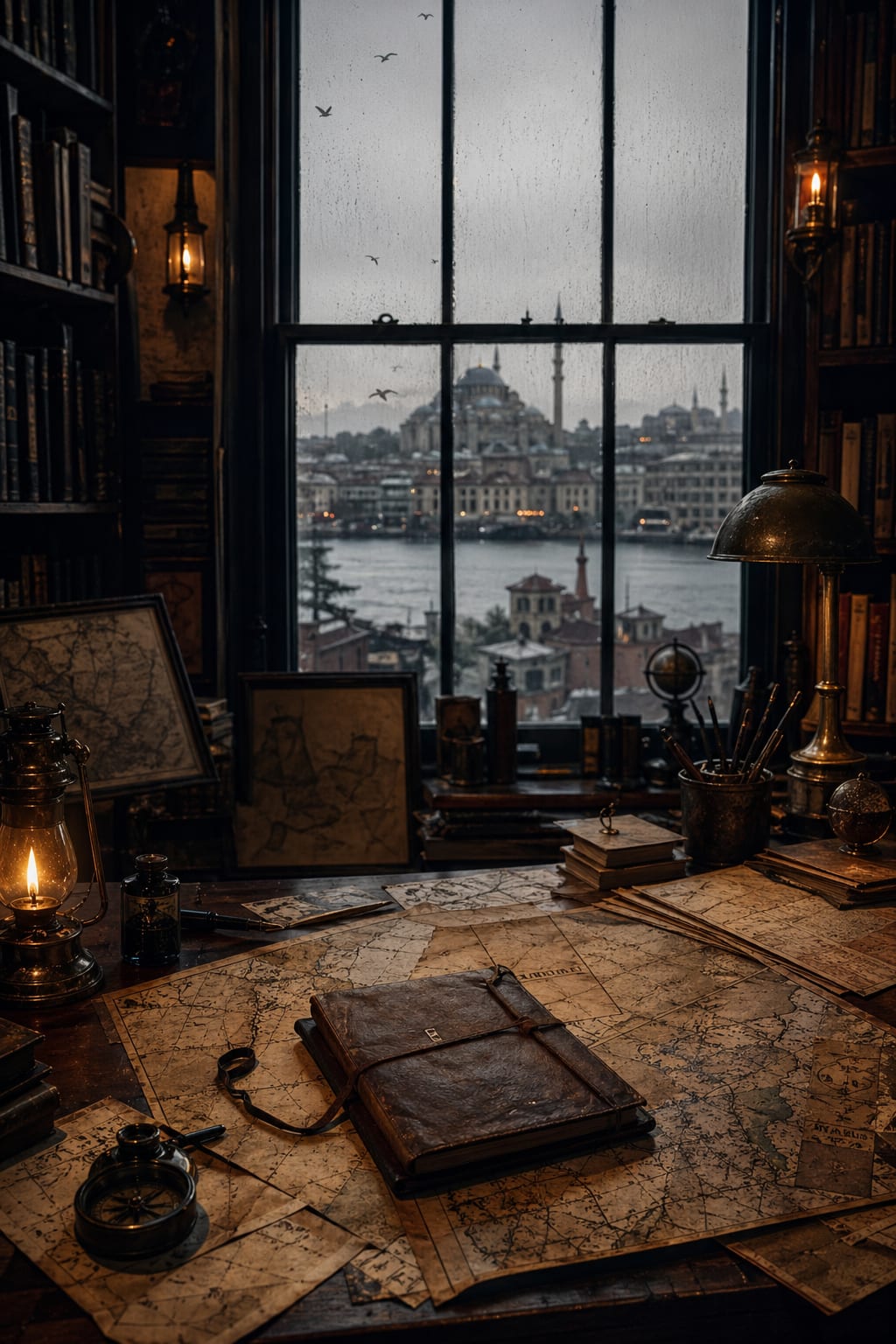
The House of Unfinished Borders
The rain fell in sheets against the library windows, each droplet tracing invisible paths down the glass—paths Mira had spent her entire life learning to read. Her father's study smelled of leather bindings, metal compasses, and something else: the faint mustiness of paper aged beyond counting. Twenty-three years she had lived in this house, and only now, sorting through his effects after his death, did she understand that she had never truly left it.
She pulled another box from the mahogany shelves that lined the eastern wall. Inside lay not books, but maps. Thousands of them. Some were printed on vellum so thin it seemed to dissolve under her fingertips. Others were handwritten, the ink faded to sepia ghosts of their original intentions. Her father, Nikolai Voss, had been a cartographer—not the kind who drew the official maps that ended up in schoolrooms and government offices, but something rarer: a maker of maps that shouldn't exist.
A map of the old Silk Roads, annotated with notes in his cramped handwriting. A detailed rendering of Prague's Jewish Quarter as it had stood in 1887, marked with tiny red crosses indicating buildings no longer there. And then, at the bottom of the box, a leather journal with her name embossed on its cover.
Mira. For the journey home.
Her hands trembled as she opened it.
The Language of Lines
Her father had begun keeping the journal on the day of her birth. The first entry was dated September 14th, 1985, in Copenhagen—though Mira had always been told she was born in Berlin. The first words were these: She arrived like an unmapped territory, undefined and infinite with possibility. Today I began the most important chart of my life.
Page after page revealed a parallel history. While Mira grew up believing her mother had died in childbirth—a tragedy she had learned not to question—her father's journal documented something entirely different. Her mother was alive. Her name was Elena. And she had walked out of their apartment on a Tuesday morning in December 1986, leaving behind only a letter and a small, hand-drawn map.
The map was pasted into the journal on page forty-seven.
It was unlike any map Mira had ever seen, even in her father's vast collection. There were no longitude lines, no compass rose. Instead, it showed a city she almost recognized—Berlin, but rendered strangely. Streets curved where they should have been straight. Buildings occupied spaces that, to her knowledge, held empty lots. The map was annotated in her mother's handwriting, a flowing script that seemed to dance across the page:
The routes between what was and what could have been. Follow the blue lines only in twilight. Trust the red doors. The cartographer will understand.
Mira traced the blue lines with her finger. They formed a pattern that resolved, if you looked at it correctly, into a single word: Remember.
The Archive of Absence
Over the next three weeks, Mira began to understand her father's life as a kind of cartography itself. He had spent thirty-seven years mapping the unmappable: the territory of loss, the geography of longing, the precise coordinates of absence.
He had mapped every street Elena had walked during their time together, marking them with different colored inks corresponding to seasons. Spring walks were rendered in green. Summer walks in gold. Autumn in rust and crimson. Winter—when she left—in a blue so dark it was almost black.
He had created a map of Prague showing it as Elena remembered it from her childhood, overlaid with the Prague that existed in official records. Where the two didn't match, he had drawn careful question marks. In the margins, he had written her childhood stories: the fountain that sang, the house with the purple door, the old woman who sold flowers from a cart that moved.
And there were maps of Copenhagen, where they had lived together. Mira recognized some of the streets from her own childhood memories, but her father had marked them with red circles at seemingly random intervals. When she found another journal—his personal diary, not written for her—she discovered that these red circles marked the places where he had stopped, on different days and in different years, hoping to see Elena walking toward him.
The last circle was dated six months before his death.
The Unmapped Journey
In the deepest drawer of her father's desk, Mira found an envelope addressed to her in his handwriting. Inside was a single document: a hand-drawn map of Istanbul.
At first, she didn't understand why. They had no connection to Istanbul. But then she read her father's final letter, tucked behind the map:
My dearest Mira,
Your mother did not abandon us. She was mapping her way home—to the place where she came from, to the people she lost, to the version of herself that existed before loss had a name. I spent thirty-seven years angry at this choice, and then I spent the last five years understanding it.
Elena is alive in Istanbul. I have known this for ten years, though I never told you. I was a coward, protecting you from the pain I couldn't bear to look at directly.
But you, my daughter, you are your mother's child. I see it in the way you read maps, in the way you understand that the world contains infinite versions of itself, all existing simultaneously. You know this already: the most important journeys are the ones we have to make alone.
The map is not a location. It is an invitation. Whether you follow it is entirely your choice.
Your father, Nikolai
The Cartographer's Choice
Mira sat in the darkness of the study, rain still falling outside, and studied the Istanbul map. It was more detailed than any commercial version she'd ever seen. Every street was named. But scattered throughout the city, her father had drawn seventeen red doors.
She thought of all the maps she had seen in her life—the official ones that purported to show the world as it truly was, every border fixed and final, every location pinned in place. But those maps, she understood now, were lies. Or not lies, exactly, but incomplete truths. They showed where things were, but never why. Never how. Never what it meant to leave. Never what it meant to stay.
She thought of her mother, whom she had mourned her entire life for being absent, only to discover that she had been present in an entirely different way—present in every map her father had ever made, in every careful line and annotation, in the language of love expressed through the only vocabulary he truly possessed.
The next morning, Mira began to pack. Not everything—some of her father's maps she carefully photographed and archived. But the journal marked for her, the letter, the Istanbul map, these she placed in her satchel.
She would not leave for Istanbul tomorrow, or the next day. She had things to finish first: degrees to complete, exams to pass, a life in Copenhagen to settle. But she had inherited something more valuable than money or property. She had inherited the understanding that some journeys cannot be mapped in advance, that the most important territories are those we must explore alone, and that love—true love—is not the presence of a person, but the careful, meticulous effort to understand the territory they occupy in our hearts.
As she locked the study door for the last time, Mira realized something her father had been trying to tell her all along: we are all cartographers of our own becoming, drawing and redrawing the maps of ourselves until we finally arrive at home.
About the Creator
Cordelia Vance
Lost in the ink-stained corridors of a life lived through pages. I write to capture the whispers of ghosts we pretend not to hear and the shadows we call home. Welcome to my attic of unspoken truths.
Enjoyed the story? Support the Creator.
Subscribe for free to receive all their stories in your feed.
Comments
There are no comments for this story
Be the first to respond and start the conversation.