
The Cartographer of Sorrows
A story of the scholar who charts the invisible geographies of human grief

Part One: The Atlas of Intangible Places
Dr. Amara Okonkwo has spent the last twelve years mapping things that don't exist on any conventional geography. Her office at the University of Lagos occupies the top floor of the Natural Sciences building, where the heat from the corrugated roof makes afternoons feel like slow-motion fever dreams. On the walls, she has pinned dozens of maps—none of which depict countries, coastlines, or capital cities. Instead, they show emotional terrain: the location of childhood wounds, the precise coordinates of romantic devastation, the topographical lines marking the elevation of grief.
To anyone passing through her doorway, it would appear the work of an eccentric mind. To those who have participated in her research—and there are now over four hundred of them—it is something closer to cartography of the soul.
Amara's methodology began as an accident. Nine years ago, she was a conventional geographer, respected but unremarkable, publishing papers on urban migration patterns and demographic shifts. Then her daughter, Zainab, was stillborn at seven months. The hospital offered condolences. Her colleagues offered a week of compassionate leave. Her husband, Kofi, offered silence—the particular, glacial silence that would ultimately lead to divorce papers signed at his sister's kitchen table.
In the weeks after the funeral, Amara experienced something that modern psychology had no adequate language for. The grief was not merely emotional—it seemed to occupy actual space. She could feel it in the corner of their bedroom. She could sense it in the kitchen, hovering near the cabinet where she had begun to store the bottles of formula she would never use. Walking through the university library, she felt it waiting in specific aisles, following her like a weather pattern. The sensation was so visceral, so physically localized, that she began to wonder: what if grief is not metaphorical? What if it actually reshapes the geography of where we live?
That question became her obsession.
She began, hesitantly, to ask her grief-stricken friends where their sorrow lived. Not metaphorically, she would clarify—literally. In which rooms? On which street corners? At what time of day did the feeling intensify? She sketched their descriptions. She created overlays. She noticed patterns.
A woman named Chioma, whose son had been killed in a robbery, described her grief as concentrated in the space between the front door and the kitchen—the path her son walked every morning before the day he didn't come home. An old man named Tunde, bereaved of his wife of fifty-three years, mapped his sorrow to the eastern wall of his sitting room, where the afternoon light had once illuminated her reading chair. A young man named Kwesi, destroyed by unrequited love, located his anguish in the specific café where he had last seen the person who didn't love him back—not just the café itself, but a particular table, a particular corner of that table, a particular angle of approach.
Within two years, Amara had collected sixty detailed grief maps. She began to correlate them, overlay them, search for meaning in the patterns. She discovered something that made her heart accelerate: grief had geography. Real, measurable, reproducible geography. The locations shifted based on proximity, memory, sensory triggers. A familiar song could relocate sorrow from the bedroom to the car. The smell of a particular food could move it from the kitchen to the marketplace where that food was purchased. But the fundamental topography remained. Grief, it seemed, was a place. A place that could be mapped.
She published her first paper in a small academic journal, expecting dismissal. Instead, she received seventy-three requests for participation in her study. Within five years, she had mapped the geographies of grief across three hundred and twelve individuals. Her work, initially dismissed as pseudo-scientific mysticism, began to be taken seriously by neuroscientists studying trauma, by architects designing therapeutic spaces, by hospice workers seeking to understand the phenomenology of loss.
The maps themselves became increasingly sophisticated. Amara developed a color system: deep indigo for the locations where grief felt heaviest, pale blue for the places where it was merely present, white for the spaces where, mysteriously, the bereaved person reported feeling almost nothing. She added topographical lines to show emotional elevation—the peaks of acute sorrow, the valleys where numbness had carved temporary respite. She included temporal annotations: grief intensifies here on Thursdays, this corner feels different in the morning, the back hallway holds memories of January but not June.
Her apartment became a laboratory. Every surface was covered with drafts, sketches, color samples. She lived among the grief maps of strangers, sleeping on a mattress pushed to one corner of her bedroom to avoid the space in the center—the coordinates where, according to her own daily journals, her daughter's absence lived most vividly. She had mapped her own sorrow with the same meticulous precision she applied to everyone else's. The work became her way of converting formless anguish into something she could observe, study, perhaps eventually understand.
Part Two: The Cartography of Unexpected Geometry
Five years into her research, Amara discovered something that destabilized everything she thought she understood.
The grief maps were communicating with each other.
She noticed it first in the overlap studies. When she layered the maps of individuals who had never met—a woman in Accra grieving her brother, a man in Abuja grieving his career, a teenager in Ibadan grieving her stolen future—their sorrow locations, despite being physically miles apart, began to align. The coordinates didn't match exactly, of course. But there was a resonance. A harmonic convergence. Where one person's grief was most acute, another person's grief was also strongest. As if the geography of loss followed rules that transcended individual architecture.
Amara began a new phase of research: mapping the correlations. She took the most detailed grief maps and began to triangulate them, not as separate documents but as components of a larger, hidden cartography. What emerged over months of obsessive work was something that made her entire body go cold.
There was a landscape beneath the landscape.
The grief maps, when properly overlaid and cross-referenced, revealed topography that no building, no street, no physical geography could explain. It was as if the city itself—Lagos, with all its sprawling, chaotic, magnificent complexity—had a hidden twin made entirely of sorrow. A mirror Lagos. A grief-Lagos. A place that existed in the same coordinates as the material city but in a different register of reality.
Amara began calling it the Sorrowscape.
She mapped it obsessively. She recruited help—first her graduate students, then colleagues from philosophy and anthropology departments. Together, they created what became her magnum opus: a complete atlas of the Sorrowscape, with more than four hundred data points, showing the precise topology of collective human grief across the city. The maps revealed valleys and peaks, plateaus and ravines, rivers of sadness flowing through certain neighborhoods, mountains of rage rising in others.
Most disturbingly, the Sorrowscape was growing. The maps from each successive year showed expansion, deepening, intensification. The grief geography was becoming more detailed, more saturated, more real.
Amara's colleagues began to express concern. Not about her methodology—by this point, her work was rigorous enough to withstand scrutiny—but about her mental state. She had stopped eating regular meals. She had stopped sleeping in her bed, preferring to sleep surrounded by the maps, as if she could absorb their meaning through proximity. She had become thin in a way that suggested not mere neglect but a kind of voluntary dissolution.
She didn't care. She was on the verge of understanding something fundamental about the nature of suffering, about the way human emotion reshapes reality, about the hidden architecture of the world that grief-stricken people actually inhabit.
Part Three: The Discovery
The breakthrough came on a Wednesday in August, during the onset of the harmattan winds that would soon dry the city into brittleness.
Amara was alone in her office, surrounded by maps, when she noticed something she had somehow missed for years of staring at the same data. The Sorrowscape wasn't random. It wasn't merely the aggregate of individual grief geographies. It had structure. It had intention. It was, in fact, precisely arranged—with the same mathematical elegance as a cathedral, as a musical composition, as a living organism.
And it was pointing somewhere.
All the rivers of sadness converged. All the peaks and valleys aligned. The topographical lines, when traced backward through time across all her maps, led to a single location. A place in Lagos that showed up in the grief maps of hundreds of people, even those who had never been there physically. A space that held the most concentrated, the most ancient, the most profound sorrow that she had ever mapped.
It was the National Museum of Nigeria, in the Onikan district.
But not the surface museum, where tourists moved through air-conditioned rooms admiring artifacts. Something deeper. Something in the basement, perhaps, or below the basement. A place that the physical architecture didn't adequately explain. A place where all the city's historical grief—centuries of it, kingdoms fallen, families separated, futures stolen—had accumulated into something almost solid.
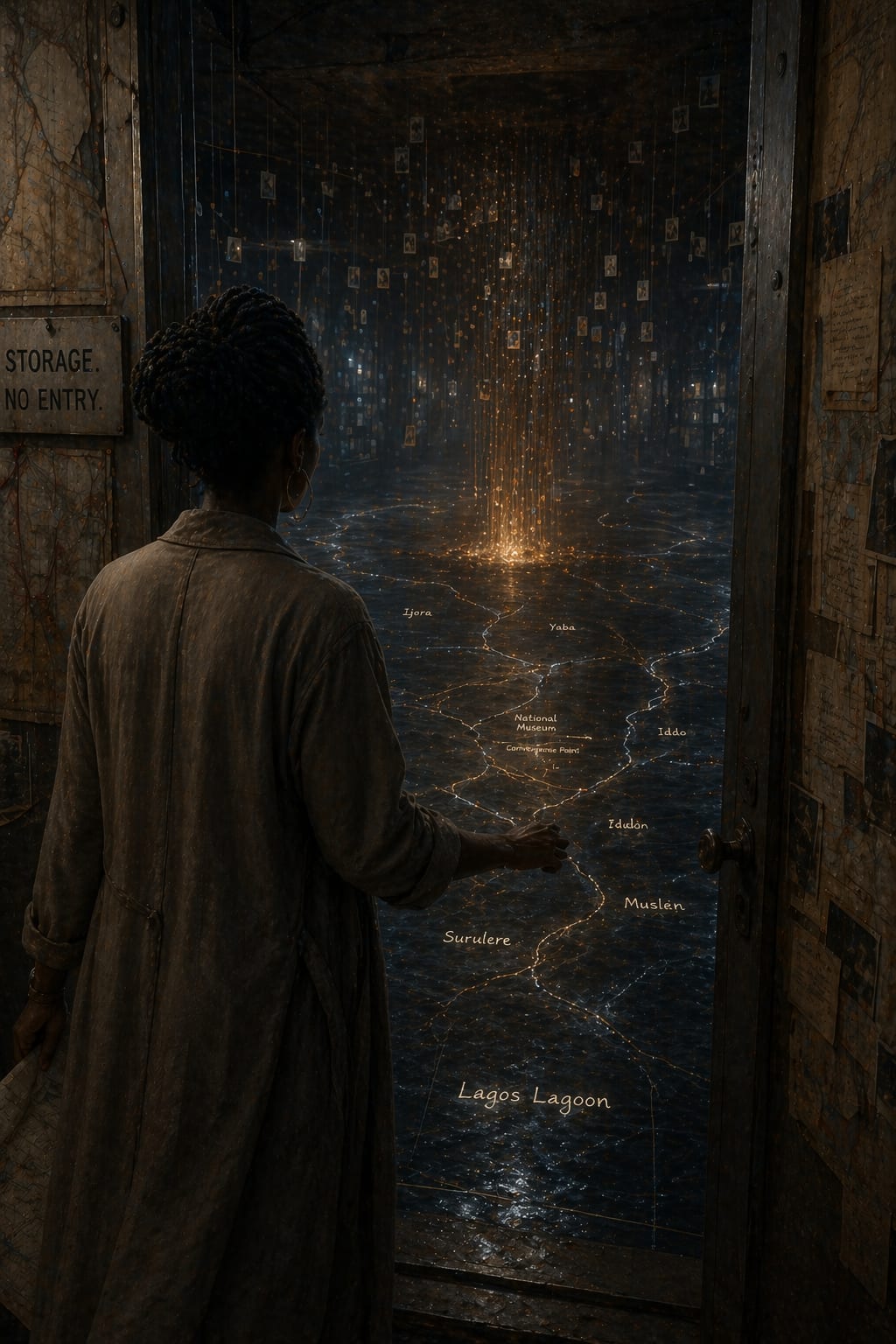
Amara packed her most detailed maps and went to the museum on a Thursday afternoon, when crowds were thinnest. She convinced a guard to let her into the basement archives. She walked through rooms of stored artifacts, all of them charged with the weight of historical loss. And then, following the precise coordinates indicated by her Sorrowscape atlas, she found herself in front of a sealed door, a barrier that the physical museum had marked with a simple sign: Storage. No Entry.
Her hands shook as she traced the coordinates on her map. According to her data, according to the convergence of four hundred individual grief geographies, this sealed door led directly into the heart of the city's sorrow. This was where all the tears of Lagos had pooled. This was the real geography. This was what the Sorrowscape had been trying to show her all along.
She understood, in that moment of standing before the sealed door, that cartography had limits. Some territories, once mapped, demanded to be entered. Some geographies could only be truly understood by crossing into them completely.
Amara reached for the door handle, her fingers trembling against the cold metal.
Behind it, she could already feel the weight of accumulated grief—centuries of it, waiting, patient, eternal. The geography of human sorrow, finally made manifest and real and tangible.
She pulled the door open and stepped through into the darkness that her maps had predicted but could never adequately describe.
END
About the Creator
Cordelia Vance
Lost in the ink-stained corridors of a life lived through pages. I write to capture the whispers of ghosts we pretend not to hear and the shadows we call home. Welcome to my attic of unspoken truths.
Enjoyed the story? Support the Creator.
Subscribe for free to receive all their stories in your feed.
Comments
There are no comments for this story
Be the first to respond and start the conversation.