
The Call Before the Sirens
Some departures happen only once

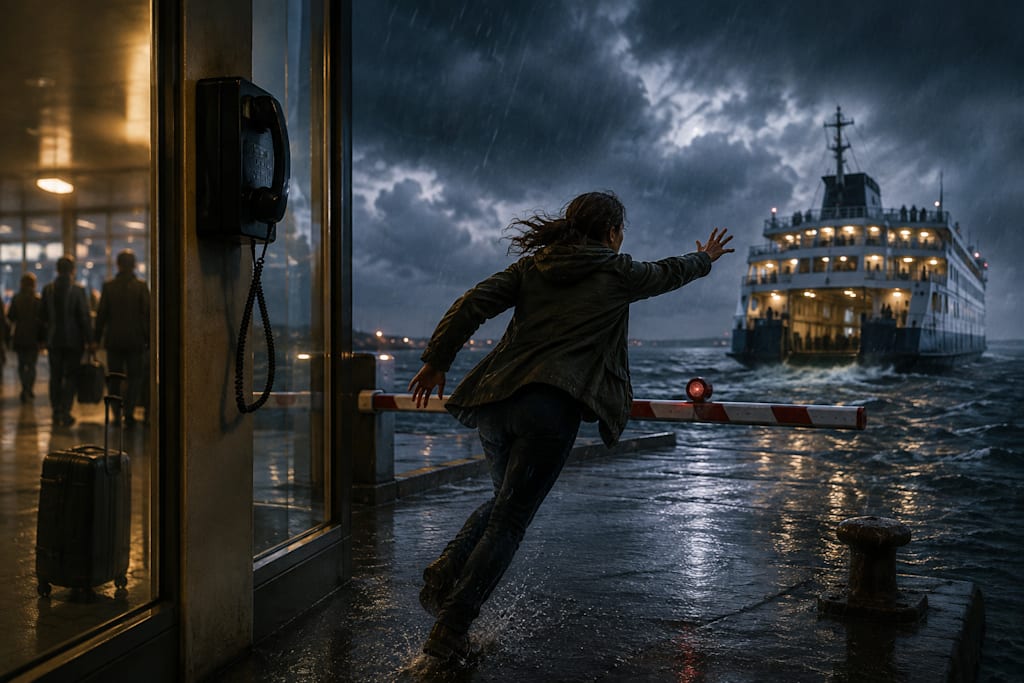
At 6:43 p.m., the loudspeaker announced the last ferry.
"Final boarding for the mainland. All remaining passengers proceed to Gate Two."
Mara heard the words from inside the terminal café, where she was drinking coffee that had gone cold twenty minutes earlier.
Outside, rain moved sideways across the harbor.
The ferry waited at the end of the pier, enormous and brightly lit against the darkening water. Its engines vibrated through the floor.
Everyone on the island had known the storm was coming.
By noon, the supermarket shelves were half empty.
By three, schools had closed.
At five, the mayor had gone on local radio and used the phrase "strongly advised," which islanders understood to mean leave if you have somewhere to go.
Mara did.
Her sister lived seventy miles inland.
There was a spare bedroom.
Fresh sheets.
A refrigerator full of food.
No sea outside the windows.
Mara's suitcase stood beside her chair.
One bag.
Enough for three days.
Maybe five.
The storm would pass.
Things always passed.
The announcement came again.
"Final boarding."
The café owner switched off one row of lights.
"You getting that?" he asked.
Mara looked toward the ferry.
"Yes."
He nodded as if this settled something.
Then the telephone rang.
It was mounted on the wall beside the toilets.
An old black handset no one used anymore because everyone had phones.
Except Mara's phone had no signal.
Neither did anyone else's.
The storm had taken one of the towers an hour earlier.
The phone rang again.
The café owner looked at it.
Then at Mara.
"Probably emergency services."
He was carrying crates into the kitchen.
"You answer it."
"Why me?"
"Because I'm closing."
The phone rang a third time.
Mara picked up.
"Hello?"
For several seconds there was only static.
Then a man's voice.
"Mara?"
She stopped breathing.
The ferry horn sounded outside.
"Who is this?"
Static again.
Then:
"It's Dad."
Mara closed her eyes.
Her father lived at St. Vincent's, a small care home on the northern side of the island.
Or had lived there.
Mara had not visited in six months.
There were reasons.
There are always reasons when people have stayed away long enough.
"How did you get this number?" she asked.
"I asked them."
"Who?"
"The woman here."
A voice in the background said something Mara couldn't make out.
Her father continued.
"They're taking us to the school."
The island's emergency shelter.
Mara looked through the café window toward the ferry.
People hurried across the pier beneath umbrellas that turned inside out in the wind.
"That's good," Mara said. "You'll be safe there."
A pause.
"I don't want to go."
"Dad."
"I called because I thought you might still be here."
Mara gripped the receiver.
The café owner appeared from the kitchen wearing his coat.
"You've got about five minutes," he said.
Mara covered the mouthpiece.
"I know."
He looked at her suitcase.
Then at the phone.
"Five," he repeated.
He left.
The café door slammed behind him.
Mara was alone.
Her father's breathing came softly through the line.
"You should go with them," she said.
"They say there are fifty people already."
"So?"
"You know I don't like crowds."
She almost laughed.
For seventy-eight years, her father had disliked almost everything involving other people.
Restaurants.
Weddings.
Hospitals.
Neighbors who stopped to talk.
Children who shouted.
Tourists.
Tourists especially.
"You'll manage."
"I suppose."
The ferry horn sounded again.
Longer.
Mara looked at the clock above the counter.
6:47.
Four minutes.
Her father said, "Your mother used to hate storms."
Mara looked down.
"Yes."
"She'd sit in the hallway because there were no windows."
"I remember."
"She made sandwiches."
Mara smiled despite herself.
"She made sandwiches for everything."
"Yes."
Silence.
Mara could hear rain striking something on his end.
Or perhaps it was static.
Her mother had been dead eleven years.
Her father had talked about her less each year, as if grief could be reduced through rationing.
Then, after the stroke, he began speaking about her more.
Sometimes as though she were still alive.
Sometimes as though she had died yesterday.
Sometimes as though he had forgotten which version hurt less.
"Mara?"
"I'm here."
"They're coming for me."
"Then go."
Another voice appeared in the background.
A woman.
"Mr. Vale, we need to leave now."
Her father said something away from the receiver.
Then came back.
"I wanted to hear you."
Mara stared through the window.
The final passengers were running down the pier.
A crew member stood beside the boarding ramp, waving them forward.
"You're hearing me."
"I know."
"Will you come?"
The question was quiet.
Not dramatic.
That made it worse.
Mara looked at her suitcase.
Six months earlier, she had walked out of St. Vincent's after her father told her she was becoming exactly like her mother.
He had meant it as an insult.
Her mother had spent most of her life caring for people who rarely noticed.
Mara had spent three years organizing appointments, medication, laundry, finances, repairs to a house her father could no longer live in, answering calls at midnight because he had forgotten where he was.
Then one afternoon he had looked at her and said:
"Your mother gave up her life too."
Mara had stood.
Taken her coat.
And replied:
"Then maybe I've learned something from her."
She had not returned.
There had been birthday cards.
Two phone calls.
A Christmas visit that lasted eleven minutes because he was asleep.
Six months.
The loudspeaker outside crackled.
"This is the last call for Ferry 17 to Northport. Boarding closes in two minutes."
Her father heard it.
"You're leaving."
Mara did not answer.
"You should."
She hated him slightly for saying it.
"You just asked me to come."
"I know."
"So which is it?"
He was silent.
The lights inside the café flickered.
"That's always been your problem," Mara said.
"What?"
"You ask for something, then pretend you didn't."
"Mara-"
"You need help but you don't want anyone helping. You want people close but punish them for being there. You tell me to leave, then ask why I stayed away."
The words came faster now.
Outside, the crew member began pulling a barrier across the pier entrance.
Mara continued.
"You don't get to do both."
Her father said nothing.
The ferry horn sounded.
Once.
Short.
Final.
Mara watched the boarding ramp begin to lift.
She dropped the receiver.
Not hung up.
Dropped it.
Her father's voice continued faintly from the dangling handset.
"Mara?"
She grabbed her suitcase.
Ran.
The automatic terminal doors had stopped working, so she pushed them apart with both hands and stepped into the rain.
The wind almost took the suitcase.
She dragged it across the pavement.
"Wait!"
The ferry was twenty yards away.
A crew member saw her.
He shook his head.
"Boarding's closed!"
"Please!"
"The ramp's up!"
"I have a ticket!"
"Doesn't matter!"
She reached the barrier.
Behind it, the ferry was already pulling away from the pier.
Slowly.
Only a few feet at first.
Close enough that she could see people through the windows.
Warm light.
Dry clothes.
Faces turning toward the terminal.
The gap widened.
Ten feet.
Twenty.
Thirty.
Mara stood in the rain holding the suitcase.
The ferry turned toward open water.
The last ferry.
Gone.
For several seconds she felt nothing except the rain striking her face.
Then the sirens began.
Across the island, emergency warning sirens rose over the sound of the storm.
The shelter.
She turned back toward the terminal.
Through the café window she could see the black telephone handset swinging against the wall.
Still connected.
Mara left the suitcase where it was.
She ran back inside.
The receiver was wet from where her hand had been.
She lifted it.
"Dad?"
Nothing.
"Dad?"
Static.
Then a voice.
Not his.
"Hello?"
The woman from St. Vincent's.
"Where is he?"
"They've taken him down to the bus."
"Which bus?"
"Second one. We're leaving now."
"Tell him I'm coming."
A pause.
"What?"
"Tell him not to leave without me."
"You need to go to the nearest shelter."
"I am."
The woman understood.
"You won't make it here before we leave."
"Where are you going?"
"Central School."
Mara looked at the road beyond the terminal.
Three miles inland.
"I'll meet you there."
She hung up.
The café lights went out.
Completely.
Outside, wind pushed rain beneath the terminal roof.
Mara took her suitcase from the pier entrance, opened it on the floor, removed everything except her coat and a bottle of water, and left the clothes in a neat pile beside the ticket counter.
The suitcase would only slow her down.
She stepped outside.
The road toward town was already flooding along one side.
She started walking.
Then running.
A truck passed and sprayed water across her legs.
The driver stopped fifty yards ahead.
Mara climbed into the cab without asking where he was going.
"School?" she said.
The driver nodded.
They drove through streets stripped of their usual shape.
Branches lay across pavements.
Shop signs swung wildly.
A garbage bin rolled past them like something escaping.
Neither spoke.
When they reached Central School, the parking lot was full.
People moved toward the gymnasium carrying bags, blankets, dogs, children, plastic containers of food.
Mara jumped from the truck before it fully stopped.
Inside, volunteers shouted directions.
"Registration to the left!"
"Families toward the far wall!"
"Keep the entrance clear!"
Mara moved through bodies.
Wet coats.
Umbrellas.
Crying children.
Someone carrying a cage with two terrified rabbits.
"St. Vincent's?" she asked.
A volunteer pointed toward the basketball court.
"Back corner."
Mara pushed through.
There were wheelchairs.
Foldout beds.
Blankets.
Staff in green uniforms.
She saw him almost immediately.
Her father sat in a wheelchair near the wall holding a paper cup.
He looked smaller than she remembered.
That irritated her.
Age should not be allowed to change people while you are angry with them.
He saw her.
For a moment neither moved.
Then her father looked at the paper cup.
"You missed the ferry."
"Yes."
"That was stupid."
Mara started laughing.
She couldn't stop.
Her father stared at her.
Then he laughed too.
Not loudly.
But enough.
She pulled a plastic chair beside him.
The gymnasium lights flickered.
Outside, the storm struck the building with a low, continuous roar.
Her father took a sip from the paper cup.
"It's terrible coffee."
"I know."
"You haven't tried it."
"I know this place."
He nodded.
They sat without speaking.
After a while, he said:
"I shouldn't have said that about your mother."
Mara looked at the rows of people settling in for the night.
"No."
Another pause.
"I wanted you to stay."
"I know."
"I didn't know how to ask."
"I know that too."
The sirens stopped.
The storm did not.
Mara leaned back in the plastic chair.
Her father held the cup between both hands.
Nothing was repaired.
Six months did not disappear.
Her mother did not return.
Her father's nature did not suddenly soften.
Mara did not forgive everything because time was short.
But she had answered.
And when the last call came, she had stayed.
About the Creator
Alain SUPPINI
I’m Alain — a French critical care anesthesiologist who writes to keep memory alive. Between past and present, medicine and words, I search for what endures.
Enjoyed the story? Support the Creator.
Subscribe for free to receive all their stories in your feed. You could also become a paid subscriber, letting them know you appreciate their work.
Comments
There are no comments for this story
Be the first to respond and start the conversation.