
The Bus for Daniel
Every morning in July, it came looking for a boy who had been gone for forty years.

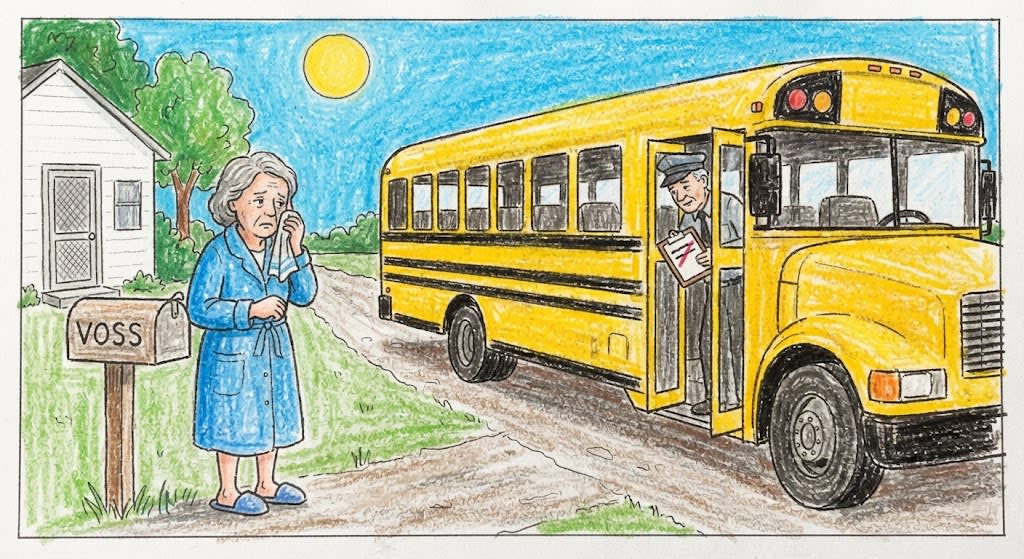
It was seven-thirty on a July morning, and Eleanor Voss had already changed out of her nightgown and into the housecoat she wore around the house. The heat had started early that summer, and the screen door had begun sticking in its frame whenever the humidity climbed. On the second week of the month, Eleanor carried a glass of iced tea outside and had barely settled into her seat when she heard a diesel engine coming up the road. School had let out back in June, and the buses had been parked behind the district building ever since, waiting for September. Eleanor watched the long yellow bus slow down in front of her mailbox and stop. She figured somebody had made a mistake, since she had lived in that house for twenty years and knew the school schedule as well as anybody.
The driver was an older man with sweat rings under his arms and a stained mesh cap, and he lifted an arm when he saw Eleanor watching him through the screen. She gave him a small wave in return, more out of habit than anything else, then watched him sit there with the engine running for close to a minute. The doors stayed shut, and nobody climbed off. Finally, the bus pulled away and disappeared down the road. Eleanor went back inside, finished her tea, and decided the driver had probably been given the wrong route. The next morning, the same bus came at seven-forty and stopped beside her mailbox again, and it came again the morning after that. By the end of the week, Eleanor had quit trying to find a sensible explanation.
By the middle of July, Eleanor had begun checking the clock before seven-forty each morning. The bus came at the same time, stopped in the same place, waited for a full minute, and moved on. The humidity had gotten bad enough to make the front door stick, and Eleanor kept a dish towel beside her seat to wipe sweat from her neck. She called the district office and explained what she had been seeing, though she left out the part about watching from the yard because she already felt foolish enough. The clerk told her every bus had been parked since school let out and said the district had no summer route running along Eleanor's road. Her neighbor Patricia had seen the bus too, since her three children played outside most mornings, and she told Eleanor it had never slowed near her house. Patricia came over one afternoon carrying a casserole dish and said, "You're sure it's stopping here?" Eleanor told her she had watched it stop every morning. Patricia looked toward the road and said, "Somebody must be using an old route." Eleanor reminded her school was closed for the summer, and Patricia shrugged before saying she had no idea what else it could be.
The conversation bothered Eleanor more than she wanted to admit. Patricia had three children, three school backpacks hanging by her back door, and three sets of shoes scattered around the house, so a school bus meant something simple to her. Eleanor had spent forty years knowing exactly what a school bus meant to her. She started staying inside some mornings and watching through the kitchen glass, while other mornings she sat outside with her tea and waited for the engine. Once she walked halfway down the driveway before the bus came, then turned around and went back toward the house because she suddenly felt foolish standing outside in her robe. Patricia mentioned the bus again later that week, saying one of her children had wondered why an old school bus kept coming during summer, and Eleanor told her she didn't know. After that, Eleanor stopped discussing it with anybody.
On the last morning of the month, Eleanor walked toward the roadside before seven-forty and waited for the bus to come. She wore her robe and old house shoes, and the morning was already hot enough that sweat had gathered along the back of her neck. The bus slowed beside her mailbox and stopped, and the driver opened the folding door before looking down at her. Eleanor stepped closer and said, "Who are you here for?" The driver glanced at the clipboard resting beside him and replied, "Daniel Voss." Eleanor stared at him, and when he added, "Daniel Voss, six years old," she gripped the mailbox tightly. "You have the wrong house," she told him, and the driver looked back at the paper before saying, "That's what I've got." Eleanor told him he had been coming to her house all month and that no boy lived with her. The driver rubbed his forehead and said, "Look, lady, I drive the thing. I got a Daniel Voss down for this stop. If he's not riding, call the garage and tell them to take him off the manifest." Eleanor swallowed and told him, louder than she meant to, "You've had it wrong all month. There's no boy here." The driver studied the clipboard again and wanted to know how old the boy would be. Eleanor almost laughed at the question before telling him Daniel would be forty-six.
The driver looked at her, and Eleanor said, "He's dead. He drowned at the lake forty years ago. He was six years old." The driver lowered the clipboard and said he was sorry, and Eleanor nodded because she had heard those words so many times that she hardly knew what to do with them anymore. Daniel had been supposed to start school that fall, and Eleanor told the driver they had already bought his school things. She told him about the Masters of the Universe lunchbox Daniel had begged for, the ugly plastic thing with He-Man on the front that she had finally bought because she got tired of hearing about it. She told him she still had it in the pantry, along with the thermos that had come inside it. The driver looked at the clipboard and then back at Eleanor before wanting to know whether she wanted Daniel's name removed from the route. Eleanor said yes, and he took a yellow pencil from behind his ear and marked the paper before closing the clipboard. "I'll take care of it," he said, and Eleanor stepped away as the folding door shut and the bus pulled down the road.
That afternoon, Eleanor went to the pantry and pulled the lunchbox from the back shelf. She had kept it for forty years, even after the picture on the front faded and one corner cracked, and she still remembered Daniel carrying it around the house before school ever started. The thermos sat inside, smelling faintly of old plastic, and beneath it she found the little paper napkin he had tucked inside the day she bought the lunchbox. She sat at the dining table with the lunchbox open in front of her and remembered how much trouble he had given her over getting He-Man on the front instead of some other cartoon character. She could see him standing in the yard with one front tooth missing, arguing that He-Man could beat anybody. She had told him he would grow tired of it eventually, and he had told her she didn't understand anything. Eleanor smiled at that, then wiped her face with the dish towel beside her seat. After a while, she put the lunchbox back on the shelf.
The bus came the next morning. Eleanor heard the diesel engine and went outside before she had time to think about whether she wanted to see it. The driver stopped beside the mailbox, opened the door, looked at Eleanor, and then looked down at the clipboard. Neither of them spoke, and after several seconds the driver closed the door and pulled away. The bus came again the following morning and repeated the same routine, and it continued for several more mornings. Eleanor began wondering whether the driver had actually removed Daniel's name or whether some other part of the district's records kept putting him back onto the route. She thought about calling the office again, but every time she reached for the telephone she lost the desire to explain any of it.
On the last morning of July, Eleanor stood beside the mailbox before seven-forty and waited. She had put on shoes this time, and the grass was wet against her ankles from the early morning dew. The bus came around the bend and stopped, and the brakes gave a sharp squeal that made Eleanor wince. The folding door opened, and the driver looked down at her with the tired expression of a man who had been doing the same job for a very long time. Eleanor said, "He's not coming. He's been gone a long time," and the driver nodded before looking down at the clipboard. He took the yellow pencil from behind his ear, found Daniel's name, and drew a thick line through it. The lead snapped at the end of the stroke, and the driver stared at the broken pencil for a moment before putting it on the dashboard. He said nothing else, and Eleanor didn't try to make him. The door closed, the transmission clunked as he shifted into gear, and the bus pulled away. The diesel exhaust hung over the road for several seconds, carrying the rotten-egg smell Eleanor remembered from old buses, before the morning took it away. She remained beside the mailbox until her shins ached, watching the empty road long after the engine could no longer be heard.
The bus never came back after that morning, and Eleanor kept the mailbox clear through the rest of August even though she had stopped expecting it. The Masters of the Universe lunchbox remained on the dining table for several days before she finally returned it to the pantry, and Daniel's old paperwork went back into the drawer. Patricia came by once and wanted to know whether the bus had stopped coming, and Eleanor told her it had. Patricia said she was glad Eleanor could finally forget about it, then seemed to realize how badly that sounded and started talking about one of her children instead. Eleanor listened and let the conversation move on. When September came, the regular school buses returned to their routes, carrying children with backpacks and lunchboxes toward school each morning. Eleanor watched them from her house and saw one little boy run back because he had forgotten something, while his mother called after him from the yard. Eleanor watched until he came running back, then went inside and made herself some tea.
Daniel was still dead, and Eleanor still thought about him more often than she told anyone. Some mornings she woke convinced she had heard a diesel engine outside, and for a few seconds she would lie still before remembering that forty years had passed. She never called the district office again, and she never told Patricia what the driver had said about Daniel's name. The lunchbox remained in the pantry, the paperwork stayed in the drawer, and the photograph of Daniel with his missing front tooth remained tucked behind a stack of old bills. Eleanor never figured out why the bus had come for him that July, and she eventually stopped trying to decide whether it had been a mistake, a bad record, or something she would never understand. All she knew was that a yellow bus had come every morning for a child who had died before his first day of school, and then one morning a tired driver crossed his name off a list and kept driving. The next July, seven-forty came and went with nothing on the road, and Eleanor finished her tea and went on with her morning.
About the Creator
Tim Carmichael
Let your becoming be louder than your fear, and your smallest steps become the road you once thought impossible to walk. An Appalachian poet and cookbook author my book Beautiful and Brutal Things is on Amazon, Link 👇
Enjoyed the story? Support the Creator.
Subscribe for free to receive all their stories in your feed. You could also become a paid subscriber, letting them know you appreciate their work.
Comments
There are no comments for this story
Be the first to respond and start the conversation.