
The Boy Who Heard the Stars
A lonely student’s obsession with the sounds of space leads him to uncover the hidden heartbeat of the universe.

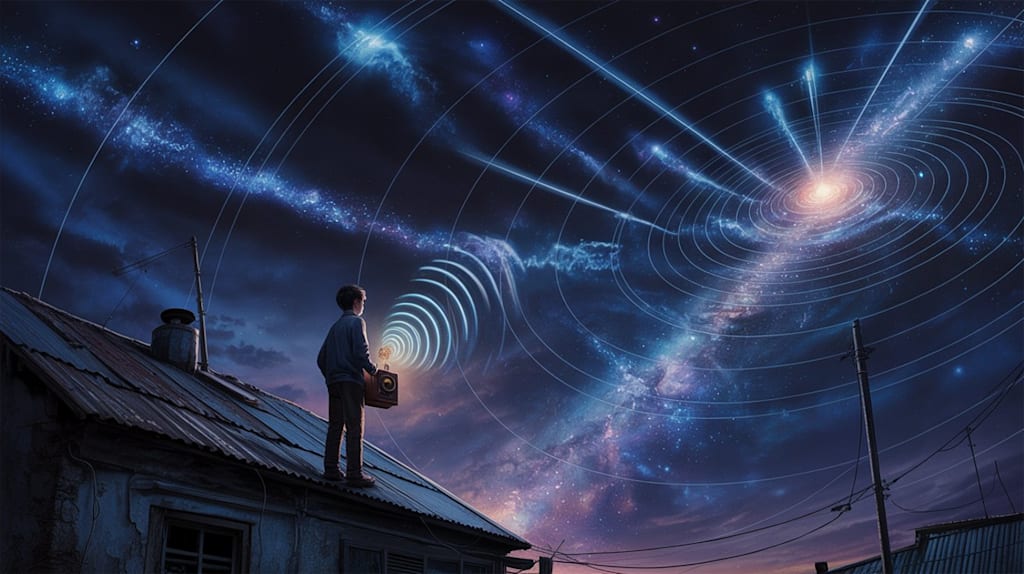
In a small village surrounded by mountains, there lived a seventeen-year-old boy named Ayaan. Unlike the other students in school, Ayaan was obsessed with one strange question:
“What does space sound like?”
People laughed whenever he asked it.
“Space is empty,” his classmates would say. “There’s no sound there.”
But Ayaan refused to let the question die.
Every night, while the village slept under cold winds and silent skies, he climbed to the roof of his house with an old radio his grandfather had left behind. The radio barely worked. Its antenna was bent, its speakers crackled, and sometimes it randomly shut off. Yet Ayaan believed it could help him hear something beyond Earth.
His grandfather had once told him, “The universe is never truly silent. We just don’t know how to listen.”
Those words stayed with him for years.
One winter night, while turning the radio dial between stations, Ayaan heard a strange rhythmic pulse.
Tick… tick… tick…
It was not music. Not static. Not a human voice.
The sound repeated with mathematical precision.
Ayaan froze.
His heart pounded as he adjusted the antenna toward the sky. The pulses became clearer.
Tick… tick… tick…
The next day, he skipped cricket practice and rushed to the town library. After hours of searching through old astronomy books, he found something unbelievable.
Pulsars.
Dead stars.
He learned that when massive stars explode in supernovae, they sometimes leave behind tiny ultra-dense cores called neutron stars. Some rotate hundreds of times per second and emit beams of radiation like cosmic lighthouses. Scientists detect those beams as repeating pulses.
The sound he heard was not alien music.
It was the heartbeat of a dead star.
For the first time in his life, Ayaan felt connected to the universe.
He became obsessed.
Every evening, he built homemade antennas from scrap metal, copper wire, and broken electronics collected from junk shops. His room slowly transformed into a miniature laboratory. While others spent time scrolling through social media, Ayaan studied radio astronomy, electromagnetic waves, and celestial coordinates.
His parents worried.
“You need a real career,” his father said. “Not invisible sounds from the sky.”
But Ayaan continued.
Months later, during a thunderstorm, something extraordinary happened.
His equipment captured a signal unlike anything before.
It was fast, powerful, and lasted less than a second.
A sharp burst.
Then silence.
At first, Ayaan thought his machine had malfunctioned. But after checking the recordings repeatedly, he realized the signal was real.
He spent weeks researching until he discovered another phenomenon:
Fast Radio Bursts.
FRBs.
Mysterious flashes of radio energy arriving from distant galaxies billions of light-years away.
Scientists still debate what causes them. Some believe they come from magnetars — neutron stars with magnetic fields so powerful they could erase every credit card on Earth from halfway to the Moon. Others suggest black holes or unknown cosmic events.
The universe was not silent.
It was alive with invisible messages.
Ayaan decided to present his findings at his school’s science exhibition. Most students displayed volcano models or charts about the solar system. Ayaan arrived carrying wires, antennas, and his dusty radio equipment.
The judges looked confused.
“What exactly is your project?” one teacher asked.
Ayaan smiled nervously.
“I recorded signals from dead stars.”
The audience laughed.
But then he connected his speaker.
The room filled with the eerie pulse of a pulsar.
Tick… tick… tick…
The laughter stopped.
Ayaan explained how radio telescopes work, how electromagnetic waves travel across space, and how humans convert those signals into sound. He described neutron stars, supernova explosions, and the possibility that some signals began traveling through space before humans even existed.
The hall became silent.
For the first time, people understood what fascinated him.
One judge, a retired physics professor, stared at Ayaan with amazement.
“Do you realize,” he said softly, “that you are listening to objects thousands of light-years away? You are hearing the past.”
That sentence changed everything.
Hearing the past.
Ayaan suddenly understood the true scale of the cosmos.
When astronomers observe distant galaxies, they are not seeing them as they are now. Because light takes time to travel, they are seeing ancient history. A galaxy one million light-years away appears as it existed one million years ago.
The universe itself was a time machine.
Years later, Ayaan earned a scholarship in astrophysics. He eventually worked at a radio observatory where massive dishes scanned the heavens day and night. Yet despite all the advanced technology around him, he kept his grandfather’s broken radio on his desk.
Visitors often asked why.
Ayaan would smile and answer:
“Because this is where I first learned that silence does not mean emptiness.”
Then he would point toward the stars.
“Somewhere out there, dead stars are still singing.”
About the Creator
Zeeshan Ali
i am just a student but want to share my toughts with you
Enjoyed the story? Support the Creator.
Subscribe for free to receive all their stories in your feed.
Comments
There are no comments for this story
Be the first to respond and start the conversation.