
The Boy by the Pumpkin Patch
A childhood cricket match, a tragic night in an Indian village, and a promise that defied death.

It had been years since I last held a cricket bat, and honestly, my nerves were shot. To make matters worse, Swarup was bowling. He was the local fast-bowler of our village, and the opposing team had already put up a massive score. We all knew that if we could even manage half of their runs, we’d celebrate it as a moral victory.
Standing right next to me was Ritu, my seven-year-old cousin. Instead of offering any actual encouragement, she was busy throwing petty taunts my way. She didn't know the first thing about cricket, but she knew exactly how to mess with my focus so I’d get frustrated and throw down the bat.
Now, don't picture some grand tournament here. This wasn't even a local inter-village match. We weren't even playing on a real field. Our "stadium" was just the dirt courtyard of my eldest uncle’s (Jethababu) house, and the entire spectator gallery consisted of one person—my annoying little sister.
Swarup ran in and delivered the ball. I literally closed my eyes and swung the bat with everything I had. Thwack!
Opening my eyes, I saw the ball flying over the boundary line—but it went straight into Jethababu’s prized garden, landing right in the middle of a dense, overgrown patch of wild vines and pumpkin bushes. We all rushed over, but looking for a small leather ball in that tangled green mess was a nightmare.
Our team captain, Rintu-da, raised his bat. "Mongol-da, should I clear some of these leaves away to look for it? But I’m worried it might ruin the pumpkin patch."
Mongol-da, my older cousin whose house this was, shrugged. "Yeah, go ahead. Why not?" But just as Rintu-da took a step forward, Mongol-da grinned wickedly. "But just so you know—it's a 50-rupee fine for every single leaf you break."
Rintu-da froze, slowly lowering his bat. He wasn't about to risk his pocket money for a lost ball.
That was pretty much the end of the game for the day. As we walked back, Swarup couldn't resist a final dig: "If we kept playing, you guys would’ve lost anyway." I didn't bother arguing because, deep down, I knew he was right.
I rarely played sports. I lived in the chaotic rush of the city with my parents, and I only visited our ancestral village during major holidays, usually staying with my younger uncle (Kaku). This time, I had come down for Kali Puja. Even though I was an outsider in many ways, the village always held this strange, invisible pull over me.
But the real story isn't about a lost cricket ball. That started later that night.
As the sun went down, Ritu and I walked over to the village Kali temple. Every year on Kali Puja, the entire structure is lit up with hundreds of tiny clay lamps (diyas). It’s beautiful to watch.
The local kids walk around with candles, carefully lighting the oil-soaked cotton wicks, while the older folks arrange them in intricate, glowing patterns. Whenever a lamp accidentally blows out in the wind, a swarm of kids will eagerly rush over to relight it.
While Ritu was busy helping the other kids, I stood back, chatting and laughing with some of the village elders. Suddenly, we heard a loud commotion breaking out a little distance away. The adults immediately walked over to see what was wrong, telling the kids to stay put and watch the lamps.
When we got to the source of the noise, the scene was absolutely heartbreaking.
In a small house right in front of us, a four-year-old boy had suddenly developed a severe breathing problem. His panicked mother had rushed to tell her husband, but before he could even manage to find a vehicle, the boy passed away.
There were no proper doctors in the area; the local village medic had taken one look at the child and told them to rush to the city hospital, but it was already too late. To make matters worse, the only car in the village had been driven to another town that evening and didn't make it back in time.
My stomach churned, but it got worse. The boy’s older sister—just a little girl herself—had been one of the kids happily lighting lamps at the temple just moments ago. Now, she was kneeling by her brother's still body, crying violently. The parents were inconsolable; the father was just a poor daily-wage laborer who looked completely broken.
The little girl kept shaking her brother's shoulders, sobbing, "Wake up, please! Tomorrow is Bhai Phonta (Brother's Day). I bought you a new dress and toys..."
I couldn't stand to watch it anymore. The grief felt suffocating. I grabbed Ritu's hand and walked away into the dark.
Later that night, as we sat down for dinner, Kaku mentioned that because the boy was only four, they had buried him somewhere near the edge of the forest bushes. According to local customs, children under five aren't cremated, and burying him in the main village graveyard might scare people.

All night long, the little girl’s voice kept echoing in my head: Wake up... I bought you a new dress...
A few days passed. The tragedy was the only thing people talked about at the village tea stalls, but life slowly crawled back to normal. My vacation was wrapping up, and I was supposed to head back to the city the next morning.
On my final afternoon, we ran out of drinking water at home. The groundwater in our part of the village had a terrible iron taste, so we always had to fetch drinking water from a specific tube-well in the neighboring village.
Usually, Kaku did this after work, but since I was visiting, I had taken over the chore. I actually liked it—pedaling a bicycle down the narrow dirt roads, sandwiched between two rows of tall, silent trees. The sheer quietness of it, so far away from the honking horns of the city, was incredibly peaceful.
By the time I reached the well, the sun had already slipped below the horizon. Usually, there’s a long queue of people here, but at this hour, it was completely empty. I filled up two large water containers by myself. Kaku hadn't returned from his office yet, and Ritu was off playing somewhere, so it was just me and the twilight.
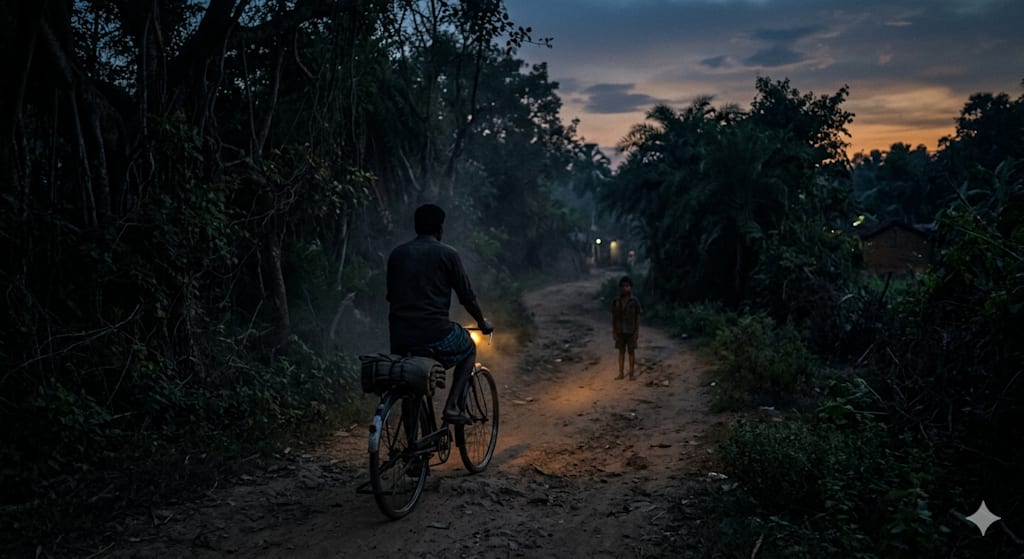
I strapped the heavy containers onto the cycle and began the ride back. The small bicycle headlight cut a weak beam through the deepening shadows.
There weren't any dangerous predators like tigers or bears in these woods—just plenty of wild rabbits and jackals. Wild elephants sometimes wandered through, but this wasn't their usual season, so I wasn't worried.
Suddenly, a few yards ahead, something caught my eye in the dim light.
At first, I figured it was just a jackal crossing the path. But as I pedaled closer, the shape resolved into something else. It was a small boy, standing right by the edge of the dark woods.
The village wasn't miles away, but this was still a pretty isolated stretch of road for a toddler. Assuming he had wandered off from his parents, I squeezed the brakes, stopped my cycle, and looked at him. "Hey, what are you doing out here all alone?"
The boy didn't look scared at all. He just looked up at me and said quietly, "I'm waiting for my mother."
"Where is your mother?" I asked, looking around the dark trees, expecting an adult to pop out.
"At home," he said. Then, he looked right into my eyes and added, "Please tell my mother not to cry. I will return very soon."
I blinked, thoroughly confused. "Which village do you live in? Come on, hop on, I’ll drop you home."
But before I could even finish the sentence, the boy spun around, darted into the thick undergrowth of the forest, and completely vanished into the shadows.
I stood there for a second, my heart hammering against my ribs. My logical brain immediately kicked in—I figured it might be a trap. Sometimes, thugs used children to lure unsuspecting travelers into the woods to rob them.
I didn't have anything valuable on me, but I wasn't about to risk my life finding out. I pushed down on the pedals and rode back to the village as fast as I could. The next morning, I packed my bags and went back to the city.
Three years slipped by in a blur. I got admitted to a college in Kolkata, and the relentless pressure of exams, assignments, and city life completely swallowed my time. I barely had a chance to visit my own parents, let alone take a trip down to the village.
Finally, after clearing my final exams, I had a brief window of freedom. The longing for that rural peace became too strong to ignore, so one early morning, I caught a bus back to my ancestral home.
When I arrived, it felt like no time had passed. Kaku, Jethababu, and the rest of the family welcomed me with open arms. In the evening, I went out for a walk around the village neighborhood. I bumped into old friends, and we ended up sitting down, catching up on everything we had missed.
Eventually, the conversation drifted back to old times, and someone brought up that hilarious backyard cricket match where we lost the ball in the pumpkin patch. The memory brought a smile to my face, but it also triggered another memory—the tragic night of the Kali Puja three years ago.
I looked at one of the village elders. "By the way, whatever happened to that poor family? The one whose little four-year-old boy passed away from that sudden breathing attack?"
The elder paused, a strange, thoughtful smile crossing his face. "Ah, you know, something truly miraculous happened there. About a year after that boy passed, his mother gave birth to another baby boy."
He leaned in slightly, lowering his voice. "And the weirdest part? The kid looks exactly like his late older brother. It’s uncanny. It’s like looking at a ghost."
The noisy chatter of the village square suddenly faded into a dull hum. A cold shiver crawled straight down my spine as the warm evening air turned freezing.
Sitting there on that wooden bench, three years later, the voice of that little boy on the pitch-black forest road echoed clearly in my mind, as if he were standing right next to me:
"Please tell my mother not to cry. I will return very soon."

About the Creator
Muhammad
A craftsman of words. I love transforming life, philosophy, and everyday experiences into stories. Here, I have curated my thoughts and perspectives just for you.
Enjoyed the story? Support the Creator.
Subscribe for free to receive all their stories in your feed.
Comments
There are no comments for this story
Be the first to respond and start the conversation.