

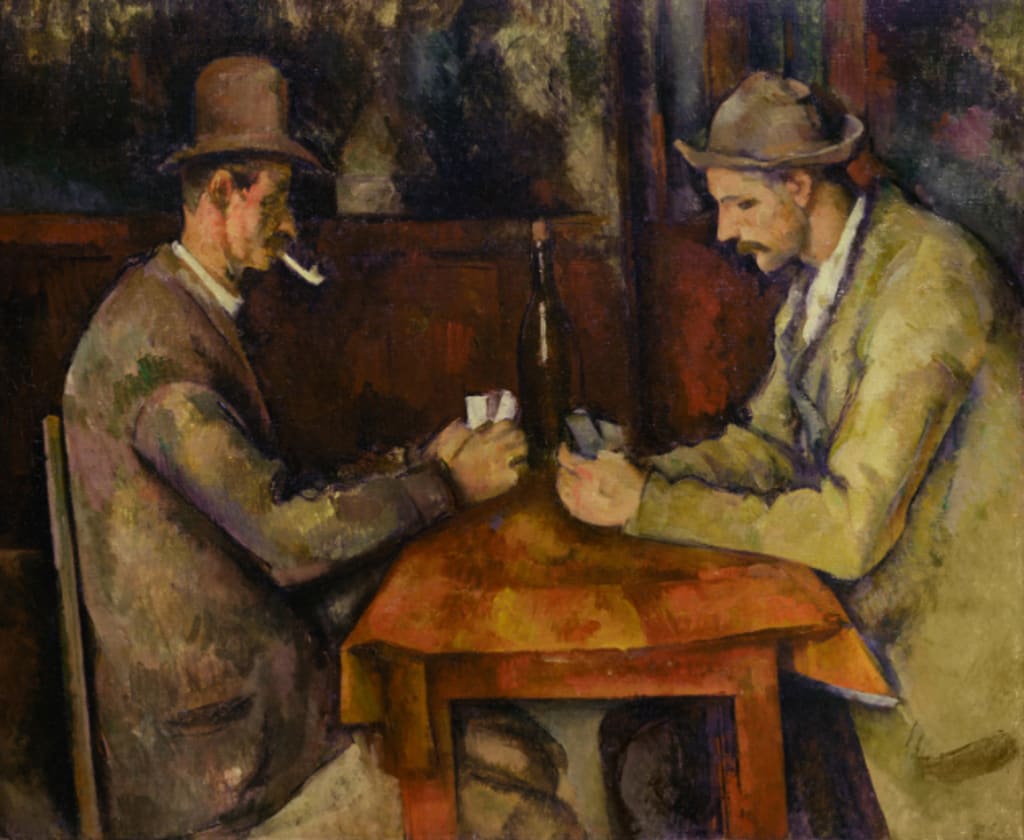
A skillful player kept his cards face down throughout the game. One by one, the others surrendered. The crowd, seeing only hidden hands and an untouched wager, declared him defeated.
They spoke of victory.
They spoke of loss.
They spoke as though the board were sacred.
He answered none of them. He neither sought victory nor settled for a draw — the game had failed to interest him long before it began. What burdened him most was not the game itself, but the certainty with which everyone assumed he was a player.
It took him a long time to recognize that he wasn’t playing with others, but with fate itself. No matter how much he insisted on not playing, he kept being moved to the wrong corner of the board. And yet, despite everything, he was destined to win. Eventually he stopped resisting that destiny and ran the race it had set for him.
Time slowed. Each card bore a different weight. A Joker brought laughter. An Ace froze the table. A King ruled it. At last, the game stood between him and Death itself. He reached beneath his sleeve — not for the potion, not yet — but for the card he had kept hidden from the very first deal. He turned it over. Blank. Its edges were frayed, soft as old cloth, worn down by the countless hands that had held it before him. No King. No Joker. No number. Just a rectangle of battered paper that had outlived every game it had ever been dealt into. This was what he had gambled on all along: not a face, not a fate — but the empty space where meaning used to be. And in that emptiness, he finally saw that the game had no rules except the ones he kept projecting onto it. Only then did he slide the potion — the life of an Ancient — from his sleeve.
Was fate truly his enemy all along? No. He was fate. And in seeing that, he understood the board had never been a trap — it had been a mirror, showing him a self he hadn’t yet agreed to become.
He returned, then, not to claim a prize but to take his place — not among the others at the table, but as himself.
He asked me, “Am I late?”
I answered, “You came at the right time.”
That answer stayed with me longer than I expected. Time, I think, is something we’re given to hold, not to chase — one true move can outweigh a hundred hurried ones. So I didn’t rush either. Before the next dawn, I climbed to the edge of what I knew, the way he had once stared down a card he couldn’t read.
What I found there wasn’t an abyss so much as a place that demanded everything of me and gave nothing back but silence — and somewhere in that silence, the ground I stood on stopped feeling like a fall and started feeling like a summit. From it, I watched the sun come up at six in the morning, and understood I hadn’t been looking for a mountain, or a road to Heaven or Hell. I had been reclaiming my own conscience, piece by piece, the way he had reclaimed his.
Even my mistakes were necessary — not virtues, but lessons, the only way I came to understand what I was actually doing the whole time.
And all the while, like him, I had been winning the game. Not because I had outplayed anyone. Because I had finally agreed to sit at the table as myself.
Not a struggler, but a stranger — born into a living world of lies and illusion. That is why I flipped the switch, casting light into the darkest corners.
I did not flee the void.
I ignited it.
I used to wonder why I could never see the next move coming. Now I know why. The deceiver wore my own face. He was the part of me that believed, all along, that I was only a player — that there was a game, a board, an opponent, something outside myself to beat or be beaten by. He clouded nothing. I had simply mistaken my own reflection for an adversary.
I was not foolish. I was early — early to the trick, before I was ready to see it as my own.
Now I see the trick behind the tricks: there was never anyone across the table.
There was only ever the hand that dealt the cards, and the hand that played them, and they were the same hand.
Author's Note
A philosophical flash fiction exploring fate, identity, and the illusions through which we come to understand ourselves.
L.Layth
About the Creator
LUCCIAN LAYTH
L.LUCCIAN is a writer, poet and philosopher who delves into the unseen. He produces metaphysical contemplation that delineates the line between thinking and living. Inever write to tellsomethingaboutlife,but silences aremyway ofhearing it.
Enjoyed the story? Support the Creator.
Subscribe for free to receive all their stories in your feed.
Comments
There are no comments for this story
Be the first to respond and start the conversation.