
The Baptism of Constantine
The Death of the Greatest and Most Terrible Emperor of Rome
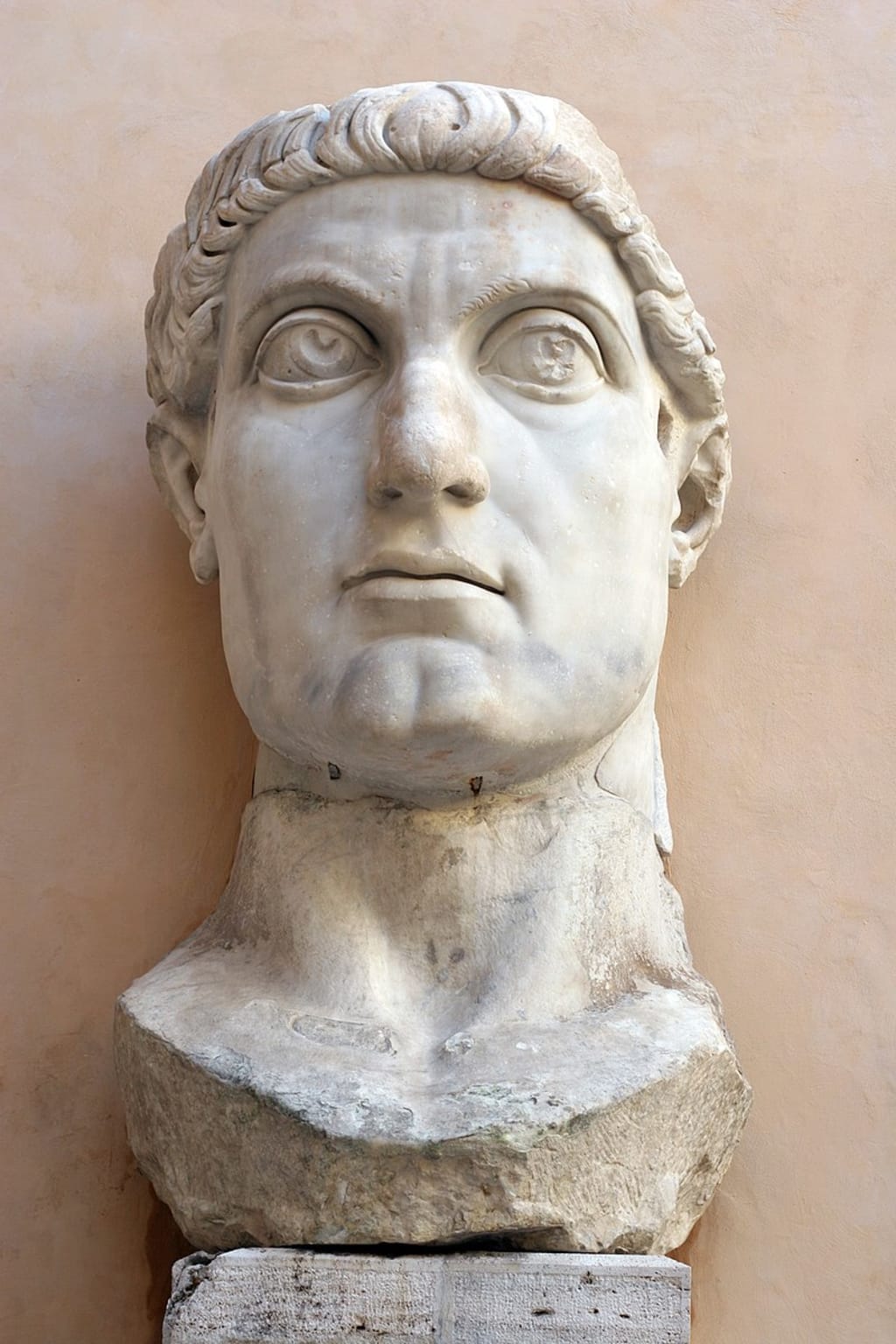
We knew that the Emperor had come here to die. He had been on his way east, some said because he wanted to be baptised in the River Jordan, and others because his will was to crush the Persians in a last great campaign. It did not matter. He was taken ill, suddenly, and - knowing that he was dying - he demanded to be taken west immediately, to that monstrosity of vanity across the water that bore his name. Constantinople. But it was too late, he had lacked the strength to make that journey, and so his death procession ground to a halt in Nicomedia, my older, poorer city across the water.
That is how I came to meet Constantine. I had lived for fewer than thirty years then, and had recently been ordained as a parish priest near the house where Constantine lay. I was shaken awake, roughly, while my wife screamed beside me. I was marched through the armed guards, past the pale, nervous courtiers, each knowing that their days of power were numbered, and into the chamber where the Emperor of the Romans lay.
Terrified as I was, limbs shaking and cold sweat dripping down my back, my first impression was still the deathly chill of the place. Outside the night was warm and lush, humid and oppressive. The cicadas chirped and you could hear the gentle hum of the town, its street-sellers, friends, lovers and enterprising prostitutes, whispering of the God-man in our midst. Here, however, there was only a waxy, fragile stillness - and cold marble. Two scented candles, one on each side of Constantine’s bed, could not mask the stench of death that made the air thick and close. The bed itself was draped with the imperial purple that Constantine had worn so proudly, and its silken covers were drawn halfway up the man’s protuberant belly.
I think that I spent so long staring at the room because I could not bear to look at the man. I was a Christian, and a good one! My family were old Christians, who benefited from Constantine’s acceptance and then conversion to our religion, but had followed the faith long before his birth, battling through persecutions, torture, and all the prejudice and superstition that our faith earned in the old days. But even so I could not escape the thought that I was in the presence of a living God. His statue was in every town square in the Empire that this man had reunited, made strong again, and dominated for as long as I could remember.
“Look at me.” All I had heard was that Constantine was dying, and so the extraordinary strength of the man’s voice actually made me jump. I did the opposite of what he commanded. I dropped to my knees and shook. I heard a cruel laugh from the bed. “It is not wise to disobey your Emperor’s commands”. With the greatest wrench of effort that I have ever known, I stood, legs quivering, and managed to look the prostate figure in his eyes.
He was sixty, perhaps seventy years old that year, but my first impression was that, until a few days ago, this man must have throbbed with vitality and strength. His will held you in place as soon as you looked at him. His eyes were so dark that you fell into them, submerged in deep pools. His hair was still thick, wavy, iron grey on top and white at the temples, contrasting brilliantly with skin that had darkened like teak over decades of campaigning. If he had ever lost a campaign, I suddenly thought, he would not be here. Emperors do not normally die in their beds. He had a straight nose and his cleft chin bristled with white stubble. Even at his age, even dying, even with a yellowish pallor under his tanned skin, he was handsome in the brutal angular way that an iron city gate is handsome.
“Your Excellency” I stammered in a pipsqueak voice. I was trying hard, so very hard, not to piss myself. What did he want? Constantine tried, with an enormous effort, to sit up, holding the covers self-consciously so that his lower body, the source of the stench of death, stayed hidden. “I need a confessor” he said, almost matter-of-factly. When I just stared, he continued. “I want to be baptised as a Christian. At last.” “Your Excellency” I replied, “I heard just yesterday that you were baptised, by Eusebius, the most Holy Bishop of this city.” Constantine laughed.
“You should know” he said, “that if you ever repeat anything I say to you in this room, your death will be more slow and painful than you could possibly imagine.” That kept me quiet. “I have a deal with Eusebius” he continued, “that he will write the story of my life, and that story will portray me only in the best possible light. He will write about my baptism, my final, total, induction into the true faith, and my steadfast bravery and dignity until the very end. That is the story that will be repeated.”
“But” he continued, “given this state of affairs, the baptism I received yesterday, surrounded by bishops, soldiers, and courtiers shitting themselves at the prospect of my death and their sudden irrelevance, how could I be honest?” His voice had grown a little hoarse. “How can I go to the Christian God without confessing my sins? My doubts?”
For a moment, the many years of my training kicked in, despite everything. “There is only one God” I said primly. He smiled, “that’s more like it. I prefer defiance to snivelling. When you are the most powerful man in the world you have to put up with a lot of snivelling.” Despite everything, I found myself beginning to relax, and felt an urge to try and understand this man. “It is natural to feel doubts, Excellency. That is how God tests us. We must earn his favour through trial.”
Constantine held my gaze for a long time, and I fought every urge to look away. “You will, I am sure, know the story of how I came to embrace Christianity. I was preparing to fight the usurper Maxentius, and I saw a flaming cross in the sky. I can still see it now. I was worried, for a moment, that I would go blind, such was the power of the vision. Below it were a few words, etched in fire. ‘By this sign, conquer.’ I interpreted the vision in the way that I thought right. I had my men paint their shields with the Christ symbol, and we won that battle! I knew, then, that the Christian God favoured me, and me alone. That I must serve him.”
“It is a most holy miracle, Excellency, that has brought the light of the Church to the heathen, and in step with-” “But there is another story you do not know” he interrupted me. Two years before that, while I was out on a ride in Gaul, I saw three suns blazing in the sky. The sign of Apollo! I fell to my knees and wept, because I knew that the old Roman God was watching me.”
I watched him with horror. Every Christian in the Empire owed their security and new-found prominence to this man’s championing of our religion, which was once a minority sect and much derided. To hear him speak of other Gods was like a mail-clad punch to the stomach. “Excellency,” I managed, “are you saying that your faith is not genuine?” “No! He said. The Christian God showed me the way, and brought me victory. He is the God that I have chosen. But how can he be the only God, as you say, when Apollo also showed me his light?” In his amination, his illness was forgotten, and his strong, brown hands cut shapes in the air. In doing so, the covers slipped and I could see a glimpse of the swollen, bruised skin of his belly until he angrily yanked them up again and shot me an oddly peevish glance.
“And when we talk of victories” he continued, “how can we ignore the fact that the old Gods gave the Roman people all this” he swept an arm around as if the entire Empire was visible within the death room, and the gesture made beads of sweat bead on his yellowish forehead. “How can I be so sure that I am right to discard the Gods of my fathers because of my personal success? How can I justify such arrogance?”
I was somehow not afraid anymore. “Because there is but one God” I told him. “He may have shown you a sign that you thought was the sign of Apollo, but was actually a symbol of his own trinity, or…” But he was not listening. “In the end” he said softly. “I cannot know. I am just a mortal man. All I can decide is what is best for my people, for all the Roman people. For the past hundred years, we have suffered defeat after defeat, calamity after calamity, and our best blood has drained into the earth. The old Gods do not care. They show us signs, they take an interest in us as a person might in a theatre performance, but they are not affected by whether we live or die. They have no duty to protect us, whether we submit to them or not.”
“But the Christian God” he mused, more breathily now, as if the effort was tiring him, “he is like a hard father. He sets his rules, and we must obey them. If we do not, He turns his back on us, but if we do, we are rewarded with His protection. He is an austere master, and He admires duty over joy. But He is what the Roman people need. We need something, someone, greater than an Emperor. I have held my peoples together, and I have spent my life protecting them. Once I am gone, who will protect us? My sons?” The last words were said almost with a sneer. “We must submit to his authority. It is the only way.”
I was torn between rejecting the shocking heresy of what he was saying and seeking to understand more about this extraordinary man, who could weigh up Christianity and paganism, looking for advantages, in much the way that I might inspect a pair of oranges in the market.
“You mentioned confessions, Your Excellency?” I asked in time, deciding that the best option was to change the subject. I had not realised it but over the course of the conversation I had tiptoed closer to the end of Constantine’s bed. He looked at me, and seemed to notice my trembling legs for the first time. He raised a weak hand, and gestured to a stool next to the bed. Made cheaply of wicker and felt, it stood out sorely amongst the whites purples and calming, lifeless creams of that cold room. I presumed that this was where his doctors had leaned over him to little avail. He suddenly looked almost kindly as he surveyed me, like an elderly uncle examining a disappointing but well-meaning nephew.
“I killed my son, and my wife.” His next words, said in a flat monotone, were so shocking that for a terrifying second I was reaching for breath, rocked backwards on the stool as if I’d suffered a physical blow. It was known around the Empire that Crispus, the man’s oldest son, had died about ten years before, and his statues, his name, had been quietly damned and destroyed. Rumours had flowed as they always did, but this casual confirmation was as shocking as anything that Constantine had said.
For the first time, there was real pain on the Emperor’s lined face, and he looked truly old. I leaned over him, playing the role of confessor, and made the sign of the cross. “What happened?” I asked, after seconds of jagged silence.
“I met Minervina when I was a very young man” he whispered. I frowned, knowing that his wife had been called Fausta. “She was Syrian, and had smooth skin the colour of honey. She made me laugh, and whenever I grew too self-serious in my ambition, she would tease me, needle me, cajole me.” I had a hundred questions, but let him speak. “Crispus was my son by her, but you see, she was not my wife. She was not high-born, just as my mother was not high-born. I found myself in the same position as my father, once he died ” he continued, “I could not have a public mistress who I loved, and who brought no power with her. It was too much of a weakness. I had to let her go.”
“You sent her away?” I asked, feeling a twinge of sympathy despite myself. “I did, and the worst part was that she went quietly. She did not complain, she knew that it was what I had to do.” “Did you see her again?” “No.” One silent tear rolled down his wasted cheek, and he angrily wiped it away. “Crispus was the best of my sons. He was the most handsome, the most charming, the quickest in thought. Everyone loved him, and I mean everyone.” A dark edge had entered his tone.
“You must understand that this was when I was just one claimant to the Empire then. There were many of us, relics of the old system that tried to divide power but only fed ambition until the Empire almost tore itself apart. I only controlled the far west, I was weak, and I needed allies. Fausta was the sister of Maxentius, who controlled Rome, the heartland. She was young, she was beautiful, she was part of the most powerful family in the Empire. So I married her. I was thirty-five, she was eighteen, and Crispus was thirteen, already a handsome youth.” He sneered, mouth puckering into a ugly jagged line, revealing a missing tooth in his upper jaw.
I was leaning so close over him that the stench of death was almost overpowering, but I could not help it.
“I don’t know when they became lovers, though I imagine that it was at least ten years later. By that time I had found the Christian God, and I will admit that I had no time for my young wife once she had borne me children. I have spent my entire life fighting. It took me eighteen years to reunite the Empire. Once I had, and only then, could I spare a moment to realise what was happening to my own family.” He closed his eyes for a moment, and my own gaze strayed to a small scar on his cheek, the only visible sign of his endless wars.
“I turned a blind eye for two years, but people were whispering. I was forcing new laws, Christian laws, to make Christian families and fight debauchery and corruption. And all the while people were sniggering in my own palace. He had to die. My son, my most-beloved son. It took me two years to find the strength, but I killed him with my own hand, and ordered his memory excised. My best son, the only person who still reminded me of my own Minervina. Dead. And I killed him. I make no excuses.” He smirked bitterly. “I dare say the Christian God will take a dim view of my actions. I wonder if he will let me explain myself, as you do now, or whether we will just judge me. I, who have done more to spread his word than any other.” He spat, out of instinct more than anything, and the dribble dripped feebly down to his chin. Without thinking, I ripped off part of my sleeve and wiped it away, as tenderly as I could. He looked at me, torn between gratitude, dark amusement and self-loathing.
“I am sorry, Excellency.” I said feebly. Was I? I wanted to find him monstrous, but somehow, I could not. “I went mad for a time after I killed my son” he carried on, voice taking on new strength. “I wandered into the bathhouse where I knew my wife was, carrying a bloody sword in my hand. I found her naked, infuriatingly young and beautiful, and I could not bring myself to kill her. It would have felt too peevish, too pathetic. But she also had to die. So I locked her in that room, the hottest, and ordered the slaves to heat the water more and more until her screams were silent.”
The room was silent too. I made the sign of the cross over my own breast, and then his forehead.
“I cannot say whether God would forgive these sins.” I said flatly. The wicked glint returned to his eyes then, and I subconsciously backed away a little. “That is why you must baptise me! He said, hoarsely, and he grabbed my collar with his claw-like hand so that his face, and sickly sweet breath, was inches from mine. “The Christian God knows everything, but he has decreed that a baptism washes all a man’s sins away! I will be clean when I face him, I can explain myself without the threat of punishment. I will fall at his feet, as he would wish, and thank him for his mercy.”
I carefully extricated myself from his grip, and nodded slowly. So that, ultimately, was why I was here. Constantine had confessed his sins, his doubts, so that I could wash them away in a single moment of charity. In doing so, I could cleanse the blackened soul of this great and terrible old man, who was half uncle, half demon from the deepest and most seductive reaches of Hell.
I sighed. It was easy to pass this moment off as a moment of coercion, to think that I must baptise the Emperor because he had commanded it, and I could not disobey. But it was more complicated than that. I wanted to help him, and I felt a flicker of distaste at that realisation. My only true master was my God, so why was I so eager to help this despot, this murderer. “Render unto Caesar the things that are Caesar’s” I whispered, and if Constantine heard me, he made no comment. He had exhausted himself with his talking, I could see, and as I backed away he seemed to shrink, burrowing himself more closely into the sheets, and looking at me with almost pleading eyes.
In some ways, it was the most power I ever yielded in my life. I could choose whether to send my Emperor to heaven or hell, and only then did I appreciate how naked he had made himself with his confessions. A lesser man, I thought, would have gone to his death without reflection, without remorse. My slow thoughts oozed as I gazed at the dying man. Like many small boys I had once dreamed of power and glory, but as I watched Constantine I reflected that some people are exceptional, but perhaps they are not happier for it. He had changed the course of history, he was one of those rare people who are strong and confident enough, and are given the chance, to carve an untrodden path through life. But this was where that had left him, a man without friends, without a family that he loved, dying with only a young foolish priest and his own bitterness for company, unable to reach the glorious but cold new capital that he had built across the sea.
Wearily, I sat down again by his side, and listened to his rattling breaths for a moment. “I will baptise you, my Emperor. You will be born again here, at the last, and you will meet God as a true Christian, with a soul wiped clean.”
I am old now, and surely the last person alive who knew Constantine the man, rather than the God-Emperor, or the champion of Christianity, or the great innovator who built a new capital and even changed the religion of the Romans. So many of us are Christians now, and we hiss and make evil signs as we pass the old pagan temples. We are not as joyful, perhaps, but we are changed, and more purposeful. We know that we owe it to Constantine.
Sometimes I bounce my granddaughters on my knee and I tell them about the time that I met the great Constantine, omitting some of the more choice details of course. No men have come for me in the night. I live on, and sleep easy, though sometimes - when I pass a statue of Constantine - I bow for a moment and close my eyes in prayer.
About the Creator
Enjoyed the story? Support the Creator.
Subscribe for free to receive all their stories in your feed.
Comments
There are no comments for this story
Be the first to respond and start the conversation.